| Author |
 Replies: 10 / Views: 2,956 Replies: 10 / Views: 2,956 |
|
|
Valued Member
92 Posts |
|
|
|
Hello,
I just bought a stamp collection that has hundreds of pre 1900 Wurttemburg and Bavaria stamps and, in researching, I've noticed that there are Key stamps.
Can anyone help me in how I am able to identify these types of stamps for these countries and/or other countries?
Thanks,
|
|
Send note to Staff
|
|
|
|
|
Pillar Of The Community
United States
8577 Posts |
|
|
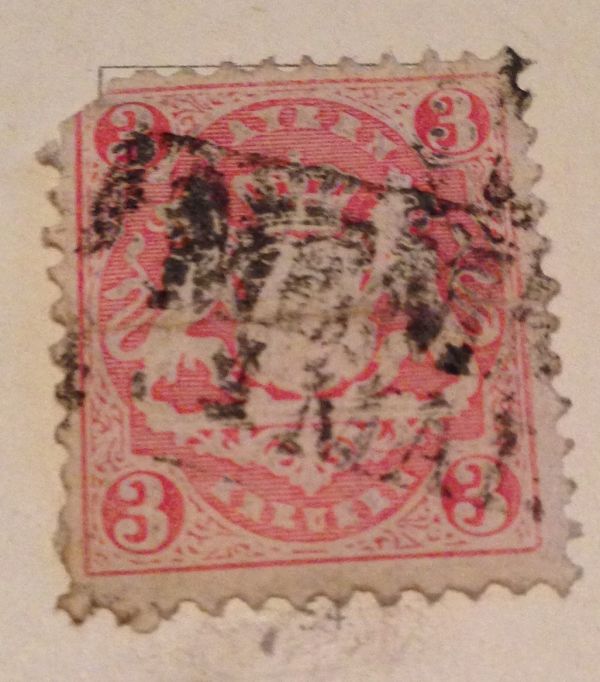
Both countries have forgeries , do not worry about key stamps at this point . Try posting a few scans of what you got because quality is very very important on these early issues . |
Send note to Staff 
|
|
|
Valued Member
92 Posts |
|
|
Pillar Of The Community
United States
526 Posts |
|
|
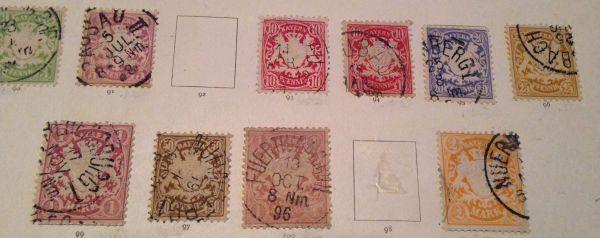
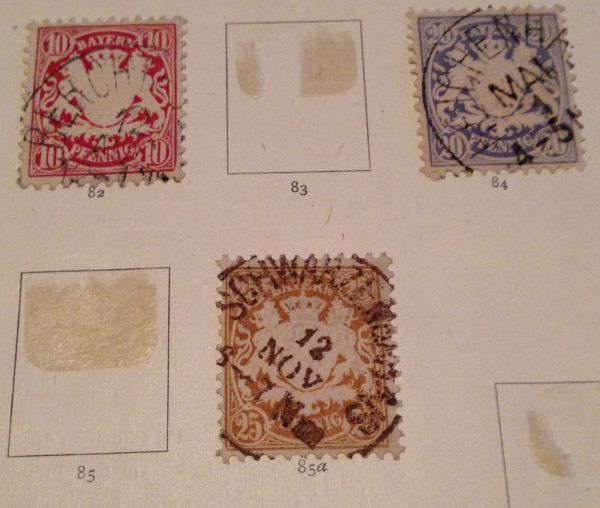
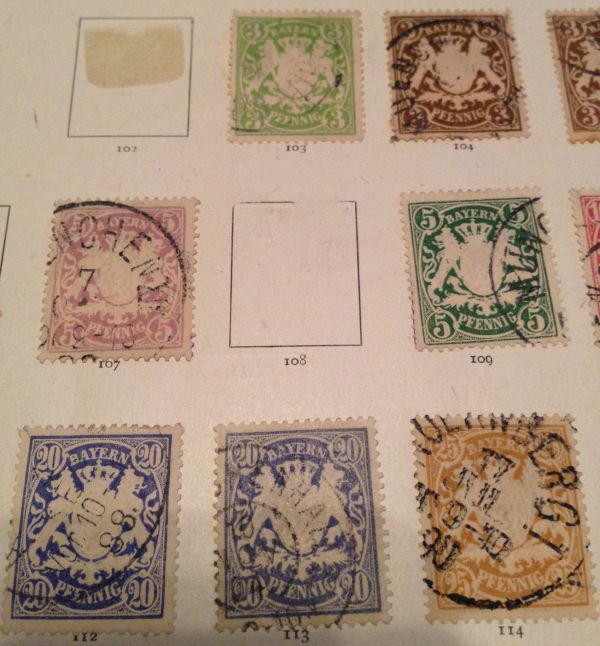
Well, first of all, the pages have been picked over. That means that the best stamps were probably removed to add to someone's collecion and you have the remainder.
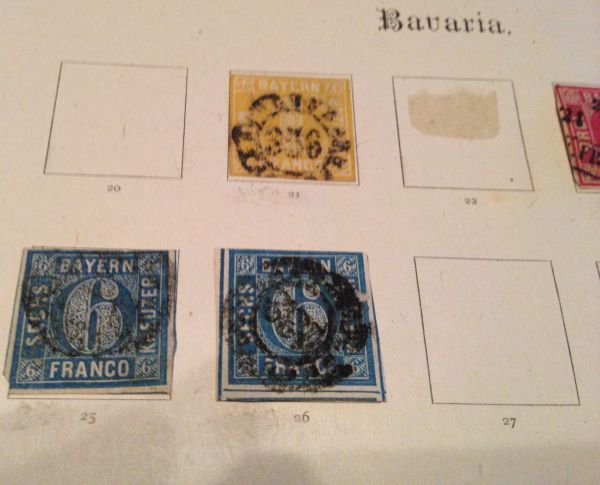
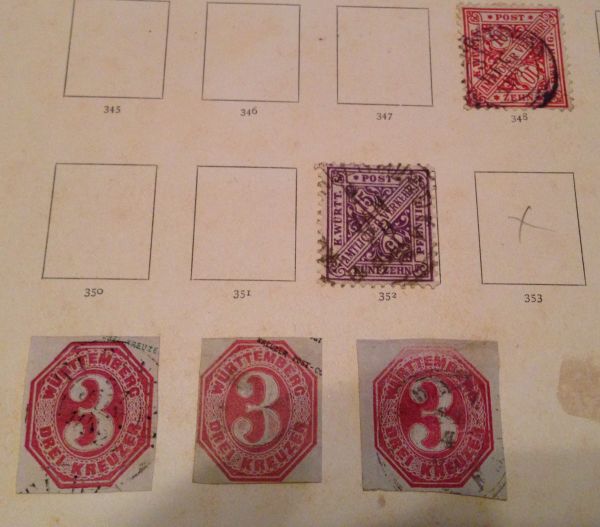
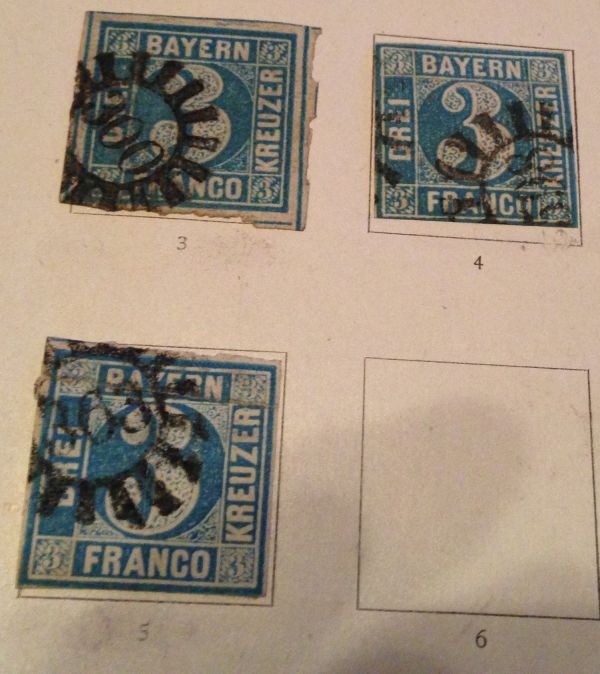
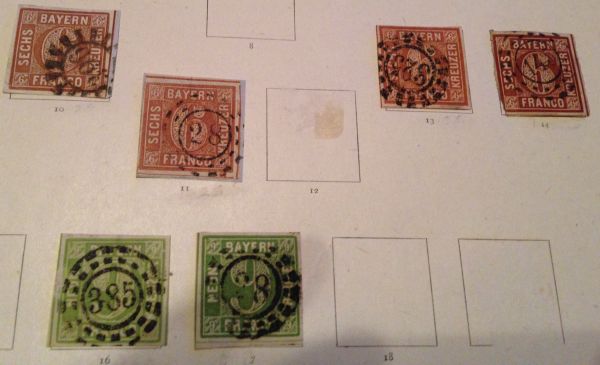
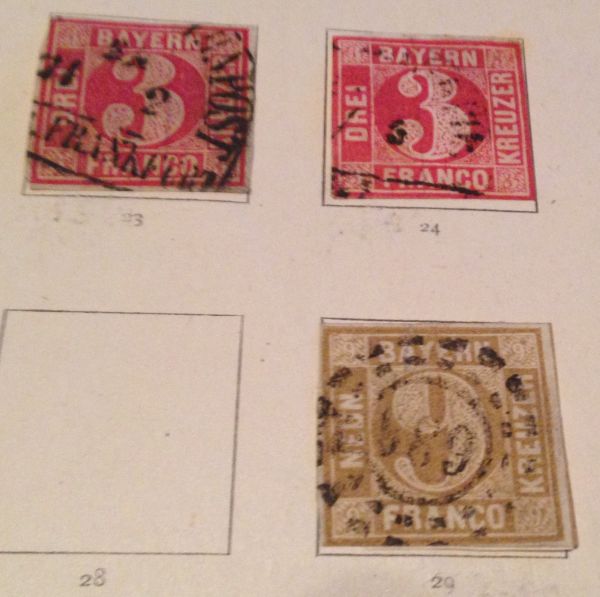
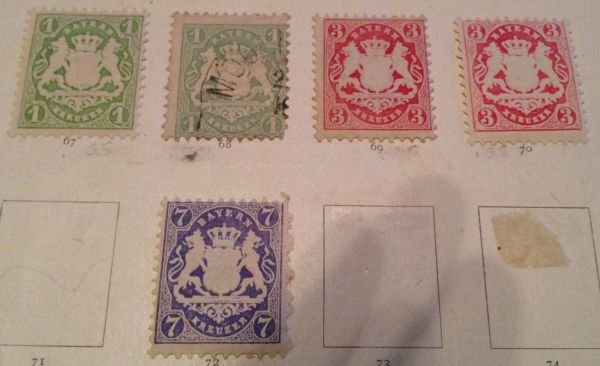
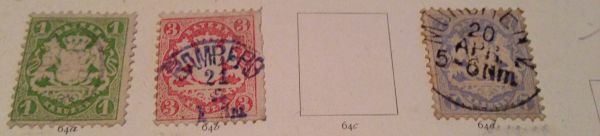
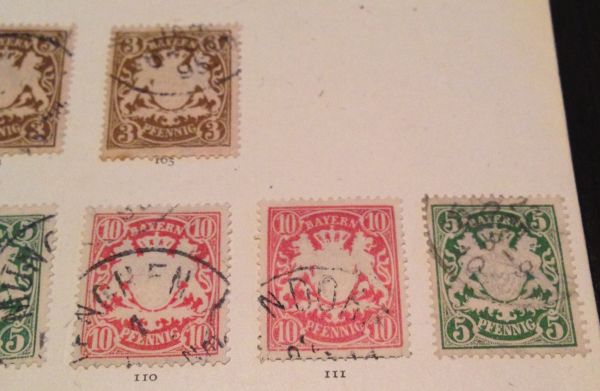
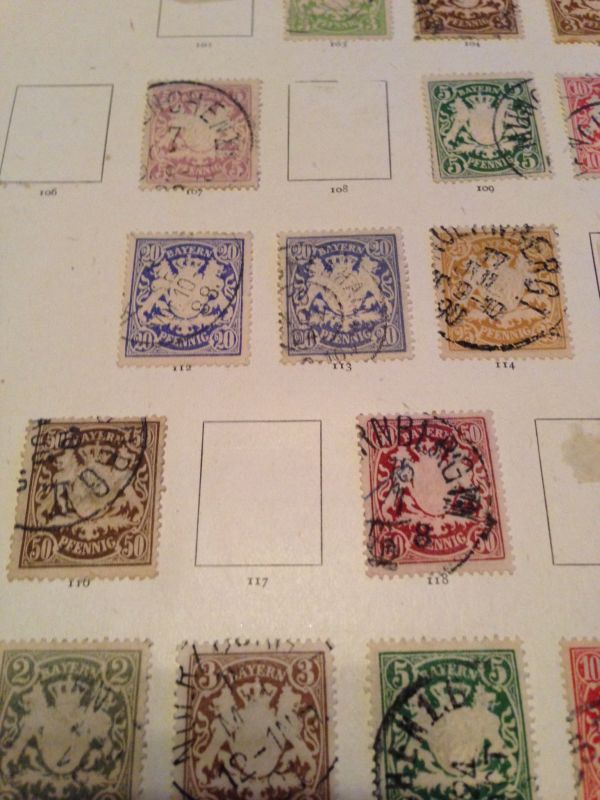
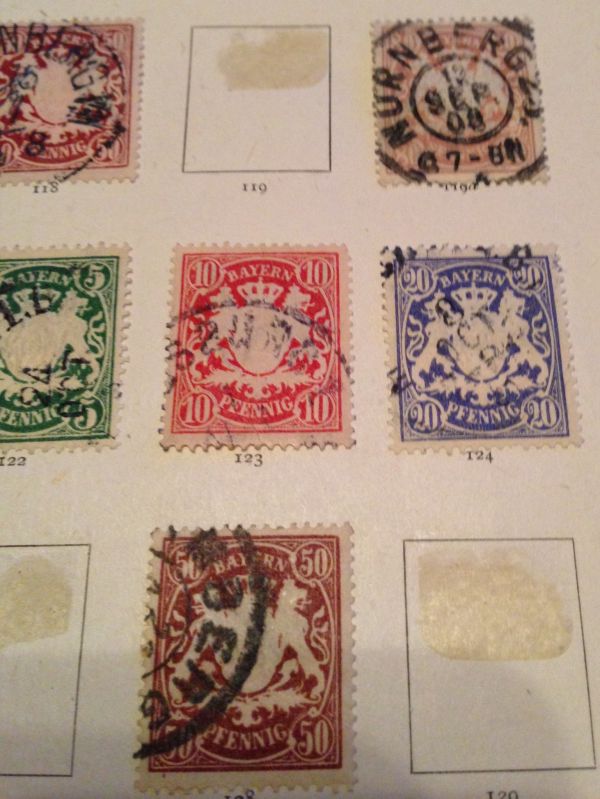
Second, while some Bavarian earlies are quite valuable, many of them are worth under $1 and others in the $1-3 range, in very fine condition. Some of the ones in these photos are in very poor condition and thus, despite catalogue values of $1-3 dollars, are worth a few pennies if they could even be sold at all.
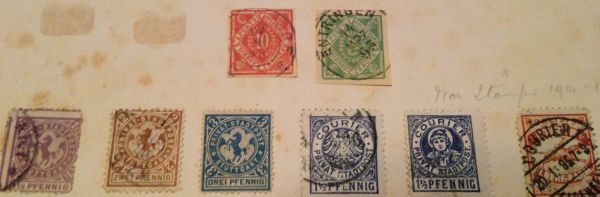
Even among Bavaria Scott nos. 1-14, many stamps have a cv of only $15 or so. A few catalogue around $100 or more. Chances are good that they are gone, picked over. The only way to know whether you have anything worth more than a dollar or two is to sit down with stamps and a catalogue and identify them all. Pictures of entire pages from a distance are difficult to work with. Perforation differences can't be done very well from these photos and watermarks not at all. But others who know their German states inside and out might be able to give you identifications from these photos.
On the up side, there may well be some interesting/more valuable cancels on your pages--at least at a glance one see some boldly struck cancels. A real specialist would need to address that issue--I don't know enough.
Finally, as someone pointed out, there were reprints and forgeries of the earliest ones. It's rather unlikely that you have any of the most valuable ones that were the focus of reprinting and forgeries but it's something that has to be addressed.
Upshot: yes, these are 19th century German States, but of the German States, Bavaria and Wuerttemberg are among the least valuable because they had the largest stamp issuing programs of all the German States. There are simply a lot more of these kind of stamps around than for Baden, Hannover, Prussia, Saxony, Mecklenburg etc.
These are interesting stamps, esp. the embossed eagles and they are certainly worth working up. They'd make a fine addition to a standard Germany collection. But don't quit your day job just yet. These pages are a good example of how stamp collecting can be fun and interesting but is rarely lucrative. |
|
Send note to Staff
|
| Edited by Hieronymus - 12/01/2014 10:19 pm |
|
|
Valued Member
92 Posts |
|
|
Okay thanks for all of that feedback. I do have quite a few of these stamps that fell out of the album so maybe they are a big reason for the empty slots. This album also had those other countries with the exception of Mecklenburg. |
|
Send note to Staff
|
|
|
Pillar Of The Community
United States
2055 Posts |
|
|
Anything in the German States area worth more than a few dollars should be looked at warily as forgeries are very commonplace. Even some relatively cheap stamps have been forged. I am not knowledgeable enough yet to identify them as such for you, but there are some here who could. However they'd likely need a closer up scan rather than a photo. |
|
Send note to Staff
|
|
|
Pillar Of The Community
United States
526 Posts |
|
|
Okay, if there were some loose Bavaria and Wuerttemberg then it may not have been picked over and you may have some higher catalogue Bavaria and Wuerttemberg. If you also have Prussia, Saxony etc. it points to a fairly extensive German States collection, well above average.
But that then means that you have to consider the reprint issue very carefully. Particularly for Heligoland (Helgoland) there are far more reprints out there than there are genuine ones.
Pick up the loose ones and put them in (glassine) envelopes or a stockbook or Vario pages to protect them. Then you will need either to find someone knowledgeable to sit down with you and a catalogue or learn about German States in a catalogue and work through the collection yourself. Distinguishing reprints from genuine ones will not be possible from photos like these. High resolution scans of each individual stamp might make that possible on this forum. But first you will have to use a catalogue to determine which of your hundreds of stamps are the high catalogue ones. There's really no shortcut.
But it's a fun project. Read up on the history of the unification of Germany. All these independent principalities existed for centuries and then started issuing stamps in the late 1840s and 1850s and 1860s. But Bavaria and Wuerttemberg had been turned into kingdoms by Napoleon as buffers between Prussia and the Austrian Empire on the one hand and France on the other. So Bavaria and Wuerttemberg retained stamp-issuing rights even after they entered the unified German Empire.
When you are finished with that, go do the Italian States. (Just kidding. They are way more expensive and an even worse quagmire as far as forgeries and fakes are concerned. But the history is interesting. . . .) |
|
Send note to Staff
|
| Edited by Hieronymus - 12/02/2014 08:37 am |
|
|
Valued Member
Denmark
445 Posts |
|
|
I recommend getting a copy of Michels's Deutschland catalog. The Spezial edition Band 1 if you are serious about this.
Nothing beats educating yourself.
|
|
Send note to Staff
|
|
|
|
Pillar Of The Community
United States
526 Posts |
|
|
I did not mention Michel because it adds an extra layer of complexity (German language) that I think, in this instance, is not necessary. I am assuming, however, that the OP is from a Scott catalogue region, i.e., the US -- can't tell from Dw9540's profile. If that's not the case, then turning to Michel out of the starting gate might make sense. The most important thing is to take the plunge, to get started with what even a generalist collector can do. And that would be the basic task of distinguishing high cv from low cv, can be done from Scott or Stanley Gibbons or whatever is at hand. If Dw9540 knows a bit of German, great. But if not, I don't want to discourage him or her from beginning with Scott or SG if that's what is at hand. We don't want the perfect to be the enemy of the good. If Dw9540 then gets interested enough in this area of collecting, turning to Michel Spezial would be highly recommended. One step at a time. . . .  |
|
Send note to Staff
|
| Edited by Hieronymus - 12/02/2014 09:20 am |
|
|
Valued Member
92 Posts |
|
|
Man this forum is great. I bought this collection for $60 and there was all of the above I spoke about, 1,000+ 1860-1910's russia with many overprints (including dollars and cents overprints), 25 sheets of mnh WW2 german stamps, $30 FV U.S. Stamps and much more.
My father wanted me to help him sell his grandmothers collection about a year ago and while I was researching, I absolutely fell in love. At 29 years old, I am becoming very passionate about stamp collecting. I sell off what I don't want but I'm starting to sell less and less. (Wife isn't too happy but Ahh well). |
|
Send note to Staff
|
|
|
Pillar Of The Community
United States
526 Posts |
|
|
Beware fake overprints on Russia of that era. Overprints are easier to fake than entire stamps (which is why Offices in China or Turkey etc. are a minefield whether Russia, England, US, German, France or whatever). But by now you know the drill--fakes are out there but don't let forgeries frustrate the Fun. There are good online resources for forgeries and fakes, starting with stampforgeries.com
It sounds like you'll get your $60 back and a good bit more. Congratulations on a good purchase and enjoy yourself! |
|
Send note to Staff
|
|
| |
Replies: 10 / Views: 2,956 |
|



 Posted 12/01/2014 6:34 pm