| Author |
 Replies: 17 / Views: 4,336 Replies: 17 / Views: 4,336 |
|
Valued Member
Canada
228 Posts |
|
|
Since I have almost completed my album page of the basic Admiral stamps, I decided to examine them a little more closely to see which were wet and which were dry printings. I thought that this would be done easily using Photoshop with some scans of the stamps, but it proved more problematical than I imagined. I used a black rectangle of a fixed width that seemed to best represent the width of a dry printing. My assumptions were that this rectangle would reveal: (1)that all the known dry-only printings were of almost exactly the same width with maybe a little latitude for shrinkage over time since the close to 100 years since these were printed and (2) that all the known wet-only printings would show significant if inconsistent widths that would be clearly narrower than the dry printings. Some of my findings are shown below. The dry-only printings are what I find interesting. The 3c carmine shows the width of a typical dry printing. The 10c bistre brown shows a very slightly narrower stamp that I would attribute to some paper aberration or small shrinkage over the decades. But the 8c blue shows quite a significantly narrower stamp that is more consistent with the wet printings shown below. Since there is no record of a wet printing for the 8c and I would guess that there is pretty much no chance of my having discovered the first one, I am a bit confused as to why this stamp would be significantly narrower than a typical dry printing stamp. Does anyone have any idea what may have caused this? Are the 8c stamps typically narrower than other dry admirals? Can anybody suggest other specific reference stamps (coils, war tax) for making this analysis better? Note that these stamps are all mint NH so shrinkage due to postal usage or soaking would not be relevant. Any insight would be appreciated. 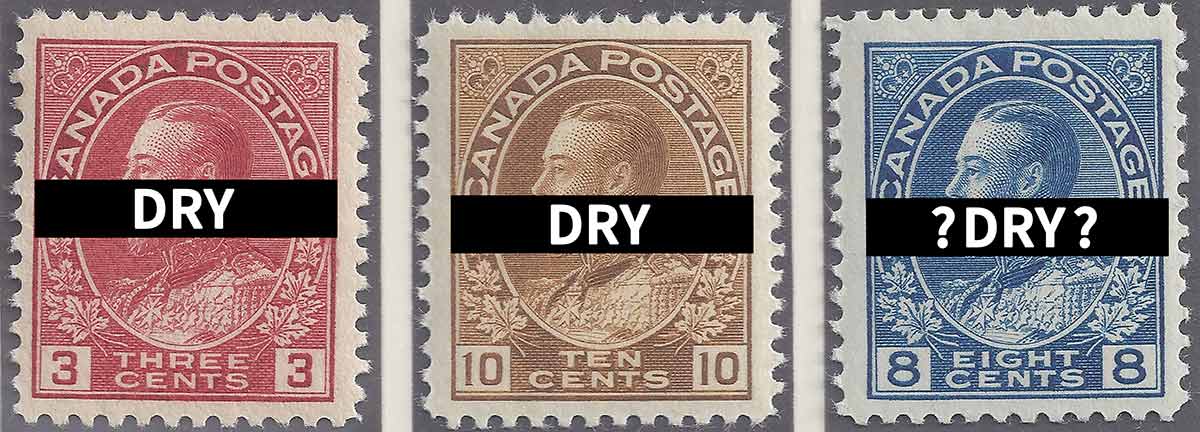 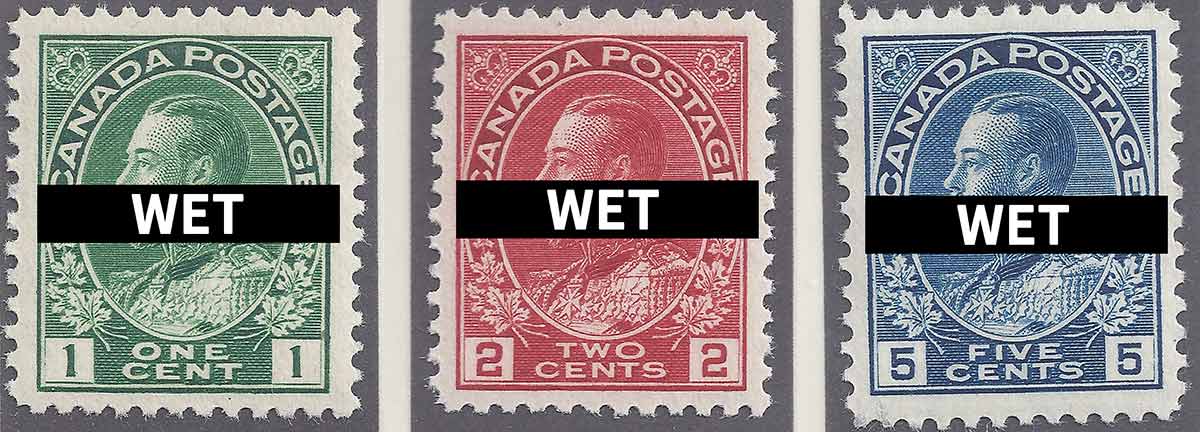 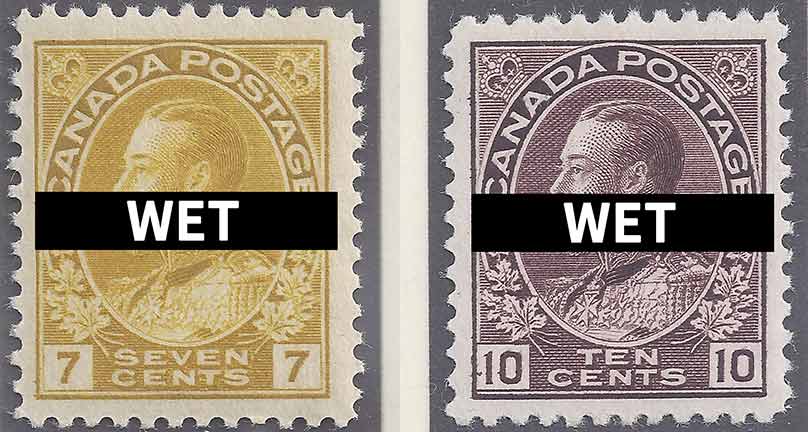 |
|
Send note to Staff
|
|
|
|
|
Rest in Peace
7742 Posts |
|
|
Pillar Of The Community
Canada
528 Posts |
|
|
Hi Scottamer, In another thread ( https://goscf.com/t/41173&whichpage=2 ), member "BeeSee" on 3rd January makes the following statement: "as most scanners on the market do not actually scan 100%, and the actual size can vary in different locations on your flatbed!" This may be an influence in your varying measurements! - stamporator - |
Send note to Staff 
|
|
|
Rest in Peace
7742 Posts |
|
|
Valued Member
36 Posts |
|
|
Both wet and dry printings show some variation in width. There was an article in the June 2004 issue of the BNAPS Admiral Study Group newsletter (unfortunately, not available online) that discussed this subject ("Identification of 10c Blue on Horizontal Wove Paper" by Don Krause). Although the focus of the article was the horizontal wove paper variety on the 10c blue, an Editor's note appended to the article discussed width variations found on wet and dry printings on the normal vertical wove paper. This stamp was printed by both methods.
According to the note, the width of wet printings on this stamp varied from 17.5 to 17.7 mm and the width of dry printings varied from 18.0 to 18.2 mm. The note also mentioned the existence of similar variations on the 5c violet. I have seen marked variations in width on the 2c green and, to a lesser extent, the 3c brown printed by the wet method.
A possible explanation for the variation in width on wet printings, especially on stamps that went through the transition from wet to dry, was that there was more or less moisture content in the paper on specific printings. Although this is admittedly speculative, perhaps the moisture content was reduced on the later printings by the wet method. The variation in width on dry printings is a bit more difficult to explain ...
Scottamer, it would be interesting to see whether the width on your 8c stamp is consistent across all 8c stamps or whether this stamp comes in different widths.
As a side note, although the width of the stamp is a good differentiator between wet and dry printings, it shouldn't be used as the only differentiator. Others include:
1. The sharpness of the design lines - dry printings are sharper. With a bit of practice, one can readily distinguish between wet and dry printings of the 3c brown and 7c red brown just by inspecting the design lines.
2. The embossing of the design lines on the back - most wet printings don't show any embossing; however, wet printings prior to the switch to dry printings do show some embossing so this isn't a fail-safe differentiator. |
|
Send note to Staff
|
|
|
Valued Member
Canada
228 Posts |
|
|
Thanks AdmCol for some good information. Judging the printings by the sharpness of the design is difficult and requires some experience with numerous copies to learn from. I know about the embossing on the mint stamps (which my Admirals are) and this generally works well but I have found this also to be inconsistent with some embossing clearly showing on wet printings while also being hard to detect on some dry ones.
Your comment about it being interesting to see "whether the width on your 8c stamp is consistent across all 8c stamps or whether this stamp comes in different widths" goes to the crux of my post. I am interested to know if others have found this stamp to be narrower than typical dry printings or if it comes in significantly different widths.
Thanks for your information from the BNAPS article. This is the first I have heard of differences in the width of dry printings and it is particularly interesting to note that they have seen the same range of differences (0.2 mm) on both wet and dry printings of the 10c blue. I would have thought that dry printings would show considerably less range in width than the wet printings.
|
|
Send note to Staff
|
|
|
Rest in Peace
Canada
5701 Posts |
|
|
Quote:
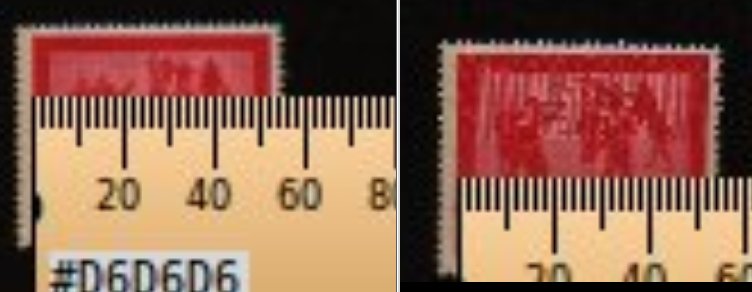
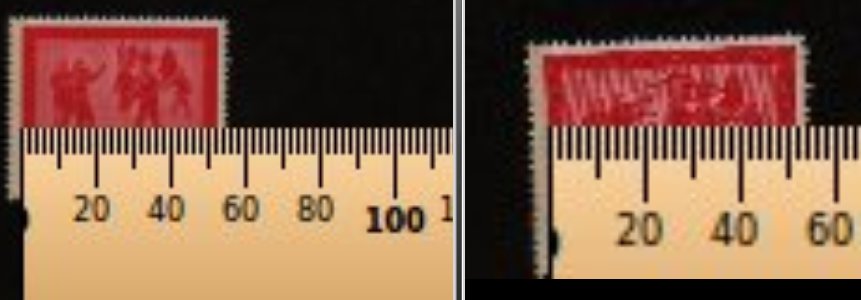
Cropping cuts down on clarity, but as you can see, all scans were 52 on my rule Wert, you must have a better scanner than mine. What model do you have? Inaccurate scans are known problems, and were covered in this thread and others: https://goscf.com/t/27079&whichpage=4#242124This was all related to a discussion on Ezperf, an interesting perforation software tool by SoftPro. |
|
Send note to Staff
|
|
|
|
Pillar Of The Community
Canada
528 Posts |
|
|
Hi Wert and BeeSee,
Keep in mind that Wert`s measurement was 52mm for all four (4) stamps and that the reported difference in widths was 0.2mm. I understand that Wert conducted his measurements before degrading the resolution, but it does not seem that the original measurements were to the required resolution (ie. 0.1mm), as the ruler used only has 2mm markings.
- stamporator -
|
|
Send note to Staff
|
|
|
Moderator

United States
4788 Posts |
|
|
Rest in Peace
7742 Posts |
|
|
OK stamporator...You are correct..I am completely wrong..Have no more input. |
|
Send note to Staff
|
|
|
Valued Member
Canada
379 Posts |
|
|
How about superposing the stamps, the wet printing over the dry one as shown : 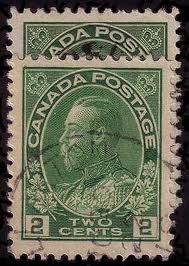 ... OR, use 2 stamps as the reference measure which were printed wet only method and dry only method like : #116 a wet print only #118 a dry print only... and superpose on each of the two the stamp you want to identify if it is a wet onr or a dry one This is the way I proceed with my Admirals and I never missed so far... |
|
Send note to Staff
|
|
|
Valued Member
135 Posts |
|
|
I even go as far as cutting the bottom of dry and wet known examples, and using them as templates to measure with. Simple and fast way to determine wet and dry printings. |
|
Send note to Staff
|
|
|
Valued Member
Canada
379 Posts |
|
|
Valued Member
Canada
265 Posts |
|
|
wet and dry printings on the Admirals.
I know if you can see the embossing effect on the back of the Admirals on Mint Gummed stamps it it the DRY printing method.
Is it the same process for identifying ungummed(used) stamps?
Trodent |
|
Send note to Staff
|
|
|
Pillar Of The Community
3860 Posts |
|
|
Sometimes you have to stick to only the stamps from one specific denomination when making a comparative determination within that denomination rather than to other stamps from a different denomination in the same issue. |
|
Send note to Staff
|
| Edited by jogil - 12/19/2020 09:25 am |
|
|
Valued Member
496 Posts |
|
|
Just curious... what would be the explanation/mechanics of why the dry printing would leave embossing marks? |
|
Send note to Staff
|
|
|
Replies: 17 / Views: 4,336 |
|




 Posted 01/03/2015 3:35 pm