| Author |
 Replies: 56 / Views: 12,370 Replies: 56 / Views: 12,370 |
|
Pillar Of The Community
Canada
5821 Posts |
|
|
As I was going through my duplicates of the Czechoslovak 1965/66 definitives to post on the thread Definitives from around the World I noticed that not only had some colour variations but also the screening in the photogravure portion of the stamps was different. There is nothing of course in Scott but it appears there was probably a second printing. Scott 1347    Scott 1348    Scott 1348A 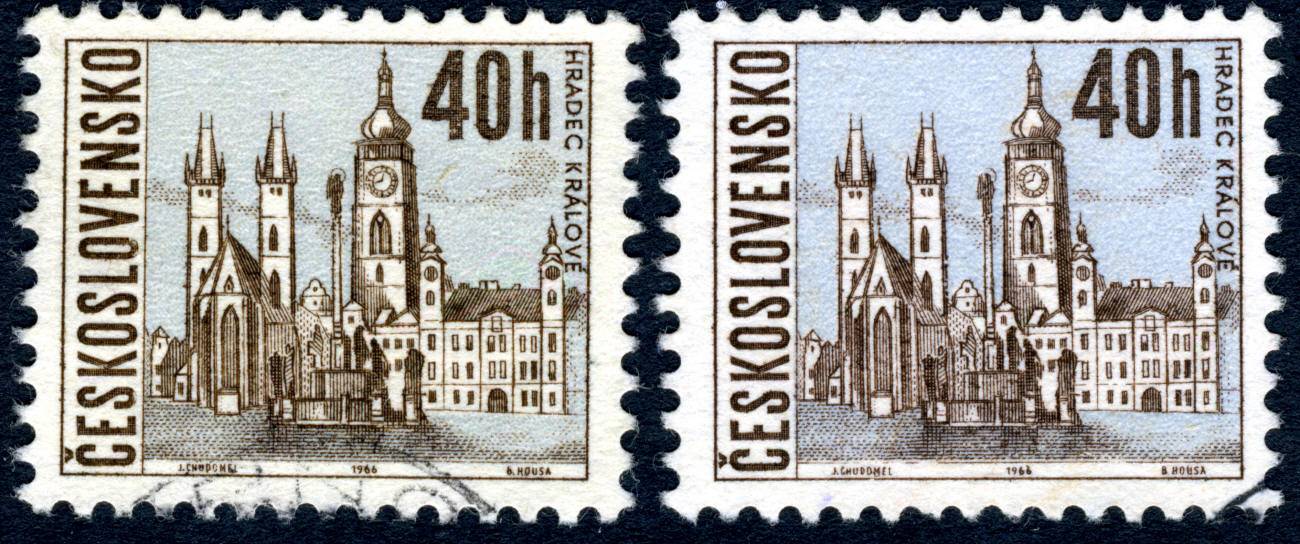 Scott 1348B  Scott 1348C  Scott 1348D  |
|
Send note to Staff
|
| Edited by lithograving - 03/24/2018 7:24 pm |
|
|
|
|
Valued Member
France
69 Posts |
|
|
Hello,
I may be wrong, but it seems to me that it was no screening for the offset printing of these stamps.
Ink and inking were different for the second printing, but the plate is the same. It is not also the same paper.
Papy24 |
Send note to Staff 
|
|
|
Pillar Of The Community
Canada
5821 Posts |
|
|
Papy24 when you say, Quote:
but it seems to me that it was no screening for the offset printing of these stamps do you really mean offset or is it an error in the translation ? These stamps were a combination print, 1 colour recess engraving and 1 colour photogravure not offset. At least that's what the catalogues say. |
|
Send note to Staff
|
|
|
Valued Member
United States
289 Posts |
|
|
Excellent find. I have Czech stamps on my radar to sort through soon.
Scott neglects many varieties such as these. Especially for these eastern European countries. I have found many printing and perforation varieties that are not mentioned.
|
|
Send note to Staff
|
|
|
Valued Member
France
69 Posts |
|
|
Hello,
I am sorry. Now, I have a doubt. I think the stamp Scott 1347 left, was printed in intaglio and offset-litho without screen, because I do not see dots, and the Scott 1347 at right was printed in photogravure, but without traditional screen (with dots in line), engraved with powder.
I have read somewhere on this forum that Czechoslovak stamps were printed by several printing machines like Wifag or Waite & Saville with different way, either offset-litho or photogravure more the intaglio (offset or héliogravure for me). Is it not possible that the same stamp was printed by the two ways and by two printing machines?
I do not enough know the czechoslovak stamps to be sure, but I think so. I may be wrong and I will be happy to know.
Lithograving, it is not an error in the translation with Google, I write directly in English, but I verify at home with Google in french.
I wish you a happy new year.
Papy24 |
|
Send note to Staff
|
| Edited by Papy24 - 01/04/2015 1:13 pm |
|
|
Pillar Of The Community
Canada
5821 Posts |
|
|
Pillar Of The Community
Canada
5821 Posts |
|
|
Papy24, you are right, the 20h light blue does have a more or less
solid background which makes it appear to be offset.
There is no evidence of any dot structure so reminiscent
of photogravure so perhaps it is unscreened?
I'm sure Florian and/or Rein will have the answer.
PS: what do you mean by engraved with powder. ?
|
|
Send note to Staff
|
|
|
Valued Member
France
69 Posts |
|
|
Pillar Of The Community
United States
2830 Posts |
|
|
Outstanding post litho. Scott's is definitely USA-centric and does miss many of these varieties not only in Eastern Europe, but also in Western Europe and British Commonwealth. I've long been used Stanley Gibbons for Commonwealth printings and got a Facit for Scandanavia last year. I would love to pick up some additional cats for other European countries this year as I find them. |
|
Send note to Staff
|
|
|
Pillar Of The Community
Canada
5821 Posts |
|
|
shermae, I guess Scott's is limited in how much detail
they can include in their standard world catalogs,
unless they go to 10 volumes and double the price.
I think most world catalogs have removed information
over the years which the editors felt that the average
collector didn't really care about in the first place.
I suppose I'm part of the minority who are interested in
those facts though.
For instance I like to know the names of the stamp designers,
the engravers, the Printers and the quantity printed.
The 1968 Michel Europa had all that and more.
Lo and behold when I bought the new 2004/2005 Michel Europa Band 3
all that was left were the quantity printed.
I'm so glad that I kept the old catalogue.
|
|
Send note to Staff
|
|
|
Pillar Of The Community
Czech Republic
623 Posts |
|
|
lithograving - The Czechoslovak 1965/66 definitives were originally printed on WIFAG I rotary press which lacked etching equipment for the photogravure process and therefore the photogravure background had to be engraved and transferred onto the photogravure printing cylinder by means of a transfer roll (see enlargements in your post of 05/18/2013 04:16 pm on p. 117 of the Collecting by Engraver thread - https://goscf.com/t/9106&whichpage=117 ) These 1965/66 definitives were reprinted several times between 1965 and 1973 resulting in print runs of up to several hundred million and several shades of colour. The largest print run was that of the 30h value (inland postcard rate) reaching 408,180,000, followed by the 60h value (inland basic letter rate) amounting to 294,390,000. In 1967, WIFAG II was put into operation, this time complete with the etching equipement and the process of engraving the photogravure background was gradually abandoned in favour of the simple etching, which again changed the look of these stamps. Just have a look at lot 261 ( http://www.filaso.cz/katalog-znamky...nska-mesta-i ) offering 7 different printings (18/09/1965, 26/05/1970, 16/02/1972, 31/08/1972, 19/07/1973, 09/08/1973, 04/12/1973) of the 20h stamp (inland basic printed matter rate) with the total print run of 259,530,000. Your dark shade examples will be the first printing while the lighter shades appeared in later years. |
|
Send note to Staff
|
| Edited by florian - 01/05/2015 07:40 am |
|
|
Pillar Of The Community
Canada
5821 Posts |
|
|
Florian, thanks for refreshing my memory regarding the
"moletted photogravure" process.
So that's why there is no evidence of screening which
led Papy24 to believe that the stamps were printed
via offset/litho.
I should have used a different title for this thread. |
|
Send note to Staff
|
|
|
Pillar Of The Community
Canada
5821 Posts |
|
|
Florian, another question.
During what time period were these postal rates below in effect?
60h value (inland basic letter rate)
30h value (inland postcard rate)
20h stamp (inland basic printed matter rate) |
|
Send note to Staff
|
|
|
Pillar Of The Community
Czech Republic
623 Posts |
|
|
lithograving - For Czech postal rates, please consult http://phist.webpark.cz/rates.htmfrom which follows that the 60h letter rate, the 30h postcard rate and the 20h printed matter rate were effective from 01/06/1953 to 22/07/1975 for private individuals and from 01/06/1953 to 31/12/1969 for organisations. |
|
Send note to Staff
|
| Edited by florian - 01/06/2015 03:42 am |
|
|
Valued Member
France
69 Posts |
|
|
Hello,
Printing cylinder intaglio engraved by transfer roll, I understand, I have seen so many times, but printing cylinder photogravure is very different.
So it needs a new die engraved, a transfer roll, but there is a deformation of the metal after moleting. In photogravure, the printing cylinder needs a doctor blade and no deformation on the cylinder. I wonder how they did it. Traditionally, the cylinders are engraved by ferric chloride.
Papy24 |
|
Send note to Staff
|
|
|
Rest in Peace
Netherlands
963 Posts |
|
|
Papy, I agree with you! "The Czechoslovak 1965/66 definitives were originally printed on WIFAG I rotary press which lacked etching equipment for the photogravure process and therefore the photogravure background had to be engraved and transferred onto the photogravure printing cylinder by means of a transfer roll The photogravure cylinders are of different materials than the recess cylinders. Furthermore, the etching equipment has nothing to do with the WIFAG-press. They could prepare the photogravure cylinder in a separate department. The background colours are mostly arranged by sets of parallel lines - different angles for different colours - and show signs of halftone where necessary. When I first saw these Cz-Sl stamps they reminded me of the unscreened photogravure the NRM had invented and used for South African definitives in the 1929-1948 period.. 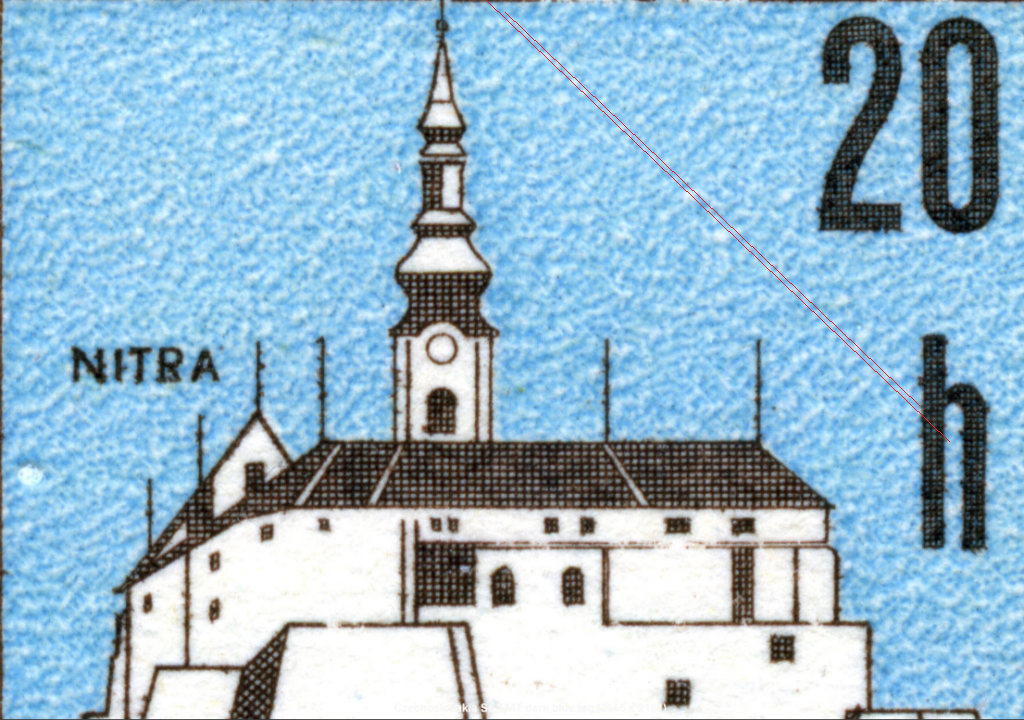 The blue diagonal lines can be seen where I drew red lines. This was standard procedure for a long time, even after they acquired the new press! |
|
Send note to Staff
|
| Edited by Galeoptix - 01/06/2015 4:39 pm |
|
|
Replies: 56 / Views: 12,370 |
|




 Posted 01/03/2015 5:07 pm


