Stamp Community Family of Web Sites
Thousands of stamps, consistently graded, competitively priced and hundreds of in-depth blog posts to read


Stamp Community Forum
 
Username:
Password:
Save Password
Forgot your Password?

This page may contain links that result in small commissions to keep this free site up and running.

Welcome Guest! Registering and/or logging in will remove the anchor (bottom) ads. It's Free!

Learning About Cancellation Types...

 
To participate in the forum you must log in or register.
Author Previous TopicReplies: 7 / Views: 3,052Next Topic  
Moderator
1589 Posts
Posted 02/12/2015   9:30 pm  Show Profile Bookmark this topic Add blcjr to your friends list Get a Link to this Message
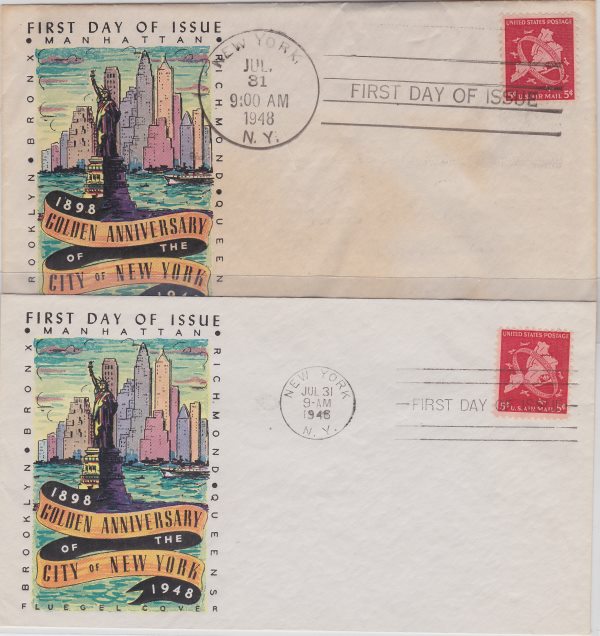
I'd like to learn more about cancellation types. I understand the basic difference between a machine cancel, and a hand cancel, but how can one tell the difference just by looking at a cancellation? In collecting FDC's, I'll often encounter the same FDC but with different cancellations, like the following:


How does one learn to tell which is hand and which is machine? I've looked around the web for resources or guides, but all I've found are very basic, and not as detailed as I'd like. Are there any "standard" references for this sort of thing?
Send note to Staff

Pillar Of The Community
United States
1115 Posts
Posted 02/12/2015   10:18 pm  Show Profile Check docgfd's eBay Listings Bookmark this reply Add docgfd to your friends list  Get a Link to this Reply
Here's a link to a Machine Cancel Finder page. Although the main site only describes those that are pre-1920, the additional links to external sites provided on the page will take you to modern era cancellations. Altogether a very useful source.

http://swansongrp.com/machtest.html
Send note to Staff  Go to Top of Page
Pillar Of The Community
United States
1047 Posts
Posted 02/13/2015   08:12 am  Show Profile Bookmark this reply Add DonSellos to your friends list  Get a Link to this Reply
That is a nice looking cachet. Any idea who designed and/or printed it? It has the look of a watercolor.

Don
Send note to Staff  Go to Top of Page
Moderator
1589 Posts
Posted 02/13/2015   08:29 am  Show Profile Bookmark this reply Add blcjr to your friends list  Get a Link to this Reply
I appreciate the link, and have bookmarked it. And I plan to go back and download some information I saw linked there. But it doesn't directly address my question, except in an oblique way. I'm trying to learn to identify whether a cancellation is a machine cancel or a hand cancel by sight. Obviously, if I used that resource to identify a particular machine cancel, then I've answered my question. But that is more work than I want to do; I am not trying to identify the type of machine that produced a machine cancel.

I am guessing here, but looking at the image I posted, the top cover has a hand cancellation, and the bottom one a machine cancellation. The basis for this guess is that in the bottom one the cancellation is nice and parallel with the top edge of the cover, while in the top it is not. While that basis for deciding what is a hand cancel is not perfect -- a careful person could no doubt square up a hand cancel nice and parallel to the top edge of a cover -- I think that it probably works in most cases. But is there anything else that gives away the difference between the two. What about the larger postmark? Is that significant? In my experience, most (if not all?) of the time I see these larger dials they are with what looks to be a hand cancel. It might be nice if there was a resource for hand cancels comparable to the one for machine cancels.

Why am I interested in telling the difference? Well, as an FDC collector, I like finding different varieties or variations of an FDC I already have. Besides differences in cancellations, such varieties can include different frankings (such as plate block versus single, or in the modern era, "combos" and "dual" cancellations), or unofficial city cancellations. The difference between hand and machine cancellations is just another one of those variations.

Basil
Send note to Staff  Go to Top of Page
Pillar Of The Community
United States
692 Posts
Posted 02/13/2015   10:28 am  Show Profile Bookmark this reply Add jarnick to your friends list  Get a Link to this Reply
The cachet was done by H. "Capt" Fluegel, who produced a series of colorful, well-designed covers during the 1940s into 1960s.
Send note to Staff  Go to Top of Page
Pillar Of The Community
6328 Posts
Posted 02/13/2015   10:51 am  Show Profile Bookmark this reply Add John Becker to your friends list  Get a Link to this Reply
Yes, the top cover has a hand stamp.
The lower one has a machine cancel.

Most FDC's have machine cancels, characterized by a cancel impression parallel to the top of the envelope, which is crisp and fine due to being made by a metal die.
Send note to Staff  Go to Top of Page
Moderator
1589 Posts
Posted 02/13/2015   11:45 am  Show Profile Bookmark this reply Add blcjr to your friends list  Get a Link to this Reply

Quote:
That is a nice looking cachet. Any idea who designed and/or printed it? It has the look of a watercolor.

As jarnick explained, it is a Fluegel cover. Once you've seen a few -- and my collection of Fluegel airmail covers is quite extensive -- they are easily recognizable. The older ones were a lot more colorful and detailed, giving the watercolor appearance you note. In Scott's 2002 FDC Catalog, 1945-1959 Fluegel covers have a "6 to 8 times" value multiplier. Oddly (to me) the newer covers, 1960-1964 have a "10 to 15 times" value multiplier. Like all "catalog values" these multipliers are inflated, but Fluegel covers do have a value premium over most other common cachet producers.

Edit: the 2002 Scott FDC catalog errs in implying that 1964 was the last year of Fluegel covers. Mellone catalogs Fluegel covers through #1337 (12/11/67) and the last airmail cover was #C71 (4/26/67).


Quote:
Yes, the top cover has a hand stamp.
The lower one has a machine cancel.

Most FDC's have machine cancels, characterized by a cancel impression parallel to the top of the envelope, which is crisp and fine due to being made by a metal die.

Thanks. The detail about them being crisp and fine due to being made by a metal die is something I hadn't thought about. That will be a bit of helpful knowledge.
Send note to Staff  Go to Top of Page
Edited by blcjr - 02/13/2015 11:58 am
Pillar Of The Community
United States
1047 Posts
Posted 02/14/2015   08:43 am  Show Profile Bookmark this reply Add DonSellos to your friends list  Get a Link to this Reply

Quote:
As jarnick explained, it is a Fluegel cover. Once you've seen a few -- and my collection of Fluegel airmail covers is quite extensive -- they are easily recognizable.


Thanks, blcjr and jarnick. Had I looked a little closer at the initial scan I would have seen the "Fluegel" signature at the bottom of cachet.

I'm not much of a FDC collector, but the lighter, almost pastel colors used on the buildings in that cachet caught my eye. I have seen a few of Fluegel's more contemporary cachets and they are almost gaudy.

Don
Send note to Staff  Go to Top of Page
Edited by DonSellos - 02/14/2015 08:45 am
  Previous TopicReplies: 7 / Views: 3,052Next Topic  
 
To participate in the forum you must log in or register.

Go to Top of Page

Disclaimer: While a tremendous amount of effort goes into ensuring the accuracy of the information contained in this site, Stamp Community assumes no liability for errors. Copyright 2005 - 2026 Stamp Community Family - All rights reserved worldwide. Use of any images or content on this website without prior written permission of Stamp Community or the original lender is strictly prohibited.
Privacy Policy / Terms of Use    Advertise Here
Stamp Community Forum © 2007 - 2026 Stamp Community Forums
It took 0.16 seconds to lick this stamp. Powered By: Snitz Forums 2000 Version 3.4.05