| Author |
 Replies: 37 / Views: 7,043 Replies: 37 / Views: 7,043 |
|
|
|
Pillar Of The Community
United States
1125 Posts |
|
|
I would buy a restored cover, but would pay less (if I knew it was restored). Generally speaking, I would only restore a cover to prevent further degradation (such as de-acidifying it) I have no plans to restore two valuable covers that I would likely benefit financially if I did, including one that is on the title page of my exhibit of 12c covers: Note the tear through the top: 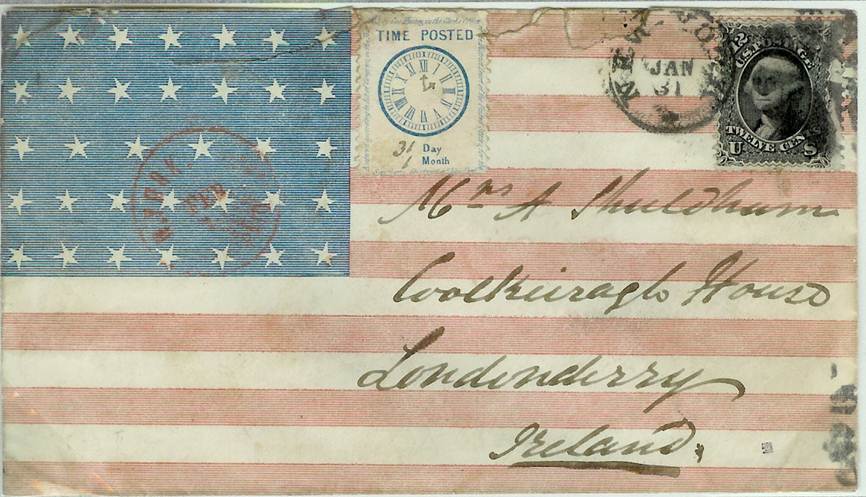 Note the right side - was torn through the stamp to open it and some "matching" paper added later (though not to the stamp): 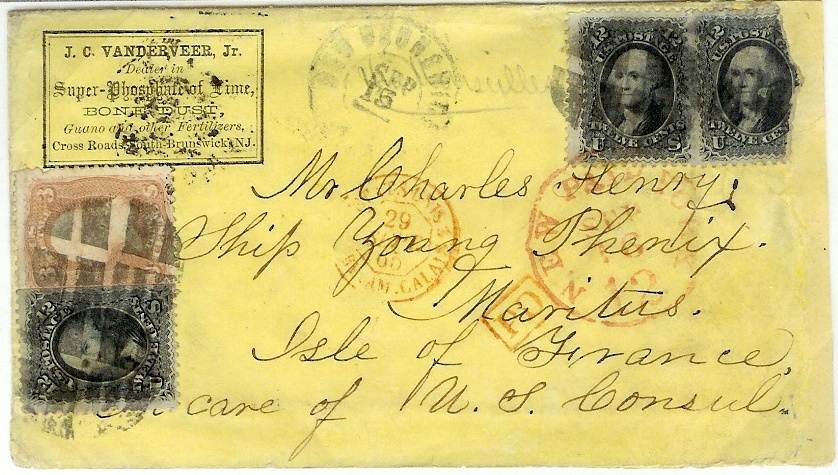 The next owner can restore them if he/she so chooses. Chip |
Send note to Staff 
|
| Edited by chipg - 03/01/2015 10:35 am |
|
|
Pillar Of The Community
1515 Posts |
|
|
Bill sadly as we all know, there are no guarantees. But how do collectors of other "antique" items manage without having restored items marked with indelible ink? I fear that you have seen too much bad in our hobby which colors your thoughts on legitimate restoration. Realistically, if I had a valuable cover restored (which is quite expensive to do), I certainly would not then make it lose value by marking it with indelible ink.
Chipg just out of curiosity, if you did spend a lot of money restoring one of those (fabulous) covers, would you then permanently mark it with ink as having been restored? |
|
Send note to Staff
|
| Edited by Jenny2U - 03/01/2015 11:02 am |
|
|
Pillar Of The Community
United States
1125 Posts |
|
|
As long as Bill asked... I did buy this cover: 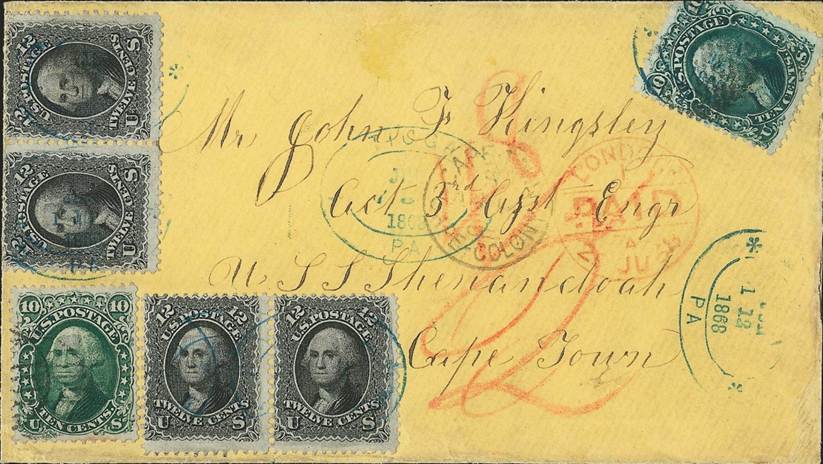 My description of it notes that the lower left stamp was replaced. However, it is sufficiently rare (like that Mauritius cover) that I made allowances in my quality standards. However, it still bugs me a bit every time I look at it. On the other hand, I did return an Angel patriotic cover to a dealer when I found that one stamp had been replaced. In that case, even though the covers are expensive, there is no reason to settle for one with a replaced stamp. There are enough that don't have that replacement. Pulling this back to the original post - it's a cheap cover that would be further cheapened by swapping out the stamp. In fact, I'd say that swapping the stamp would make it absolutely worthless. C. |
|
Send note to Staff
|
|
|
Pillar Of The Community
United States
1125 Posts |
|
|
@Jenny: No, I don't think I would mark the cover in ink. I would disclose it, however. There is nothing to be gained by hiding it. If it were put up in an auction and the buyer bought it subject to an expert opinion and the restoration was detected (as it would be using the right tools), I'd get it back and have to refund the money. Then I'd be stuck with it and everything else would be tainted with the "did he?" or "didn't he?" questions. My reputation is too important to me to try to pull off a con (and that's what trying to slip a restored cover as original really is). Chip PS - for context: http://12c.cgpostal.com/ |
|
Send note to Staff
|
| Edited by chipg - 03/01/2015 11:02 am |
|
|
Pillar Of The Community
United Kingdom
895 Posts |
|
|
I don't follow the "stamp on top of the d" argument. Isn't it possible the address was corrected before the stamp was applied? I don't see it would prove anything. |
|
Send note to Staff
|
|
|
Pillar Of The Community
1515 Posts |
|
|
chipg I would be more worried about postal historians chasing you with pitchforks if you defaced those covers in any way  |
|
Send note to Staff
|
|
|
Pillar Of The Community
United States
1125 Posts |
|
|
@Ringo:
The stamp is not on top of the "d." If you look closely, you'll see that the "d" was written when the stamp was on the envelope, as proved by the extra ink that was deposited when the nib hit the two bottom perforation tips. There is no top to the "d" because the stamp was in the way. The stamp on the cover is original to the mailing.
C. |
|
Send note to Staff
|
|
|
Pillar Of The Community
United States
3304 Posts |
|
|
chipgsaid Quote:
Look at the 'd' of Cloverdale again.
The person writing it had their pen run into two of the perf tips, which led to a little extra ink being put down at the spot adjacent to the stamp.
The stamp is original to the envelope. And he was 100 % correct. The lower part of the stamp was not glued down as well as most of the stamp is. I held it over steam until I could lift the lower right corner up, enough the see that the person who corrected the spelling did indeed run into the perfs. The upper loop of the d stops right there between the perfs. Damaged stamp stays. I've drawn a line across where I lifted the bottom right corner. Thanks Chip! 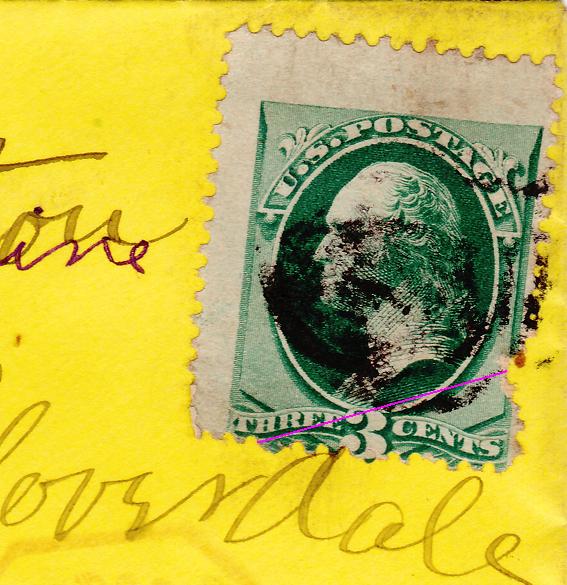 |
|
Send note to Staff
|
|
|
Pillar Of The Community
1213 Posts |
|
|
A cover is all of its parts - the envelope, the stamp, the postal markings, and the handwriting. If a person changes any of these, they are committing an act of forgery in the name of conservation. It is the same as with a stamp - if a person sells the stamp after having re-perfed it, or replaced missing or disturbed glue, or used chemicals to brighten the ink color, or adding a cancelation, etc. - it is forgery and it is a major problem with our hobby today. It is why expertizations are becoming ever more important not only in philately but also coins and other collectables as more and more of these are being manufactured by people with both good and bad intentions. Once the forgery is created and not permanently marked, it becomes a serious problem no matter how honorable the maker's intentions may be. |
|
Send note to Staff
|
|
|
Rest in Peace
United States
763 Posts |
|
|
Quote:
Realistically, if I had a valuable cover restored (which is quite expensive to do), I certainly would not then make it lose value by marking it with indelible ink.
; The problem Jenny, is that not everyone has the same ethical attitude as chipg. It is true that if EVERY person who had restoration work done would reveal it, indeed, there would be NO problem. Also, many folks who submit items to an expert restorer are doing so primarily to improve the visual aspects of the item. They are NOT trying to defraud anybody. But unfortunately, unless every person discloses it, very often the restoration work slips out and is sold wiithout mention of the work, which can result in great financial harm to the buyer. As a personal example, at one time I specialized in the US 15c stamp of 1870-1890, and at a big show I purchased a usage to Russia - the only one I had ever seen, for $1,000. from a well-known (at that time) postal history dealer. At the show, it looked great, but when I got it home and could examine it under my own powerful lighting, I could clearly see that it had ben restored. So I returned it and got a full refund. He claimed he "didn't know it was restored" (and he might have been truthful). That cover, if the restoration would have been revealed, would have been worth maybe $300. or so. Therefore, because the work wasn't revealed to me, I could have lost $700. or more when I went to sell it if I had not detected the work. If it would have been indelibly marked somehow, it might never have happened. I confess, I don't know the answer in philately, but I recently bought a signed baseball for a friend. It was marked in invisible ink which could only be seen under a UV light and came with a cert. from a respected certifying body. The number on their cert. was the same number marked on the ball! A perfect way to guarantee that the genuineness of that ball can be checked by anyone - if that is the industry standard for how to mark baseballs to prevent forged signatures from being sold. Why couldn't we do the same in philately? Why can't a cover be marked in indelible but invisible ink just as the baseballs are? If we could convince the professional restorers to do this with every item they restore, the problem would be solved easily - because there are only a FEW pro restorers in philately. So if they would agree and if the practice were well-publicized (such as by all philaelic media), the problem would cease. |
|
Send note to Staff
|
|
|
Pillar Of The Community
1515 Posts |
|
|
Thanks Bill for your thought provoking reply. Professional restorers of no other collectible item mark their work as you suggest, so why should philatelic restorers be any different? As for the baseball, the COA is being tied to the item with invisible ink, which I think is a different matter altogether. |
|
Send note to Staff
|
|
|
Valued Member
United States
77 Posts |
|
|
Bill-what was done to "restore" the Russia cover that you did not initially notice?
|
|
Send note to Staff
|
|
|
Rest in Peace
United States
763 Posts |
|
|
Russia cover - Under better lighting I could see large areas at some of the edges that had been restored.
Jenny - I don't understand. If you can mark a baseball with a number in indelible invisible ink, why not the back of a cover? The restoraton "artists" would have to co-operate for the plan to work, of course, and ample publicity would have to be done so that the hobby is aware if it, but then only a UV light would be needed to inspect a cover to see if it has the mark of the restorer or not. Of course, I'm sure some crook would figure out a way to remove the indelible ink! |
|
Send note to Staff
|
|
|
Pillar Of The Community
1515 Posts |
|
|
Bill unless I'm misunderstanding, no restoration was done to the baseball - it was simply marked with the COA number to permanently guarantee its value. If the baseball been restored in some manner, are you suggesting that this fact be marked by the restorer in invisible ink on the baseball? I doubt even the most ethical owner would consent to this type of marking.
We must be realistic - restoration is done primarily to improve the value of an item. No one is going to spend good money on restoration and then deface/devalue the work done in any way. |
|
Send note to Staff
|
|
|
Rest in Peace
United States
763 Posts |
|
|
Jennie,
All that would need to be done is for the restorer to get a distinctive handstamp and stamp it on the back of the cover in indellible invisible ink on any item they restore. In fact, they can make it a provision of accepting things to restore - part of their standard Terms, requiring the owner's agreement before the work is accepted. Such a handstamp would not deface the item in any way. |
|
Send note to Staff
|
|
|
Replies: 37 / Views: 7,043 |
|



 Posted 03/01/2015 10:32 am


