| Author |
 Replies: 37 / Views: 7,042 Replies: 37 / Views: 7,042 |
|
Pillar Of The Community
United States
3304 Posts |
|
|
I just acquired a cover that has a damaged stamp on it that did not originate on the cover, original stamp is gone, and another added. I would like to remove the damaged stamp and replace it with a sound stamp. It seems to me that I should mark ( in ink ) the cover indicating that the stamp has be replaced, should that information be on the front of the cover, or would the back be sufficent? Here's the cover. You can see where the original stamp was, and that the current stamp is on top of the d. Another question, any linguists amongst us that could tell me what nationality the author was? 1880 Mendocino had quite a few immigrants from the Azores. Address look to have been written in another language, and corrected to English. 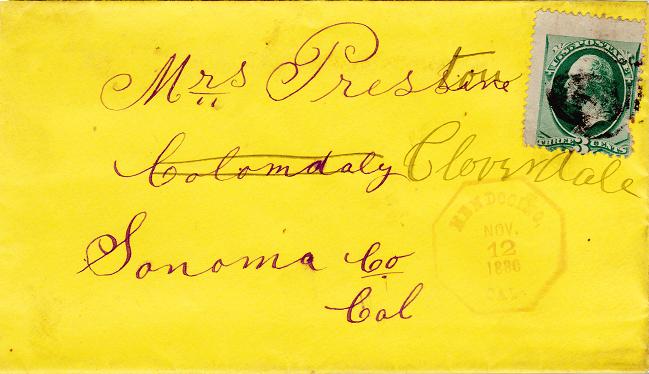 |
|
Send note to Staff
|
| Edited by littleriverphil - 02/24/2015 3:29 pm |
|
|
|
|
Pillar Of The Community
United States
1115 Posts |
|
|
Interesting observations - how can you tell that the stamp didn't originate on the cover? It looks like the smudge cancel which is on the stamp and cover may be ok. BTW, you acquired the cover from me, so I would like to know what I missed! |
Send note to Staff 
|
|
|
Bedrock Of The Community
United States
12128 Posts |
|
|
Pillar Of The Community
6364 Posts |
|
|
NEVER write in ink on a cover, and certainly not on the front. If you are compelled to leave a note for posterity, use lite pencil on the reverse side. Part of any restoration is preserving the maximum amount of reversibility.
The scan does not clearly show the original position of the stamp, so a closer scan of tha area would help. I agree the stamp being over the top of the "d" warrants some more examination. Is it possible the stamp is the original and that it has just been repositioned? (i.e. fallen off and put back on poorly?) I would take small steps slowly. |
|
Send note to Staff
|
|
|
Pillar Of The Community
1213 Posts |
|
|
The stamp on this cover appears to be a replacement from what I can see. The black ink cancel/smudge does not line up.
I disagree with the suggestion to write lightly in pencil on the back since that can be easily erased by someone unscrupulous. There is no way to make a "reversible" change of the stamp on any cover. What is on there now appears to be a forgery in terms of the stamp not having originated on this cover, which is what the original poster is saying. To "improve" the cover by putting a different stamp on it would remove the slightest doubt that it will be a forgery so the only honest thing to do in such a case is what the original poster is suggestion which is to go ahead and change the stamp but at the very least clearly and indelibly mark the cover as having a replacement stamp so no one in the future can try to sell it as original or honestly mistake it as original. Pencil is not indelible, ink is indelible. Putting the marking on the back in ink would be a reasonable compromise between using pencil and putting the marking on the front. The back of the envelope can be cut off, but having a front only would greatly reduce the resale value and would not likely be worth the trouble for a dishonest person in the future to do it. |
|
Send note to Staff
|
| Edited by Kimo - 02/24/2015 1:12 pm |
|
|
Pillar Of The Community
6364 Posts |
|
|
It would be good to do some reading on general conservancy techniques. Like in medicine, the first rule is "do no harm". Many stamps and covers have been tainted by permanent markings put on by later collectors. Kimo's advice is contrary to most every reference you will find. |
|
Send note to Staff
|
|
|
Pillar Of The Community
1515 Posts |
|
|
The stamp is placed on top of the Cloverdale notation, but it doesn't look like there is enough space to place a stamp without obscuring what is written?
In my opinion, writing anything in ink on the cover would be the antithesis of restoration. |
|
Send note to Staff
|
|
|
Pillar Of The Community
United States
3304 Posts |
|
|
Quote:
you acquired the cover from me, so I would like to know what I missed! Yes, I did, along with two others, and a nice lot too! I don't know positivly that you've missed anything, but heres what I see; Above and to the right of the stamp are adhesive remains, so either the stamp was too moist when applied and slipped to its current position, or it peeled off. There is part of that black cancel on the cover indicated by my blue arrows. It is highly possible that the stanp was applied over the d, especially if it slipped. The red arrow points to a portion of brown glue that was used to glue down the torn piece marked with the pink circle. The presence of that brown glue, the other adhesive remains, and the stiffness of the stamped area ( like it has a hard glue under it ) are what makes me think this stamp didn't originate.  |
|
Send note to Staff
|
| Edited by littleriverphil - 02/24/2015 3:50 pm |
|
|
Pillar Of The Community
1213 Posts |
|
|
I am very familiar with conservancy. I have even spent a fair amount of time working with a museum on conservation of some of their items (non-philitelic). Yes, you want to do things in a reversable way, but equally important is to ensure that there is no question of anyone in the future either mistaking a repair or replacement for an original part of the object. Using different color materials, marking objects indelibly, documenting each element, and so on are all essenial. In stamps, one comes across "conserved" items all the time such as re-glued stamps, reperforated stamps, trimed perforated stamps to make them imperfs, replaced stamps, added marking covers, etc. etc. Unless they are clearly and indelibly marked they are more commly known as forgeries and they are a pox on the hobby. |
|
Send note to Staff
|
|
|
Pillar Of The Community
United States
1125 Posts |
|
|
Look at the 'd' of Cloverdale again.
The person writing it had their pen run into two of the perf tips, which led to a little extra ink being put down at the spot adjacent to the stamp.
The stamp is original to the envelope.
Don't touch it. The only reason to "restore" a cover is to prevent further deterioration. If you change one bad stamp for another, you haven't gained anything. |
|
Send note to Staff
|
|
|
Bedrock Of The Community
United States
10862 Posts |
|
|
"In stamps, one comes across "conserved" items all the time such as re-glued stamps, reperforated stamps, trimed perforated stamps to make them imperfs, replaced stamps, added marking covers, etc. etc."
Reperforated or trimmed stamps or added markings on covers are not in any way "conserved", they are altered. Conserving philatelic items properly is a good thing; altering them is fraudulent. |
|
Send note to Staff
|
|
|
Pillar Of The Community
United States
1125 Posts |
|
|
I agree that this stamp originated on this cover for all the reasons mentioned above plus, if the stamp was a replacement, one would think the person replacing the stamp wouldn't have used a faulty one. |
|
Send note to Staff
|
|
|
Rest in Peace
United States
763 Posts |
|
|
I agree with chipg's observation. But **IF** the stamp had been replaced, then I am 100% with "Kimo" that to not indelibly mark it on the back "stamp replaced" is wrong. Of course this should only be done by either the person who replaced it or an expert. But even there, the expert could be wrong, so the only person who should do it is the person doing the replacing. Although personally, if I saw "Stamp replaced" on the back of a cover and the signature of a known expert, I would be content. |
|
Send note to Staff
|
|
|
Rest in Peace
United States
7097 Posts |
|
|
I wouldn't go messing with it if it were me. Just be careful, but you already know that. I doubt that anyone would even want it if it had a hard-lined ink notation on the back (or front) and a replaced stamp. All that would be appealing to anyone would be the cancellation example and perhaps the history behind it. |
|
Send note to Staff
|
|
|
Pillar Of The Community
1515 Posts |
|
|
Art, antiques of all types and books are restored all the time but you don't see a notation confirming same written in indelible ink on the item. Why should postal history be any different? Obviously I believe that any restoration should be disclosed (of course experts will have no trouble identifying restoration), but as ILS said above, to use an indelible marker would reduce the value greatly and in my opinion ruin the item. Many paintings have been restored due to damage and you can be sure that any documentation of the work done is recorded separately and not indelibly marked on the piece. |
|
Send note to Staff
|
|
|
Rest in Peace
United States
763 Posts |
|
|
And what if the documentation and the piece get somehow separated (or purposely separated)? One of the biggest problems with restoration work is non-dislosure by the person who hired the professional restorer to do the work. The two best cover restoration people, both women, can do such good work, that the average collector wouldn't be able to identify the restoration work. They can't mark the items since they don't own them, so it's up to that first person to "pass on" that it's been restored. Trust me, the ethically-challenged do NOT "pass on" that the cover has been restored, which enables them to obtain a much higher price for it. So the only solution is to mark it. Does it make it less desirable - yes it does. But it does not make it totally undesirable. Just ask serious cover collectors here, like chipg if he would NOT buy a restored cover if it fit into his collecting/exhibiting plan? See what he says. 90% will. So simply marking the cover as being restored is not the "kiss of death" many would imagine it to be. Hoew else can you guarantee that the restoration work will be revealed to every future buyer of the item? |
|
Send note to Staff
|
|
|
Replies: 37 / Views: 7,042 |
|




 Posted 02/24/2015 11:51 am


