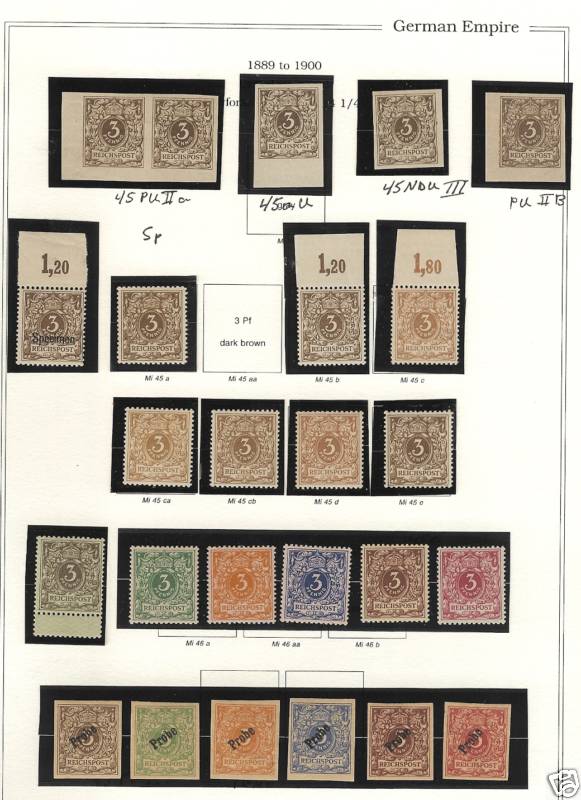
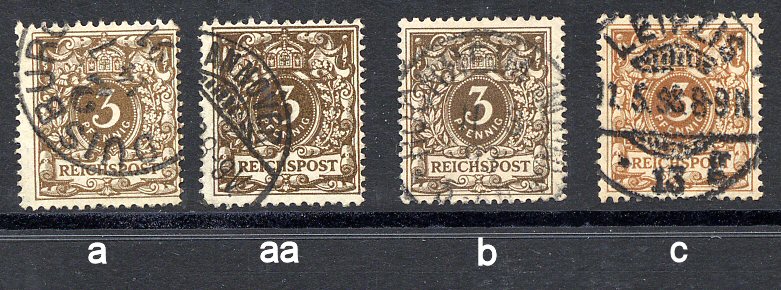
This is my translation of the listing of Michel Germany #45 3pf of 1889 including []s and ()s. On each line and color is listed followed by another color in [brackets]:
45a yellow brown [brown] (1889-1892)
45aa dark (yellow) brown [dark brown] (1889 / 1890)
45b medium brown [grey brown] (1891-1897)
45c light ocher brown [yellow brown] (1897-1900)
45d bright brown ocher [reddish ocher] (1897-1900)
45ca light ocher (1898-1900)
45cb bright orange brown [ocher brown] (1899-1900)
45e dark ocher brown [olive brown] (UV brownish black) (1899-1900)
My first question: What is significance of the [color] vs. the preceding color in the listing?
The UV color (see 45e above) is "as seen under a UV lamp". In the US we use two different types, long-wave (black light) and short-wave (for USA tagging). Using the long-wave, I have seen the prominent red orange glow on Michel Germany 96AIa (3m brownish violet) so I think that Michel refers to a long-wave UV lamp.
Compared to other examples of #45, the stamp in this scan looks obviously brownish black in long-wave light.
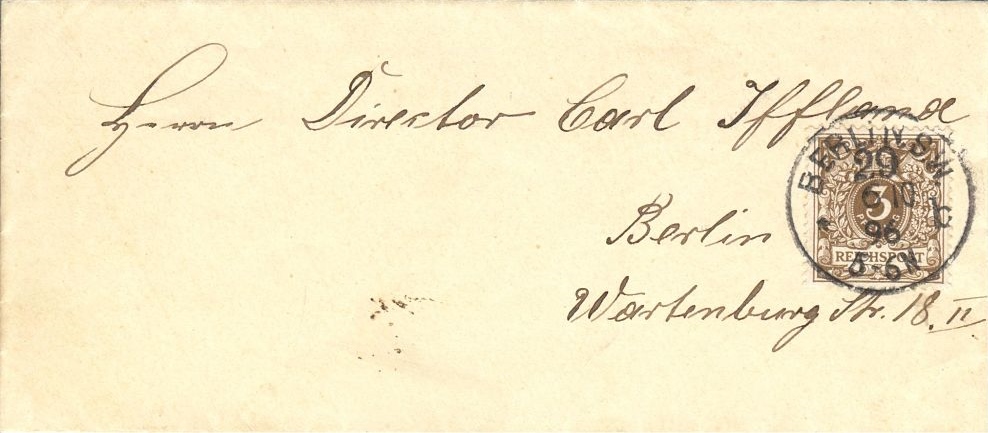
My second question: What do the dates in the Michel 45e listing (1899-1900) refer to?
I had assumed that Michel was listing the range of printing dates.
My cover, canceled 1896, cannot be Michel 45e if that variety was not printed before 1899.
However, Scott says that "on cover" values are for covers canceled within those same dates.
Why would varieties on cover be valued differently if the stamp was used later/earlier in the "normal" period that the basic stamp was current?





 Posted 05/16/2015 1:50 pm