Stamp Community Family of Web Sites
Thousands of stamps, consistently graded, competitively priced and hundreds of in-depth blog posts to read


Stamp Community Forum
 
Username:
Password:
Save Password
Forgot your Password?

This page may contain links that result in small commissions to keep this free site up and running.

Welcome Guest! Registering and/or logging in will remove the anchor (bottom) ads. It's Free!

Anyone Help To Identify My Stamps. Penny Red

 
To participate in the forum you must log in or register.
Author Previous TopicReplies: 5 / Views: 10,822Next Topic  
Valued Member
14 Posts
Posted 08/08/2015   10:02 am  Show Profile Bookmark this topic Add kirku to your friends list Get a Link to this Message
I searched a lot on the internet about "how to plating penny red stamp" but I didn t find nothing particular

Anyone can hellp my?


*** Moved by Staff to a more appropriate forum. ***
Send note to Staff

Pillar Of The Community
Learn More...
United States
663 Posts
Posted 08/08/2015   10:16 am  Show Profile Bookmark this reply Add oldguy to your friends list  Get a Link to this Reply
Plate numbers

On 1 April 1864, the stamp was issued with the plate number engraved in the design, in the left and right side lace work. At this time, the stars in the top corners were also replaced with the same check letters as used in the lower corners, but in reverse order.

Because of wear, over 400 different plates were used to print the Penny Red. Two different basic watermarks were used for the paper, small crown, (on the early issues) and large crown, introduced on 15 May 1855.

The era of the Penny Red came to its close at the end of 1879.
Send note to Staff  Go to Top of Page
Pillar Of The Community
United States
1125 Posts
Posted 08/08/2015   2:26 pm  Show Profile Bookmark this reply Add chipg to your friends list  Get a Link to this Reply
I posted this on another site, but it applies here: Intro to plating Penny Reds

Let's see if we can't get you started in figuring out what you have when you're looking at a penny red. Start with a basic question:

1- Does it have perforations?

If no, it's going to be SG catalog numbers 7-12 (most people who are going to go into the plating area will use the Gibbons catalog, rather than Scott). To narrow this down, you'll have to know a bit about how to plate the imperforate penny reds (no plate numbers are on any of the issued imperforates).

You can narrow the range of possible plates down in this way:
1a- Does it have a Maltese Cross cancellation?

- If yes, it's most likely from a plate from 1-40
- If no, it most likely from a plate from about 38-177
For the plates between 1 and 40, there are a few SG numbers - those stamps printed from the plates that printed penny blacks (1-11) are SG 7 (also referred to as (Specialized Catalog Number A2). *Note - the "Standard" Stanley Gibbons Catalog numbers are what you usually see. The "Specialized" Catalog numbers are used in the Gibbons Queen Victoria Specialized Catalog and provide a bit more granularity*

If it was from plates 12-40, it is one of SG 8-12 (but most likely SG8) (Specialized Catalog Number B1)

Now, moving on to the numeral-cancelled stamps (which your three are), we can look at the size and shape of the letters to put them into two batches - those printed with letters that were made with the first letter punch set - Alphabet 1 - and those made from the second letter punch set - Alphabet 2.
Alphabet 1 letters are found on plates 12-131 (still SG 8-12, but most likely SG8, and also referred to as Specialized number B1). Those printed with Alphabet 2 letters (plates 132-177) are also SG 8-12, but the Specialized numbering scheme differentiates the alphabets and calls these B2s. As a rule, the comparable letters from Alphabet 2 are larger than those from Alphabet 1 (the "G" is pretty close in both alphabets).

To further differentiate between SG8, 9, 10, and 11, you have to look at the colors. SG8 is red-brown; SG8a is on very blued paper; SG9 is pale red-brown; SG10 is deep red-brown; SG11 is lake-red (very rare); and SG12 is orange brown. Virtually everyone just calls the bulk of the stamps in this batch "SG8" unless there is a really good reason to think it's one of the others.

There are various ways to further narrow down individual stamps and match them to the plate that originally printed them. This has to do with looking at the position of the letters within the lower corner boxes, other marks that may have resulted from the plate making process (such as the blur on the top left of your first stamp), gaps in the lines around the stars at the top corners, remnants of guide lines, doubled letters, etc.

Plating is about 50% science and 50% art and is beyond the scope of this note. You'll have to invest in copies of the imprimatur sheets (available as compilations of scans on CDs - privately produced), as well as some of the standard plating references, such as Statham (for the Black plates) or Fisher/Brown (for the reds).

Now, moving on to the perforated reds:
There are many different varieties of these. I've chosen to just ignore the perforated reds in my collection (my choice). However, let me hit the high points:

2 - are there "stars" in the top corners, or letters?

If "stars," they'll fall in the range of catalog numbers SG 16-42 (Specialized numbers CE1-3 and C1-13). These are differentiated by the die used to print the profile (dies 1 and 2 were used for these issues), alphabet punch sets (1, 2, and a new set, 3, were used for these issues), perforation, paper, watermark, and color. Again, you'll have to refer to the Gibbons catalog, probably complemented by Wiggins books.

3 - If there are letters in all four corners, the stamps are SG 43-53 (Specialized category "G"). These are the stamps that have the plate numbers within the turnings at the sides of the Queen's head.

If you want a quick run down of the different stamps I'm talking about here (and relative values), you might want to check out the specialized price list put out by someone like Arthur Ryan. (http://www.gbstamps.co.uk ). If you select his "stamp price list" link, then choose "Queen Victoria stamps." There, you'll see a list of all of the stamps with the SG number, the Scott number, and a brief description of the stamp.

Hope that helps get you started.
Chip
http://victoria.cgpostal.com
Send note to Staff  Go to Top of Page
Edited by chipg - 08/08/2015 2:35 pm
Pillar Of The Community
Germany
1714 Posts
Posted 08/08/2015   2:36 pm  Show Profile Bookmark this reply Add scotzm to your friends list  Get a Link to this Reply
To plate your stamps is a very difficult task and probably cannot be done with internet knowledge alone. You would need the books and illustrations which would HELP identify them.
The Penny Reds which are imperforate will range from Plate 12 up to plate 131 so with 240 stamps done by EACH plate you need loads of illustrations to compare one of your stamps with a known plated example.
But... you can narrow it down somewhat..for instance your imperforate stamps are all Alphabet 1 and Die 1 which would be stamps printed up to 1852. Your Penny Red with the Maltese Cross cancel indicates a plate ranging from 12 up to 40. If you can get books on ebay covering those characteristics you can do a little bit of plating.
Your perforated Penny Red with letters in all corners will have the plate number on each side of Victoria.
I like the look of your stamps as they are nice and clean. The ones that are not 4 margin are worth considerably less than the 4 margin ones.
Send note to Staff  Go to Top of Page
Pillar Of The Community
United States
6756 Posts
Posted 08/08/2015   2:56 pm  Show Profile Bookmark this reply Add khj to your friends list  Get a Link to this Reply
Chip provides a great guideline overview. Scotzm makes a good point -- you will reach a point where you have to invest in some reference books to understand it.

Your bottom right stamp in the OP should have the plate number in the side scrollwork.

Meanwhile, you might find this site useful: http://www.pennyreds.co.uk/Tips-for-platers
Send note to Staff  Go to Top of Page
Valued Member
146 Posts
Posted 09/25/2017   12:22 pm  Show Profile Bookmark this reply Add agb to your friends list  Get a Link to this Reply
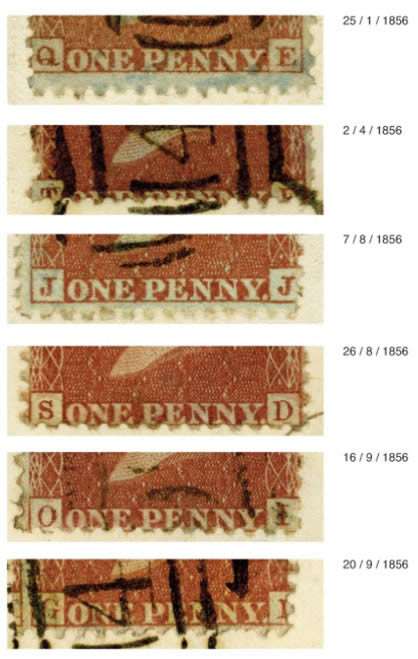
I read this forum with great interest, so decided to check a few of my perforated penny reds which I had put aside sometime ago meaning to look at them later but somehow didn't get round to doing so... Guess this is common amongst collectors

I have managed to sort them out into large crown watermark and Die 2 head all on blued paper

I realise that I will need to invest in some good reference books on the subject in future. But first, I would appreciate any kind reader who has the required books by Tonna, just to check the lettering for me? Its a lot to ask, but I am hopeful

The stamps all have Liverpool spoon cancels for 1856


Send note to Staff  Go to Top of Page
Edited by agb - 09/25/2017 6:07 pm
  Previous TopicReplies: 5 / Views: 10,822Next Topic  
 
To participate in the forum you must log in or register.

Go to Top of Page

Disclaimer: While a tremendous amount of effort goes into ensuring the accuracy of the information contained in this site, Stamp Community assumes no liability for errors. Copyright 2005 - 2026 Stamp Community Family - All rights reserved worldwide. Use of any images or content on this website without prior written permission of Stamp Community or the original lender is strictly prohibited.
Privacy Policy / Terms of Use    Advertise Here
Stamp Community Forum © 2007 - 2026 Stamp Community Forums
It took 0.52 seconds to lick this stamp. Powered By: Snitz Forums 2000 Version 3.4.05