I received my winnings yesterday from Siegel's auction of The Curtis Collection (Part 2).
Siegel, while a high-profile auction house, isn't the best in the world when it comes to U.S. revenues and the writeups that items receive. Their choices as to which lots get highlighted versus those that get short shrift is frequently puzzling. Additionally, they don't always perform due diligence in their fact checking. It's one thing for an
ebay seller to get it wrong, but for one of the nation's foremost auction houses to phone it in is inexcusable.
That said, if their laziness contributed to my not having to stretch farther for these pieces, I'm not complaining.
Bart (revcollector) and I discussed quite a few of the lots prior to the auction, and I appreciate his expertise and input, especially as he has an opportunity to view many of the lots in hand, since he is located in New York.
The first document is the one lot I really wanted (that I could afford anyway; there were plenty of high-priced balance lots that I would have loved to own but were well beyond my means). It presented a bit of a difficulty though, as it was the second-to-last lot in the entire auction, which meant that impulse buys would be severely curtailed.
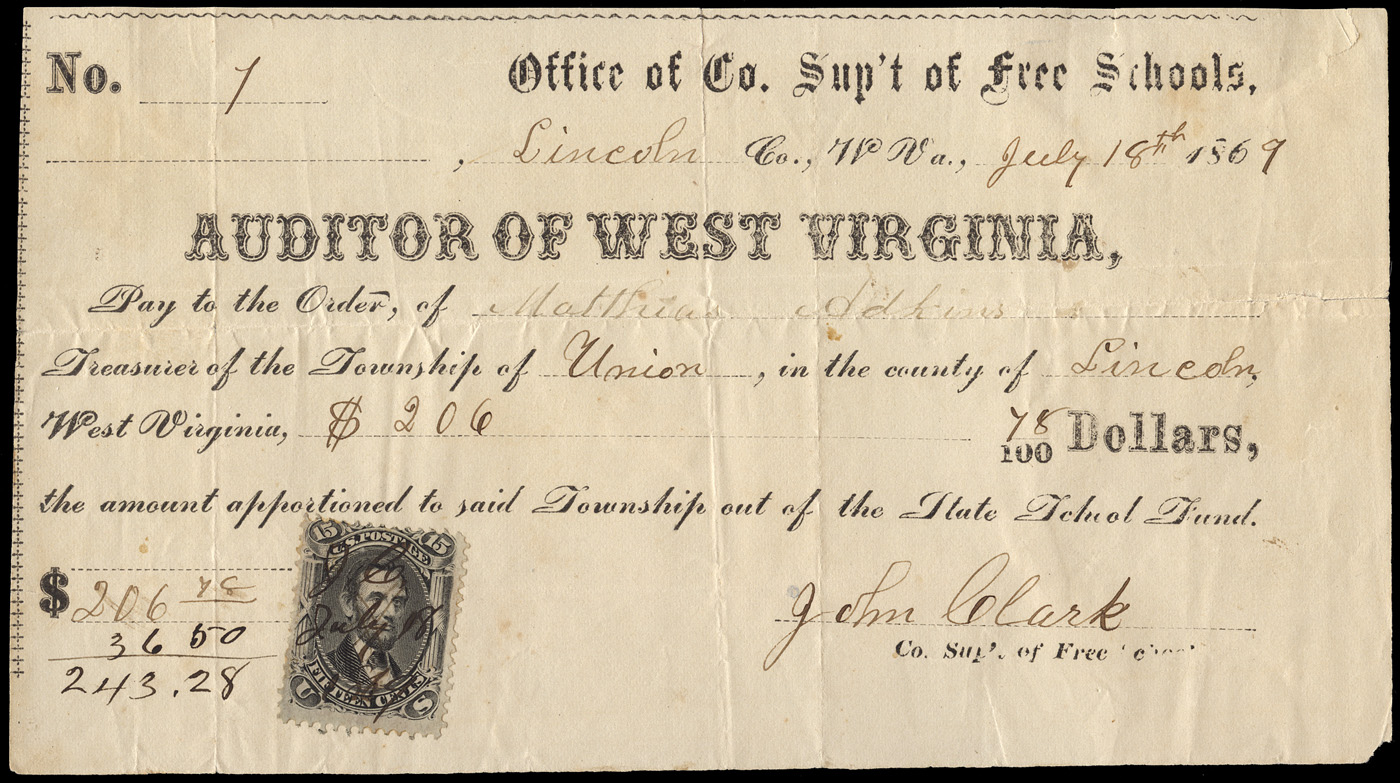
It is an improper/illegal use of Scott #77, 15-cent Abraham Lincoln, as a revenue stamp, on a demand for payment, taxed as an inland exchange and paying the correct rate. Siegel wrote it up as an "overpaid revenue use" presumably because they think every small document is a check, which (1) is inaccurate, and more importantly (2) the implication of an incorrect usage can cast doubt as to the authenticity of the document. Were any bidders put off from bidding because of the writeup?
Regardless, it is a very scarce usage of the stamp and I'm glad the bidding didn't go crazy. The document was apparently sold by Siegel once before, in 1993. They got the document wrong back then too, but they added some commentary that they didn't include this time around:
On July 18, 1869 Auditor of West Virginia check apportioning funds for the schools of the township Union in the county Lincoln, ms. cancel, a very rare usage of the 15c Lincoln stamp, which must be more than a coincidence.Whether the use of a Lincoln stamp on a document in Lincoln County was intentional or merely coincidence, we'll never know.
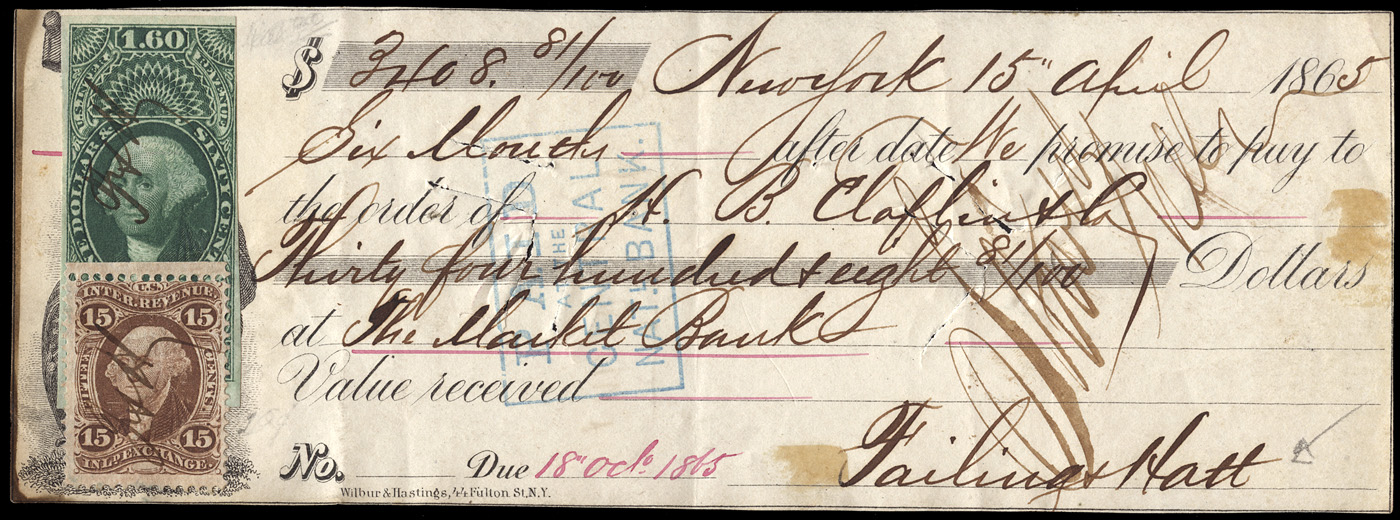
The second document wasn't one I intended to bid on, as both Bart and I felt the estimate was absurdly low, and I assumed that the lot would sell for a much higher price. It too, was misdescribed by Siegel. For one thing, the writeup was minimal... only a single sentence. Once again Siegel called it a bank check. About the only superlative they used was the word "unusual".
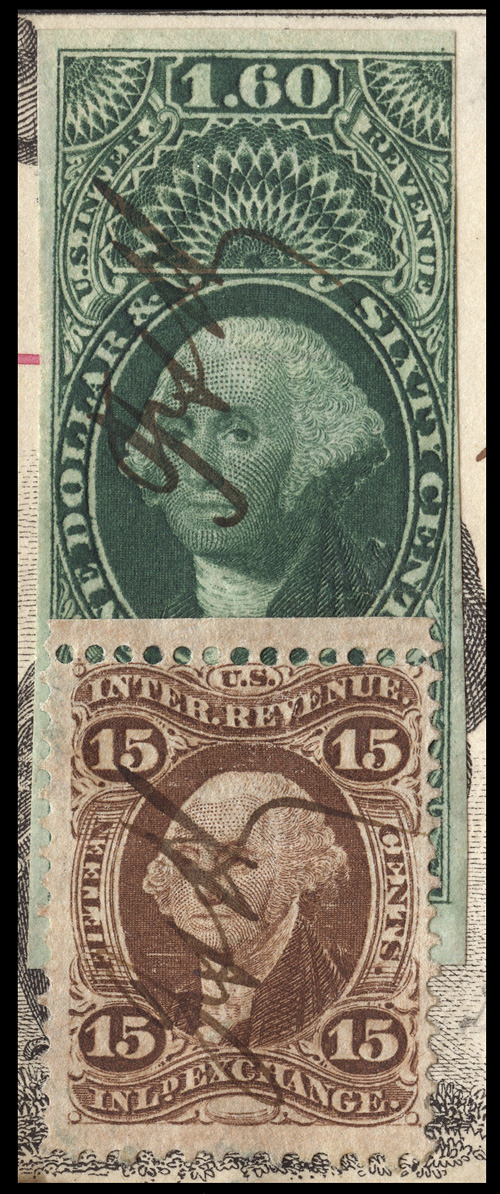
Unusual? How about damned scarce if not outright rare! R79a, the imperforate $1.60 is never found on document. After the auction, I asked both Richard Friedberg and Eric Jackson how many R79a on documents they have had pass through their combined 80ish years of inventory. The answer? Zero. I can find records of only three other reported examples: one in the 2008 Spink auction of the Cunliffe Collection, which brought $1,800 + BP, and two documents named but not pictured, in Mike Mahler's book "A Catalog of United States Revenue-Stamped Documents of the Civil War Era" (a must-have book for anyone interested in U.S. revenue documents).
The stamp by itself off document currently catalogs $1,500, up from $1,400 in the 2015 catalog. I assumed the bidding would easily be in the 4 figures. When I saw the lot about to close at $275, I just couldn't let it go for that, bid once, and won the lot.
In my opinion, if Siegel had given the document a proper writeup and a realistic estimate range, I feel it would have gone much higher.
Richard viewed the auction lots in person, so I asked him why he didn't bid on the document. His answer was that he hadn't looked at the document as he was focused on the large balance lots.
The stamp is just in along the frame line at top right, but the other 3.5 margins are exellent. It is a bottom sheet margin example that gets progessively wider towards the bottom of the stamp. It is unquestionably genuine.
Another Lincoln connection, which Bart pointed out to me as I completely missed it: the documented is dated April 15, 1865, the day Lincoln was assassinated.





 Posted 10/17/2015 2:15 pm





