| Author |
 Replies: 15 / Views: 2,223 Replies: 15 / Views: 2,223 |
|
|
Moderator

United States
5106 Posts |
|
|
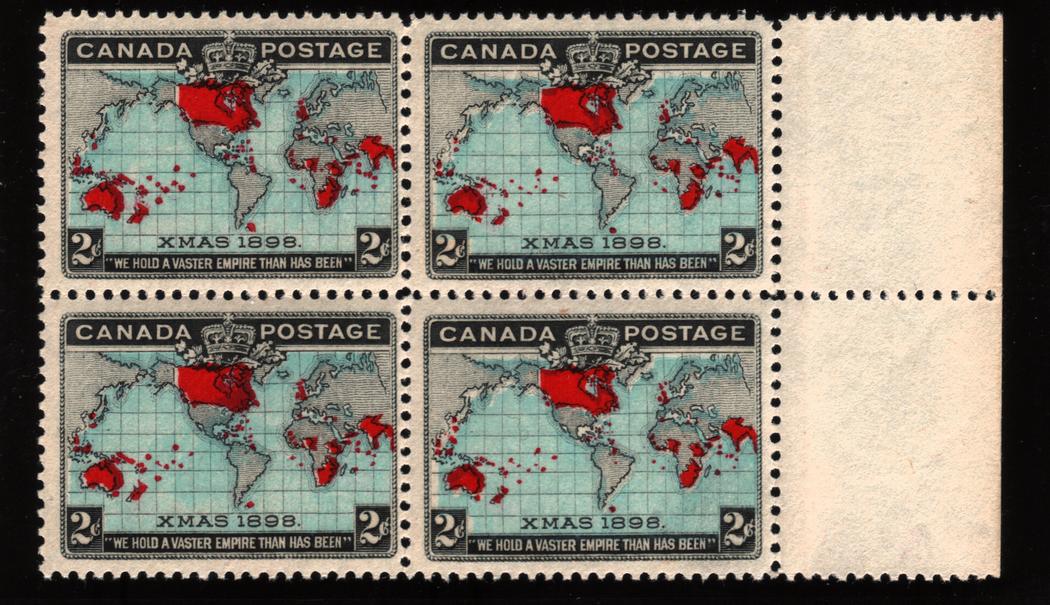
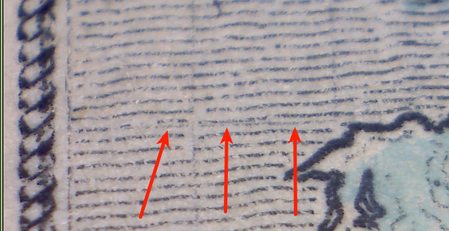
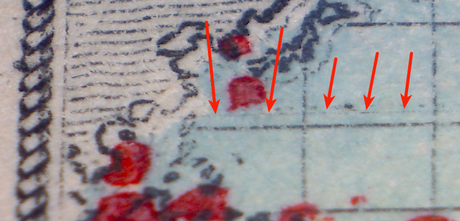
I know that this topic was discussed earlier https://goscf.com/t/18718#18718but I finally picked up a nice, clean copy and can look at it a little closer. I'm surprised that Wert hasn't posted more examples. In my new Canada 85, I saw this horizontal line: 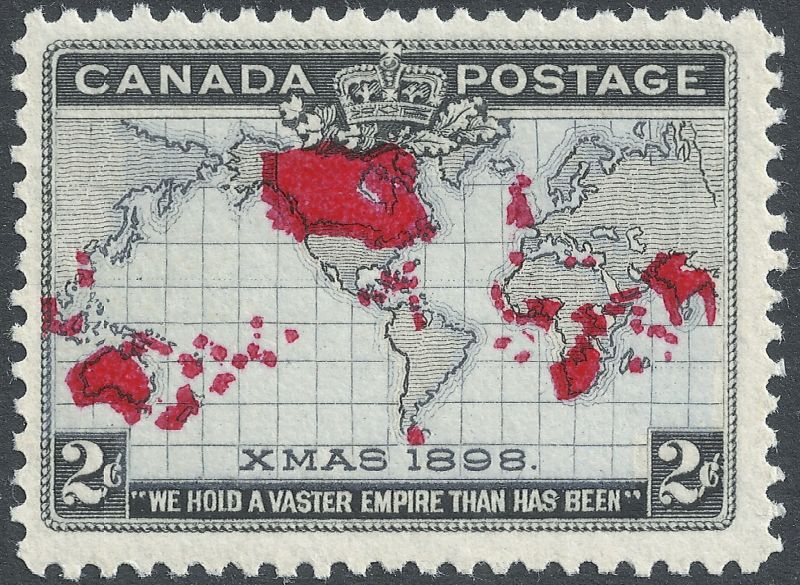 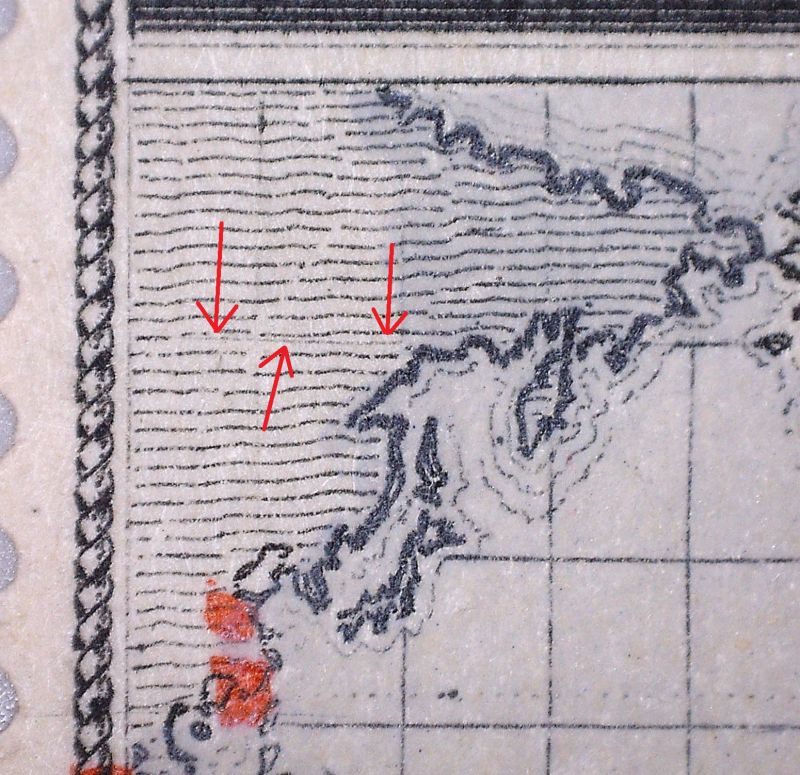 Upon closer examination,this seems to be consistent for all of my other copies but then I noticed a line further down: 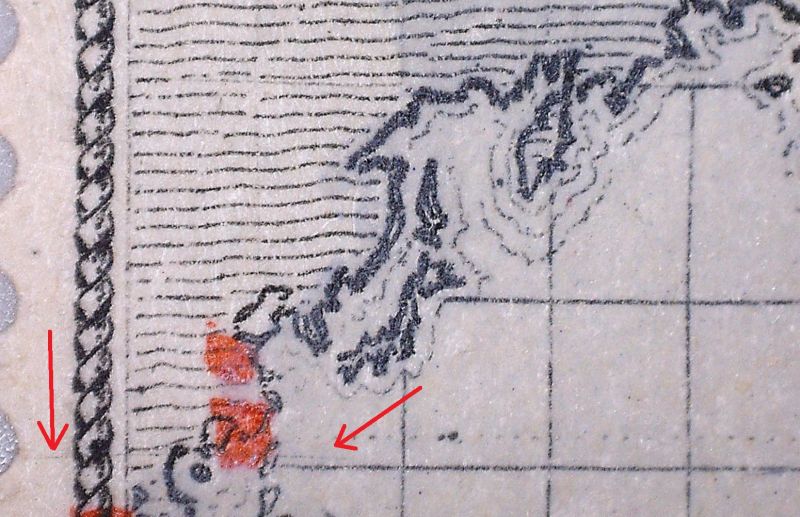 My copy of Canada 86 shows the same consistent line I noted above, plus a DIFFERENT curved line further down: 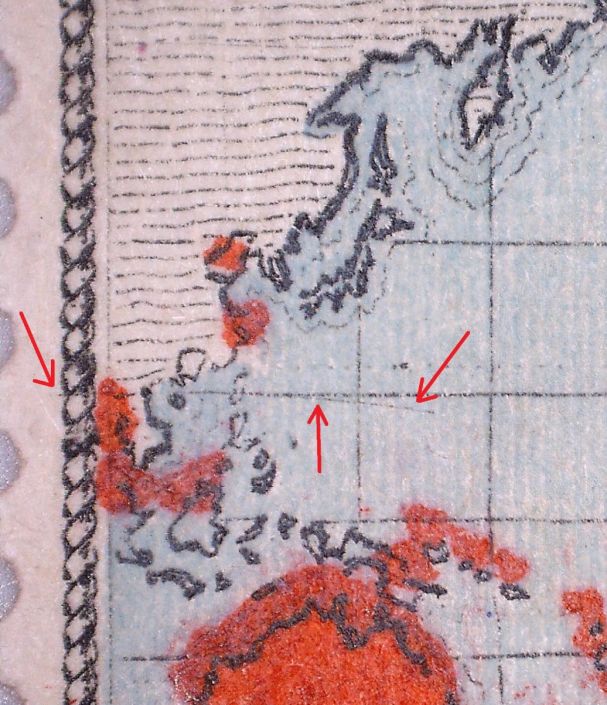 Maybe plate scratches, guide lines, ??? I may have to purchase some of the books referred to in the linked post. |
|
Send note to Staff
|
| Edited by Partime - 03/22/2016 10:10 am |
|
|
|
|
Pillar Of The Community
Canada
6525 Posts |
|
|
I have a booklet called 'The Canadian Map Stamp of 1898' A detailed study by Frederick Tomlinson and printed by the Canadian Philatelic Society of Great Britain 1960 reprinted 1972.
A quick look in the book does mention that 'The Tropics of Cancer and Capricorn are also shown, as dotted lines, mainly across oceans, and never very clearly anywhere....On some stamps a guide line in the centre of the stamp does follow fairly closely to the marking of the northern tropic (Cancer)'
So, I'd suggest the straight line you've pointed to just below the dotted line is a guide line, which seems to extend out beyond the rope border.
I think the lines you point to in the first closeup, running through China (and there are some faint vertical lines above those, in Russia) appear to be extensions of the lines of longitude and latitude. Perhaps these were lines that were faintly engraved during the initial drawing process. I'll have a look through the book and see if it says anything about that.
edit - regarding the lines in China and Russia, it is pointed out in the paragraph just above the one I quoted above (so didn't have to look too far!) that 'Whilst these (latitude and longitude lines) are only strikingly apparent across the oceans, they nevertheless exist elsewhere, particularly in China. They should not be confused with guide lines.'
So there you have it.
The only mystery you have is the curved line in your bottom image. That one does seem to be an anomaly. |
Send note to Staff 
|
| Edited by jamesw - 03/22/2016 10:36 pm |
|
|
Pillar Of The Community
Canada
6525 Posts |
|
|
Partime, I just had a quick look at my map stamps (I have 5, three used and two mint, of various colours). I notice that my unused lavender (#85) has a curved line similar to yours, though mine is much fainter. Now I'm really curious! |
|
Send note to Staff
|
| Edited by jamesw - 03/22/2016 10:49 pm |
|
|
Moderator
United States
5106 Posts |
|
|
Jamesw. Thanks for looking. All of my other copies are used, and very hard to see these lines. Maybe someone else could look also? |
|
Send note to Staff
|
|
|
Rest in Peace
7742 Posts |
|
|
Patrtime...wow...nice eye on you..I got about 20 of them and a nice mint block to now look through...Thanks Partime, thought I would have a day off...haha..BUT...haha.
Robert |
|
Send note to Staff
|
|
|
Valued Member
Canada
228 Posts |
|
|
Hi Partime,
The marks you are seeing are indeed guidelines or actually guide arcs. Notice that these are actually downward bending arc lines and that they pass through a guide dot near the shore of Vietnam. Both the dots and the arcs are constant guide marks known at various plate positions. They tend to be appear slightly differently in this area of the design and are both known to be doubled at some positions.
Thanks to fellow forum member "watermark" for confirming my suspicions about these marks via email. |
|
Send note to Staff
|
|
|
|
Rest in Peace
7742 Posts |
|
|
Pillar Of The Community
United States
8956 Posts |
|
|
Wow! I have never heard of a guide arc. Does anyone know why it is an arc rather than a line?
And Robert, the last picture you showed has a very clear Tropic of Cancer showing! Great stamps,
Peter |
|
Send note to Staff
|
|
|
Moderator
United States
5106 Posts |
|
|
Thanks to Scottamer and others for assisting with the identification of these "guide arcs". I also share Peter's question on why a guide arc rather than a guide line. Thinking further, though, I remember the old days when I had to draw parallel lines using a compass. Where the arcs met was a point on my line. Maybe the arcs are more accurate and repeatable than lines? Anyway, great responses and pictures.
Do we think we would see the guide arcs on other Canadian issues? |
|
Send note to Staff
|
| Edited by Partime - 03/23/2016 4:38 pm |
|
|
Valued Member
Canada
228 Posts |
|
|
My understanding is that the arcs are compass marks used in the alignment and centering of various lines on the plate. They arc not very common on Canadian stamps. If memory serves, I believe that they are known on the Small Queens, the Registration stamps, and some Admirals. Some of them are much more visible than those on the Map stamps.
I will try to get a good example up on FlySpecker.com for all to see.
|
|
Send note to Staff
|
|
|
|
Valued Member
Canada
228 Posts |
|
|
For those who are interested in these arc-shaped guide lines that are occasionally found on Canadian stamps, I have added a nice example on a registration stamp to my FlySpecker website. It is the last 5-cent green registration example near the bottom of the page at this link: http://flyspecker.com/registration.html |
|
Send note to Staff
|
|
| Edited by Scottamer - 03/24/2016 1:06 pm |
|
|
Moderator
United States
5106 Posts |
|
|
Scottamer. Excellent updates to your website. Please keep up the good work! |
|
Send note to Staff
|
|
|
Valued Member
Canada
124 Posts |
|
|
I am curious to know: Is a stamp with such a guide line (either arc or strait) would see its value changes? If so, going up or going down? I am guessing that since the guide lines are not present on all stamps, so they must have a grater rarity factor... All that is left to know is if collectors look for the guide lines or if most consider them as being not desirable. |
|
Send note to Staff
|
|
|
Pillar Of The Community
United States
8956 Posts |
|
|
Thank you Scottamer for the explanation and the great picture. That is indeed very interesting, and I do not believe we have any guide arcs on United States stamps. At least I have never seen any!
And Pepere_jack, I am not sure if anyone can answer your question. Personally, I specialize in the US Transportation series, and stamps printed on the old Cottrell presses seem to show more guide dots and lines. To me they add value, but if someone is willing to pay more ? I could not tell.
Peter |
|
Send note to Staff
|
|
|
Valued Member
Canada
22 Posts |
|
|
I have 3 different colours for this stamp. What I would say is actually a light, a medium and a dark blue ocean. I can see the straight lines on the light and the medium easily. The dark is used and difficult to tell. But the arc is visible, to me, only on the light version.
You guys are making me stay up late again. |
|
Send note to Staff
|
|
|
Rest in Peace
Netherlands
963 Posts |
|
|
What I have read so far is NOT an explantion!
Simply calling it "guide lines" or "guide arcs" does NOT explain a thing.
In order to prepare a whole plate from a single stamp image you may need a guide dot but these are usually NOT inside the stamp image but at the corners or edges.
So, the question remains! What are these lines? |
|
Send note to Staff
|
| Edited by Galeoptix - 03/01/2019 03:16 am |
|
| |
Replies: 15 / Views: 2,223 |
|




 Posted 03/21/2016 11:04 pm