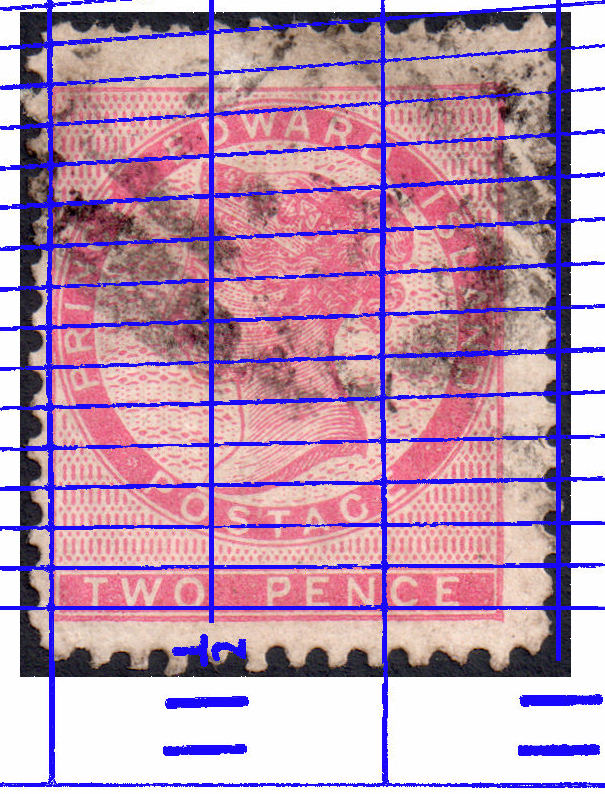
I have investigated the term "compound perforation" further.
Scott Catalogue defines compound perforations as follows, under the heading of Basic Stamp Information:
If the gauge of the perforations on the top and bottom of a stamp differs from that on the sides, the result is what is known as compound perforations. In measuring compound perforations, the gauge at top and bottom is always given first, then the sides. Thus, a stamp that measures 11 at top and bottom and 10 1/2 at the sides is "perf. 11 x 10 1/2." See U.S. Scott 632-642 for examples of compound perforations. Stamps also are known with perforations different on three or all four sides. Descriptions of such items are clockwise, beginning with the top of the stamp.
What this means is that any stamp that has a differing perforation on the top and bottom is a compound perforation. It could be one, two or three sides. Scott does not say what the differences between a comma and a dash between perforations (as mentioned by Northern above). However, I saw on another website that the comma separates compound perforations while the dash indicates that the perforation wheel varies between 11-1/2 and 12 (example) due to poor spacing of the pins.
http://www.apexstamps.com/app/newsletter-40I interpret all of this with the following examples:
11 (11 on all sides)
11 x 12 (11 on top and bottom, 12 on sides)
11 x 11 1/2-12 (11 on top and bottom, varies between 11 1/2 to 12 on sides)
If I interpret the Scott description for compound, I assume the following:
11 x 11, 12 (11 on top and bottom, 11 on the right side, 12 on the left.
However I can find no actual compound listing of three or four differing sides of perforations in Scott, beyond the note similar to the PEI description "
Perf 11, 11 1/2-12 and compound". There are similar descriptions for other countries. Scott does not appear to assign numbers or values to stamps with differing perforations on three or four sides.





 Posted 06/03/2016 12:27 pm