| Author |
 Replies: 32 / Views: 4,740 Replies: 32 / Views: 4,740 |
|
Rest in Peace
7742 Posts |
|
|
Hi guys...As most of you know I am concerned with the policy of rounding off perforation..I took a sample stamp (Scott 13 Nova Scotia) with decent perforations for my little experiment. 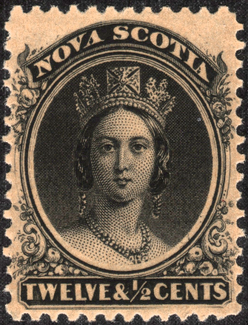 I took the electronic gauge first to measure the stamp I choose...It says to scan the stamp at exactly 600 DPI....I use GIMP, which is equivalent to Photoshop in Windows...Below are the results for TOP, BOTTOM, LEFT SIDE and RIGHT SIDE. 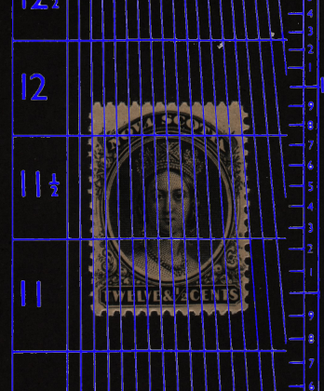 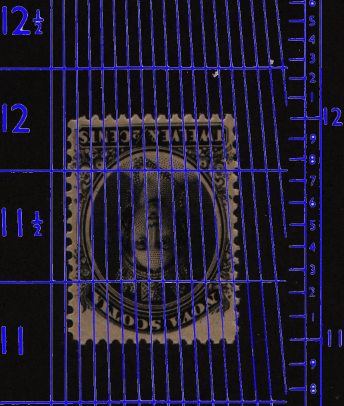 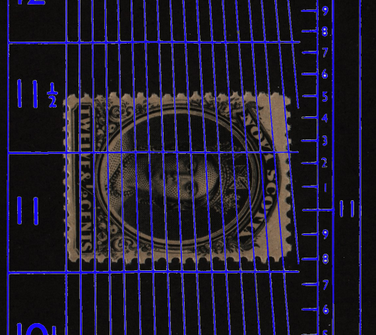 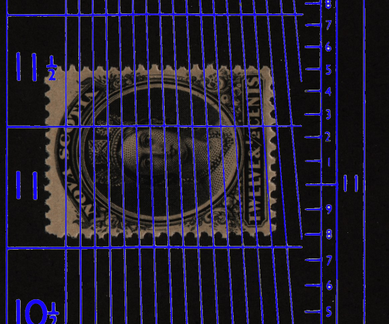 Now I took the same stamp and used manual gauge..Checked it 3 separate times for accuracy..Below is a simple chart showing the differences. 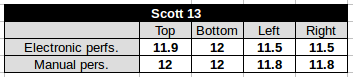 I attribute the electronic difference caused by accuracy of any scanner at 600 DPI..If my (or your) scanner is out by even 1% to 5%, this could make a false reading...The Unitrade gauge I used will be with experience more reliably. Now here is my beef..You may or may not agree with my concerns..I have always been an advocate of perforation accuracy, after all it is apart of a stamp as important as paper, colour, etc...How would you feel if ALL catalogues, stamp web sites rounded off perforations..?? Take this for instance..We have an orange stamps and a red orange stamp, and everyone says, well, ok lets just round it off to orange..That would be non acceptable in my eyes..So why should we accept rounding off of perforations. Below is Scott rounding off this beautiful Scott 13. 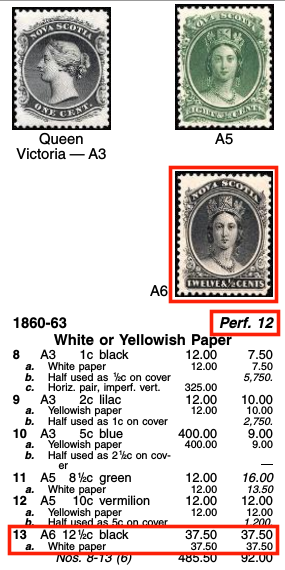 Further more Unitrade and Scott shows some Newfoundland stamps as 12.0 X 12.0...The NSSC (Newfoundland Specialized Stamp Catalogue) shows up to 3, 4, and some times 6 or 7 different perforations for the same stamp. To me..Perforations are important. Robert |
|
Send note to Staff
|
|
|
|
|
Pillar Of The Community
United States
692 Posts |
|
|
True, perforations are important. But take into consideration that, when dealing with used stamnps, soaking may cause a slight difference in reading the actual perforation because of shrinkage or expansion of the paper. |
Send note to Staff 
|
|
|
Pillar Of The Community
United States
845 Posts |
|
|
First, you have to round off to some precision, whether its 0, 1 or 2 decimal points.
Second, why should all catalogs be the same? Specialized catalogs require more work and should cost more. For those that don't care to pay more or don't collect varieties, a standard catalog would be sufficient. The consequence of not consulting a specialized catalog is you have limited knowledge and can't accurately judge value, but its a choice. |
|
Send note to Staff
|
|
|
Rest in Peace
7742 Posts |
|
|
. Quote:
For those that don't care to pay more or don't collect varieties, Yet..people will collect colour varieties..Correct..? Robert |
|
Send note to Staff
|
|
|
Pillar Of The Community
United States
845 Posts |
|
|
Yeah, I'm with you. I try to collect both perf and color varieties. Major color differences are easy to discern but some subtle differences even the expertisers won't recognize. |
|
Send note to Staff
|
|
|
Rest in Peace
7742 Posts |
|
|
Quote:
Yeah, I'm with you. I try to collect both perf and color varieties Good for you HungaryForStamps...At least some one out there understands the importants of accurate perforation measurements..Keep up the good work my friend. Robert |
|
Send note to Staff
|
|
|
Pillar Of The Community
3865 Posts |
|
|
When it comes to gauging line perforations for Canada both Scott and Unitrade use 1/2's but for comb and other perforations after 1968 they use 1/10's. They should at least go into 1/4's for line perforations. Why? For BABN stamps issued from 1930 to 1934, the sheet and booklet stamps printed by rotary press gauge 11 1/4 x 11 (not 11 x 11) while the sheet and booklet stamps printed by flat plate gauge 11 x 11 and the rotary press coils gauge 8 3/4 (not 8 1/2). On the other hand, Unitrade has a Kiusalas perforation gauge chart for the Small Queens on page 55 which measures in 1/1000" between perforations which is very specialized. |
|
Send note to Staff
|
| Edited by jogil - 08/11/2016 7:15 pm |
|
|
Pillar Of The Community
United States
8956 Posts |
|
|
Robert, very interesting. I too am a specialist, and I look for differences in perforation,
I was very lucky I guess, in the Netherlands the NVPH Speciale Catalog lists all of the known perforations of the stamps of the Netherlands and Overseas.
However, keep in mind that the Scott is, despite its title not a specialized catalog. And it probably can not be without making it at least twice as expensive as it is now.
I think you are aware that I collect Transportation Coils. All of these are perforated 9.8 vertically, so that is fairly straightforward. But even that is approximated in for instance Stamp Smarter. And that is OK with me. If I want a specialized catalog for my stamps I will either go elsewhere or write one myself.
Above I saw where you mentioned a Newfoundland specialized catalog that lists all the perforation varieties. Great, let us use this catalog instead of Scott!
Robert, make a study of all the perforation varieties of Newfoundland and publish it!
Peter |
|
Send note to Staff
|
|
|
Rest in Peace
7742 Posts |
|
|
Quote:
make a study of all the perforation varieties of Newfoundland and publish it! Well Peter, I could make an Excel chart with Scott VS Unitrade V NSSC perforations and of course maybe others I come across. Robert I am trying desperately to bring to the attention of others that perforation differences are just as important as colour differences. |
|
Send note to Staff
|
| Edited by wert - 08/11/2016 7:18 pm |
|
|
Moderator

United States
12330 Posts |
|
|
Why stop at 600 dpi? Why not go to 3000dpi? How do decimal points relate to pixels? I mean, at 300 dpi what decimal point level can be determined accurately?
Extending that thought, if technology moves ahead again in 5 years will it then mean we will recognize even more varieties because we are now measuring 6 or 10 decimal points?
Don
APS #094826 |
|
Send note to Staff
|
|
|
Rest in Peace
7742 Posts |
|
|
Quote:
if technology moves ahead again in 5 years will it then mean we will recognize even more varieties because we are now measuring 6 or 10 decimal points? Don, are you referring to electronic gauge perforation measuring...? I just don't trust the fluctuation in monitor colour from computer to computer and now I am not sure how accurate electronic gauge perforation measuring really is...I think that EVERY scanner is NOT bang on with other scanners..I don't know, I really don't trust them. Any thoughts..? Robert |
|
Send note to Staff
|
|
|
Pillar Of The Community
3865 Posts |
|
|
Scanners can have distortions of size measurements. |
|
Send note to Staff
|
| Edited by jogil - 08/11/2016 8:30 pm |
|
|
Moderator
United States
12330 Posts |
|
|
Scanners are most accurate right in the middle of the platen. Due to the way they are designed, they get some distortion when you have the item toward the edges of the glass.
Don |
|
Send note to Staff
|
|
|
Rest in Peace
7742 Posts |
|
|
Quote:
Scanners are most accurate right in the middle of the platen. True Don..That is why I am in favour of a manual perforation gauge and bringing forward all perforation varieties. Robert |
|
Send note to Staff
|
|
|
Pillar Of The Community
3865 Posts |
|
|
Pillar Of The Community
2013 Posts |
|
|
Quote:
Unitrade has a Kiusalas perforation gauge chart for the Small Queens on page 55 which measures in 1/1000" between perforations which is very specialized. 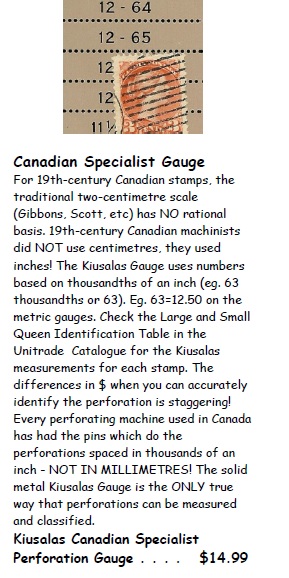 |
|
Send note to Staff
|
|
|
Replies: 32 / Views: 4,740 |
|




 Posted 08/11/2016 1:57 pm


