Victorian Typography.
French Master Engraver.
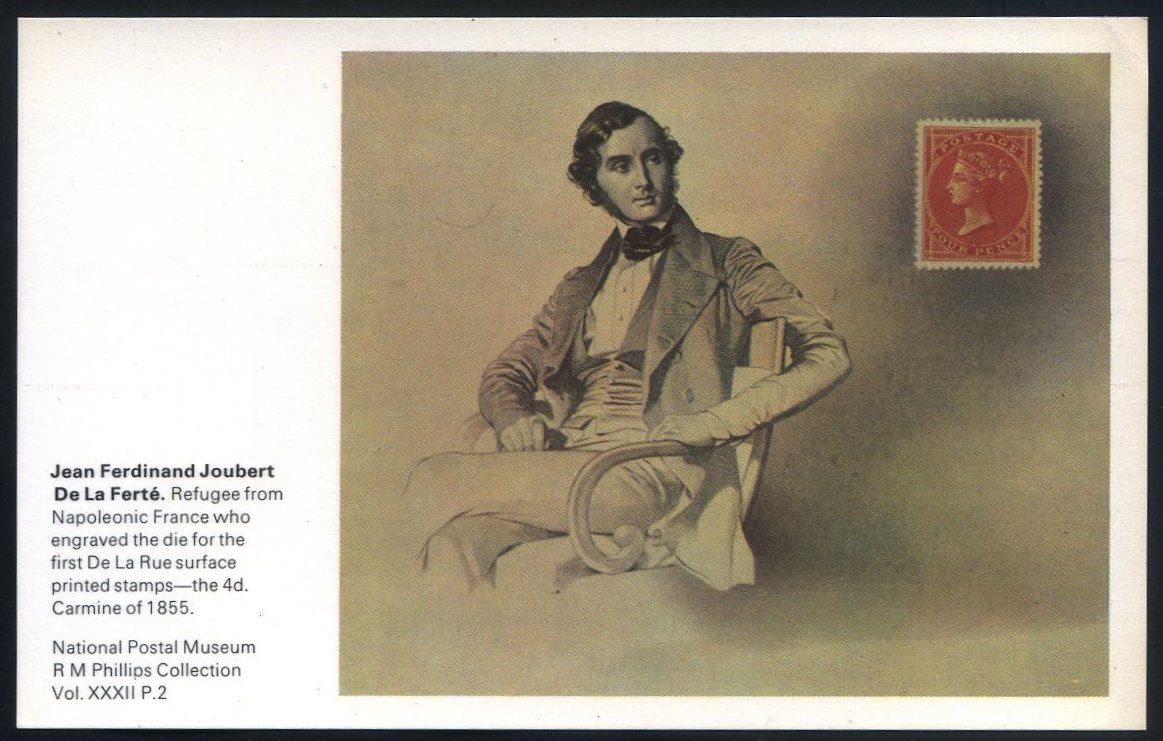
Jean Ferdinand Joubert de la Ferte.
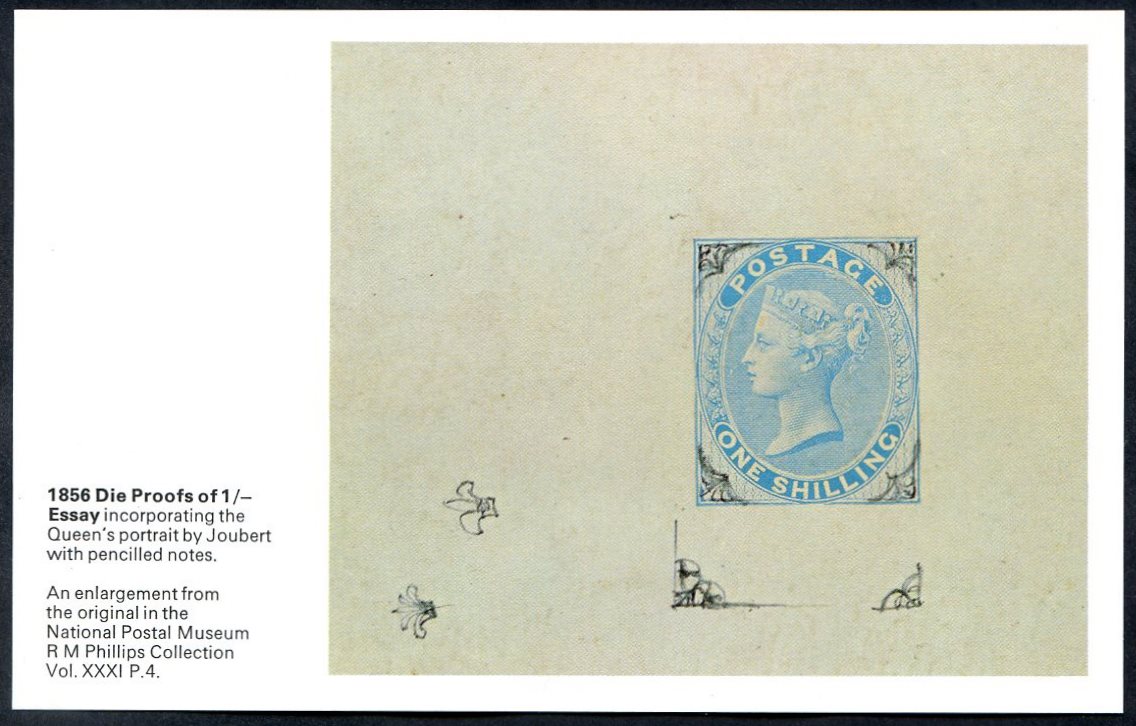
Source : British Postage Stamp Design John Easton 1943
(see also stampprinters.info by Glenn H Morgan FRPSL ..."Fourpenny Carmine Stamp")
There is evidence that Joubert's connection with de la Rue may have ended in 1866. To what extent he worked on the framework of the stamps designed in these eleven years can only be conjecture. It is hard to believe that he cut the dies for the heads and then walked away with his hands in his pockets; it is tempting to guess that he designed completely all the good ones, and left the failures to de la Rue's staff. Probably the real truth lies half-way, and he had his off-days like everybody else who depends upon craftsmanship for a living.
In 1866 a frame of designs was exhibited in his name in Paris: it contained the Great Britain Four Pence of 1855, the India Half Anna of 1855, and a Hong Kong 1862, of which the head was printed and the frame hand-drawn.
It also contained the Jamaica Penny of 1860. If this is proof that the whole of the design of the first three of these stamps was his work we may be satisfied, for they are the best that de la Rue produced during the reign.
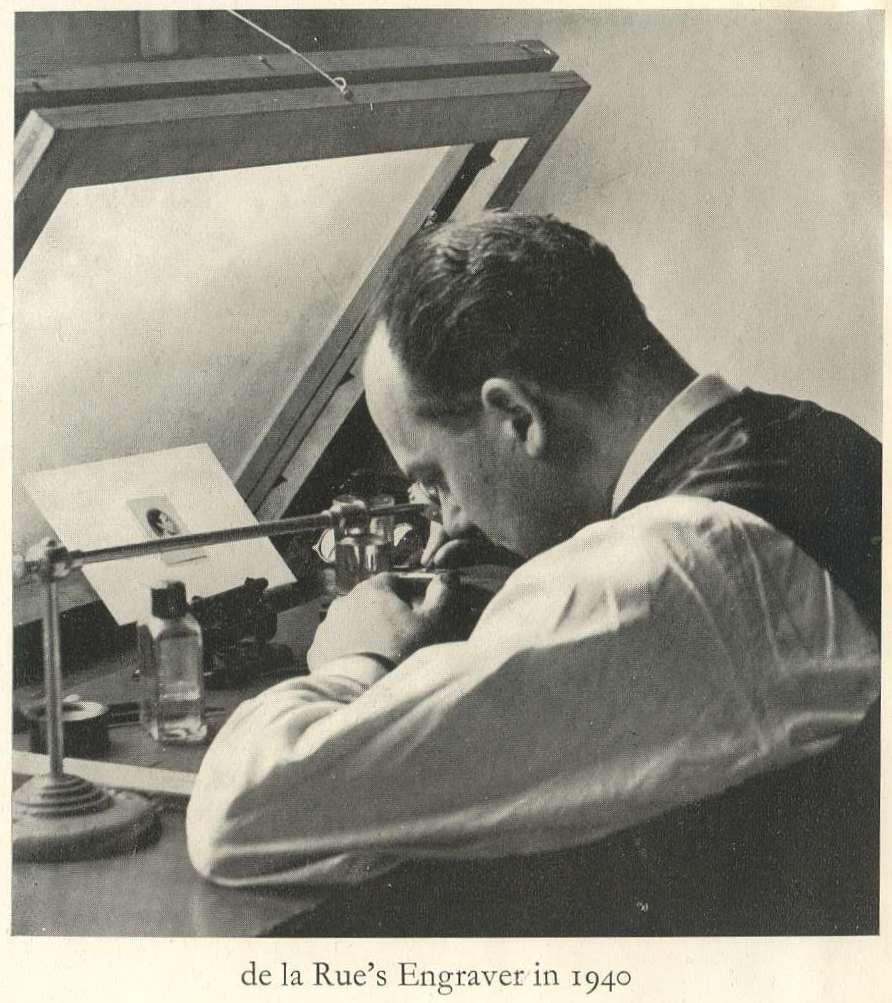
Joubert was a superb craftsman, a rare case of a designer and engraver who had a strong instinct for the practical side of producing his work. We have seen, in the development of these diadems, how closely he had the printer in his mind. When the demand for stamps in ever-increasing
quantities became so insistent, and the problem of the wearing of the plates became threatening, he played a large part in the invention of the process of facing the plates with steel, so thinly applied that it did not thicken the impression, and could be floated off and renewed at the slightest sign of wear before the copper-plate had been damaged.
Such deep personal interest in the welfare of his work makes it even more difficult to believe that he did not supervise, if not actually engrave, the designs of most of the stamps which carried his exquisite heads.
~~~~
Author Glenn H Morgan FRPSL (see above)
Note:Edited by Glenn H Morgan FRPSL from an original article by A G Rigo de Righi. First published in the Philatelic Bulletin in February 1973, it is reproduced here to commemorate the centenary of this groundbreaking postage stamp
The 1855 Fourpenny Die Joubert's next commission was his most famous, the head for the GB Fourpenny carmine of 1855, the world's first surface printed postage stamp. On the evidence of the original invoices (in the De La Rue Private Day Books), the printers were not this time responsible for the engraving, and it was Joubert who was appointed and subsequently
remunerated by the Board of Inland Revenue. It is perhaps also significant that Joubert's original 1855 master die was preserved in official archives and is held in the collection of the British Postal Museum and Archives (BPMA). It would appear to be the only surface-printed die of the mid-Victorian period to have survived
Published "Philatelic Bulletin", August 2005





 Posted 05/28/2019 03:06 am