| Author |
 Replies: 11 / Views: 2,033 Replies: 11 / Views: 2,033 |
|
|
Pillar Of The Community
United States
5894 Posts |
|
|
First off I have to say what first drew me to this cover was just the pure irony. I suspect it was just pure happenstance that this Adelaide machine cancel warns people of the correct rate for sanding 1 oz mail to the US. That aside, my burning question is, what country gave this cover the 16 and 2/3 Cts taxe marking? Anyone know? Thanks for looking. 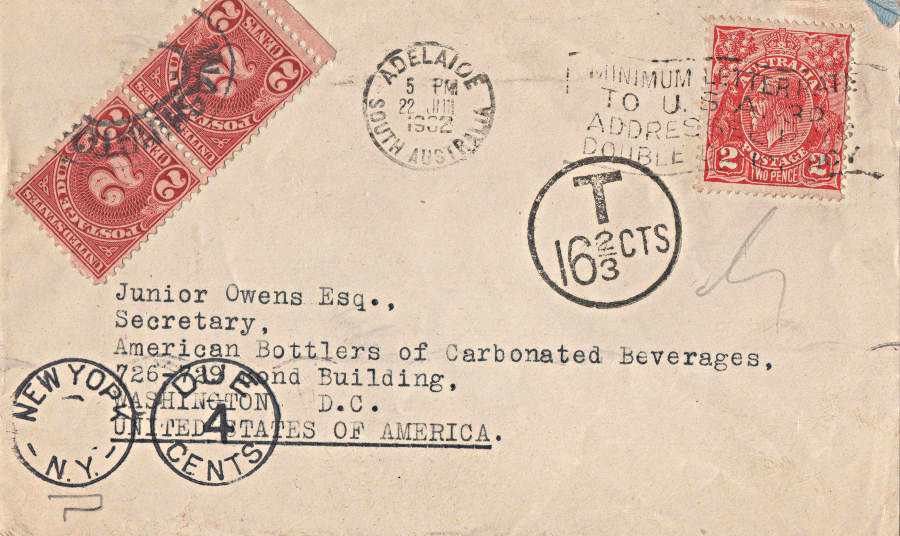 Apparently not satisfied with the warning in the cancellation, this was placed on the back cover as an attempt at social engineering. 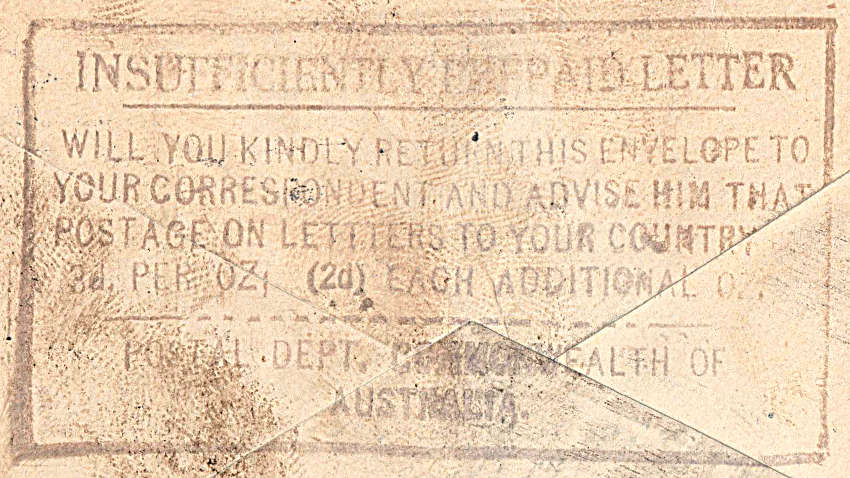 |
|
Send note to Staff
|
| Edited by smauggie - 08/02/2017 9:31 pm |
|
|
|
|
Pillar Of The Community
United States
5894 Posts |
|
|
Pillar Of The Community
United States
3305 Posts |
|
|
That is an unusual auxiliary hand stamp. Complete with finger prints?
This may have been added before it left Australia, not necessarily at the originating office. |
Send note to Staff 
|
|
|
Pillar Of The Community
6364 Posts |
|
|
The marking on the backside is obviously applied by the PO in Australia, so it clearly was determined to be due at that time, and the front (16 2/3) mark also applied at there. There would be no reason for any intermediary country to be rating mail. New York converted the deficiency and collected the due.
On a tangent, Not being a student of Australian postal history, I do not know if this was a machine cancel applied broadly to all mail at that time or was a special machine in the foreign section which might have handled the mail dropped in the "foreign" slot at the PO. It is a very interesting coincidence. |
|
Send note to Staff
|
| Edited by John Becker - 08/02/2017 10:22 pm |
|
|
Pillar Of The Community
United States
5894 Posts |
|
|
Quote:
The marking on the backside is obviously applied by the PO in Australia, so it clearly was determined to be due at that time, and the front (16 2/3) mark also applied at there. John: I don't think it is that obvious that the 16 and 2/3 cents was placed in Australia because it was underpaid by only one Australian cent. Just to be perfectly clear, the marking I am questioning is this one. 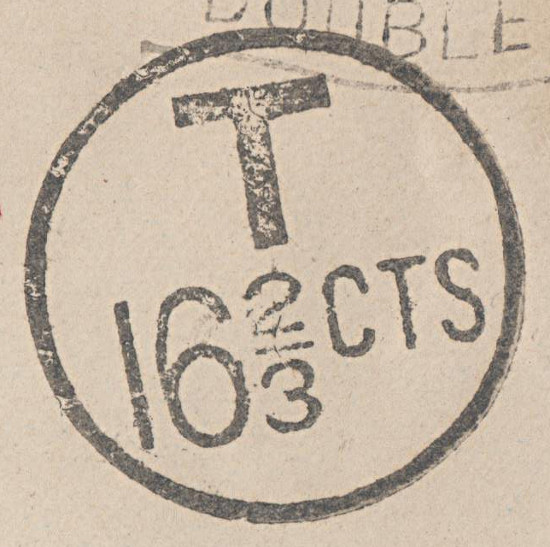 Thanks. |
|
Send note to Staff
|
| Edited by smauggie - 08/02/2017 10:35 pm |
|
|
Valued Member
Canada
395 Posts |
|
|
Quote:
John: I don't think it is that obvious that the 16 and 2/3 cents was placed in Australia because it was underpaid by only one Australian cent. The unit of currency in the T marking would be (french) gold centimes. I don't know the exact exchange rate at the time that the letter was posted, but in the mid 1920's it was 1 US cent to 5 gold centimes. If the above marking is correct, 1 Aus penny would be 16 2/3 gold centimes. Jan |
|
Send note to Staff
|
|
|
Pillar Of The Community
6364 Posts |
|
|
Indeed, much of the utility of having a universal postal currency, the gold centime, is to easily calculate postage due on international mail. The logic is clear and simple – why else have an international postal currency? The origin country is best able to recognize its own stamps and to determine whether its own outbound mail is properly rated. The origin country clerks mark any underpaid mail as due with the amount due in their own currency, or ideally, in the equivalent centime amount. The recipient country uses their own conversion rate to determine the amount to collect from the recipient. Each country's postal clerks have only to know their own rate chart and conversion factor. Very simple to operate on each end by the hundreds of UPU member countries, each with different currencies, conversions, languages, etc. There is no reason for clerks in any intermediary country to do any rating or marking. Why would they know (or care) about Australia to US rates or centime conversions? The 16 2/3 mark was applied in Australia. |
|
Send note to Staff
|
|
|
Pillar Of The Community
Australia
967 Posts |
|
|
Hi all,
I don't think the PMG in those days would Stamp in cents, Australia's currency in those days were pounds, shillings and pence.
PS Smauggie... lovely cover my friend!
Cheers |
|
Send note to Staff
|
| Edited by Laurie 02 - 08/03/2017 12:32 am |
|
|
Pillar Of The Community
6364 Posts |
|
|
Lawrence,
The CTS is centimes, the UPU currency, already converted from the Australian. |
|
Send note to Staff
|
|
|
Pillar Of The Community
Australia
967 Posts |
|
|
Pillar Of The Community
United States
5894 Posts |
|
|
Okay, now with a more complete explanation of the denomination being the UPU currency it makes sense that the marking was placed in Australia. The rate of exchange seems to be 1 Australian pence to 8 and 1/3 centimes. Since the penalty for underpaid covers was twice the underpaid amount the total postage due would then be the 16 and 2/3. Thanks for the help guys. |
|
Send note to Staff
|
|
|
Pillar Of The Community
United States
6668 Posts |
|
|
Also a nice example of how many US postage due sheets were cancelled before being applied to the cover. Many US postage due stamps will not be tied to the cover. |
|
Send note to Staff
|
|
| |
Replies: 11 / Views: 2,033 |
|




 Posted 08/02/2017 9:27 pm