| Author |
 Replies: 59 / Views: 14,137 Replies: 59 / Views: 14,137 |
|
|
|
Pillar Of The Community
United States
3224 Posts |
|
|
Valued Member
146 Posts |
|
|
Thanks , hy-brasil for spotting my mistake with the scan and reversing the image.
I should have realised this when I scanned the reverse that the black brush strokes were showing through the thin paper. |
Send note to Staff 
|
|
|
Pillar Of The Community
Australia
3547 Posts |
|
|
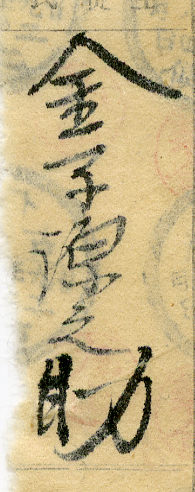
It is a man's name: the surname is probably 'Kaneko', the given name is [illegible]-nosuke. (Can't make out the first character of the given name.) |
|
Send note to Staff
|
|
|
Pillar Of The Community
United States
3224 Posts |
|
|
Last name is useful. First names can be tough, sometimes using uncommon characters or rarely used pronunciations of relatively standard characters. There is someone noted in the 1970s with the supposed real name of  all the same characters but pronounced Hiradaira Heibei (last name first). Go figure. |
|
Send note to Staff
|
|
|
Valued Member
146 Posts |
|
|
Thanks tonymacg & hy-brasil for your imput .
What started as a query regarding a postal stationery card and ended up with an analysis of various postmarks and chop marks, which has left me better inform but at the same time confused with the language barrier.
No wonder I had these items in my pending box all these years......
A big thanks to both of you. |
|
Send note to Staff
|
|
|
Valued Member
Japan
350 Posts |
|
|
Hi all, the "strange" postmark on the very first question; 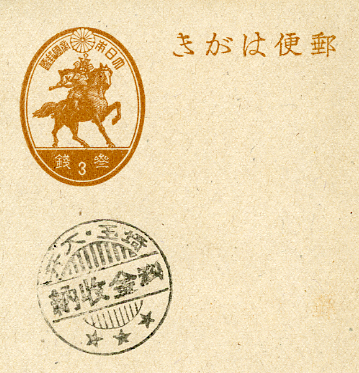 is a postage paid mark, used from February 1945, to indicate the receipt of the postage fee from the sender and to omit attaching the postage stamp. The postmark itself has been made using the comb type postmark and substituting the date inscription (the middle row) with four characters, "Ryou-Kin Shuu-Noh", literally meaning "fee received". The postage fee for domestic card has been changed from 3 sen to 5 sen on April 1st, 1945, and for this example I suspect that the postage paid mark was used at the post office to show the additional 2 sen fee. In principle a 2 sen stamp should be attached as the receipt of the additional fee, but due to the lack of postage stamps during the war (WW II), this postmark has been used instead. The post office name (on the top, from right to left) could be read as "Saitama Oo-i". The three stars on the bottom indicates this postmark was originally a non postal cancellation, used for postal savings, receipt of telegraph and telephone fees etc. - unechan |
|
Send note to Staff
|
| Edited by unechan - 09/20/2017 11:26 am |
|
|
Valued Member
Japan
350 Posts |
|
|
Some additions to the previous post, especially by Tonymacg;
The extra chop in red could be read as "Maru-Yama Toh-be-eh".
The handwritten name could be read as "Kane-Ko Gen-No-Suke".
- unechan |
|
Send note to Staff
|
| Edited by unechan - 09/20/2017 11:18 am |
|
|
Valued Member
146 Posts |
|
|
Thank you "unechan" for your replies.
So this in reality is a postal stationery card which has been revalued to the new postal rate at the time.
|
|
Send note to Staff
|
| Edited by agb - 09/21/2017 03:59 am |
|
|
Valued Member
Japan
350 Posts |
|
|
Hi, POW is something I really do not have any knowledge at all, but I suspect that these normal domestic stationeries were not used; as far as I understand the POW camps often did use dedicated postcards for POW mails and not the normal postal stationeries. This is only a guess, so let's wait someone with more knowledge to join this discussion ! |
|
Send note to Staff
|
|
|
Valued Member
146 Posts |
|
|
Hello List Members I have been wondering why have the reverse sides of these postal stationery items been brushed over in blank ink? The back of the first card has been written in pencil and the bottom card in orange ink 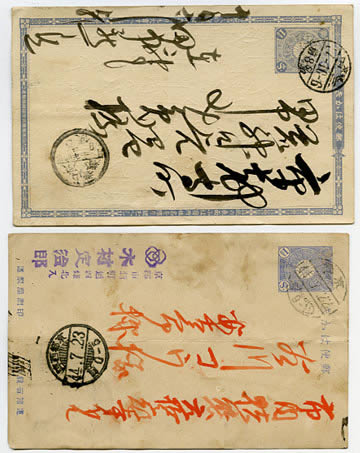 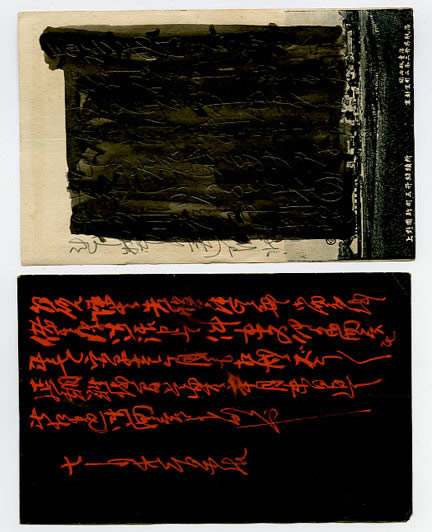 You help would be appreciated Many thanks |
|
Send note to Staff
|
|
|
Pillar Of The Community
United States
3224 Posts |
|
|
The second in red ink looks like a re-use of sorts. The writer didn't want to thrown away a prepaid card with a message already written. It was coated with the normal brush painting/writing ink, dried and written over. You might hold it at a sharp angle to the light to see if there is other writing under there.
The first may or may not be where a personal message was deleted before selling off cards and letters to a stamp dealer. I've seen that done on covers from elsewhere, including blocking out the addressee info. Same writing ink, but a thicker mix.
I can't read much at all of this style of writing. |
|
Send note to Staff
|
|
|
Valued Member
146 Posts |
|
|
Valued Member
Japan
350 Posts |
|
|
The first one might be an attempt by the writer to use a picture postcard as an usual postcard, so the writer can write more message. You can see a portion of the picture on the right (actually the bottom) of the card.
- Hironobu |
|
Send note to Staff
|
|
|
Valued Member
146 Posts |
|
|
Thanks for your input unechan I have a few more queries but this time its relating to what I think are parcel registration or registered mail receipts dated around the 1960's? I am only guessing that they are receipts as they are all postmarked. I have several of these here are a few. 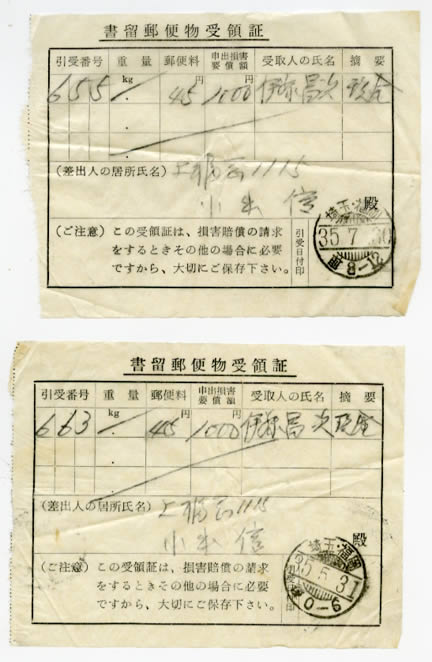 |
|
Send note to Staff
|
| Edited by agb - 10/20/2017 08:28 am |
|
|
Valued Member
Japan
350 Posts |
|
|
Wow, your guess is perfect; they are registered mail receipts from Showa 35 (=1960). The top inscription indeed says "Kaki-Dome Yu-Bin-Butsu Jyu-Ryou-Sho" = "receipt for registered mail".
-Hironobu |
|
Send note to Staff
|
|
|
Replies: 59 / Views: 14,137 |
|




 Posted 08/16/2017 3:59 pm