| Author |
 Replies: 59 / Views: 14,138 Replies: 59 / Views: 14,138 |
|
|
|
Valued Member
146 Posts |
|
|
Thanks Hironobu for confirming that they are receipts.
It was a calculated guess, mustn't get carried away though.....
I will try my luck a little further....
Can I assume that the numerals at the bottom of the datestamps are the time the mail was accepted? |
Send note to Staff 
|
|
|
Valued Member
146 Posts |
|
|
Looking further through my box of oddments I came across the following items, your help is sought as to the identification of these items, thank you in advance.. 1. This could be a merchants letter with oval company handstamp applied to back of the envelope in two places. The enlarged (logo)? is taken from the letter inside which is the same as on the envelope? 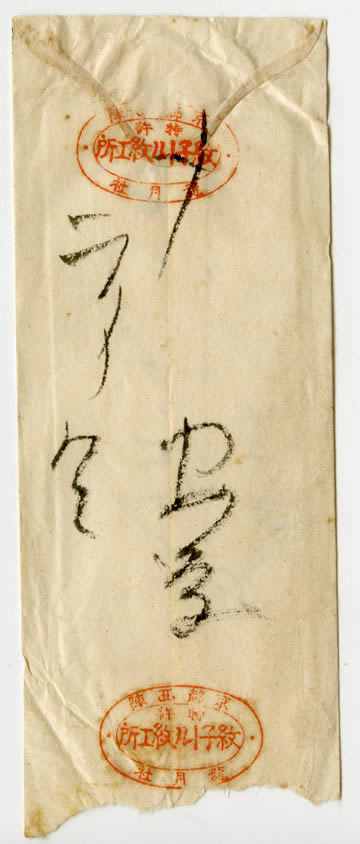 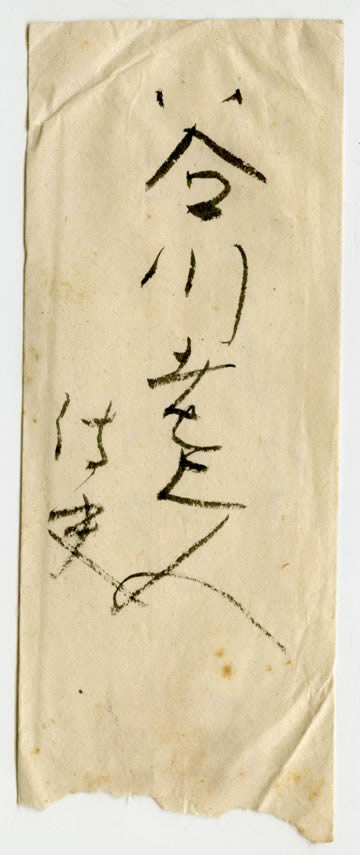 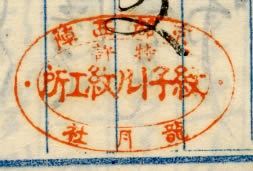 2. Badly opened and tatty envelope, I kept this because it looked interesting, I may be wrong? The date I make out to be 1934, the five kanji handstamps look interesting on the front. The large circular handstamp on the reverse, is that a company logo? 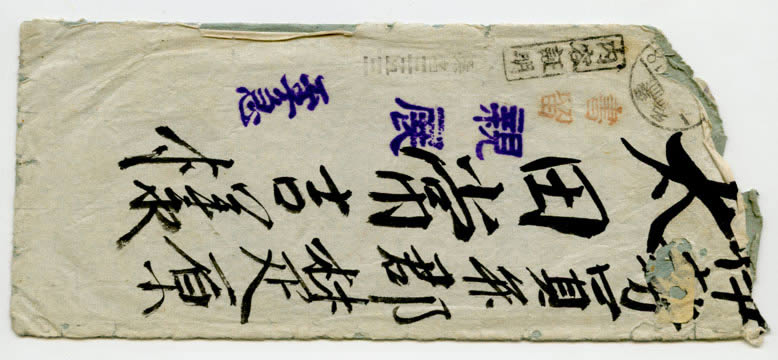 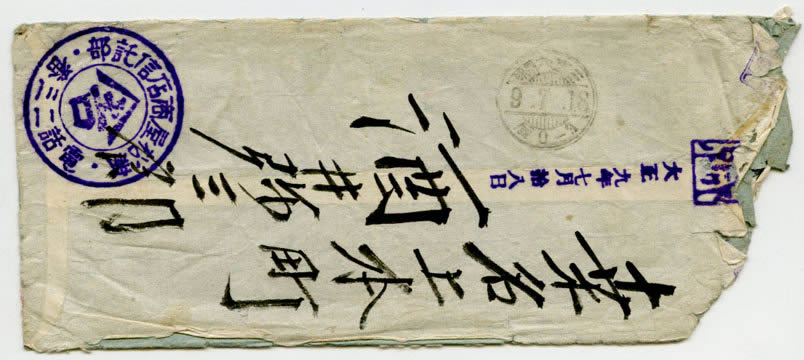 Finally are the two cachets in purple on the postal stationery cards 'Postage Paid' chop marks? 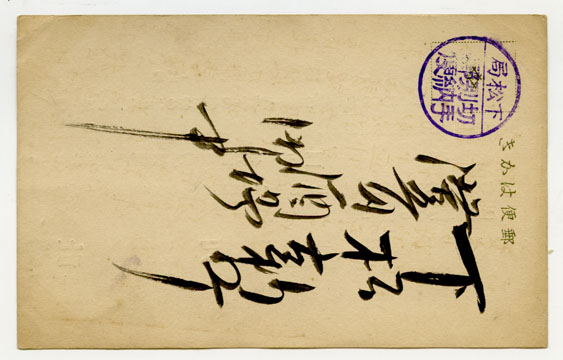 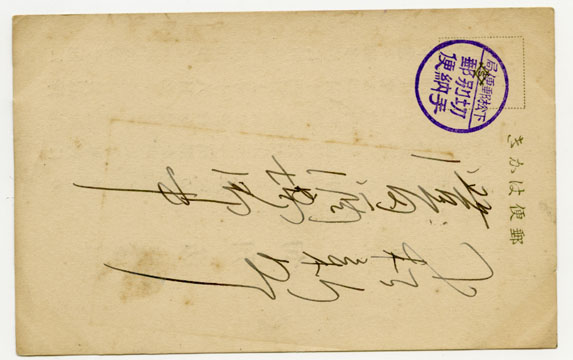 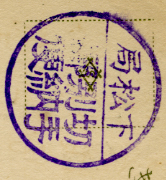 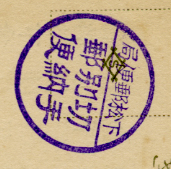 I have included the reverse side of one of the card which appear to be some kind of advertising mail? 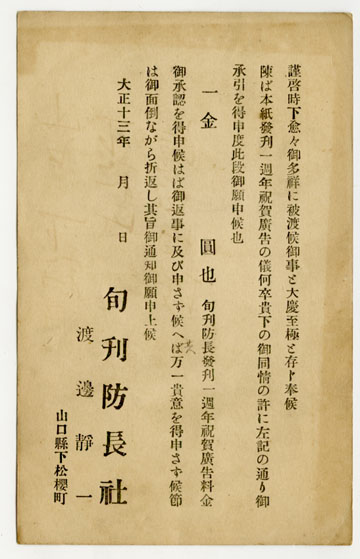 You help is sought, thank you Andrew |
|
Send note to Staff
|
|
|
Valued Member
Japan
350 Posts |
|
|
Hi Andrew, Re your question on the registered mail receipts; Quote:
Can I assume that the numerals at the bottom of the datestamps are the time the mail was accepted? Bingo  These datestamps are called as Comb-type datestamp, and could be further categorized into many variations. The ones on your receipts are "C-column with time, post-war type (post office written from left)" (complicated ...  ), used from 1949 to around 1970. The time part (called as "C-column") consists of one character, either "Zen" (=AM) or "Go" (=PM), followed by the timeframe of the receipt. The first receipt is "AM 8-12", the second one is "PM 0-6". - Hironobu |
|
Send note to Staff
|
|
|
Valued Member
146 Posts |
|
|
Thank you Hironobu for sharing your knowledge on these items.
I am already sorting these receipts out into am & pm cancels. I will need to do a search on the web for more information on comb-type datestamps.
This has really got me interested in collecting comb type cancels etc. Guess its never to late to collect something different....
Andrew |
|
Send note to Staff
|
| Edited by agb - 10/24/2017 08:43 am |
|
|
Valued Member
Japan
350 Posts |
|
|
Andrew, the red chop;  The chop says "Ryu-Getsu-Sha Mon-ko-jyo", in Nishijin, Kyoto. Deducing from the company's name, it should be a fabric design & manufacturer. A quick search lead me to a literature entitled "Formation of Modern Japanese Technology" by Mr. T. Nakaoka (2006, which says that this company was founded on 1888. I was not able to access the whole book, but deducing from what's written nearby this company seems to be making pattern papers for Jacquard weave fabrics. For your reference, Nishijin, a district of Kyoto, is a renowned area for traditional textile called "Nishijin-ori" having over 1200 years of history  https://en.wikipedia.org/wiki/Nishijin-ori https://en.wikipedia.org/wiki/Nishijin-ori- Hironobu |
|
Send note to Staff
|
|
|
Valued Member
Japan
350 Posts |
|
|
And the "tatty" envelope  ; This is a registered, content-certified mail dated July 18, Taisho 9 (=1920). It is a real pity that the postage stamp has been removed (torn away?), as there's not so many examples of registered + content-certified mail compared to regular registered mail... The five handstamps are three postage handstamps (registered mail, content-certified mail and registered mail number stamp) and two private ones (saying "Urgent" and "Confidential"). 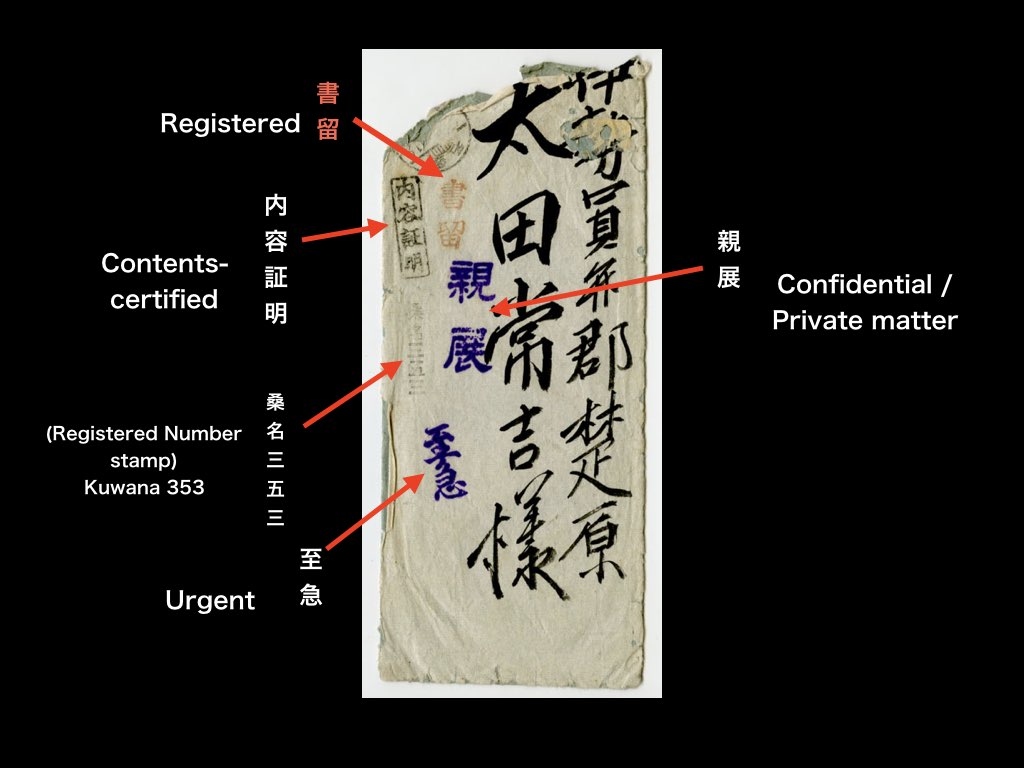 The large circular handstamp on the reverse is a company logo/chop. Although the first character unfortunately is covered by the hand script, the top part could be read as "Shin-Matsu (or Nii-Matsu)-Ya Company, Trust Department", and the bottom part as "Phone number 23". - Hironobu |
|
Send note to Staff
|
|
|
Valued Member
146 Posts |
|
|
Thank you Hironobu,
Being not familiar with the postal system in Japan. Was this a letter sent via the postal system
as I cannot see that any postage stamps were applied to this cover and any postmarks?
Or maybe delivered privately if the location was not too far away?
Andrew |
|
Send note to Staff
|
|
|
Valued Member
146 Posts |
|
|
Hironobu, thanks you so much for your detailed reply, It is really an eyeopener. I am pleased that I retained this partial cover some time ago.
I am indebted to you for the information and feel guilty for taking up so much of your time, your replies needn't be so long only a brief outline would be sufficient. However I am grateful
that you had found the time for such a detailed reply.
I will try to hold back in looking through my box of pending items for any other interesting items for a least a few days.....This will give me time to digest your replies and try to put a little collection together of Japanese stationery cards & covers.
One further query was this 'contents certified' a solicitors letter?
Andew |
|
Send note to Staff
|
| Edited by agb - 10/24/2017 09:51 am |
|
|
Valued Member
Japan
350 Posts |
|
|
And for the purple cachets, yes they are postage paid hand stamps (I rotated the image 90 degrees...) The top part shows the post office name, Shimomatsu post office in Yamaguchi prefecture; interesting to see that the first one is (from right to left) "Shimomatsu Office" and the second one is "Shimomatsu Post Office". The lower part is "Kitte Betsu-Noh Yu-bin", which literally means "Stamps separately-paid postage " = postage paid. 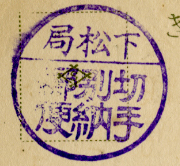 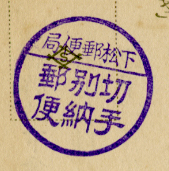 The content of the postcard is indeed an advertisement for offering to place an advertisement on the one-year celebration issue of a gazette or a newspaper, "Jun-Kan Bou-Chou". "Jun-Kan" means to be published every 10 days (I don't know the english word for this style). "Bou-Chou" means Yamaguchi Prefecture, using two Kanji characters from the two provinces (Su-o Province and Nagato Province) which was merged to Yamaguchi prefecture on 1871. -Hironobu |
|
Send note to Staff
|
| Edited by unechan - 10/24/2017 10:24 am |
|
|
Valued Member
Japan
350 Posts |
|
|
Hi Andrew, I'm just enjoying to analyze the "mysteries" of those covers and datestamps, and it's so fun that the reply gets more detail and longer as I find new things... - Hironobu |
|
Send note to Staff
|
|
|
Valued Member
Japan
350 Posts |
|
|
Andrew, Quote:
Being not familiar with the postal system in Japan. Was this a letter sent via the postal system
as I cannot see that any postage stamps were applied to this cover and any postmarks?
Or maybe delivered privately if the location was not too far away?
I bet this letter was privately delivered or directly handed to the recipient and not through the postal system; there's no postal address on the front but only the recipient's name... - Hironobu |
|
Send note to Staff
|
|
|
Valued Member
146 Posts |
|
|
Hi Hironobu,
I am pleased that you found these items interesting and worthy of further research, thank you.
Andrew,
|
|
Send note to Staff
|
|
|
Valued Member
Japan
350 Posts |
|
|
Andrew; Quote:
One further query was this 'contents certified' a solicitors letter? I believe so; this system is usually used for a solicitor's letter, such as asking for debt payment, termination of contract... something really serious and related to possible legal disputes. I'm pretty happy that I've never had received such postal item (at least up to now)  - Hironobu |
|
Send note to Staff
|
|
|
Valued Member
United States
51 Posts |
|
|
Valued Member
146 Posts |
|
|
Just a few more envelopes which may be of interest: 1. I have several envelopes with a company logo similar to the envelope above which proved to be a textile company. These may also be relating to textiles, I have scanned a selection of covers for their logos only. 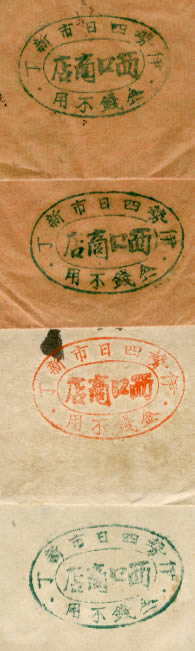 I hope I have placed the following envelopes the right way to read correctly? Could there have been an 'AR' label where I have annotated with an arrow? 2. Envelope dated 1927? 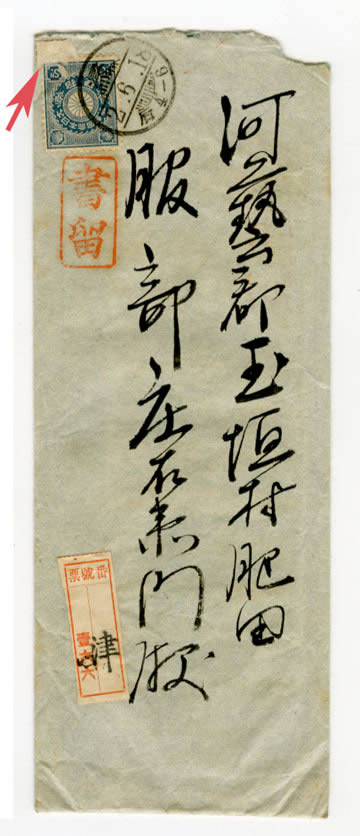 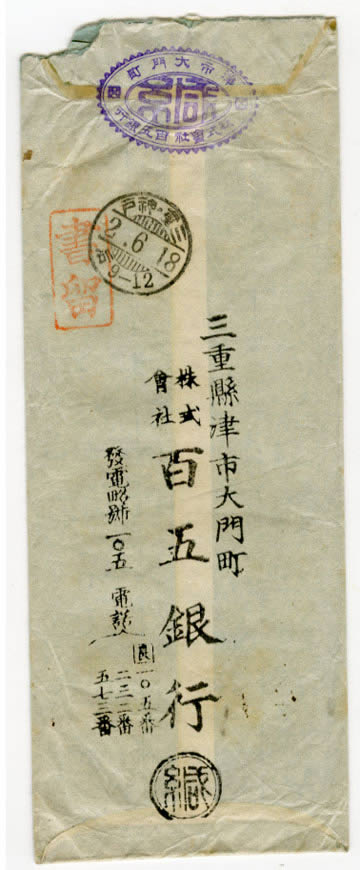 I have just added these envelopes which show where some kind of label was removed? 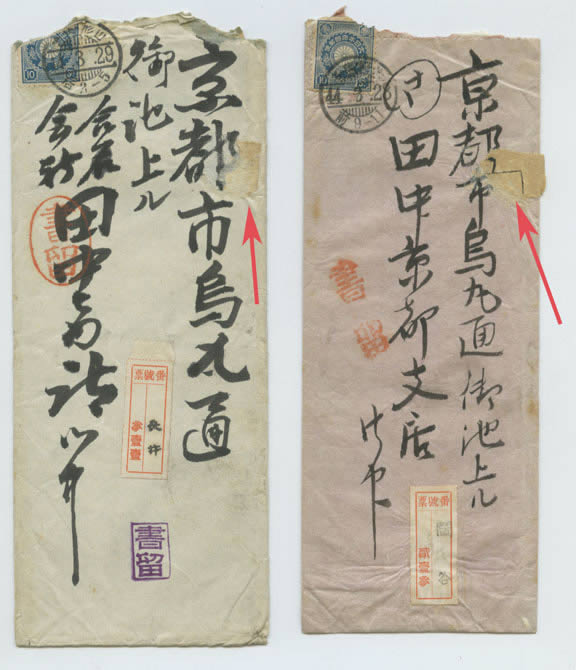 3. Local envelope with postage stamp + inland postmarks? 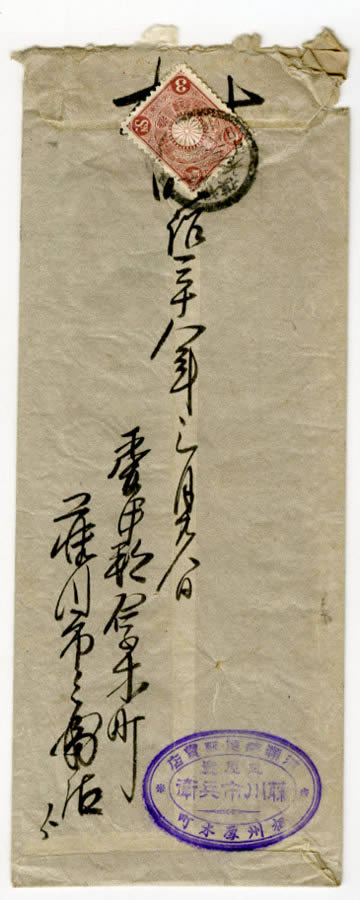 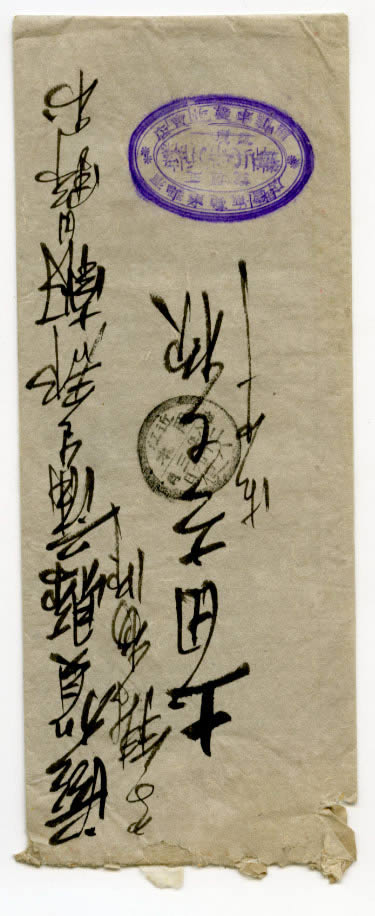 4. Postal stationery card dated 1959? Are the red boxed cachets on the reverse censor markings and the three different chop marks personal censor seals? 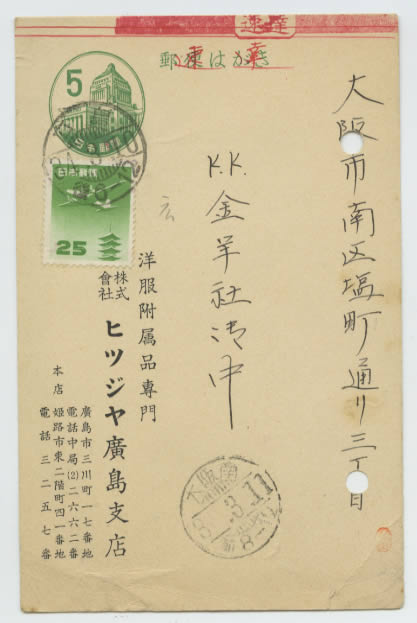 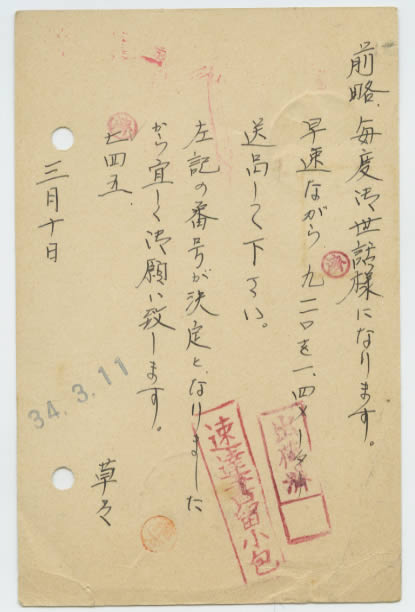 5. Post office receipt ? 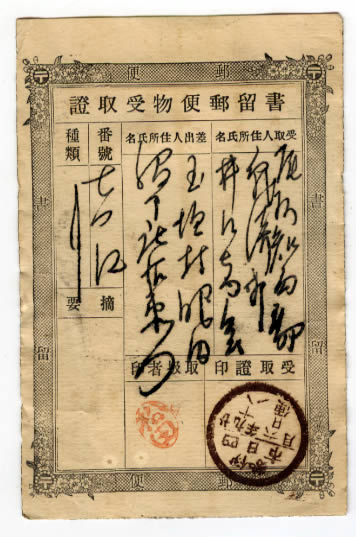 Hope these are as interesting as my previous postings? Andrew |
|
Send note to Staff
|
| Edited by agb - 10/26/2017 03:08 am |
|
|
Replies: 59 / Views: 14,138 |
|



 Posted 10/20/2017 09:51 am


