| Author |
 Replies: 59 / Views: 14,140 Replies: 59 / Views: 14,140 |
|
|
|
Valued Member
Japan
350 Posts |
|
|
Hi Andrew, thanks for the additions. Let me go step by step... The chops are from Nishiguchi Sho-ten, whose address is Shin-Cho, Yokka-ichi, Ise (now in Mie prefecture). The lower part literally says "No cash payment required", which you can find in many company chops. This time absolutely no clue on the chop of what this company was handling. Quote: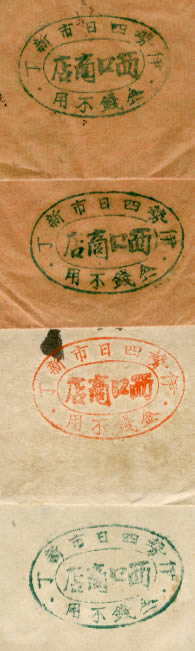 - Hironobu |
Send note to Staff 
|
|
|
Valued Member
146 Posts |
|
|
Hi Hironobu, Just had a look at the envelopes again... luckily one still had a letter inside so here is a scan. Hopefully it could reveal the trade.. 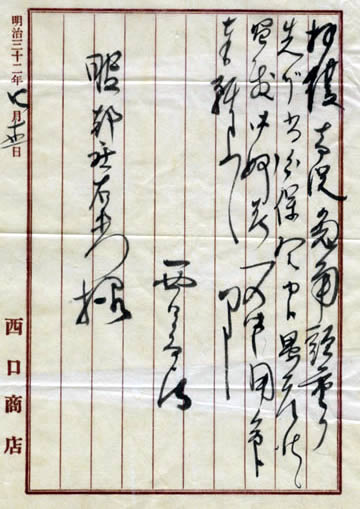 P.S. I quite like these envelopes, although no postal interest I am sure, nevertheless they are interesting. I just wonder how hard it would be to collect this kind of material. I must admit, I have never come across any before that why I kept these back intending to look into the envelopes but never got round to doing so until now. This must be common amongst us collectors? Just spotted this 1 sen postal stationery card and thought I will add this to the above it may help to solve the company logo with 'no cash payment required' cachet. Just an after thought, the cachet may refer to the booking of an entry in a trade directory where no payment is required until the directory is published and payment made upon invoice? Maybe the contents of the stationery card refer to 'commercial samples' which if requested can be sent via the postal system incurring no costs for sample merchandise, Its only a guess? I would be interested to learn who it is addressed to and the date of the two postmarks. 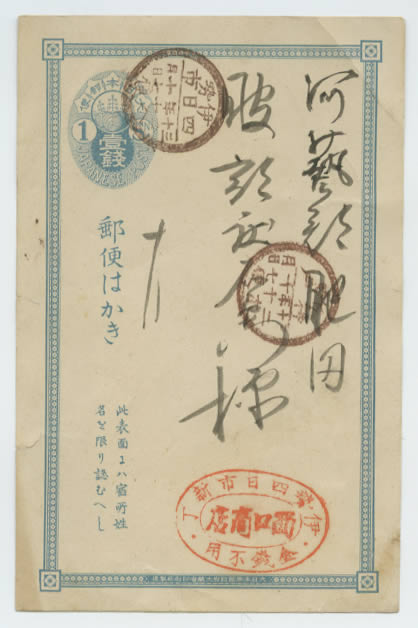 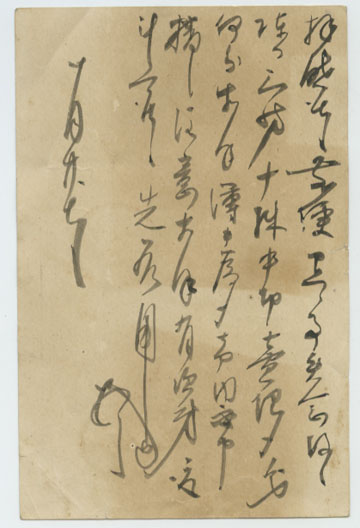 I have found this area of Japanese philately very interesting to collect, unfortunately with no knowledge of the language its very difficult to research and not to mention try and form a postal history collection. However with the 'Stamp Community' site this has enabled me to post questions & queries on items that I would have never been able to find answers to. I take this opportunity in thanking all collectors/postal historians who have found the time to reply to my queries. Andrew |
|
Send note to Staff
|
| Edited by agb - 10/27/2017 07:02 am |
|
|
Valued Member
Japan
350 Posts |
|
|
Hi Andrew, great to know that the content is still there, and also that the stationery does exist. The text itself is really hard to read for modern people like myself, and I cannot find any significant clue on the merchandise itself. The first letter seems to be a reply to (possibly) an inquiry, but definitely requires more analysis. It will be nice if you can rotate the letter 90 degrees in counterclockwise direction to prevent the viewers hurt their neck  . Re the merchandice sample mentiined on the stationery, I hitherto couldnt find any related writings in the text. The postage system for merchandise samples during the Meiji era was not free of charge but with reduced rate, categorized as "4th class mail", including printed matters, merchandise samples, photographs etc. Most of such cover will bear a cachet "4th class" ("Dai Yon Shu"), and combined with the reduced franking, it is pretty straightforward to identify them (but of course sobmetimes tricky, as is always the case with this hobby )  - Hironobu |
|
Send note to Staff
|
| Edited by unechan - 10/26/2017 9:23 pm |
|
|
Valued Member
Japan
350 Posts |
|
|
The "no cash payment required " inscription simply means that they accept selling by credit; as mentioned by Andrew, the invoice for the total payment during the period (depending on the seller) was issued for payment requests. This was a normal form of merchandise in old days (like Edo era). With the exceptions of small private shops, direct cash payment was introduced and began gaining popularity after Meiji era. My observation is that you can find this inscription in company chops in early to mid Meiji era, but more less afterwards. Analyzing such transitions might not be a pure postal history study, but certainly will be of interest as an evidence of the social history itself.
- Hironobu
|
|
Send note to Staff
|
|
|
Valued Member
Japan
350 Posts |
|
|
Quote:
I would be interested to learn who it is addressed to and the date of the two postmarks. The destination of postcard is Hida village, Kawage-gun, Ise province (now Mie prefecture). I couldn't decipher the name of the recipient... The two datestamps are called as "bisected type date stamp" ("Mari-Ichi" type in japanese, literally meaning "circle and one (=horizontal bar)"); 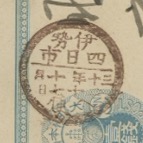 Yokka-ichi, Ise province, Oct. 27, Meiji 30 (1897), "He" delivery (=6th delivery of the day). This is where the postcard was posted by the company. 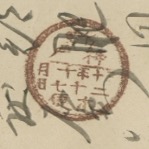 Kan-be, Ise province, Oct. 27, Meiji 30 (1897), "Ho" delivery (=5th delivery of the day), where they delivered this postcard to the recipient. This datestamp may be quite tricky at a first glance, because the characters for the name of this post office is the same as those for Kobe. The faint trace of "Ise" on the first line of the cancellation as well as the recipient's address helped me to identify the post office; I do love these kind of investigations - Hironobu |
|
Send note to Staff
|
|
|
Valued Member
146 Posts |
|
|
Hi Hironobu
Thank you for your detailed input. I have corrected the position of the scan which you kindly mentioned.
Andrew |
|
Send note to Staff
|
| Edited by agb - 10/27/2017 02:22 am |
|
|
Valued Member
Japan
350 Posts |
|
|
Hi Andrew, Sorry but I meant to rotate the letter you've found in the envelope... The text side of the postcard was in the correct position, but now looking towards 9 o'clock Just remember that during the old days Japanese writing was vertically from top to bottom. and moving from right to left. Nowadays we write in western style (horizontally from left to right, and moving from top to bottom) but also still use the old style, especially for books. - Hironobu |
|
Send note to Staff
|
| Edited by unechan - 10/27/2017 06:32 am |
|
|
Valued Member
146 Posts |
|
|
Hironobu
Comments taken on board - thanks
Andrew |
|
Send note to Staff
|
| Edited by agb - 10/27/2017 07:05 am |
|
|
Valued Member
Japan
350 Posts |
|
|
Valued Member
Japan
350 Posts |
|
|
Re the 10 sen franked registered mail envelopes, I also do have several envelopes with trace of labels removed... My guess is either a label indicating re-delivery (or forwarding to new address) in case the recipient was absent, or some sort of receipt that the recipient had to sign on delivery. Here's an example of labels indicating forwarding and re-deliverys attached onto a postal stationery (1 Sen Koban postcard). This one has 6 (!) labels attached to trace the recipient who seemed to have moved from the original address. 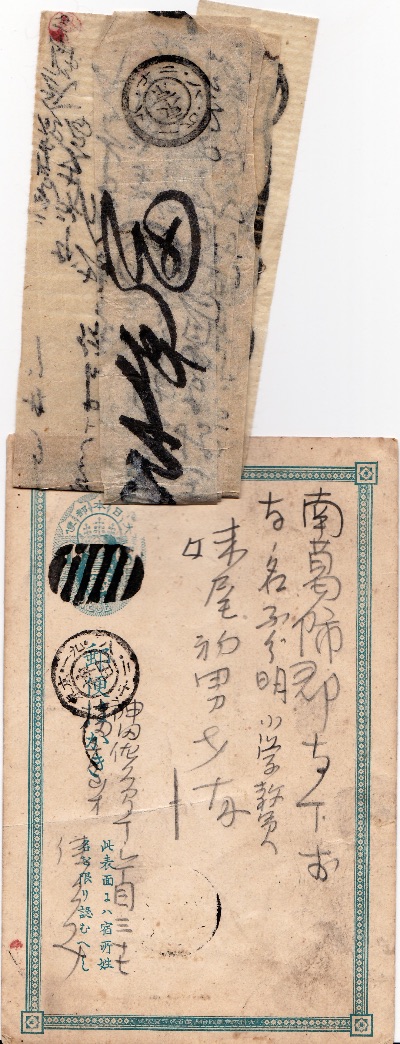 - Hironobu |
|
Send note to Staff
|
|
|
Valued Member
Japan
350 Posts |
|
|
Quote:
3. Local envelope with postage stamp + inland postmarks? This is a regular domestic mail (3 sen fee) with a purple company chop; I cannot read the detail because of the blur, but the owner's name in the middle is "Ichi-Be-I Fuji-Kawa". The stamp is attached on the back of the envelope and also used to seal the flap (this is often seen in early Meiji era) so the side without the stamp is the front face with the recipient's address and the delivery date stamp; a bisected type date stamp of Okamoto PO, Omi province, March 29, Meiji 38 (1905). - Hironobu |
|
Send note to Staff
|
|
|
Valued Member
Japan
350 Posts |
|
|
Quote:
4. Postal stationery card dated 1959?
Are the red boxed cachets on the reverse censor markings and the three different chop marks personal censor seals? Bingo for the date; it's from Showa 34 = 1959. The text is an order saying "Please send us 1.4 meters of No. 9110. " and "The number 745 has been determined." No idea of what these numbers mean, but as the sender, "Hiroshima Branch, Hitsuji-Ya" is a dedicated company of clothing accessories, the product may be something related to textile. All of the cachets/chops are non-postal and of private use for managing the product handling by the recipient company, "Kin-Yo-Sha Co. Ltd."; the red boxed cachets on the reverse says "Shipped" and "Express Registered Packet", and the smaller two chops says "Sumi" = "done", the larger chop is likely to be a private chop of the person in charge. Yes, those small, red private cachets and seals are sometimes very confusing with the postal cachets such as railway postmarks, post box marks ("Hako-ba-In") and other miscellaneous but important postmarks... - Hironobu |
|
Send note to Staff
|
|
|
Valued Member
Japan
350 Posts |
|
|
And for the last one; Quote:
5. Post office receipt ? This is a registered mail receipt from Meiji 29 (1896). Older design, with bisected type date stamp of Yokka-Ichi P.O., Ise province, June 10, Meiji 29, "Ha" delivery. Here again, I appreciate if you can turn the image 180 degrees (it's upside down) to help my neck Please note that the inscription is written in horizontal direction, but from right to left. This is the old style of writing, adopting the western style of horizontal writing but retaining the traditional Japanese style of proceeding from right to left. The receipt with comb type date stamp shown in your previous post is from more recent years and thus the inscription is written from left to right, as we do today. Thanks for the interesting items, I've really enjoyed the puzzles  -Hironobu |
|
Send note to Staff
|
|
|
Valued Member
146 Posts |
|
|
Hironobu, Thank you for all your help in providing answers to my queries.. Its left me with headache as to what I am to do next. Will have a rest from this and re-group in a few weeks and try and sort some of my covers etc. The re-delivery item with the labels was very informative, I was not aware of this. I only regret that I have a few of these cards which had these label attached and I pulled them off, thinking that they were accidentally stuck together. Guess I have a lot to learn! I have added a further topic, 'revenues on documents' which you may be able to help with. Here is the link https://www.stampcommunity.org/topi...57369#500074Andrew |
|
Send note to Staff
|
| Edited by agb - 10/28/2017 06:34 am |
|
|
Replies: 59 / Views: 14,140 |
|




 Posted 10/26/2017 04:56 am


