| Author |
 Replies: 18 / Views: 2,455 Replies: 18 / Views: 2,455 |
|
Pillar Of The Community
1151 Posts |
|
|
Hi all In Cloudy's book "Encyclopedia of Plate Varieties on U.S. Bureau Printed Postage stamps" he discussed what a cracked plate was. Now then where does leave us with my R20c? Well you can use Cloudy's book and apply his information to other than Bureau Printed Postage Stamps. Here is an example of two R20c showing a progressive cracked plate. I've added arrows to make it easier to see. This progression is small, the crack is just a little bit extended, hope it shows up nicely. Do other members have the same R20 either "C", "D", or Proof showing this crack? If so would you show us all your example(s). Hope to see another example where the progression is more easier to see or even longer in the proper orientation. Stampmaster 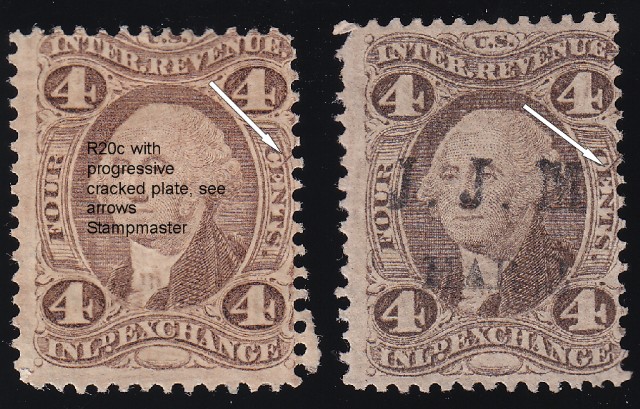 |
|
Send note to Staff
|
|
|
|
|
Pillar Of The Community
United States
8956 Posts |
|
|
Pillar Of The Community
United States
3528 Posts |
|
|
Neat item - my first reaction is that it looks pretty straight to be a crack. It might more likely be a bad plate scratch. It would be interesting to see a stamp from the plate position to the right of this one, to see more of it. |
Send note to Staff 
|
|
|
Pillar Of The Community
1151 Posts |
|
|
Hi all again, was down town today. Here is an enlarged view of both stamps side by side. Hope this helps. Removed arrows to make it easier. Stampmaster 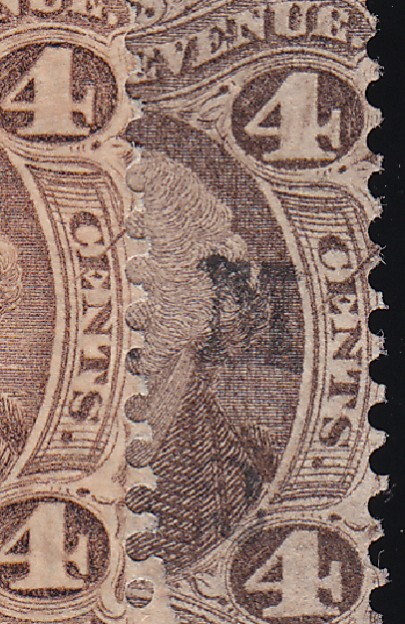 |
|
Send note to Staff
|
|
|
Pillar Of The Community
United States
8956 Posts |
|
|
It does look more like a scratch caused by an etching tool because it is not jagged enough for a crack. I am with txstamp on this one - it would be very interesting to see the adjoining stamp.
Peter |
|
Send note to Staff
|
|
|
Pillar Of The Community
1151 Posts |
|
|
Hi Txstamp, do you think this is two different scratches, just happens to be in the same place, but different lengths?
Stampmaster |
|
Send note to Staff
|
|
|
Bedrock Of The Community
United States
10839 Posts |
|
|
I think it's the same scratch but the shorter version is from a later state of the plate when it was far more worn. Without seeing a multiple there is no way to know for sure whether it is a crack or a scratch; with only the one stamp it is a scratch. |
|
Send note to Staff
|
|
|
Pillar Of The Community
1151 Posts |
|
|
Valued Member
United States
96 Posts |
|
|
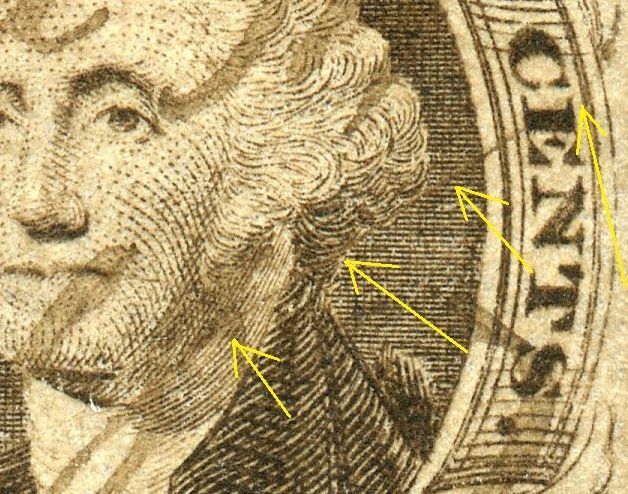
On a better copy you can see the scratch continues all the way down to Georges chin. |
|
Send note to Staff
|
|
|
Pillar Of The Community
1151 Posts |
|
|
Hi lackemacher, please scan your copy and lets us all see it.
I would be very interested in see your copy.
Stampmaster |
|
Send note to Staff
|
|
|
Valued Member
United States
96 Posts |
|
|
Pillar Of The Community
United States
8956 Posts |
|
|
Wow! No all we need is a scan of the next stamp to see how this all started. But the above scan seems to show even better that this is a scratch rather than a crack.
Peter |
|
Send note to Staff
|
|
|
Pillar Of The Community
1151 Posts |
|
|
Hi, lackemacher and Peter4522, wonderful scan.
So who has a pane, or block we all can see?
Stampmaster |
|
Send note to Staff
|
|
|
Pillar Of The Community
6361 Posts |
|
|
lackemacher's plate flaw is NOT the same flaw, it is clearly from a different plate position as the extra line leaves the bottom of the E at a different location. |
|
Send note to Staff
|
|
|
Pillar Of The Community
United States
3528 Posts |
|
|
I agree with John Becker. Deceptively similar appearing items, but definitely different plate positions. |
|
Send note to Staff
|
|
|
Valued Member
United States
96 Posts |
|
|
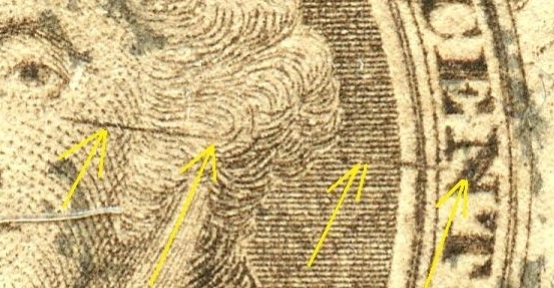 I totally agree with John, not the same scratch. While we look for confirming copies, here's another R20 scratch to look for. |
|
Send note to Staff
|
|
|
Replies: 18 / Views: 2,455 |
|



 Posted 08/16/2017 2:17 pm