| Author |
 Replies: 12 / Views: 4,871 Replies: 12 / Views: 4,871 |
|
|
Valued Member
United States
9 Posts |
|
|
Hello All- New here... I have 11 James Monroe stamps that are all cancels, some very interesting ones. First off, kind of new to stamp collection but from my research doesn't look like any of these are coil stamps, based on all of them have perforations. I understand that some stamps based on cancellation can carry value. One cancellation that stood out to me being unique is the middle far left stamp which says" I WILL" My interest is to learn more about the history of the stamps and also value for potentially selling. I purchased a collection of stamps recently that was mostly 1860 - 1940's US and International Stamps. I would appreciate any feedback greatly. 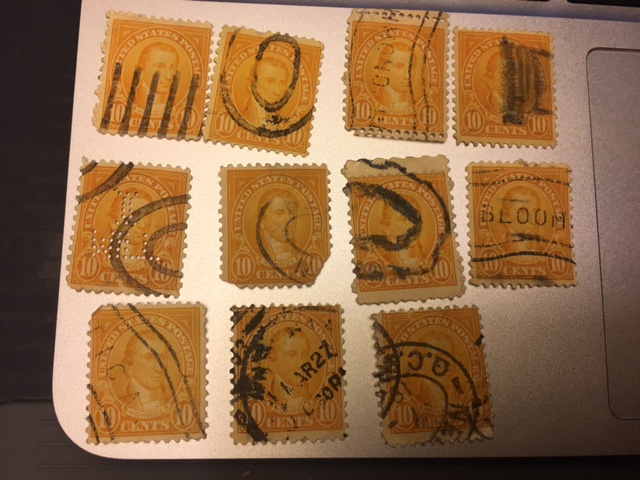 |
|
Send note to Staff
|
|
|
|
|
Pillar Of The Community
United States
2546 Posts |
|
|
The I-WILL is called a 'perfin' , for perforated initial. Companies and organizations used them in that era to help prevent pilfering. This one was used by the city of Chicago and it is one of the most common (F-rated on a scale of A-F). |
Send note to Staff 
|
|
|
Pillar Of The Community
United States
507 Posts |
|
|
The 10c Monroe (Sc# 562) is a common stamp. However, #562c, which is perf 10 at the top and bottom, has a catalog value of $15K. The "I WILL" is not a cancel, it is a perfin. You will need a perfin catalog ( http://www.perfins.org/) to ascertain its value. I am not a cancellation specialist, but perhaps someone else will be able to point you to the appropriate reference material. I suggest a visit to a local stamp club, along with a trip to the library to look a Scott US Specialized catalog. Note that you can pick up used Scott catalogs from Amazon or used book sellers for a fraction of the cost of the current year catalog. |
|
Send note to Staff
|
|
|
Valued Member
United States
9 Posts |
|
|
Thanks for the support and info regarding the perfin stamp. I was aware that the Monroe stamp was more common, but was less aware of he significance of the perf 10. From what I am learning, it sounds like perf is a major factor in determining value and of course condition. So many variables to consider, fun but a lot to absorb at the onset.
Some of my initial research was to check out the Scott's catalog (actually more confusing than helpful at the onset), but I don't think I was aware of the Scott's US Specialized Catalog which may be better for me for the type of stamps that I have.
|
|
Send note to Staff
|
|
|
Pillar Of The Community
1151 Posts |
|
|
Hi cardsavings, suggest you read the first part of the Scott's U.S. Specialized Catalog, tons of important information for all stamp collectors, no matter how long they have been a stamp collectors.
Also suggest you take your stamps, put them into a picture frame and mount on your wall (that is if the boss will let you). Years from now you can think back on these.
Stampmaster |
|
Send note to Staff
|
|
|
Pillar Of The Community

United States
1498 Posts |
|
|
As I recall, 562c is perf 10 at either the top or the bottom, but not both. The same design perf 10 on all sides would be 591.
Added: 562c is perf 11 on 3 sides. |
|
Send note to Staff
|
| Edited by JLLebbert - 09/01/2017 11:15 pm |
|
|
Valued Member
United States
196 Posts |
|
|
My 1998 Perfin Club catalog rates that I WILL as an E -- which means there is no added value associated with that perfin,and most perfin collections will likely have an example of that perfin. Still you can have a LOT of fun collecting stamps with perfins |
|
Send note to Staff
|
|
|
Valued Member
United States
9 Posts |
|
|
Pillar Of The Community
United States
507 Posts |
|
|
Yes, perforation can be the difference between common and uncommon. The same can also be true for watermark.
And FWIW, here is my short list stamp collector tools:
tongs, lighted magnifying glass, water mark fluid and tray, perforation gauge
Good luck. |
|
Send note to Staff
|
|
|
Pillar Of The Community
1151 Posts |
|
|
Valued Member
United States
9 Posts |
|
|
Stampmaster, I think it means for what it's worth (FWIW).
dkabq8 I have a good set of tongs and a magnifying glass.
I just got a perforation gauge, but I'm having a little trouble making sense of it. Any good sites with easy explanations?I understand the principle but don't know when I need to measure all sides independently or just one side. Also, the perforation edges confuse me, I'm not sure if I need to count the outer edge of the perforation or only the inside, full perforation.. I hope that makes sense, trying to be accurate with my terminology. Many of my stamps (currently reviewing) are US from late 1800's or early 1900's (presidents, etc), so many variations.
At the moment, a bit overwhelmed as I have 7,000 or 8,000 stamps that I have now organized by country, the ones I can identify anyway. Don't get me wrong its fun, but I'm really interested to know what I have in value and in historical significance.
Grateful to be learning a ton already.
Watermark fluid and tray sound good, but I'm not sure that being a newbie that I wouldn't simply destroy my stamps. Thoughts? Should I consult with an "expert" locally? I would rather do myself and keep the integrity of my stamps. |
|
Send note to Staff
|
|
|
Pillar Of The Community
1151 Posts |
|
|
Hi go by your local library, and see if they have the Scott Catalog. Read the first part, tons of good basic information.
Stampmaster |
|
Send note to Staff
|
|
|
Moderator

United States
12330 Posts |
|
| |
Replies: 12 / Views: 4,871 |
|



 Posted 09/01/2017 01:59 am


