| Author |
 Replies: 23 / Views: 10,551 Replies: 23 / Views: 10,551 |
|
Pillar Of The Community
1375 Posts |
|
|
|
Hello,
I just had a look at some of the 1923 and 1925 design stamps and the information about them in Micarelli's book.
Scott 632 and 633
For Sc. 633, the stamps with Nebr. and Kans. overprint are a little bit taller. I thought the stamps were the same as before but just with the overprint? For the Sc. 632 even the normal stamp has the smaller height.
Overview:
632: 22.75mm height vs. Nebr./Kans.: 22.75mm height
633: 22.5mm height vs. Nebr./Kans.: 22.75mm height
I also find the height of 22.75mm at the regular stamps 1930 and later (684, 685, 692, 694, 695, 696 but not 693), so I wonder if around 1929 there was a change in design height for Rotary which then would affect also the Nebr. and Kans. stamps? If so, why has 632 already the size of 22.75mm, or is this an error in Micarelli's book? Are then the sizes for the 633 correct (see above)?
Scott 571:
As I already looked at design sizes, I chose the 1 dollar Sc. 571 stamp. Is it correct that there is only one design, perforation and size version for this stamp? I wonder as I have Sc. 571 stamps with different design sizes just like with the other landscape stamps of this issue (567-570 vs. 698-701).
|
|
Send note to Staff
|
| Edited by stamperix - 09/19/2017 08:24 am |
|
|
|
|
Valued Member
Canada
29 Posts |
|
|
There are only two sizes of stamps of the 1922 Series in sheet stamps. The smaller size are the Flat Plate printings and the larger size are the rotary press printings. The Kans./Nebr. overprints were only overprinted on the Rotary Press issue, perf. 11x 10.5. Therefore, I would suggest that you re-check the perfs. on your 633 and #693. It sounds like you may actually have a #553 and a #564, which are actually perf. 11 on all sides.
Finally, the 1, 2 and 3 dollar stamps were only printed in the Flat Plate presses whereas the other landscape designs were printed by both processes! The Flat plates were 11x11 perfs and the Rotaries were 11x10.5 perfs. |
Send note to Staff 
|
|
|
Pillar Of The Community
1375 Posts |
|
|
Thank you for the good overview. To clarify: the sizes I mentioned above weren't made by me, but I just wrote down what Micarelli's book says in its last edition. That's why I also wonder about them. But I found the 22.75mm size so often that I begin to believe in it :). PS: I corrected the height mm above, of course I always meant 22.75mm... so perhaps now my questions become more clear. PPS: Here an example of the 1 dollar stamp, the others examples for the 22.75mm thing I have to search again. 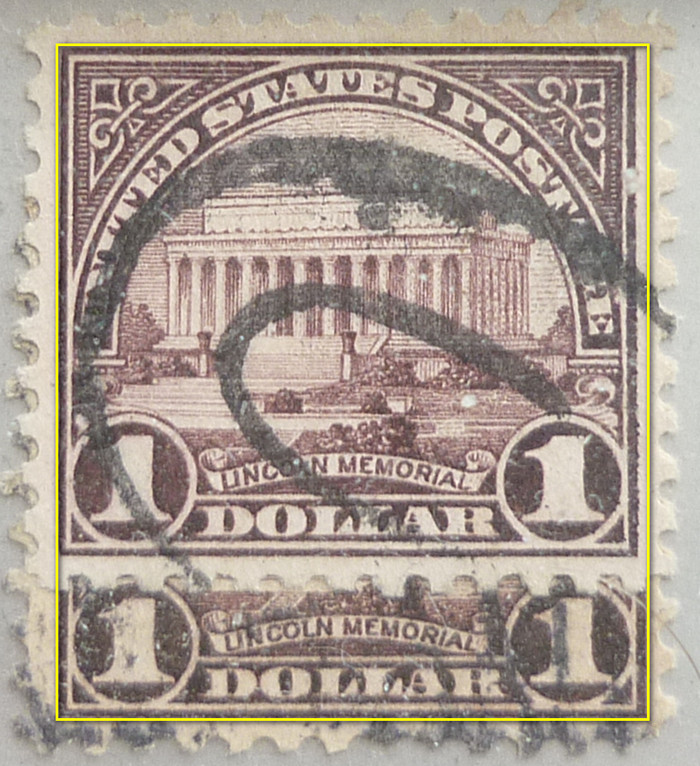 |
|
Send note to Staff
|
| Edited by stamperix - 09/19/2017 08:50 am |
|
|
Pillar Of The Community
3865 Posts |
|
|
The stamps with these overprints have a very specific gum breakers Type II which are 22 mm apart. |
|
Send note to Staff
|
| Edited by jogil - 09/19/2017 09:42 am |
|
|
Bedrock Of The Community
United States
10883 Posts |
|
|
These stamps were subject to a certain amount of shrinkage based on the grain of the paper. Size will never be an exact science, in this case there is only one type. |
|
Send note to Staff
|
|
|
Pillar Of The Community
United States
1756 Posts |
|
|
Quote:
The stamps with these overprints have a very specific gum breakers Type II which are 22 mm apart. Correct... the very first thing you want to look for when checking the Kansas-Nebraska's for authenticity, are the gum breakers... Below, is a plate # block of #662 for example... the second scan is the reverse where you can just make out the breaker, and the third is the same block with contrast and color balance adjusted... Note per Scott : "Nos 658-679 with original gum have either one horizontal gum breaker ridge per stamp or portions of two at the extreme top and bottom of the stamps, 21mm apart. Multiple complete gum breaker ridges indicate a fake overprint. Absence of the gum breaker ridge indicates either regumming or regumming and a fake overprint." 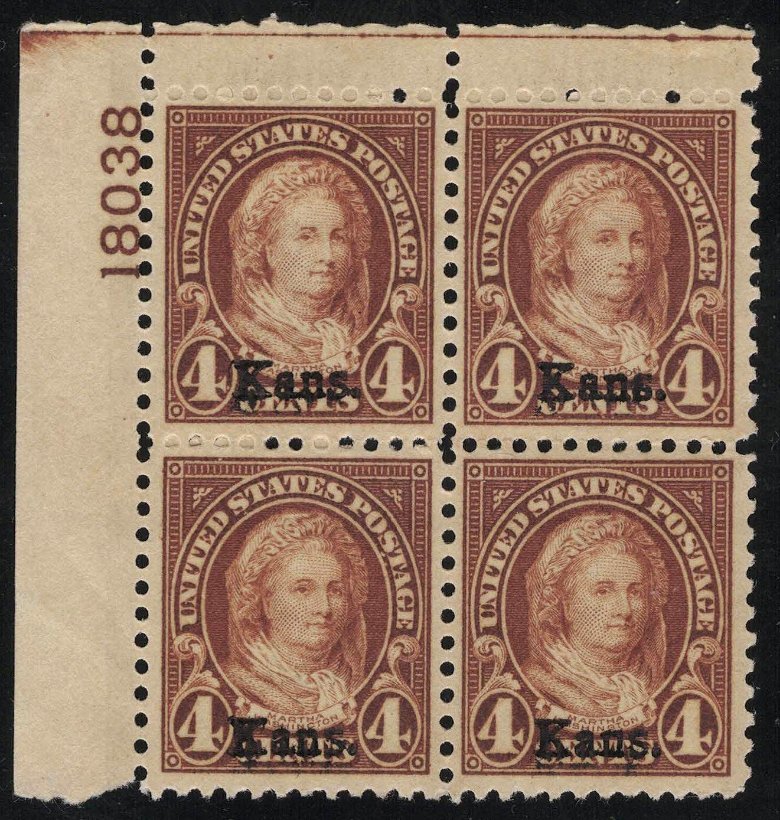 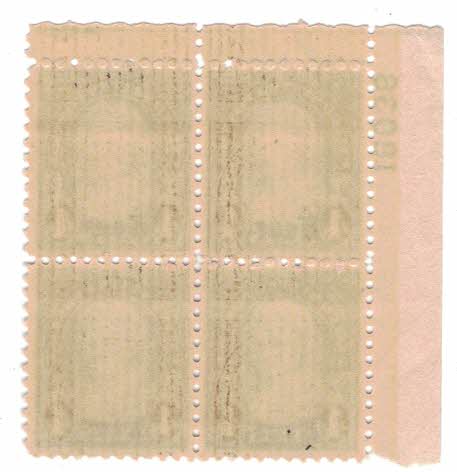 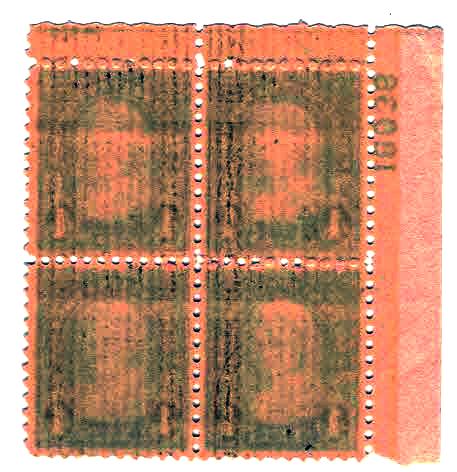 |
|
Send note to Staff
|
| Edited by disi123 - 09/19/2017 12:36 pm |
|
|
Pillar Of The Community
3865 Posts |
|
|
disi123: It is interesting that the back gum side of one of the Stickney rotary press corner plate blocks that you show has set-off. Set-off is usually found mostly on flat plate stamps which were stacked as sheets to dry after printing and before gumming so that the ink is on the paper under the gum. Stickney rotary press stamps were not stacked between printing and gumming to dry. Instead, the printed paper was a moving web roll that was dried by dryers on the press after printing and before gumming and dried again after gumming. If there was any chance for any set-off to occur, it would occur on the gum. It could occur after gumming and drying and before perforating when the printed paper web was rolled up to season before perforating. It could have occurred after the sheets were stacked together on top of each other before being cut into panes after being separated into sheets from the web roll by the perforator. It could have happened whenever the mint stamps with gum were stacked and stored on top of each other whether as panes, multiples, blocks, strips, pairs, singles, etc. receiving the image of the stamps below it. |
|
Send note to Staff
|
|
|
Pillar Of The Community
1375 Posts |
|
|
thank you all.
revcollector: You talk about the 571 with the shrinkage, right? Then this question is answered already, thank you. I was only wondering as it's really another size and aspect ratio, but both seem to be flat plate.
about the Nebr./Kans. stamps: Actually I dont't have to check any of them if they are fake, I even nearly don't have any of them. My question was more about the sizes of rotary stamps, as indicated in my first post. I also thought that there were two sizes to know, the flat and the rotary. But in Micarelli I saw now different "versions of rotary sizes". There is the normal 22.5mm height, but also the 22.75mm height. The 22.75mm height is listed for all stamps 1930 and later (except for 632 and 693), and also the Nebr. and Kans. stamps. So my questions were not directly about those and their the gum brakers (although this was interesting to learn) but only about the sizes of rotary stamps in general. I have noticed for example earlier already that some rotary stamps are taller than 22.5mm but never had an explanation for it. This is what I search for now. I can show later an example of a 633 which has minimum 22.75mm height like the Nebr. Kans. overprints but has no overprint and the wrong gum brakers.
---
jogil: just saw your post now. What a coincidence here, the 633 I mentioned also has this "setoff" on the gum, and I also think it's not a real setoff here. |
|
Send note to Staff
|
| Edited by stamperix - 09/19/2017 1:57 pm |
|
|
Pillar Of The Community
1375 Posts |
|
|
I took the following two stamps (582 and 633) out of the album to show the difference. According to Scott and Micarelli they should have the same size, as they are both rotary, so the 22.5mm height. But the stamp on the right has certainly 22.75mm or more. So there are different rotary sizes? Also note the nice "setoff" of the right 633 (a green stamp on the back, probably of a 632). 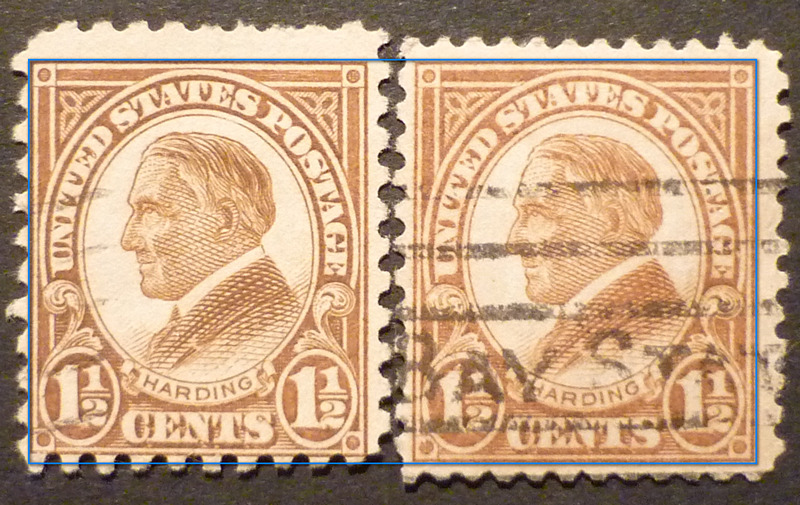 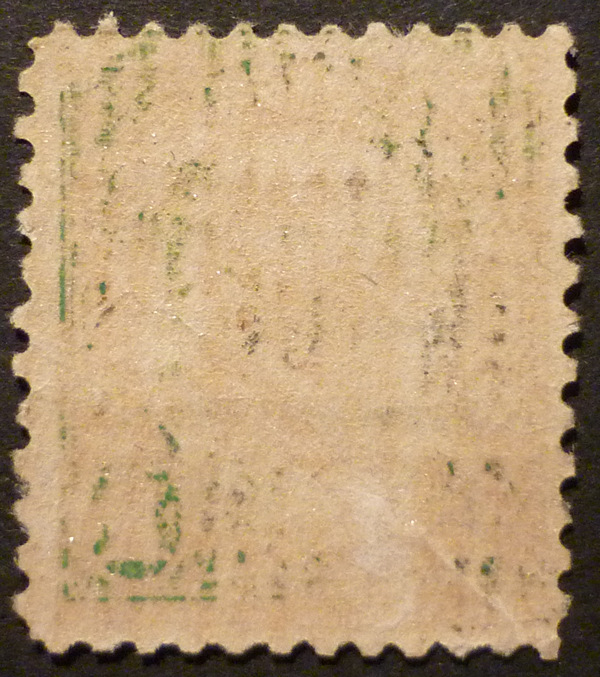 |
|
Send note to Staff
|
|
|
Bedrock Of The Community
United States
10883 Posts |
|
|
Pillar Of The Community
1375 Posts |
|
|
Yes as I said above it's not a setoff at disi's and not one at mine, I only showed it as it is still interesting. But the post is of course about the front of the stamp. |
|
Send note to Staff
|
|
|
Valued Member
Canada
29 Posts |
|
|
I would say that the stamp on the left is a Flat Plate printing. What are the perfs for those two stamps?
|
|
Send note to Staff
|
|
|
Pillar Of The Community
1375 Posts |
|
|
hi DeEll, they are perf 10, 582 (left) and perf 11x10.5, 633 (right), but the left one is 22.5mm. |
|
Send note to Staff
|
|
|
Pillar Of The Community
1375 Posts |
|
|
I did a long search for the 22.75mm height and didn't find anything saying that to a certain time the design switched from 22.5mm to 22.75mm as Micarelli suggests for the stamps after 1930 and the Nebr./Kans. stamps. Also, the information given in Micarelli about the 633 and its height seems to be wrong as my stamp has at least 22.75mm while in the book and in Scott it should be 22.5mm. It's now the 5th or 6th error I find in the book. After all I still don't know much about the different rotary sizes, and as a conclusion I think they don't exist as such. The differences are probably distributed irregularily over the stamps of that time due to smallest printing technology differences. Seems to be also the case earlier in time, as you can see in this - my last - example of size difference of this earlier 3c stamps. 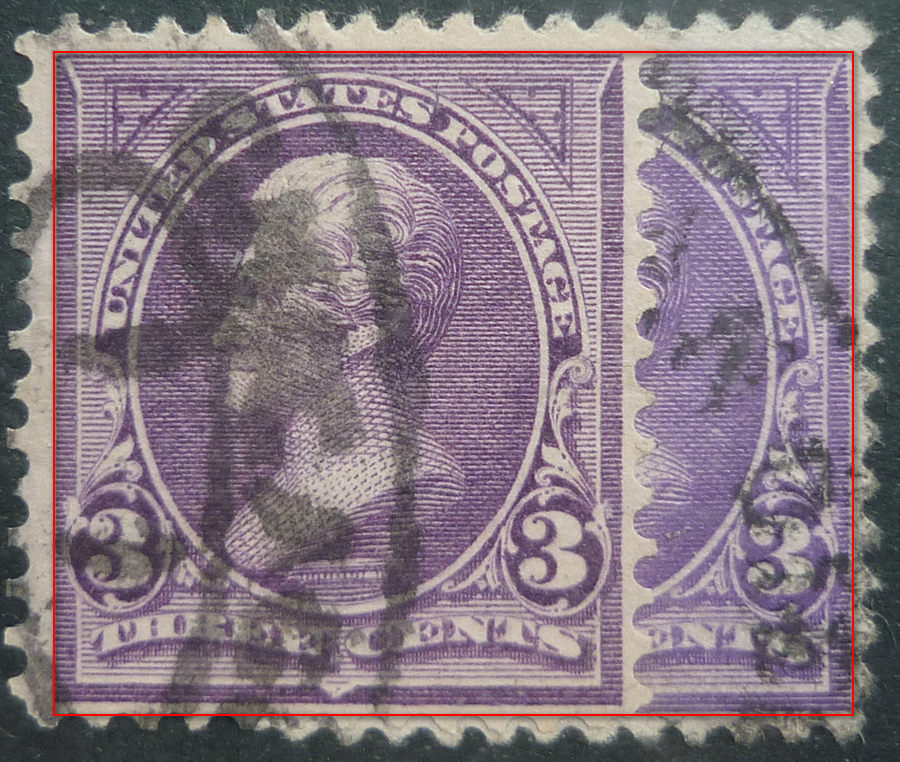 |
|
Send note to Staff
|
|
|
Pillar Of The Community
3865 Posts |
|
|
These old stamps were flat plate wet printed so that they can vary slightly in design size from each other, especially used stamps that have been soaked off paper and pressed to dry. |
|
Send note to Staff
|
|
|
Pillar Of The Community
United States
1875 Posts |
|
|
stamperix, it may be difficult to accept, but you are placing far too much emphasis and importance on the measurements given in the catalogs. They are not intended to mean 22.7500000 mm and 22.5000000 mm with no variance and no accounting for physical factors such as grain of paper, as Clark (cfrphoto) and other experts have repeatedly explained. They are merely approximations. This is a recurring issue in post after post in this forum. You will have continuing frustration if you focus on apparent failure to conform to exact measurements without understanding the production processes of these stamps and their effect on appearance and size. |
|
Send note to Staff
|
|
|
Replies: 23 / Views: 10,551 |
|



 Posted 09/19/2017 06:31 am


