| Author |
 Replies: 72 / Views: 17,791 Replies: 72 / Views: 17,791 |
|
|
|
Pillar Of The Community
United States
772 Posts |
|
|
rodgcam - keep in mind that outside North America, stockbooks and stock sheets are probably as common, if not moreso, for housing stamp collections than printed album pages. Album sales might be a good indicator for North America, but worldwide one would have to take into account different preferences for mounting/storing collections (speaking as a devotee of Vario stockpages myself, I used to have pre-printed albums but much prefer the greater flexibility that stock pages allow - and the fact that I do not have to devote a significant portion of my hobby money to purchase mounts for my mint hinged & never hinged either  ) |
Send note to Staff 
|
APS #173088
|
|
|
Valued Member
Canada
139 Posts |
|
|
If we as as collectors would show our collections to the general public, you'd be amazed at the reaction by J.Q Public. Every time some local fair or event is happening in Toronto and the organizers give me free space, I show a part of my collection. Kid's love it! Parent's love it. Stamp collectors are all around us, we just have to show them what they're missing! |
|
Send note to Staff
|
|
|
Rest in Peace
United States
4052 Posts |
|
|
The decline in the frequency of the search term 'stamp collecting' may have to do with the fact that, as the stamp collecting public becomes more net-literate, they use more targeted terms. After all, you only need to search on 'stamp collecting' once; after that, you'll be more specific. Promise! Consider the search term "power steering". There are more cars & drivers on the road than ever before. This particular feature has become so widespread as to become unremarkable and, indeed, the Google Ngram shows just how rarely is it remarked upon: 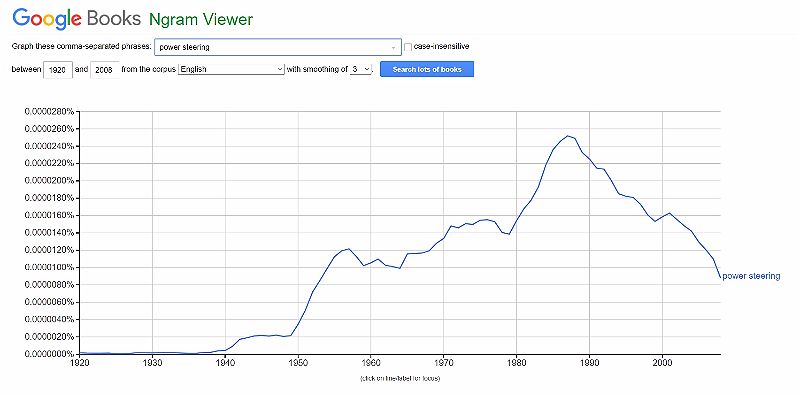 Q/ What conclusions would be draw about the future of the automobile from just the steep decline in searches for 'power steering'? Cheers, /s/ ikeyPikey |
|
Send note to Staff
|
|
|
Pillar Of The Community
United States
4174 Posts |
|
|
Quote:
eyeonwall - look at the rapid rise in values for material from China, India and Southeast Asia over the past couple decades - if the hobby was "dying" worldwide we would not have seen, or continue to see, prices for even "meat and potato" issues continue to strengthen As I understand it, the market in China is highly speculative and thus not the best reflection of actual collecting interest. As for the rise in values of Chinese stamps - this is old news and took place quite a few years ago - they are not continuing to rise. I have less of an understanding of the market in the rest of Asia. |
|
Send note to Staff
|
|
|
Pillar Of The Community
United States
4174 Posts |
|
|
Quote:
For example Indian commemoratives from the 1990s that were less than US$1 each at time of issue are now selling for several times that, if you can find them. For a long time now few dealers have been stocking new issues and those that do have been stocking fewer of them. |
|
Send note to Staff
|
|
|
Bedrock Of The Community
12721 Posts |
|
|
On the topic of new issues they sold at Rumsey's in huge quantites for under $200 per $10,000 in CV. Commonwealth, Europe, Scandanavia, Asia etc. Amazing. |
|
Send note to Staff
|
|
|
Pillar Of The Community
United States
4174 Posts |
|
|
Quote:
I also wonder about the argument that the 'greying' (aging) demographic is leading of the loss of memberships and decline of the hobby. It is well established that our hobby attracts older (40+) adults; so should not the greying of the population is good news for our hobby? While a bigger potential pool to draw from is certainly good, it does not help if a lower %age of them in inclined to join, so it is hard to guess which way that will play out. |
|
Send note to Staff
|
|
|
Pillar Of The Community
United States
4174 Posts |
|
|
rog - I think those new issues were from garbage countries and in duplication. |
|
Send note to Staff
|
|
|
Pillar Of The Community
United States
4174 Posts |
|
|
Quote:
I think that pricing/values is probably the worse example to use argue that the hobby is dying. Comic books, coins, baseball cards, antiques...every single collectable that had its marketplace turned on it ear when the internet became part of everyone's lives. Is the argument that ALL hobbies are in a steep decline? I don't know about "steep", but yes most traditional hobbies are in decline. |
|
Send note to Staff
|
|
|
Pillar Of The Community
United States
4502 Posts |
|
|
Are some confusing hobby of collecting stamps and business of buying/selling stamps for a living? The internet has helped the hobby of collecting stamps dramatically and impacted the traditional dealer who thinks a stamp soap and going to shows is the way to sell stamps.
The internet has removed the need for a middleman for many transactions. This is common with other collectibles as well.
People complain about the declining hobby almost always when trying to sell stamps. But, prices have not been dropping dramatically as much as the people who claim it is dying.
|
|
Send note to Staff
|
Al |
|
|
Moderator
1589 Posts |
|
|
ikeypikey,
The Ngram chart you post of "power steering" isn't tracking the popularity of "search terms." It is an index of the occurrence of words in the corpus of books that Google has scanned. There is probably a different explanation for the decline depicted in the appearance of the words "power steering." I alluded to it when I posted my Ngram charts of "stamp collecting" and "philately." The corpus of material that Google is scanning has grown exponentially over time, and is especially influenced, if not dominated, but a significant increase in technical and scientific literature. Understand that Ngram is basically platting a fraction, a numerator over a denominator. Even if the numerator is increasing, if the denominator is increasing faster, the fraction will decline. That's the caveat I mentioned when I posted the Ngram charts.
That said, I personally think the hobby is in stasis, if not in decline. But I would base it more on the fact that as a generalization the only philatelic materials that is increasing in real value over time (i.e. faster than inflation) is that we see being traded in the 5-7 figure range (transactions which Linn's is always happy to report on its front pages). If, in proportion to society as a whole, philately were as popular today as it was in the early part of the 20th century, common philatelic material would do a better job of holding its value against inflation. That it does not hold its value against inflation is evidence of a weak demand in relation to supply.
Angore has some thoughts about how the Internet has revitalized collecting, and I think they have merit. But in my mind that has just stemmed the tide in the decline, and has not reversed it per se.
Basil |
|
Send note to Staff
|
| Edited by blcjr - 10/17/2017 07:36 am |
|
|
Moderator

United States
12330 Posts |
|
|
Basil,
How does Google select the books they scan? I agree that there is a large amount of technical and scientific literature but I also think they have a very large percentage of public domain works and very little copyrighted works (for obvious reasons).
Don |
|
Send note to Staff
|
|
|
Moderator
1589 Posts |
|
|
Good question, Don.
I think they do scan copyrighted works. Copyrighted works show up in searches of books.google.com all the time, but only a limited view of what's in the work is shown and this is based on permissions granted by the copyright holder.
So the interesting question -- and I don't know the answer for sure -- is whether Ngram includes in its search all the copyrighted books that Google has scanned. I'm inclined to think that it does, but that is just a wild eyed guess.
And from reading one of the articles about Ngram that you linked to, I might conclude that all of the technical literature that Google has obviously scanned for its scholar.google.com service is also part of its "corpus" for Ngram. So I think it a lot more than just public domain works.
Basil |
|
Send note to Staff
|
|
|
Moderator
United States
12330 Posts |
|
|
I have been thinking about eyeonwall's opinion that " most traditional hobbies are in decline". I find this an interesting comment since it moves the discussion beyond just stamp collecting. I'll ignore the use of the word 'traditional' for a moment. Surely no one thinks that ALL hobbies in general are declining; I assume that humans always have always had 'leisure time' and we tend to fill that time with activities that we give hobby names to. So first challenge is to understand if the amount of leisure time is changing. I would define leisure time as any time that is NOT spent on eating, sleeping, working, education, business or any other 'necessary' activities. In the US, the amount of leisure time has increased. According to a study done by the Heritage Foundation... Quote:
Since the mid-1960s, the amount of time that the typical American spends working fell by almost eight hours per week, while the time spent on leisure activities rose by just under seven hours per week. This additional leisure time is equivalent to an extra seven to nine weeks of vacation per year… The amount of money Americans spend on recreation has steadily risen since 1970, and more Americans take part in various recreational activities than a generation ago. I am not sure if this trend is the same across the rest of the world but an guessing that it is true for most industrialized countries. It should also be noted that 'leisure time' is not always the same as 'hobby time' but hobby time is always a part (subset) of leisure time. For example consider the invention of television, this had a significant impact on our leisure time but few people would consider watching television as a hobby. So here is an example of a leisure time activity which is competing with hobby time. Things like Xbox, Nintendo, would typically be classified as competing activities to true 'hobby time' by most folks. So over the decades, has the total number of competing leisure time activities outpaced the increase in leisure time? Don |
|
Send note to Staff
|
|
|
Moderator
1589 Posts |
|
|
Quote:
So over the decades, has the total number of competing leisure time activities outpaced the increase in leisure time? Don, The question is more complicated than that. A generation ago a landmark book in economics was published entitled "The Harried Leisure Class." The gist of the book's thesis is that as leisure time grows, more and more is spent on "things" to occupy this leisure time that in fact prove to be counterproductive. A classic example is a swimming pool. One succeeds to the point to where they can "afford" a swimming pool. So they get one. Now they find that they have to use up a lot of their precious "leisure time" keeping it clean, or work harder to make more money to pay somebody to keep it clean. Related, can we really speak of increasing "leisure time" when it is accompanied by having to have a second income to afford the "things" one needs to enjoy it. Think of all the two-income families now, where one or two generations ago there was a just a single "bread winner." When we look at how mom and dad are now running around all over the place taking kids to this event, and that event, in their "off" time, is that really "leisure?" The statistics you allude to referring to an increase in leisure time apply to people still working. If they have kids, kids and not hobbies are going to dominate how the leisure time gets used. How many are using that leisure time with their kids in stamp collecting? Retirement, rather than leisure time, brings far more people into, or back into, the hobby, I think. Basil |
|
Send note to Staff
|
|
|
Replies: 72 / Views: 17,791 |
|



 Posted 10/16/2017 6:13 pm


