| Author |
 Replies: 58 / Views: 8,966 Replies: 58 / Views: 8,966 |
|
|
|
Pillar Of The Community
Canada
644 Posts |
|
|
Sometimes the weave of the paper, or the fact that it is used and has been soaked, can make up the slight variation in perforation. Also, it can be a bit of a trick to get exact at this scale.
Stick with the gauge (not the calculation - which is good in theory if the assumption about the number of holes/2cm is correct - not certain it is a correct assumption for this issue).
Take time to measure other examples as opportunity allows and things will start to fall together.
On the positive side, you have a nice copy of a rare perforation 2c Registration stamp. |
Send note to Staff 
|
|
|
Rest in Peace
Canada
5701 Posts |
|
|
Quote:
Stick with the gauge (not the calculation - which is good in theory if the assumption about the number of holes/2cm is correct - not certain it is a correct assumption for this issue). I completely disagree. The more the holes that can be measured, the more accurate. The gauge is measuring over 18 holes, the ruler over 26. Both are doing the exact same thing, measuring the number of perfs per 2cm, so I don't understand what you are saying. As Stamperix found out, those Instanta gauges are very difficult to use. They are made of plastic and have a much different thermal expansion than paper. Over the years they may become inaccurate. I would guess the stamp is perf 11.94, from a known perforating wheel of 192 pins on a diameter of 4-1/32". http://www.stampsmarter.com/learnin..._canada.html |
|
Send note to Staff
|
|
|
|
Pillar Of The Community
1375 Posts |
|
|
I think both ways can be ok. But what is for sure: the 2c has not the standard 11.9 perforation at top and bottom. I looked further and used now the following gauges: US Multigauge (reight side similar to Instanta): 11.8 Instanta (yellow): 11.8 BeeSee's gauge: better fit to 11.75 than to 12 Lighthouse gauge: better fit to 11.75 than to 12 And: The 5c I show here (in one scan together, no photo) is different, while it should be the same 11.9? 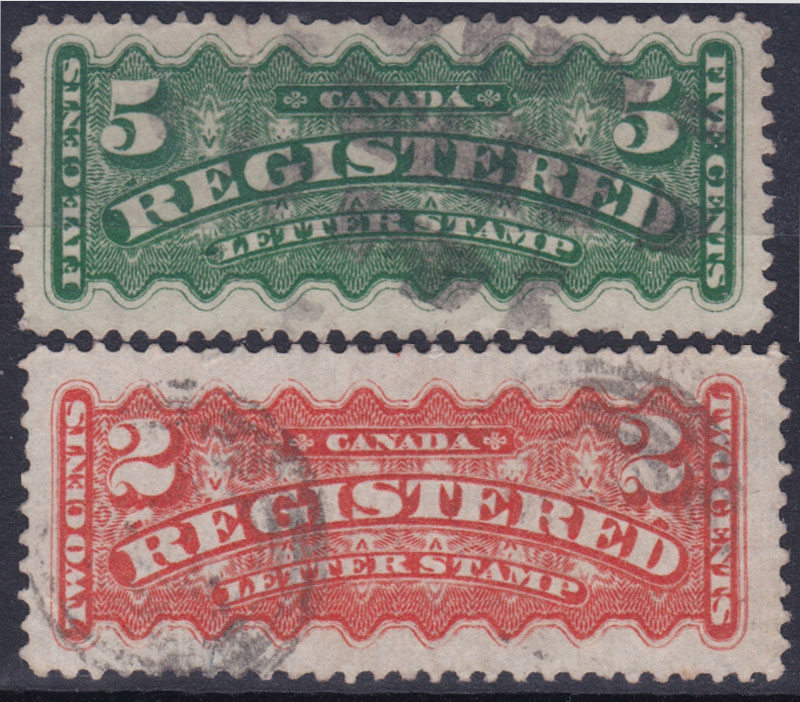 |
|
Send note to Staff
|
|
|
Pillar Of The Community
Canada
644 Posts |
|
|
There were more than one printing and the perf ranges vary. I don't have the list handy, but I believe ~12 is more common than 11.9. You really need to get some reference materials if you are interested..
BeeSee, my point about the calculation is that it may not match up with the gauge that is considered the standard tool for specialists of the Small Queens (the Registration stamps were printed around the same time).
If the calculations work, that's great (just trying to keep things simpler for a someone new to these stamps). |
|
Send note to Staff
|
|
|
Pillar Of The Community
607 Posts |
|
|
BeeSee is offering you good advice. The more perf holes you can use to measure, the better. A metal ruler and a calculator is perfectly fine for perf measurement.
The difference between 12.0 and 11.9 is truly an exercise in splitting hairs. Don't fool yourself into thinking you can measure perfs to 1:120 accuracy with any device. One slightly bent perf pin will change the reading.
One thing was bugging me about this thread. Maybe someone mentioned it. The convention is to list horizontal perfs first, then vertical. The rare compound perfs are 12 X 11.5, not the other way around. |
|
Send note to Staff
|
|
|
Pillar Of The Community
1375 Posts |
|
|
Thank you, BeeSee, for giving me the opportunity to test your gauge as PDF. I printed at 100% on high quality paper and: now I have a really good perforation gauge :). I tested the millimeter lines with a industry calibrated metal ruler to be exact. Also I tested some standard perforations (like 12) with the - very accurate - Phil-a-meter gauge. Everything is fine. So I continued to look at my registration stamp.
With the new gauge it's all very clear. The perforation of the 2c registration stamp is 11.9 x 11.6. The top and bottom fits (the best) to the following perforations on the gauge:
- standard gauge: 12
- decimal gauge: 11.9
- Kiusalas gauge: 11.93
- queen gauge: 11.94
It's really interesting that a self-printed gauge is more exact than those gauges of Instanta (old yellow and new transparent being the yellow a bit more accurate).
I had a great start into this Canada area, and with the new gauge I will be happy to look at my small queens again. |
|
Send note to Staff
|
|
|
Rest in Peace
Canada
5701 Posts |
|
|
I am glad it worked out for you Stamperix. The important thing is that whatever tool is used, it must be calibrated. |
|
Send note to Staff
|
|
|
|
Pillar Of The Community
3865 Posts |
|
|
BeeSee: Thank you very much for your very fine perforation gauge. It is the most precise perforation gauge that I have ever used. |
|
Send note to Staff
|
| Edited by jogil - 11/29/2017 10:21 am |
|
|
Rest in Peace
Canada
5701 Posts |
|
|
Jogil thanks for your help in developing it! And Mr W of course  |
|
Send note to Staff
|
|
| Edited by BeeSee - 11/29/2017 3:00 pm |
|
|
Pillar Of The Community
1375 Posts |
|
|
Just to do some honor to the title of the thread, I would like to write something about the small queens I looked at now with the new gauge. First, BeeSee: I saw in another topic that you found a 1886 12.25 perforation and wondered why so early. Just if it helps your research: I also found a 1886 with 12.25. Did you in the meantime find out anything about this? Second, I found some small queens with 12.25 only on one side. At Hillson and also in this interesting article: http://canadianphilately.blogspot.d...initial.html I only found perforations "same all round" or the same at the opposite sides. But I also found that the perforation to that time was just made not perfect, so do stamps exist with only perforated different at one side? |
|
Send note to Staff
|
| Edited by stamperix - 11/30/2017 04:31 am |
|
|
Rest in Peace
Canada
5701 Posts |
|
|
Some have suggested my 1886 12.25 is actually "98" with the date inverted, but that is not the case. The paper and shade are of the mid 80's. I also have one dated 1887 and 1991. I also have a few undated 12.25 with guide dots, so they have to be from mid to late 1880's.
On all my examples, I am referring to the vertical perforations. Even with my gauge, it can be difficult to measure the horizontal perforations on single stamps, but they appear to be between 12.19 and 12.25. definitely above 12.0.
I would really love to see and measure any pairs or greater of the 12.25 stamps! I don't have any...
|
|
Send note to Staff
|
|
| Edited by BeeSee - 11/30/2017 09:45 am |
|
|
Pillar Of The Community
1375 Posts |
|
|
I don't have any pairs either. But I can show you my "86" stamp - I read this like Montreal 1886? Sadly it's damaged. Also, I show an example of a stamp with only one side 12.25. My question was if at classic Canadian stamps there can be all kind of perforation combinations also for one side, or if those are always all around or for opposite sides? This is what I found at the mentioned sites. 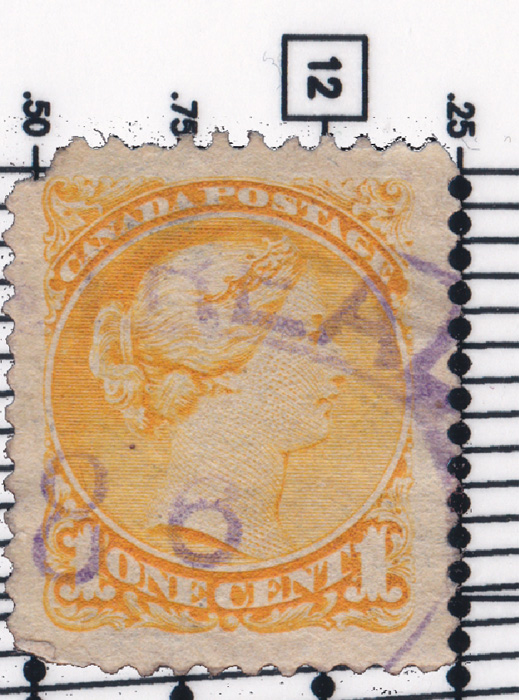 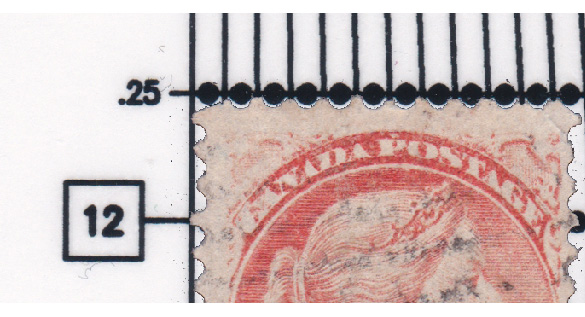 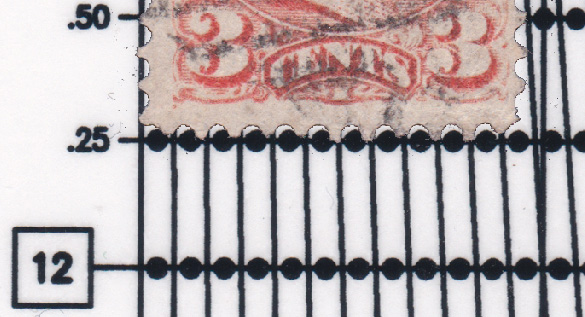 |
|
Send note to Staff
|
|
|
Rest in Peace
Canada
5701 Posts |
|
|
Stamperix, your 1c could very well be an 1886 date, but it also looks like a revenue cancel. That could indicate that the number may not be a date, but perhaps a bank branch or teller number. It is 11.25 anyway.
I have heard about compound perfs, for example different on the top and bottom for small queens, but I don't think I have any.What does the bottom on your 3c stamp shown measure? It looks closer to 12.0 or 12.1?
It is hard to measure the horizontal sides. Sometimes bent pins can give a false reading. |
|
Send note to Staff
|
|
|
|
Pillar Of The Community
United States
3224 Posts |
|
|
Sorry to jump back to the Registration stamp, but can anyone tell me the method for perforating the Registered? Specifically, was it an L-perforator or other flat perforator (typical British Empire method) vs. the rotary perforator being used in the US around this time? I already looked in Boggs and Robson Lowe in Registry stamps; no help there. The reason I ask is because comparing the top of the 5c with the bottom gives this: 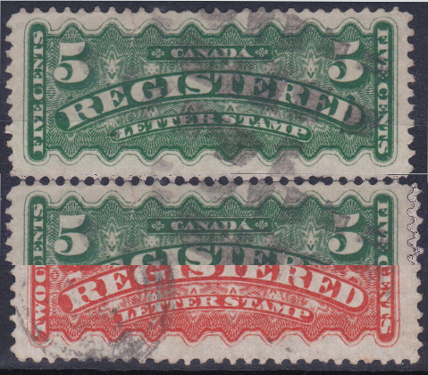 I'm seeing an "abrupt" gauge change at about the 8th perf hole from left in stamperix's original scan. But comparing top and bottom of the same stamp, to me the perfs match extremely well, considering erosion, bent pins and suchlike. So, firstly, no reperfing to my thinking. Now take that left section and do this: 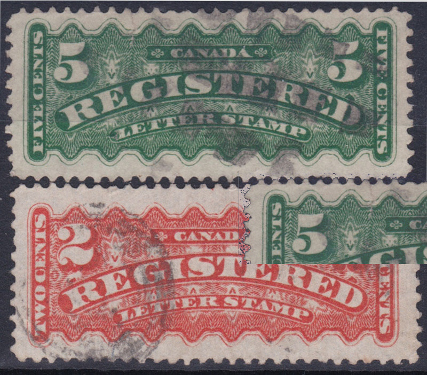 and again, considering erosion, bent pins and suchlike, that right side is the same gauge. So there's a shifted section of perfs horizontally. This can happen with a flat perforator as it advances across a sheet (horizontally here, if the thought is correct) and does not align perfectly with the section it has just punched. Since those machines can do several rows at once, this misalignment doesn't happen with every stamp. Of course, if a rotary perforator was used for these, then that's all wrong. |
|
Send note to Staff
|
| Edited by hy-brasil - 12/01/2017 1:26 pm |
|
|
Rest in Peace
Canada
5701 Posts |
|
|
Replies: 58 / Views: 8,966 |
|




 Posted 11/28/2017 3:05 pm


