| Author |
 Replies: 16 / Views: 7,836 Replies: 16 / Views: 7,836 |
|
Valued Member
United States
166 Posts |
|
|
I have a large collection of Latvia Cinderellas but Have never come across 1) Overprints and 2) Used stamps. If anyone can help me with their experience I would be interested to find out more about these two I have found. 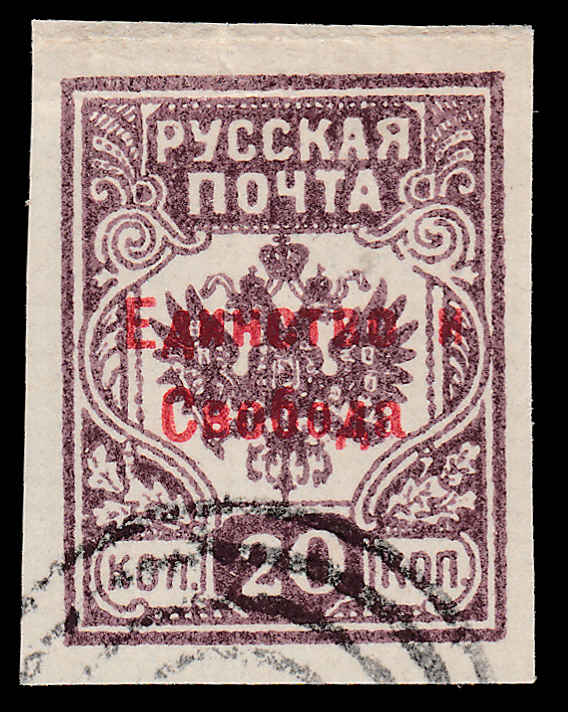 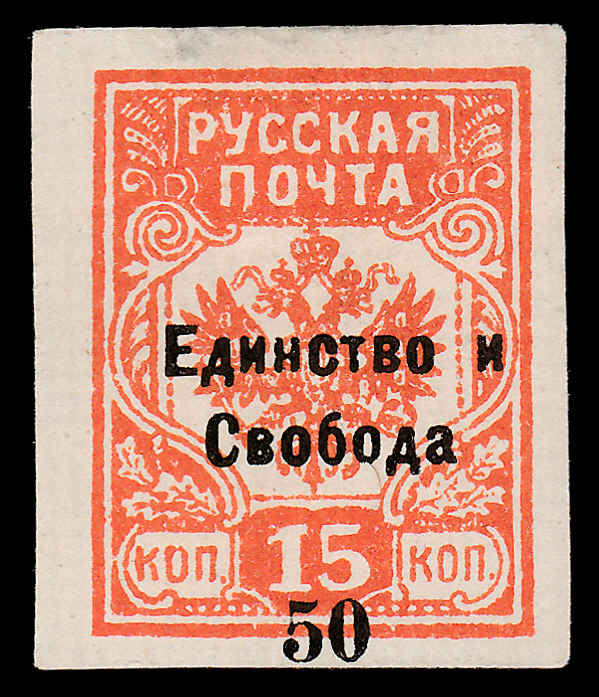 |
|
Send note to Staff
|
|
|
|
|
Valued Member
Latvia
60 Posts |
|
|
Are these considered cinderellas if they were intended for postal use but never used? Overprints are of private origin, the cancel looks like Russian Empire WW1 mute cancel. |
Send note to Staff 
|
|
|
Pillar Of The Community
United States
572 Posts |
|
|
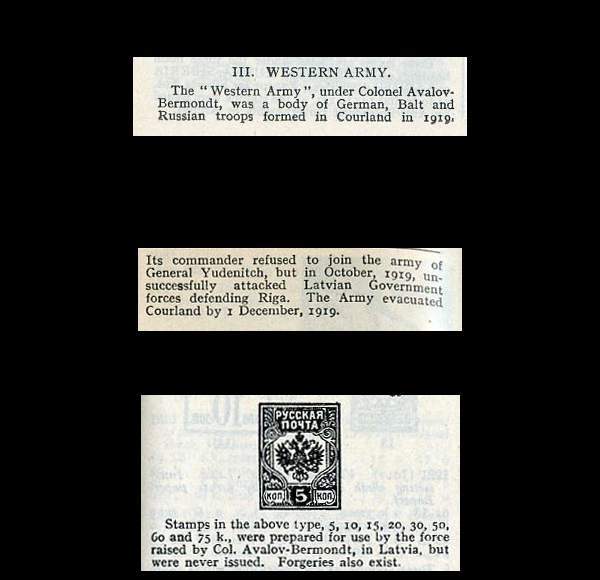
The un-overprinted ones are listed in Scott's under Latvia behind the occupation stamps. They were prepared in 1919 but never placed in use. They exist perf and inperf. Reprints and counterfeits exist. There are 8 values in the set. Scott's calls them stamps but does not assign them a number. |
|
Send note to Staff
|
| Edited by John Freibergs - 11/27/2017 2:43 pm |
|
|
Valued Member
Latvia
60 Posts |
|
|
Pillar Of The Community
United Kingdom
1255 Posts |
|
|
I have non-overprinted stamps on both thick, greyish carton paper and thinner white paper. I think the ones on white paper are the forgeries but the print quality is the same for both. I've not seen these overprints before. |
|
Send note to Staff
|
|
|
Bedrock Of The Community
Australia
38679 Posts |
|
|
Pillar Of The Community
United States
572 Posts |
|
|
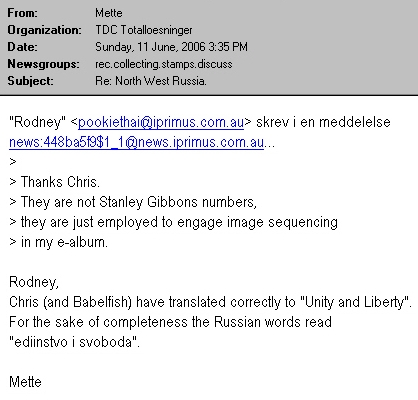
It would be interesting to know who dreamt up the overprints and for what reason. Some political reason? Or a stamp forger/dealer looking to make a fast buck? I have a pair of identical overprints unused that I bought simply because I knew what the stamps were before the overprint so they do exist out there. |
|
Send note to Staff
|
|
|
Pillar Of The Community
United Kingdom
3220 Posts |
|
|
Hi edgarsrasa,
I believe the basic stamps shown here are reprints rather than forgeries.
There has been controversy over the years about many aspects of these stamps including the basic question of which stamps were from the original plates and which are forgeries.
For a reference, I'd suggest:
The Postage Stamps of Russia: 1917-1923, Volume 3. The Armies & Post Offices, Parts 16-18 Russian Post Offices in the Levant and White Armies by Dr R. J. Ceresa (1990).
|
|
Send note to Staff
|
Nigel |
|
|
Pillar Of The Community
United Kingdom
3220 Posts |
|
|
There was a huge demand in the packet trade for these Western army eagle stamps so the stamps were reprinted over and over again with the print quality gradually getting worse.
There are also at least three different types of forgery.
I expect that this overprint was invented just to make more varieties to sell to the trade.
|
|
Send note to Staff
|
Nigel |
|
|
Valued Member
Latvia
60 Posts |
|
|
Nigelc, could you post an excerpt from that book regarding this issue? I do believe the article written in 2011 I linked really clears up the process of identifying real and fake stamps and actually the ones with wavy value box lines are fake but the straight ones are real. 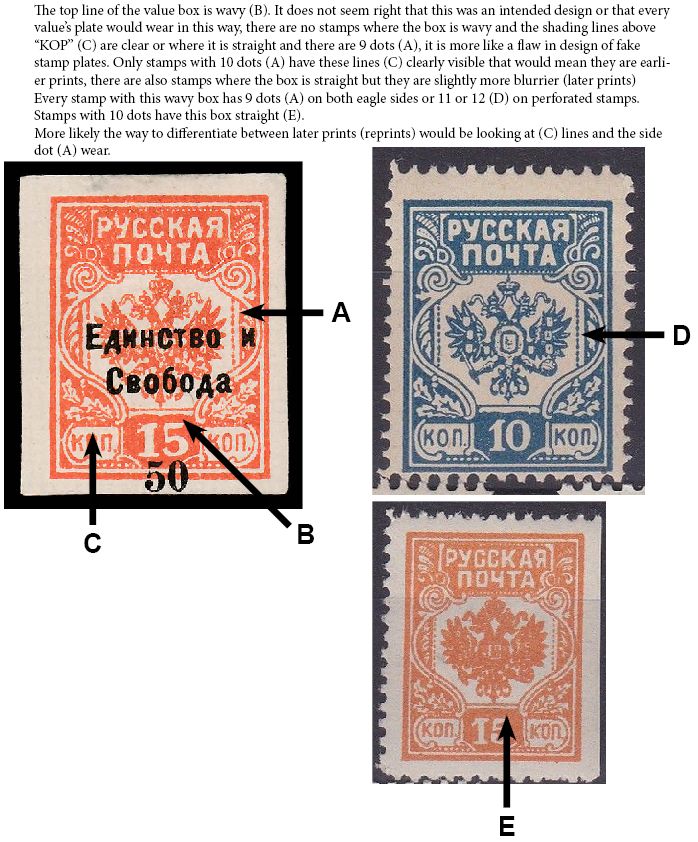 |
|
Send note to Staff
|
|
|
Pillar Of The Community
Norway
1661 Posts |
|
|
Pillar Of The Community
United Kingdom
1255 Posts |
|
|
Pillar Of The Community
United Kingdom
3220 Posts |
|
|
Hi edgarsrasa,
I'm afraid Dr Ceresa's books aren't easy to scan and I don't want to damage this one. However, I'll try and cover the relevant points.
He covers the eagle issue and forgeries in 14 pages of the book that I quoted.
The link you gave earlier quotes Varro Tyler from 1983 so the following extract from Dr Ceresa's 1990 book may be of interest on the question of assigning orginal/reprint and first forgery stamps:
This issue has been more thoroughly covered than any other attributed to the Western Army and has been the most abused, see Bibliography. The most recent publications know to me are those of V. E. Tyler in the American Philatelist under the "APS Project Fakes". He referred extensively to the article published in the BSRP Journal, based upon a BSRP Research Group's findings which we had initiated but unfortunately he at first drew a wrong conclusion in identifying the "genuine issue", identifing my F1 Type as the genuine and the genuine as his F1. Later in correspondence with me he came round to my way of thinking , expressing my views in a follow-up article in the same Journal.
He then discussed the different paper types, shades, reprints, varieties, postmarks, forgeries etc.
He refers to the "BSRP" which is the British Society for Russian Philately.
Its journal is The British Journal of Russian Philately.
Dr Ceresa describes three main forgery types which he calls F1 to F3 and further separates F1 into various sub-types.
He characterises his F1 forgery as following:
(a) The flag-like ornament near the "R" is rounded instead of pointed.
(b) The last letter of "Russkaya" has a rounded top instead of a flat top (most marked).
(c) There are small individual dots for the side chains.
(d) The value tablet has a straight top instead of a dimpled curve.
(e) The 2nd and 3rd leaves at the top are almost without shading.
(f) Unlike the genuine 5 kop. value, there are no white lines on either side of of the "5".
|
|
Send note to Staff
|
Nigel |
|
|
Valued Member
Latvia
60 Posts |
|
|
I guess I have added more to the misinformation behind this issue. Sorry about that. Could you post the other 2 forgery types? |
|
Send note to Staff
|
| Edited by edgarsrasa - 11/28/2017 10:47 am |
|
|
Pillar Of The Community
United Kingdom
3220 Posts |
|
|
Dr Ceresa describes his F2 forgery as follows: (a) An extra line around the inner shield on the eagle's chest. (b) Sceptre is more prominent with more white and even outline. (c) The bar to the right-hand acorn is smaller than on genuine. (d) There is no horizontal bar to the cross of the crown. (e) The ribbon from the crown is not shaded. and he describes his F3 forgery: (a) The wreath around the central arms gives the impression that it is mounted on an inverted hot-water bottle. (b) The right hand acorn does not have a horizontal bar as per the genuine stamps. (c) The clean white sceptre, unbroken by shading but [not] so distinctive as Type F2. (d) Leaf at top right joins the reversed "D" on that side. I like the hot-water bottle description!  John Barefoot's booklet, Forgery & Reprint Guide 16 Western Army Eagles describes the same three forgeries in less detail but calls Ceresa's F2 the "third forgery" and Ceresa's F3 the "second forgery". |
|
Send note to Staff
|
Nigel |
|
|
Valued Member
Latvia
60 Posts |
|
|
F2 (C) is the stem of the acorn?
F3 (B) means that genuine stamps right acorn does not have that horizontal line? |
|
Send note to Staff
|
| Edited by edgarsrasa - 11/28/2017 1:13 pm |
|
|
Replies: 16 / Views: 7,836 |
|



 Posted 11/27/2017 2:15 pm