| Author |
 Replies: 11 / Views: 1,701 Replies: 11 / Views: 1,701 |
|
|
Pillar Of The Community
United States
3529 Posts |
|
|
|
We had some discussion recently on the possibility of some sort of decision-tree type of plating project for the 1c stamp.
Right now, I'm speaking largely about something that might focus more on targeting harder-to-plate stamps, such as Transfer Roll #1 A reliefs, but not necessarily limited to them.
Njs900 called me just now, and we had a discussion to this effect. He, and apparently, one other person, have done some work on their own towards using Excel spreadsheets for this purpose. Njs has already spent some time thinking about key parts of the stamp design to target, and one possible way of encoding this, which he is already doing. He described it to me, and some of what he is doing was quite clever, I thought, and helps circumvent some of the subjectivity in doing this. I'll leave it to him if he wants to explain any of that here, or off-board on-demand.
One of the problems with this, is you need to see multiple copies of stamps from each position. For example, if an ornament is to be called 'short', or 'broken', you need to be sure it isn't a dry printing variety, where it just appears missing.
Right now he has been working on Plate 2 of the 1c stamp.
Neither he nor I have sufficient time to drive such an effort, but he is looking for people to correspond with and share ideas and notes with on such a project. There is someone he indicated to me, whom he is hoping might drive the effort - TBD.
Anyway, I'm starting this thread, to see if any 1c'ers out there would be interested in participating in such a project. Now, I'll just envision what it might involve, and say - there would be a list of criteria - places to look at on your stamps, and states of those places to be recorded for each. I don't know what the scope of it would be -- i.e. Transfer roll #1 stamps only, or more.
Speaking for myself, if this got going, I'd be happy to fill in the blanks for the 1c stamps that I currently hold, over time as I can get to it.
Anyone else who might be interested, please indicate so, by posting in this thread, and we'll see if this goes anywhere.
|
|
Send note to Staff
|
|
|
|
|
Pillar Of The Community
United States
1341 Posts |
|
|
I am very interested in participating in this project. I have been going over numerous ideas on how to do this on my own. |
Send note to Staff 
|
|
|
Valued Member
United States
103 Posts |
|
|
Pillar Of The Community
United States
1820 Posts |
|
|
Pillar Of The Community
United States
1341 Posts |
|
|
Moderator

United States
12330 Posts |
|
|
Pillar Of The Community
United States
1341 Posts |
|
|
No, Don. They were not talking about type Id, they were talking about plating starting with plate 2 according to the completeness of certain ornaments. |
|
Send note to Staff
|
|
|
Pillar Of The Community
United States
3529 Posts |
|
|
njs had suggested this, so I'll defer to him to answer.
Its a really good and clever idea, as he pitched it to me, but, like anything, its time consuming, and people involved have lives. We'll see what he says. |
|
Send note to Staff
|
|
|
Moderator
United States
12330 Posts |
|
|
Here is the decision tree/flow chart that I did for Douglas and the existing Stamp Smarter tool. 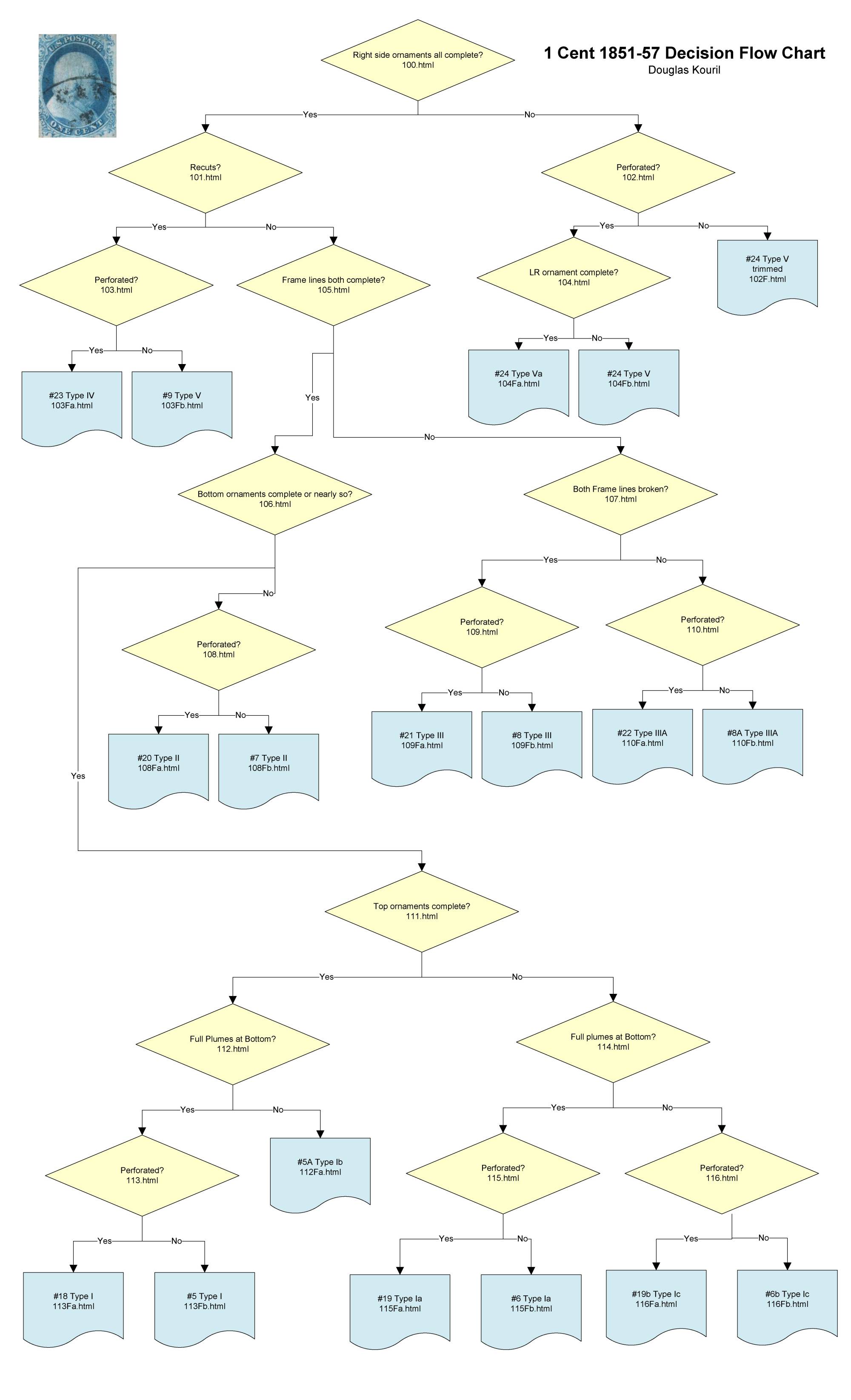 Don |
|
Send note to Staff
|
|
|
Pillar Of The Community
United States
3529 Posts |
|
|
That's wonderful. I had seen that and its great.
What we're talking about here is a different thing - its not a "Type" decision tree, but, rather a plating decision tree for certain stamps.
Essentially njs has made some extremely subtle observations about characteristics of some Transfer Roll #1 mostly Ty II (plate 1E,2,3) stamps, as opposed to others. By categorizing these very minute differences, we can more easily plate stamps which would be otherwise really hard to plate.
Many plate 2 stamps are tough to plate, for example. By driving down the criteria to even smaller minutia, and discretely classifying it according to this new criteria, it could really help plating some of these really difficult patients.
This is not about determining "Type", but, rather plate position.
If this project does get off the ground at some point, we might ask for your advice or help on ways to record it. I believe he is using a spreadsheet solution right now... |
|
Send note to Staff
|
|
|
Pillar Of The Community
United States
1820 Posts |
|
|
For the Type Identification decision tree that Don illustrates above I originally used PowerPoint in a very clumsy manner. He implemented it as a flow chart using Visio that is infinitely more elegant. I'm sure that he could find equally elegant solutions for the plating decision tree project. |
|
Send note to Staff
|
|
|
Pillar Of The Community
United States
1341 Posts |
|
|
I was trying a similar thing with plate 1 late using excel. I am trying to do it without looking at the top and bottom recuts or the guide dots. Relief B is just as hard as relief A if guide dot is missing. I would like a copy of the code for the type program to alter it for what I am doing. I cannot write code from scratch but I can understand it and change it to fit my needs. |
|
Send note to Staff
|
|
| |
Replies: 11 / Views: 1,701 |
|




 Posted 12/13/2017 2:48 pm


