Stamp Community Family of Web Sites
Thousands of stamps, consistently graded, competitively priced and hundreds of in-depth blog posts to read


Stamp Community Forum
 
Username:
Password:
Save Password
Forgot your Password?

This page may contain links that result in small commissions to keep this free site up and running.

Welcome Guest! Registering and/or logging in will remove the anchor (bottom) ads. It's Free!

What Belongs In A Stamp Catalog?

 
To participate in the forum you must log in or register.
Author Previous TopicReplies: 11 / Views: 2,030Next Topic  
Rest in Peace
United States
1189 Posts
Posted 12/16/2017   11:13 pm  Show Profile Bookmark this topic Add Stampman2002 to your friends list Get a Link to this Message
The problem with much of the ephemera and printing related material is that it has come on the market long after the people who created it have passed, leaving many unanswered questions.

This applies to photographic material as well as the engraved emanations which are shared here.

When does material, such as die work or photographic work, become directly related and collectible as part of the story behind the production of the stamp?

The card and india proofs of the 19th century were products of the USPOD, but had nothing to do with the stamps when they were issued. I'm particularly referring to the P1-P4 proofs here. These are all Scott listed.

There is a lot of material which I believe should be listed, but still has not made its way into the catalogs. These include photographic essays and publicity materials, including publicity photos. Some of this material should be considered essays as they vary greatly from the finally issued designs.

Here's an example of what I'm talking about.

The stamp in question is Scott 1135, the 1959 100th Anniversary of the American Dental Association stamp. The first image is the actual stamp.



Before the stamp was issued, a publicity photo of the expected design was prepared and mailed out. This is shown below.
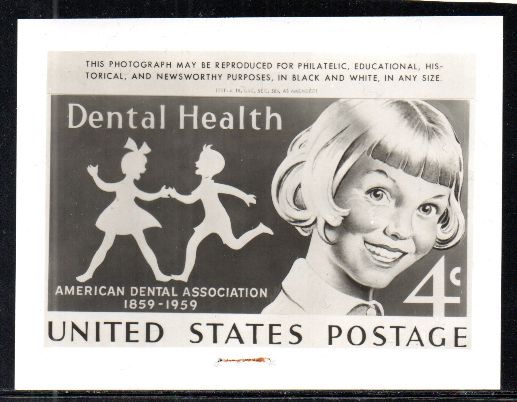


Evidently, feedback about the little girl in the image, either from the editors and cachet makers who received this publicity photo, or from someone in the USPOD, caused the change to the issued design. A second publicity photo was prepared and released, showing the finally adopted and issued design. This is shown below.
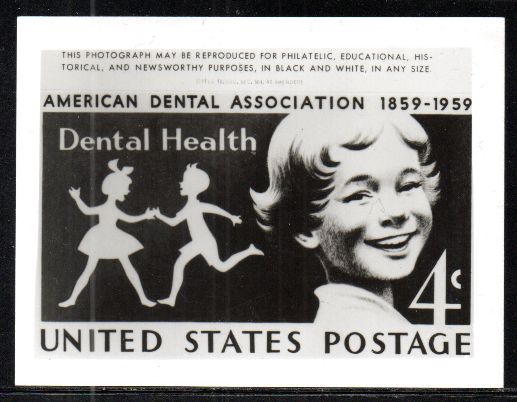


So, my question is - and has been for some time - why is this first publicity photo not considered an essay? It was produced by the USPOD/BEP team and released, making it an official product of the government. This is more than can be said of some of the listed essays in the catalog (think Schernikow essays). I've talked about this with some of the leading dealers in this material and the only answer I get is that it just isn't an essay.

Perhaps the first thing we should do, as a collective group, is create some standard terms to be used when dealing with this type of material. While we have the definitions created by people like Clarence Brazer, they have not been changed since he first created them. This, despite the wealth of material which has come on the market in the 70 years since he published his monumental work, much of which doesn't fit neatly into the listings and definitions he created.

Another consideration is that methodologies used by the USPOD and BEP have changed greatly since 1947. It is still evolving and terminology used today is vastly different than that used by Brazer.
Just because something has always been that way doesn't mean it can stay that way, and our terminology is in need of a 21st century upgrade.

When we talk about stamp production, we have to keep in mind that today, the BEP no longer creates our stamps and the proprietary nature of the businesses involved in the production of our stamps is such that we, as collectors, no longer have the ability to ask someone about how they are creating the stamps, the processes used or procedures involved in creating a design.

The current stamps are no longer created in hard copy, but are all graphically created digitally. Future generations of collectors will have no ephemera to help tell the story, or very little of it, as it no longer is available in hard or tangible formats.

What do we have? Digital images. But usually only finished images, nothing in the design process. Occasionally, something gets out and into the collectors' market.

Here's a rare piece which somehow managed to survive and did just that. The stamp is Scott 3331.

First, here's the final design, as issued.
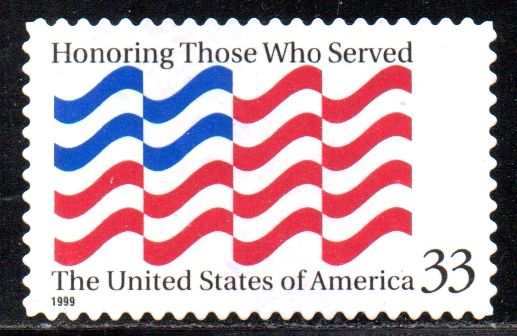


Here is the proposed design, provided on a comment sheet. This design is, to my way of thinking, a much more powerful statement than what was issued. What do you think?
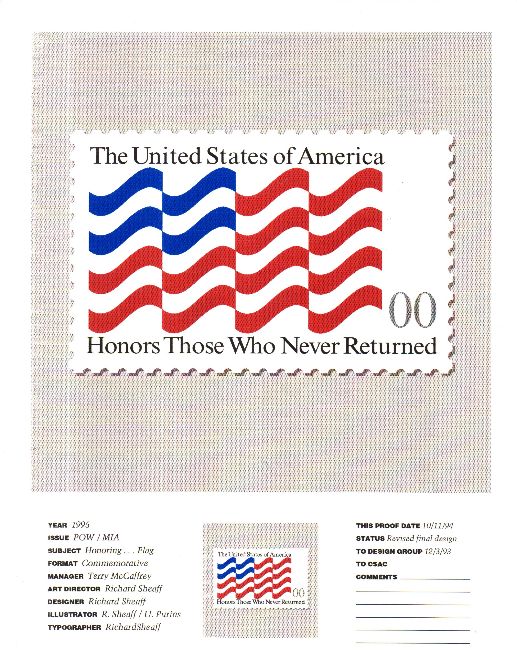


Finally, what worries me most is that much of the material I'm talking about is being - and has been for decades - destroyed, put in the trash and considered worthless. But it is an important part of the story behind the stamp and often helps explain why the stamp was issued as it was.

Shouldn't the material I've shared here be included in a catalog? I certainly think so. The historical significance is part of it. Also, without it being known and understood, why should we - as collectors - bemoan the fact the material is being destroyed. Listing it in a stamp catalog at least gives someone who sees it a point of reference and an understanding that someone, somewhere, would have an interest in it.

What do you think?
Send note to Staff

Rest in Peace
United States
1738 Posts
Posted 12/17/2017   01:09 am  Show Profile Bookmark this reply Add James Drummond to your friends list  Get a Link to this Reply

Quote:
Shouldn't the material I've shared here be included in a catalog?


My opinion is, to a point, perhaps.

The problem is, at least where I work, every single product that we produce has revision after revision, with all manner of changes and subtle color adjustments and re-wording of labeling and so on and so forth.

To take a single production of one product in one size container with a single focus of current trends, you would fill a notebook with the essays, communication, experimental artwork, wording for a particular country, and so forth.

It can't be all that much different for those that make and produce stamps.

To insist that every subtle change in design of a particular stamp design get listed and valued in a catalog is demanding that someone, somewhere, spend a huge amount of time and energy, for no reimbursement whatsoever, on something that very few collectors really care about.

In the earlier years, it might have made some sense to do this, but with the present high-speed production of stamps, this is just too much to ask of any one person or firm to address.

Jim


Send note to Staff  Go to Top of Page
Pillar Of The Community
United States
1804 Posts
Posted 12/17/2017   03:25 am  Show Profile Bookmark this reply Add GregAlex to your friends list  Get a Link to this Reply
"So ... why is this first publicity photo not considered an essay? It was produced by the USPOD/BEP team and released, making it an official product of the government. This is more than can be said of some of the listed essays in the catalog (think Schernikow essays). I've talked about this with some of the leading dealers in this material and the only answer I get is that it just isn't an essay."

A photo of an essay is a photo, just as a photo of a proof is a photo. Only the original essay is an essay. That seems pretty obvious to me.
Send note to Staff  Go to Top of Page
Pillar Of The Community
674 Posts
Posted 12/17/2017   05:18 am  Show Profile Bookmark this reply Add mdroth to your friends list  Get a Link to this Reply
Well it's an interesting conversation, but not one I think will go anywhere, unless you decide to dedicate the next few years of your life to creating such a catalog...

Greg is correct - a photo is just a photo. An 'essay' is a philatelic term - for a specific item - which is effectively a prototype of a stamp. Proof - die proof etc - are other variations of this item. Photos are great - nothing wrong with them - and the ones you've shown are certainly collectible. But calling them anything other than photos will just muddy the already murky waters...

Any item - from initial idea to final stamp - can be considered collectible & a great addition to a collection. But trying to expand this to include publicity photos would be extreme. How about the actual dies used to produce the stamp? What about letters between the designers / USPS etc? (How about emails??!) Think of all the printing waste every time a stamp is printed.

In concept a nice idea, but in practice, a monumental task with little reward.

My best suggestion would be to try submitting some pictures etc to Scott - see if they have any interest in creating a new section within the specialized catalog. But I would expect that process would take years as well!
Send note to Staff  Go to Top of Page
Moderator
Learn More...
United States
12330 Posts
Posted 12/17/2017   06:04 am  Show Profile Bookmark this reply Add 51studebaker to your friends list  Get a Link to this Reply
Based upon the number of threads/posts that we have on this forum that complain about the size and cost of mainstream catalogs; I would say that most folks do not want the inclusion of associated or collateral marketing items.

But good news is that 'self-publishing' is now easier and more cost effective than ever. Folks can establish a website and publish whatever stamp information they wish. Heck, there are even crazy people who will publish it for you at Stamp Smarter!
Don
Send note to Staff  Go to Top of Page
Pillar Of The Community
United States
867 Posts
Posted 12/17/2017   06:08 am  Show Profile Bookmark this reply Add revenuermd to your friends list  Get a Link to this Reply
The publicity photos and photo-essays are certainly important and collectible collateral when telling the story of a stamp. And certainly worth documenting in the philatelic literature. I, too, tend to doubt the necessity or desirability of listing them in the Scott Specialized.

But Gregg has shown us in another thread items that are proofs of original designs that were produced for souvenir purposes long after the fact. How does one separate these from pre-production proofs? What about proofs that were prepared for law enforcement purposes or to be entered as evidence in a case where someone has created counterfeits to defraud the government (certainly not pre-production!). What about proofs that were produced later to be handed out as favors to political friends (not that this would ever occur today!)?

In the field of state revenues the documentation of some of the material and how it came to the marketplace does not exist and may never exist. It is one thing when we can describe something as pre-production, officially produced for favors, and long after souvenirs produced from the original dies, but such documentation may not exist for some items.

To further complicate matters, many of the postage and federal revenues had added "SPECIMEN" printed or hand stamped. Surely these deserve the specimen moniker. But, again, what if the word "VOID" is added either by handstamp or in manuscript.

I agree that the static definitions of Brazer and others may need revision or additional terminology may be necessary.
Send note to Staff  Go to Top of Page
Ron Lesher
Rest in Peace
United States
1189 Posts
Posted 12/17/2017   07:01 am  Show Profile Bookmark this reply Add Stampman2002 to your friends list  Get a Link to this Reply

Quote:
A photo of an essay is a photo, just as a photo of a proof is a photo. Only the original essay is an essay. That seems pretty obvious to me.


This is, on the surface, a statement which most people would agree with. Unfortunately, it is incorrect.

By the 1920's, the USPOD was using photography to create the copies of essays which were then used as the basis for determining final design. It was a far more cost effective method than engraving a die and creating a die proof for the same purpose, only to have to create another die when the design was approved. It was also much quicker than having the artist create multiple drawings of the design - again, cost effective.

These are properly known as photographic essays. I've shown all of those used for the National Parks Series in my long thread on that series.

Publicity photos began seeing use in the 1940's and became pretty much a standard practice by the 1950's. These are not essays, normally, nor should they be considered such usually. I'm not sure myself what the proper term should be to describe a publicity photo which shows a design which was a major departure from the issued design except to call it some type of essay.

As you can see, the terminology is confusing and it is this type of misunderstanding which prompted me to begin the thread.

Don also brings up a good point, with the size and expense of catalogs being what they are now. Would inclusion of this type of material increase the size of the catalog? Absolutely, but it is still the best vehicle with which to educate as many people - collectors included - about this type of material.

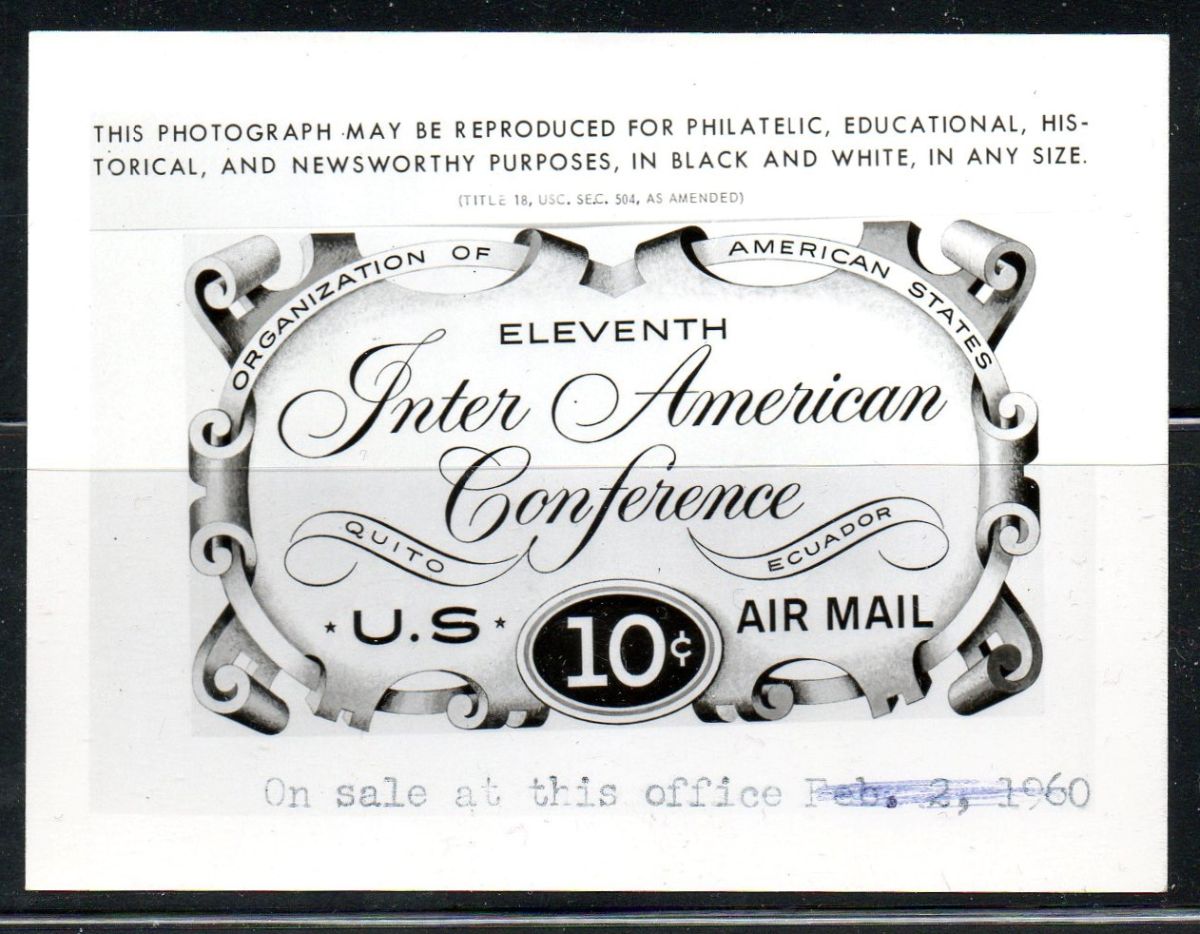
Here's a what I think is a good example of why this material is important. Below is shown a publicity photo for an airmail stamp which was planned for release on Feb 2, 1960 to honor the Eleventh Inter-American Conference scheduled for that year in Quito, Ecuador.


So, why haven't you seen this stamp? It was never issued. Political wrangling and disagreement over the U.S. handling of Cuba after Castro took the country communist resulted in repeated postponements of the conference. In 1960, all orders for the stamp were returned and on May 13, 1961 the USPOD released a statement explaining it had authorized the return of all requests for first day covers as it just didn't appear the conference would ever happen.

Another news release on April 7, 1962 stated that four plates (26564, 26565, 26566 and 26567) had been made and certified on March 1 and March 11, 1960, and were cancelled on February 8, 1962, with no impressions made.

Without the publicity photo, no one would have ever known what this design would have looked like and would likely have never heard of this issue, since it wasn't released to the public.

How many other proposed stamps have never been seen?
Send note to Staff  Go to Top of Page
Pillar Of The Community
United States
848 Posts
Posted 12/17/2017   07:18 am  Show Profile Check paperhistory's eBay Listings Bookmark this reply Add paperhistory to your friends list  Get a Link to this Reply
I think getting photo essays / publicity photos into Scott is an uphill task to say the least (though it wouldn't bother me since I use the digital version of the catalog in any case)....but I think the market could definitely use a stand-alone publication on this sort of material. I know I'd buy it.

There's a lot of demand for understanding it better, since the material now appears (and is generally EXPECTED) in first day cover exhibits. Some of it are the publicity photos (even my daughter uses one in her exhibit); some of it is real essay/production/design contest material, much of it is photographic evidence of other designs or drawings from material in BEP files.

Even in the absence of a catalog, I suspect a well written article in the United States Stamp Society's journal, or another such publication, would go a long way.
Send note to Staff  Go to Top of Page
Pillar Of The Community
United States
716 Posts
Posted 12/17/2017   08:30 am  Show Profile Bookmark this reply Add hoosierboy to your friends list  Get a Link to this Reply
Morning all,

As a minimalist, when it comes to defining what is truly a "postage stamp", we can simplify and reduce their catalog size by limiting items included to stamps actually serving a postal purpose that are widely available for use within the country.

Items issued covering subjects designed to serve the interest of collectors and the revenue of a country from foreign exchange should be recognized for what they really are - philatelic labels.

The acid test as to which group a particular issue falls is, "Is it routinely seen having a wide contemporarily useage for a valid postal purpose within the country of issue?"

Happy holidays to all.

Russ Ryle

Send note to Staff  Go to Top of Page
Edited by hoosierboy - 12/17/2017 08:31 am
Pillar Of The Community
United States
6430 Posts
Posted 12/17/2017   09:46 am  Show Profile Check revenuecollector's eBay Listings Bookmark this reply Add revenuecollector to your friends list  Get a Link to this Reply

Quote:
Items issued covering subjects designed to serve the interest of collectors and the revenue of a country from foreign exchange should be recognized for what they really are - philatelic labels.


Stamps not issued for valid postal use, e.g., Sand Dunes, are a far cry from the legitimate collateral material shown above.

Inclusion in Scott? No, I don't think so, but that doesn't prevent one from authoring companion catalogs devoted to specialty areas. Just ask Jim about all of the catalogs he has authored.

It's defintiely worthy of cataloguing in order to capture historical data for the benefit of future collectors, but I don't think the Scott Catalogue is the appropriate vehicle.
Send note to Staff  Go to Top of Page
Rest in Peace
United States
1189 Posts
Posted 12/17/2017   3:13 pm  Show Profile Bookmark this reply Add Stampman2002 to your friends list  Get a Link to this Reply
Perhaps, given the depth of the material, inclusion in the Scott catalog would be difficult. It would definitely take a change of mindset with the editorial staff, at the very least.

Looking at past expansions, it took decades after Brazer published his work on essays and proofs before these were included in the Scott catalog.

What I think could be reasonably done would be the inclusion of terms relating to this material, with definitions to help anyone looking for information of a basic nature.

What do you think of that approach?
Send note to Staff  Go to Top of Page
Pillar Of The Community
United States
4079 Posts
Posted 12/17/2017   10:37 pm  Show Profile Check eyeonwall's eBay Listings Bookmark this reply Add eyeonwall to your friends list  Get a Link to this Reply

Quote:
Even in the absence of a catalog, I suspect a well written article in the United States Stamp Society's journal, or another such publication, would go a long way.


I believe there was an article (by J. Lee??) in Linn's during this year.
Send note to Staff  Go to Top of Page
  Previous TopicReplies: 11 / Views: 2,030Next Topic  
 
To participate in the forum you must log in or register.

Go to Top of Page

Disclaimer: While a tremendous amount of effort goes into ensuring the accuracy of the information contained in this site, Stamp Community assumes no liability for errors. Copyright 2005 - 2026 Stamp Community Family - All rights reserved worldwide. Use of any images or content on this website without prior written permission of Stamp Community or the original lender is strictly prohibited.
Privacy Policy / Terms of Use    Advertise Here
Stamp Community Forum © 2007 - 2026 Stamp Community Forums
It took 0.34 seconds to lick this stamp. Powered By: Snitz Forums 2000 Version 3.4.05