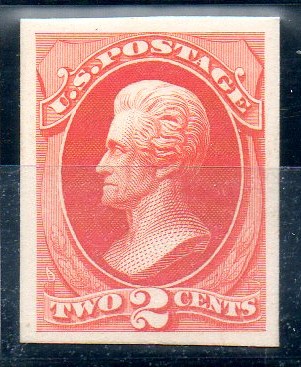
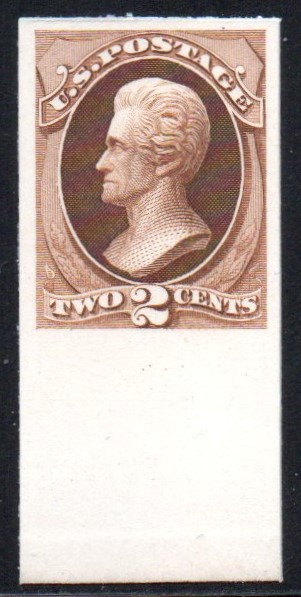
| Author |
 Replies: 70 / Views: 6,395 Replies: 70 / Views: 6,395 |
|
|
|
Bedrock Of The Community
12734 Posts |
|
|
Valued Member
United Kingdom
299 Posts |
|
|
Here, in UK, is past midnight so I wish everybody a good night.
Please have a look at your A45 and A45a stamps: any information is more than welcome ... |
Send note to Staff 
|
|
|
Rest in Peace
United States
1189 Posts |
|
|
Valued Member
United Kingdom
299 Posts |
|
|
Stampman2002, thank you very much! Do you have by any chance the possibility to scan them at a higher resolution, please? On the die proofs below, of a lower resolution, the top right stamp of each block seems to have a similar feature - especially the top right stamp of the block on the right. 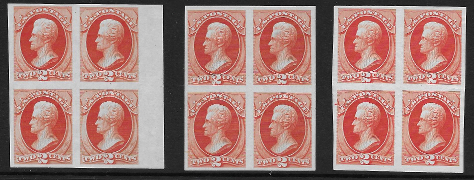 |
|
Send note to Staff
|
| Edited by aug-stamps - 02/27/2018 10:33 pm |
|
|
Pillar Of The Community
United States
1946 Posts |
|
|
Sorry I missed him, but I was having dinner when he left. Quote:
Essayk, if you have the die proofs of #183, #193 and #203 please post them here! With that request the OP betrays a serious lack of understanding. I need to explain a few things to him, but don't wish to offend. So far he has not been willing to accept instruction from me. Number 183 was produced from 2 plates made by the Continental Bank Note Co. and 8 plates of the American Bank Note. Co. It was printed in vermilion for general issue to the public. Number 193 was produced from American BNCo plate #413 which was specially prepared for the Special Printing, and never used to produce regular stamps. This was printed in black brown. To the best of my knowledge number 203 was also printed from plate 413, but this time in scarlet vermilion. All these plates originate from the same die, which is the Continental 2c die with added secret mark. Just below I show you from left to right the critical spot for the 2c design as it appears on die proofs: a) for the original die made by National; b) the die produced by Continental as altered by the addition of a secret mark; and c) the Continental die printed in vermilion. 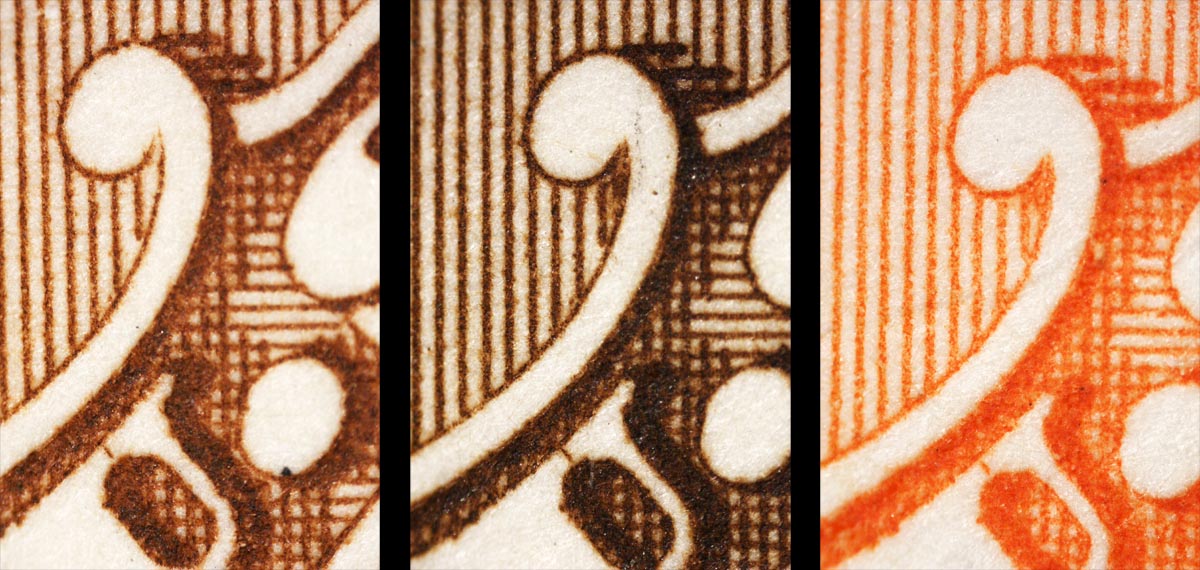 The distinction between the Continental die prints and that of National is readily apparent. The secret mark on these die prints does not appear as it was drawn by Luff and retained by Scott, a fact long known by specialists. Here it has the character of what I believe the OP has attempted to describe all along: an occlusion between the crux of the upper left panel ornament and the first descending shading line to its left. This should be the normal mark. How does it compare with what we see on the Special Printing of 1880 (no. 193)? The OP has been gathering comparatively low res images of certified examples of #193 in an attempt to "see" the secret mark. Despite his claims, this is an ambiguous proposition at best, since the mark is small and rather obscure. However, we have access to an item that will make it possible to get high res images of a few examples of #193. More on how that came to be later. However, here are some high res images of proofs from the one and only plate used to produce #193. 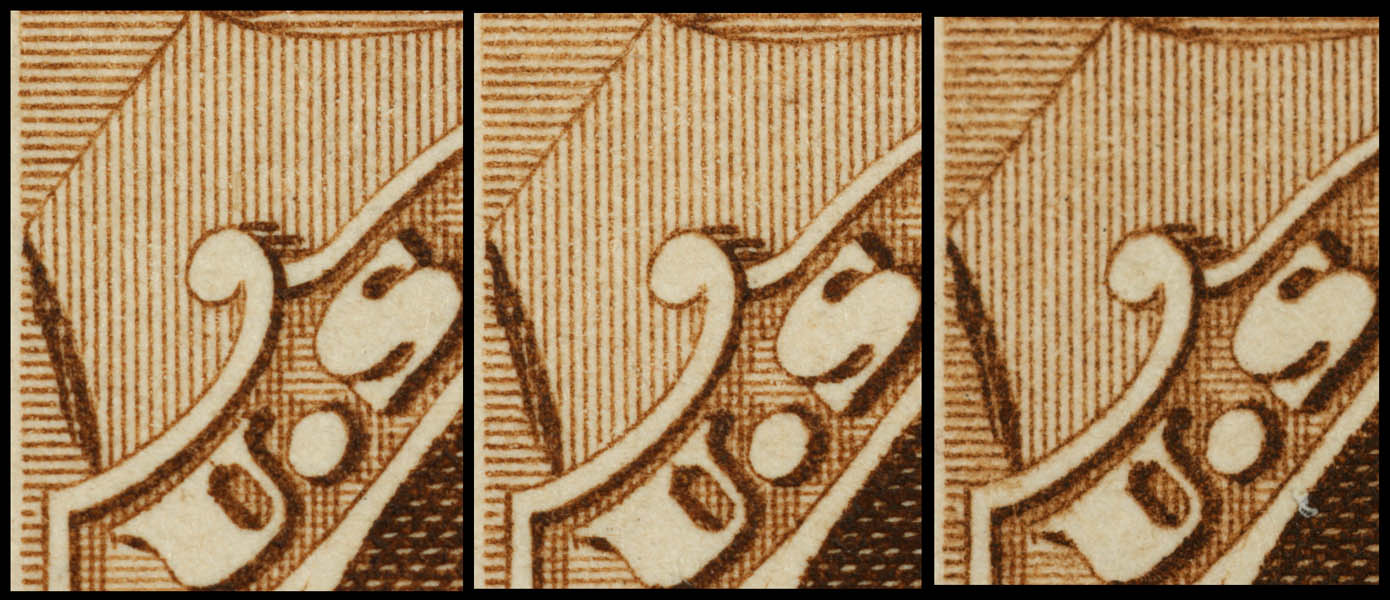 These images show you the condition of the secret mark in a few spots on that plate. |
|
Send note to Staff
|
| Edited by essayk - 02/27/2018 11:28 pm |
|
|
Valued Member
United Kingdom
299 Posts |
|
|
Essayk, thank you very much for making such an effort!
So, the A45a stamps from 1879 onwards were direct or indirect print, please? |
|
Send note to Staff
|
|
|
Valued Member
United Kingdom
299 Posts |
|
|
Essayk, my previous question - direct or indirect - is there for a reason: Fred P. Schueren, in his "The United States 1869 Issue, An Essay-Proof History" states that "very few plates were hardened prior to 1880." To summarize: 1. The mark on my stamp is different than what the die proofs show. 2. The die proofs are printed before starting to print the entire issue. 3. The three images you have posted from the #193 plate are showing various degrees of wearing. As the plate was already used before starting to produce #193 (and then 203), it is reasonable to assume that the wearing could only continue and more and more anomalies could appear during production. For example, out of the six #203 presented on usphila.com, five are showing various degrees of ink inside the normally white area of the base of the 'S' in 'U.S.'! This characteristic is already starting to appear on the three proofs of the plate used. [And it shows on my stamp, too. It is visible in the image I posted.] Regarding your mention of my ignorance: Essayk, it just happens that I am a beginner in the study of stamps. That impacts neither the mark on my stamp, nor the natural wearing of the plate used to stamp it  [Seing your proofs, I am pretty sure there was no intentional design work as to result in the mark on my stamp!] Anyway, I am waiting to see if any members of the forum have anything similar on this type of stamps! |
|
Send note to Staff
|
| Edited by aug-stamps - 02/28/2018 06:42 am |
|
|
Bedrock Of The Community
12734 Posts |
|
|
Pillar Of The Community
United States
1946 Posts |
|
|
Quote:
So, the A45a stamps from 1879 onwards were direct or indirect print, please? I'm glad to help where it is wanted, but do not wish to intrude where it is not. For this question I am not sure what you mean by "direct" and "indirect" since these are not terms normally associated with intaglio printing of securities. Which prompts me to ask if you are familiar with the essential stages of siderography. If not, then do you have access to a copy of Scott's Specialized Catalog of U.S. Stamps and Covers? In one of its introductions it has a brief description of how intaglio printing is done. Please read that. If you don't have access to that intro, then this page will give you a good start: https://www.collectionscanada.gc.ca...20301_e.htmlIntaglio is not relief printing nor litho, typo, nor offset. So if I have correctly intuited what you meant by "direct" it is a direct process. But only you can tell me what you meant. Quote:
Was the steam press used? RC, this is at least the second time you have brought up the question of steam press printing in one of these threads. It's not a bad question, but not particularly relevant for U.S. securities printing until we get to 1885. One of the employees of the Continental BNCo had patented a two-plank steam press, and used it in the course of assisting its development, mostly on non-government projects, no doubt. Nonetheless, Luff reports (pp. 139-140) some limited, intermittent use of the two-plank press for printing some stamps from 1873-1876. He includes the plate numbers used and the numbers of stamps output, but his records do not appear to be complete. Three plate numbers were assigned to the two cent, but these do not include Continental plate 161, known to have been used for the hard-paper Special Printing. That plate was also used for regular stamp production in both dark brown and vermilion. Officially, stamp producers were barred from the use of steam presses due to the action of the plate printers union. The contracts for 1877 and 1881 specifically required the use of hand operated presses in government work. However, this was overturned in 1885, and the new stamp contract for that year REQUIRED the use of steam presses. That was the beginning of a new era in stamp production. Does that address anything of what you are asking about when you bring up steam printing in these contexts? |
|
Send note to Staff
|
|
|
Valued Member
United Kingdom
299 Posts |
|
|
Essayk, my question was regarding a direct contact between the hard steel design plate and paper. Indirect, through an intermediary component like an alloy transfer roll.
As you are pointing out so rightly, this is siderography, therefore the paper is printed with a roll, normally hardened. However, if Schueren - in his Essay Proof History - is right, then until around 1880 many of those rolls were used without hardening. That is, making them prone to earlier wearing, reflected in differences between earlier and later stamps of the same issue.
My questions regarding the apparition of that particular mark on my stamp were revolving around the possibility of this roll to either be on purpose altered, either to suffer enough wear during its exploitation as to result in such erosion becoming visible on at least one position on the sheet.
The thing is, after all, to establish what is the origin of the mark.
Your high-resolution images are definitely showing it was not present before starting to print the 1879 and later issues of this design. Therefore, it has to be natural erosion of some of the thinnest surfaces of the roll.
The progressive building of ink in the white area at the base of the 'S' in 'U.S.' seems to continue during the exploitation of the roll, to the extent of making it more visible in the images of certified #203 stamps.
Now, so far, thanks to you guys, I know the following:
1. My stamp is a design A45a - Clark (crphoto) has an older post (over three years ago, I believe) in which he explains that National issues are clean between the first two lines under the left scroll, while Continental and American present at least a blur.
2. The mark I found is definitely not a design feature made on purpose. That also would explain the presence, under the more visible mark I am pointing out, of a much thinner line which later becomes so visible on #203. [The line between the two lines of the scroll, tending to reach their joining point.]
3. My stamp seems be a late issue #183 (very likely) or an earlier #193 (possible).
From here onwards, the expertize will say exactly what it is. That's why I sent it to Royal Philatelic Society here in UK.
The presence of this or any similar mark on other A45a stamps will help reduce the time of research, whatever the type of paper, because in the 1870s Continental was, apparently, using several types of paper for their Government clients.
Also, the presence of this type of mark on vermilion stamps will most likely help in identifying them as #203, since they were printed using the same roll.
Again, thank you very much to everyone contributing to this post!
Once the stamp is identified and certified I will post it with a better quality image and a copy of the certificate, of course. |
|
Send note to Staff
|
|
|
Bedrock Of The Community
12734 Posts |
|
|
Valued Member
United Kingdom
299 Posts |
|
|
... and until the expertize is finished, I am more than happy to see some of the good people having a good time reading my post.  |
|
Send note to Staff
|
|
|
Moderator

United States
12330 Posts |
|
|
Valued Member
United Kingdom
299 Posts |
|
|
Moderator
United States
12330 Posts |
|
|
If you make listening and observation your occupation, you will gain much more than you can by posting.
Don |
|
Send note to Staff
|
|
|
Replies: 70 / Views: 6,395 |
|




 Posted 02/27/2018 6:58 pm