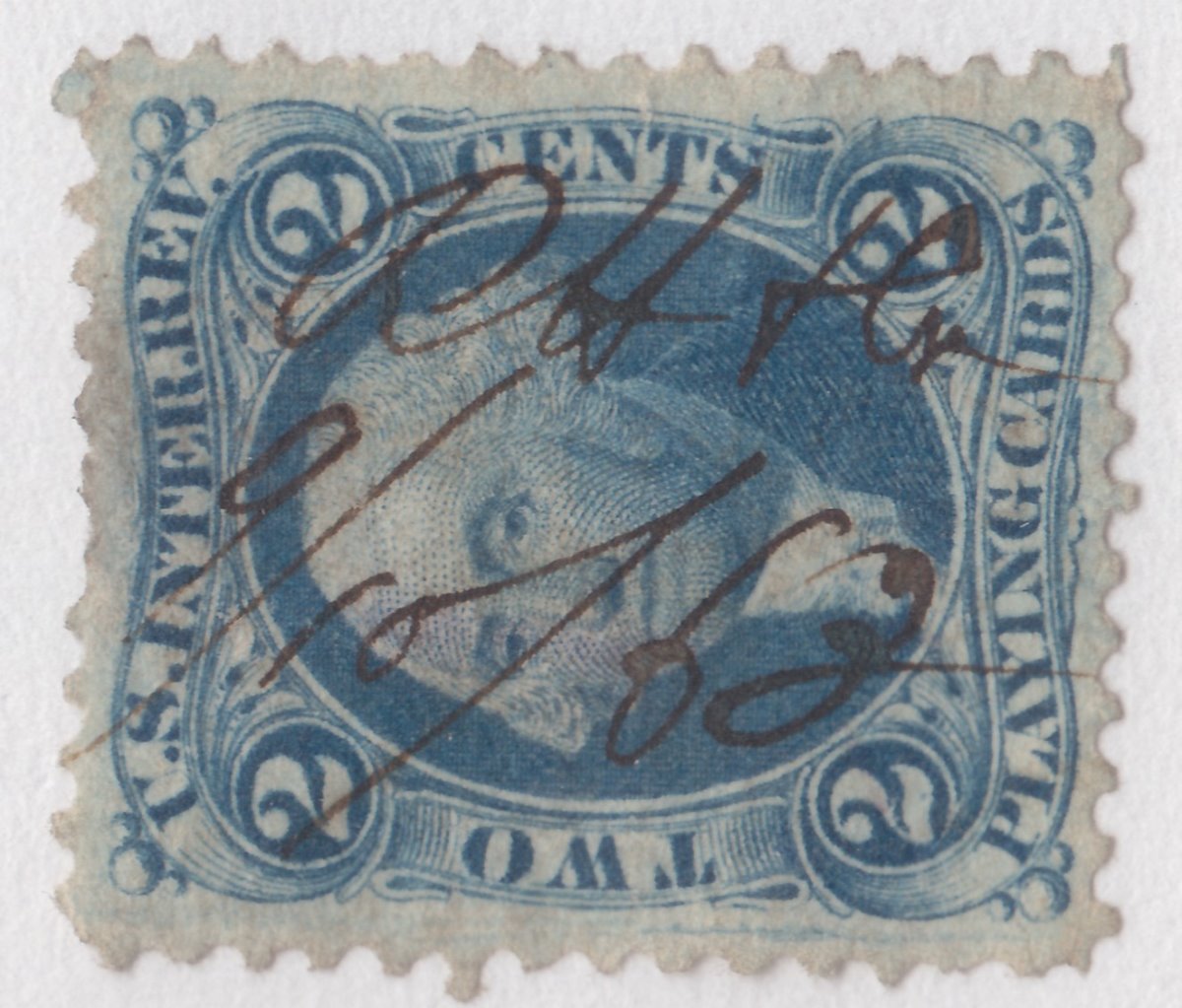
It says "D W May 25/68". Clear as day. Who writes a "3" with a final upstroke to the right?

You can see where the writer began some characters where the ink is heavy at the top of the "6" and the "8". This is common with a pen dipped in ink. The ending point is sometimes a flourish up to the right which you can see at the end of "May" and in the number "8". The "5" also has an ending flourish at the top. Tops of "5's" are commonly added last—even today—so that makes sense. You can see this guy often ended characters with final flourishes. That's still common in handwriting today. Watch someone sign their name. It often ends with that same flourish to the right.
The three end flourishes are also lighter and quicker than the other strokes – the final strokes on the word "May" and "5" and "8". That's how we know it's the end of what they wrote. (What keeps the top of the "5" flatter, by the way, is that you're supposed to make the top of a 5 flat.) Clearly, this guy liked to end words with a final flourish up to the right -- still common in handwriting today.
A "3" cannot be ended with a flourish up to the right. A "3" ends at the bottom. If you wanted a final flourish on a "3," you'd most likely make a stroke down to the left. He didn't do that. If you were writing a "3" why would you make a final flourish up to the right? Try writing a "3" and then go up to the right. You would be crossing out the entire "3". That makes no sense. A "3" finishes at the bottom of the character.
But the final stroke on this character goes up to the right. Try writing each number from 0-9 with final flourishes. The only number that can end with an upstroke to the right is an "8". All other numbers end at the bottom (unless you write "4" with the vertical stroke first, and then you finish in the middle).
On the "6," the pen went from upper right downward to the left -- a letter "C". Then he made a final circle to make it a "6". That circle is closed—no opening in the center. The same closed circle can be seen at the bottom of the "8" and in the "a" in "May" which is also closed. So another characteristic of this guy's handwriting is that his circles were closed (also common). A number "3" has no circles. So why are both the top and bottom circles closed? Because it's an "8". In writing a "3," you don't even make circles. Instead, first you go right (he doesn't), they curve back to the left, making a backwards "c". Then you go right again to make a second backwards "c". This writer didn't do any of that. Instead, they did what someone writing an "8" would do -- they made an "S" curve, then went back up, leaving the bottom circle closed (as they did elsewhere), and finishing with that straight line flourish up to the right once again. That's an "8".
But more to the point --

-- those definitely look like perf holes to me. I'd say someone has trimmed the right edge of that stamp.

I'm almost ready to ask whether Anthony's sells altered material that is badly described at times.





 Posted 04/15/2018 8:10 pm