| Author |
 Replies: 7 / Views: 2,161 Replies: 7 / Views: 2,161 |
|
|
Pillar Of The Community
United States
4515 Posts |
|
|
This is a Ceylon 20c KGV ultramarine (Die I) Scott 237a. Scott values this as $6.00 mint and $7.25 used in italics which means value will vary. The stamp has a cancellation but not sure if it may be some revenue cancel rather than a through the mail cancel. Guidance please. 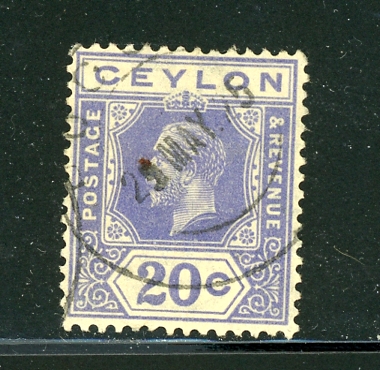 Here is another example where the used value is high in italics. This looks like a cancel that may not be postal usage. 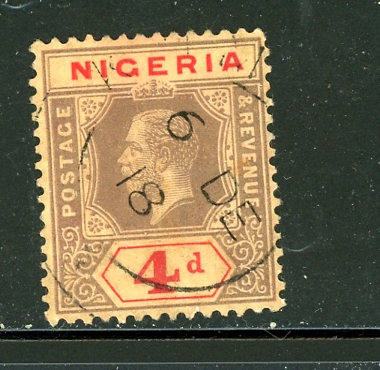 |
|
Send note to Staff
|
Al |
| Edited by angore - 04/24/2018 8:04 pm |
|
|
|
|
Pillar Of The Community
Australia
3299 Posts |
|
|
For Scott values shown in italics on lower value used stamps, this is a warning to make sure the stamp has a contemporaneous and genuine cancel.
The cancels on the two stamps shown look genuine but I wouldn't like to say that they are genuine. Something in my gut says to have doubts on both, but I'd be more than happy to be wrong. |
Send note to Staff 
|
|
|
Valued Member
United States
69 Posts |
|
|
Angore, your question isn't clear to me. Is it "what is the catalog value of this stamp?" or is it "How do I determine whether the cancel is a legitimate postal use?" I might add that when stamps in used condition are more valuable than those stamps in mint condition, there is a substantial danger of forged cancels as well as non postal usages. Having it on-cover may be the only reliable case. |
|
Send note to Staff
|
|
|
Pillar Of The Community
United Kingdom
1255 Posts |
|
|
Angore, both cancels look like contemporary postal CDS to me. Hope this answers your query. Tim |
|
Send note to Staff
|
|
|
Valued Member
United States
328 Posts |
|
|
I agree with Tim, I think they are used CDS cancellations.
The higher values are where you really tend to see revenue usage, so it helps if you are familiar with how the revenue cancels look.
According to the Stanley Gibbons Catalogue, the 20c Ultramarine Die I was issued in 1922, and it was replaced by the Die II version in 1924. So you probably need to look at the usage date. This was appears to be May 25, 1925 which would be within the normal date for usage of this stamp.
The Nigeria 4d - Die I comes on 6 different yellow paper colors - including the white back. Your copy appears toned, so it may be hard to see accurately. I look at the back to determine the paper color (if you are looking for them). The cancel date is within the normal usage time frame also. |
|
Send note to Staff
|
|
|
Pillar Of The Community
United States
4515 Posts |
|
|
Based upon feedback, the cancellations appear to be contemporaneous so the Scott values listed would be apply if they were in VF condition. I am not saying they are worth it but just it meets Scott's intentions for pricing it.
I still marvel at how so many common stamps seem to have high catalogue values. Now one may argue that most are actually not in the true VF used condition. This gets to the thought that if 80% of the stamps available are only F-VF then having a catalog price with just VF seems like a mispresentation by those always quoting catalogue values.
So how does one grade these two stamps? |
|
Send note to Staff
|
Al |
| Edited by angore - 04/26/2018 06:54 am |
|
|
Pillar Of The Community
United Kingdom
8634 Posts |
|
|
I think your question may run up against different interpretations of the word "fine". As I understand it, Scott's meaning is focused in centring, or incorporates it as a key element, whereas a UK auction description of, say, an album lot as "fine used" would be based on the condition of the stamps, not their centring. |
|
Send note to Staff
|
|
|
Valued Member
United States
328 Posts |
|
|
So how does one grade these two stamps?
For British Colony stamps, I look at several factors in grading them. I mark them down to a lower percentage of catalog as the negative factors increase.
1. The centering - how close to perfect is the stamp centered on all four directions. Most of these keyplate stamps (like what you have pictured) tend to be found in a less than absolutely perfect state, so you can expect some variation.
2. The quality and length of the perforations - they should be at least long enough to not be considered short or pulled perfs, and as a bonus it helps if they are uniform. The first aspect is much more important.
3. The quality of the impression - are the stamp faded, or in any state other than the way they were printed.
4. For unused stamps, the gum should be evaluated. Most of the older British Colonies I see (prior to King George VI) are hinged. Many have pencil marks or worse the owner put an ink or owner's stamp on them. All of these aspects should go into the grading.
I collect the various color shades of these stamps and will admit to some with not high grades based on my criteria, because it is a color shade that I have been seeking for a long time.
You have to decide what works for you. The lower the grade, the more holes in your wantlist will be filled. The higher the grade and you just have to be a very patient collector.
To answer your actual question - both stamps have less than perfect perforations, but don't look too bad. The centering is reasonable. The Ceylon seems to have good color, but I think the Nigeria has faded. The postmarks look good, so they appear to have actually gone thru the mail (rather than revenue use).
So I would put a higher catalog value percentage on the Ceylon than the Nigeria stamp. |
|
Send note to Staff
|
|
| |
Replies: 7 / Views: 2,161 |
|




 Posted 04/24/2018 8:01 pm


