Stamp Community Family of Web Sites
Thousands of stamps, consistently graded, competitively priced and hundreds of in-depth blog posts to read


Stamp Community Forum
 
Username:
Password:
Save Password
Forgot your Password?

This page may contain links that result in small commissions to keep this free site up and running.

Welcome Guest! Registering and/or logging in will remove the anchor (bottom) ads. It's Free!

Assistance Please With Identifying1922 Series 1c Franklins - 11-Perf

 
To participate in the forum you must log in or register.
Author Previous TopicReplies: 8 / Views: 1,892Next Topic  
New Member

United States
2 Posts
Posted 08/16/2018   8:24 pm  Show Profile Bookmark this topic Add laluecht to your friends list Get a Link to this Message
Hello! I'm new to the stamp collecting world. I've recently aquired at auction a fairly large number of "classic" stamps that were in a box labeled "Work to do." Boy has it ever been work combing through over 2,000 stamps - sorting, measuring, checking watermarks -- it has been over 80 hours of work thus far and I'm just now seeing an end to the tunnel.

There are a number that seem as though they may be slight oddities and so I joined this community to see if I could get the recommendation from people who are so vastly more experienced. While I have about 15 in total that I'm not sure on, I thought I would start with two that have me most "hopeful" -- although I realize that the odds are very, very much against me.

I appreciate anyone who has some knowledge on this subject taking a look at a couple of stamps I've pictured below and letting me know if there is any chance whatsoever that they may be one of the rare Franklin 11 perf oddities that I see in the Scott catalog.

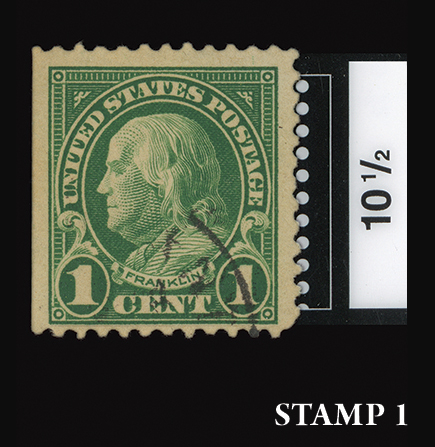
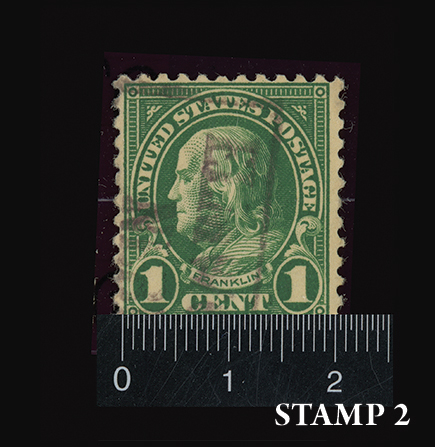
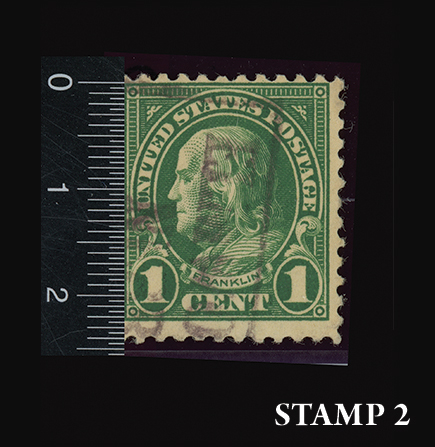
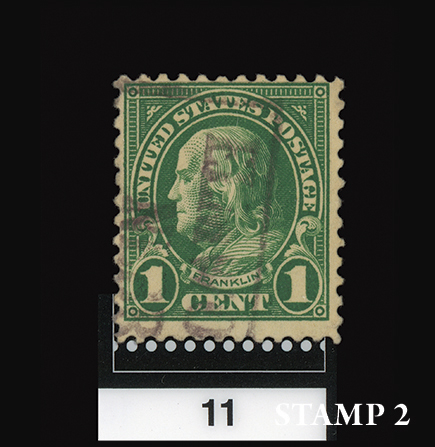
I have two differently sized Franklins that each measure on the 11perf scale that I have (pics below with the 11 gauge, as well as a comparison of each on the 10.5gauge). The color on the computer screen isn't too reliable, so all I can say regarding color is that they seem to be a deeper green than most of the other 1C's I have from the 1922 series. The majority seem to have a more yellow hue than these two.

The images show my cheaper gauge/ruler. I've measured them on a pair of digital calipers as thus:
Stamp #1: 19.5mm x 21.75mm
Stamp #2: 19.25mm x 22.35mm
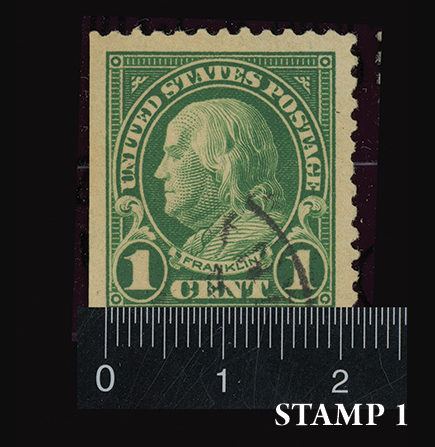
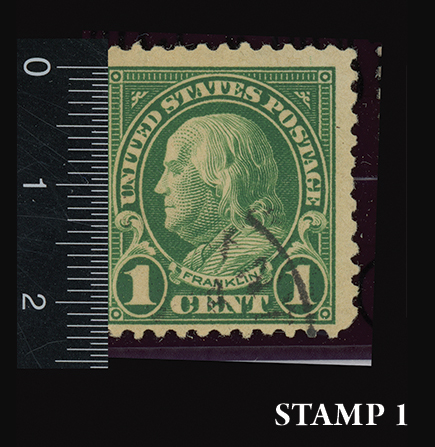
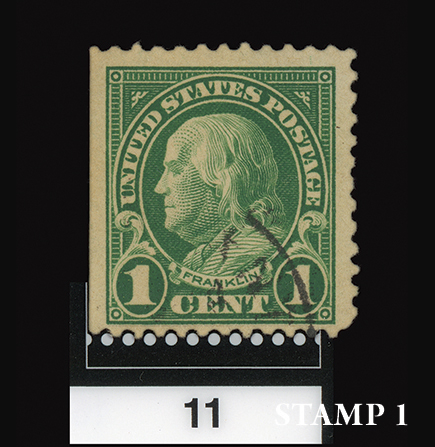
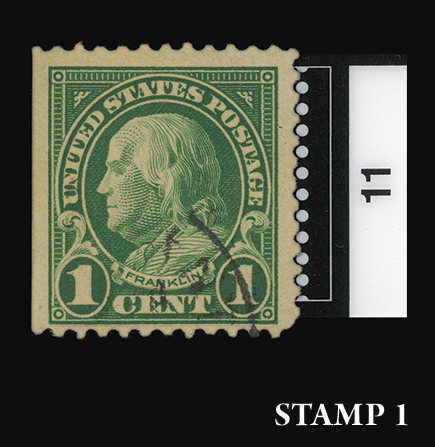
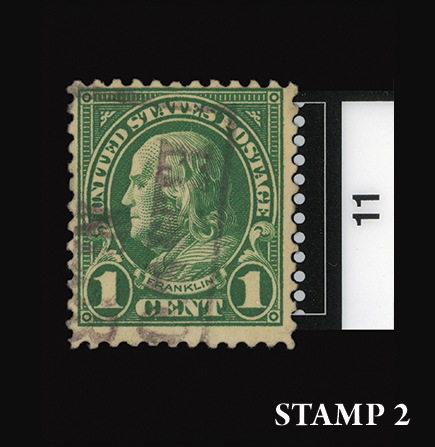
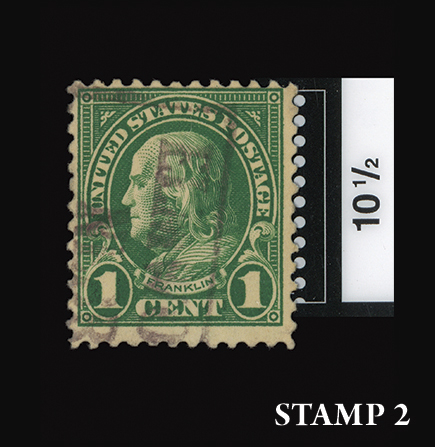


Again, any assistance is very much appreciated!

Send note to Staff

Pillar Of The Community
United States
8956 Posts
Posted 08/16/2018   8:58 pm  Show Profile Bookmark this reply Add Petert4522 to your friends list  Get a Link to this Reply
http://www.stampsmarter.com/1847usa...ntifier.html

Try the above link for some easy ways to ID you stamp

Peter


***Fixed Link***
Send note to Staff  Go to Top of Page
New Member
United States
2 Posts
Posted 08/16/2018   10:21 pm  Show Profile Bookmark this reply Add laluecht to your friends list  Get a Link to this Reply
Hi Peter,

The link is taking me to a "404- Directory not found" error, but I googled a portion of the link and I believe I found the table. It's definitely the best identifier I've seen on these thus far so I appreciate you sending it along. I've been using the scott catalog and a few other online help tools, but always thinking I may have been missing something when it comes to these Franklins.

A quick follow-up question for anyone out there who has the expertise I do not:

Stamp #1 doesn't seem to fit anywhere in the table. Dimensions of 19.5 x 21.75 are not represented in the 11x11 perf sections. What can one assume as a reasonable amount of variance when considering the measurements on these 11 perfs?

Thanks!
Lindsay
Send note to Staff  Go to Top of Page
Pillar Of The Community
United States
8956 Posts
Posted 08/16/2018   10:43 pm  Show Profile Bookmark this reply Add Petert4522 to your friends list  Get a Link to this Reply
Lindsay, the dimensions of the stamp do not mean a whole lot, at least not for identification. More important are perforations, watermark and color. Also important is the presence of ink on the back of the stamp

Peter
Send note to Staff  Go to Top of Page
Pillar Of The Community
6340 Posts
Posted 08/17/2018   12:00 am  Show Profile Bookmark this reply Add John Becker to your friends list  Get a Link to this Reply
Your stamp #1 appears to be 552a, a single from a booklet pane. The identifier in the link above is incorrect in giving the identical dimensions of the printed area for both sheet and booklet stamps. The booklet stamps in this era are printed on paper turned 90 degrees from that used to print sheet stamps. During production, the paper is dampened, then printed, then dried, gummed, perforated, etc. The orientation of the grain of the paper causes a slight shrinkage in one direction more than the other when dried. Thus the image size of stamps from booklet panes will be shorter and wider than sheet stamps of the same issue.
Send note to Staff  Go to Top of Page
Pillar Of The Community
United States
1414 Posts
Posted 08/17/2018   12:16 am  Show Profile Bookmark this reply Add cfrphoto to your friends list  Get a Link to this Reply
This topic has been covered many times. I don't believe that the information is on stampsmarter.com. It may be buried in the Scott Catalog.

To make a long story short, the straight edge stamp is a flat plate booklet pane single while the second stamp is a normal sheet stamp. A wide straight edge margin without the center line must come from a booklet pane. A straight edge with a center line could be either a booklet pane single or a sheet margin straight edge.

Most flat plate sheet stamps from that era were printed on plates of 400 cut into sheets of 100. Paper mesh (or grain) was vertical. Paper was dampened before printing and then allowed to dry before gumming and perforating. Some shrinkage across the grain would be expected.

Booklet pane stamps were printed on sheets of special paper with horizontal mesh (or grain) to improve the accuracy of cutting sheets into booklet panes. The resulting stamps were slightly wider and generally shorter than corresponding sheet stamps. When production of flat plate booklet panes ended in the 1920s, remaining stocks of special paper were used to print higher denomination flat plate sheet stamps. The Durland Catalog carefully documents special paper varieties.

The best on-line reference is back issues of the United States Stamp Society archive of back issues of the US Specialist (formerly the Bureau Specialist). Also, this site contains many threads on this topic, including more efficient ways of identifying rotary press, flat plate regular paper and flat plate special paper by using reference stamps instead of measurements. Dimensions in the Scott catalog are not precise enough to be useful to most collectors. The Scott catalog mentions paper mesh and size differences in the preface to the I grill listings (starting at Scott 134A). Earlier Washington/Franklin, Second Bureau and some First Bureau issues are easier to separate because watermark orientation is the same as paper mesh orientation.

For a fascinating study, check sizes of Special Handling stamps. In addition to the wider 1928 printings on special paper, the last wet printings required somewhat less moisture and the final dry printings required no moisture. Check Bob Rufe's articles on the subject in the US Specialist. Can't get to recent articles on the web site? Join the United States Stamp Society. Dues are a bargain.

Send note to Staff  Go to Top of Page
Edited by cfrphoto - 08/17/2018 12:21 am
Moderator
Learn More...
United States
12330 Posts
Posted 08/17/2018   12:28 am  Show Profile Bookmark this reply Add 51studebaker to your friends list  Get a Link to this Reply
Clark,
I will develop a new page on Stamp Smarter dedicated to the 'measuring' of the Washington/Franklin series stamps.

I am not sure that casual hobbyists are likely to dig through back issues so perhaps adding a simple explanation (like yours above) will be helpful.
Don
Send note to Staff  Go to Top of Page
Rest in Peace
United States
1189 Posts
Posted 08/17/2018   07:45 am  Show Profile Bookmark this reply Add Stampman2002 to your friends list  Get a Link to this Reply
Don,

These stamps are not WF's but 4th Bureau (1922-1926).

Greg
Send note to Staff  Go to Top of Page
Pillar Of The Community
United States
1414 Posts
Posted 08/17/2018   09:36 am  Show Profile Bookmark this reply Add cfrphoto to your friends list  Get a Link to this Reply

Quote:
These stamps are not WF's but 4th Bureau (1922-1926).


My comments were not limited to the Fourth Bureau issue. Paper mesh direction is critical for identifying Fourth Bureau special paper varieties, Third Bureau AEF booklet pane singles, first Bureau watermark orientation varieties, National Bank Note early or late state grills and identifying 1875 reissues of the 1869 issue.
Send note to Staff  Go to Top of Page
  Previous TopicReplies: 8 / Views: 1,892Next Topic  
 
To participate in the forum you must log in or register.

Go to Top of Page

Disclaimer: While a tremendous amount of effort goes into ensuring the accuracy of the information contained in this site, Stamp Community assumes no liability for errors. Copyright 2005 - 2026 Stamp Community Family - All rights reserved worldwide. Use of any images or content on this website without prior written permission of Stamp Community or the original lender is strictly prohibited.
Privacy Policy / Terms of Use    Advertise Here
Stamp Community Forum © 2007 - 2026 Stamp Community Forums
It took 0.16 seconds to lick this stamp. Powered By: Snitz Forums 2000 Version 3.4.05
