Quote:
In such a short time, this is not wear, but continued whittling during idle moments ... a widening of the original gashes and then adding more cross cuts.
Show me another sequence of 2 cancels where it was whittled in "idle moments". This was not done the lazy joker that's currently in my local P.O.

Why would anyone bother,
particularly when no effort was put into JUN 27 to clean it up? The second vertical gap from left is wider in JUN 27 than
JUL 27 -- how could that happen? They are different. I suggest someone overlay JUL 27 on JUN 27 to see how well they match.
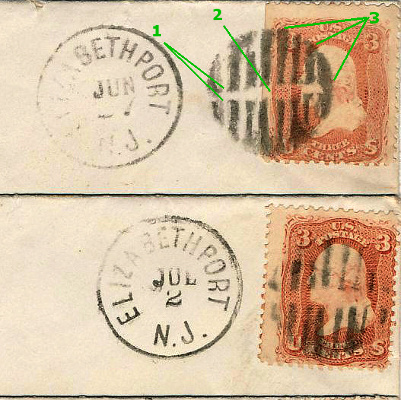
The full size version of the first 2 cover corners, with contrast and sharpening added.
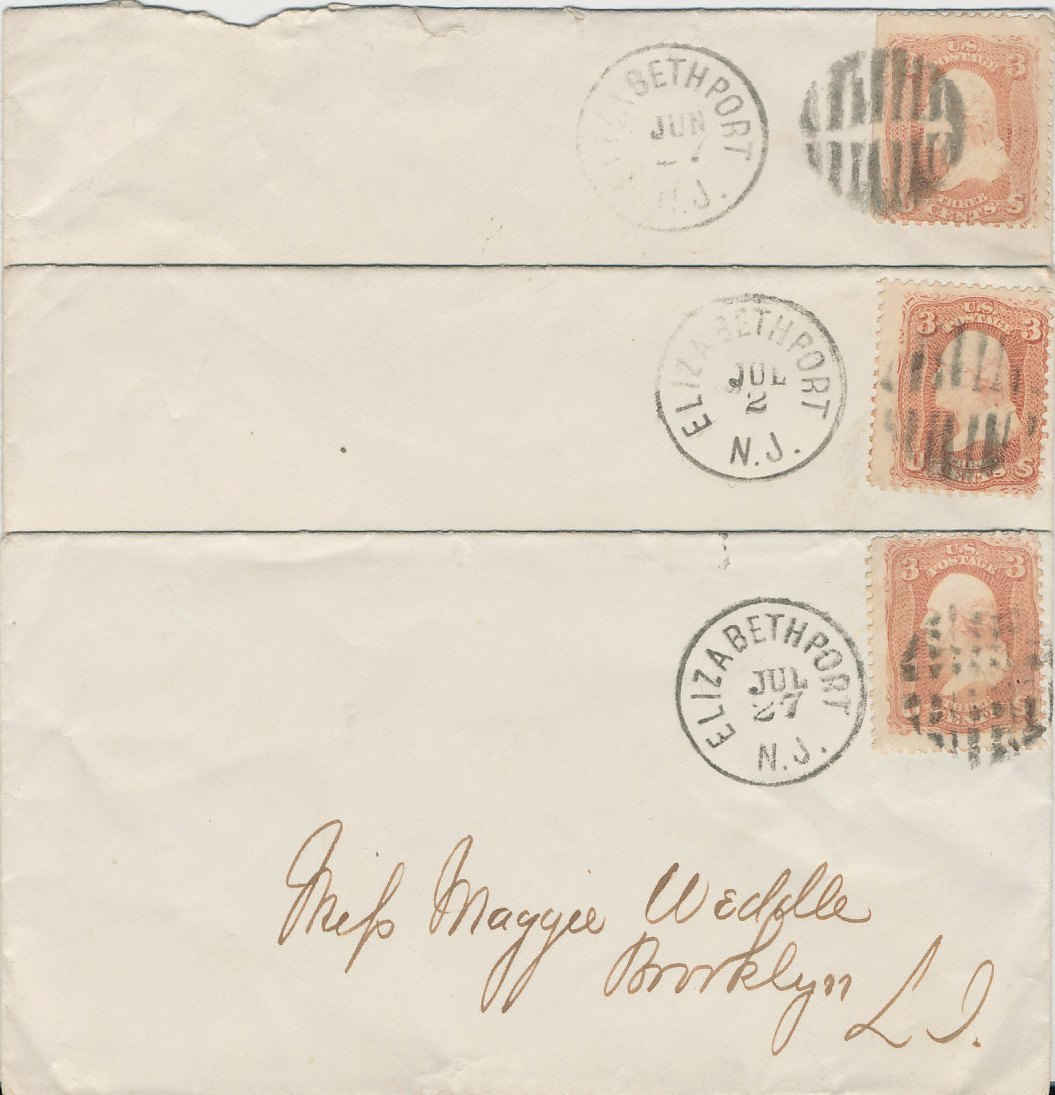
Can we all agree the strikes are fairly close in strength? Can we all agree the ink color and therefore composition (colorant and oil content) are very close here if not the same? And can we agree that JUN 27 is a very good strike of probably an early state of the bar killer? And also the ELIZABETHPORT townmark is the same one on all 3 covers (dent in circle to right of the "T"?
This is a duplex cancel device. The townmark part is metal/steel and a ring or somesuch is attached to hold a removable (wooden) killer.
In JUN 27 it is clear to me the horizontal cut was made last and was, relative to what we see, made from right to left, leaving whiskers or points on the vertical bars in several places (see point 1 and other spots as indicated on JUN 27). These whiskers are what I mean by "not cleaned up". These are gone in JUL 2. That's wear there, however small. Even if JUL 2 was lightly inked, you'd think that at least one or two of those whiskers would show up.
Weak/light inking of the killer in JUL 2? It's slightly lighter than JUN 27, but only slightly. Comparing townmarks of both dates, they are very close in strike strength. So how can one side of the cancel be underinked and the other not? Further, the killer is completely on the stamp in JUL 2 where it should normally be struck stronger than the townmark; it is not.
In JUL 2, that horizontal gap has opened up relative to JUN 27 (point 2 shown in JUN 27). Also in the JUL 2 killer , the outer rim is almost gone (point 3 shown in JUN 27). Again, if weakly inked, the outer rim would probably catch at least some ink. What's going on here? Think of pounding in a wooden stake into hard ground. That stake end will mushroom, spreading out the end and rounding it out slightly as your hammer will not strike the end dead on every time. And so it is with this wooden killer, struck many times by July 2. It has spread out the killer, most noticeable in the center, and with the rim mushroomed out so it no longer contacts the stamp/cover. I see slight distortion of the vertical bars as well.
Weak inking, especially as weak as the JUL 2 killer is, would show some or all rounded ends to the vertical bars where they meet the horizontal gap. So more ink pooling on the cancelling device than full inking. The bar edges should be among the first places to be inked. There are clear squared-off ends on that killer, though very slightly rounded and are fully inked at the ends, not so much at their sides, especially in the upper row of bars.
And you'd ask "How could this cancel be worn in a week?" If someone has an 1860s PL&R or whatever they had then, or the P.O. report, we can get a rough idea of how many letters went through each month by the monies taken in by each post office. Unfortunately, we don't know how many cancelling devices Elizabethtown had back then. And I would think the majority of mail would come at the end of the month, sending bills, paying bills, reordering from suppliers. A further guess is that the killer was made June 27 to replace a worn one in anticipation of month-end traffic.
Also, one cannot say definitively that the three covers are in sequence. The cancel strikes in general quality and ink color/quality match very well, so I would say it is very, very likely. But without dated contents, docketing or receiving cancels, one cannot say the sequence is absolutely correct.





 Posted 08/22/2018 1:29 pm