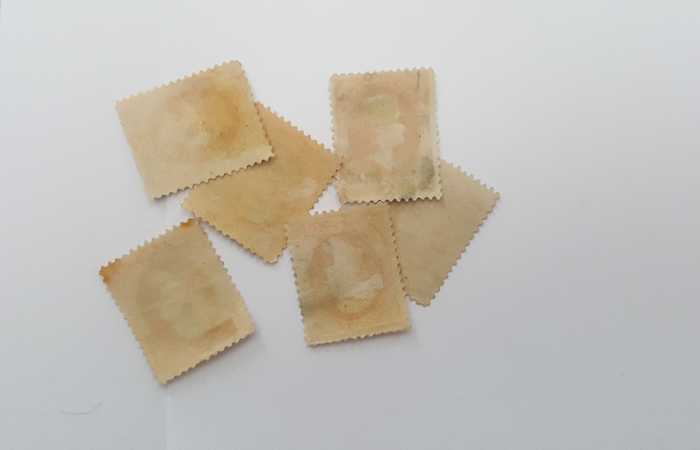
| Author |
 Replies: 14 / Views: 2,061 Replies: 14 / Views: 2,061 |
|
|
Valued Member
36 Posts |
|
|
The Dealer said that they are 1875 continental Scott 178. For me the jacskons second row look more 1879 american bank Scott 183 vermilion, than like the dealer mean 1875 contintentals. Or unlikely but the colour in surruonding Jackson looks likely the same 1880 Special Printings American bank Scott 203 and also its more scarlet vermilion than vermilion.Photos always can give a not correct impression. The blue Zacharys Taylors looks like 1879 american bank Scott 185 and not like the dealer meant scott 179 continental bank. I couldnt do the snap test if hard or soft porous paper. They dont seems to have a secret mark (the Jacksons). The dealer gave me only this photo. Thanks. 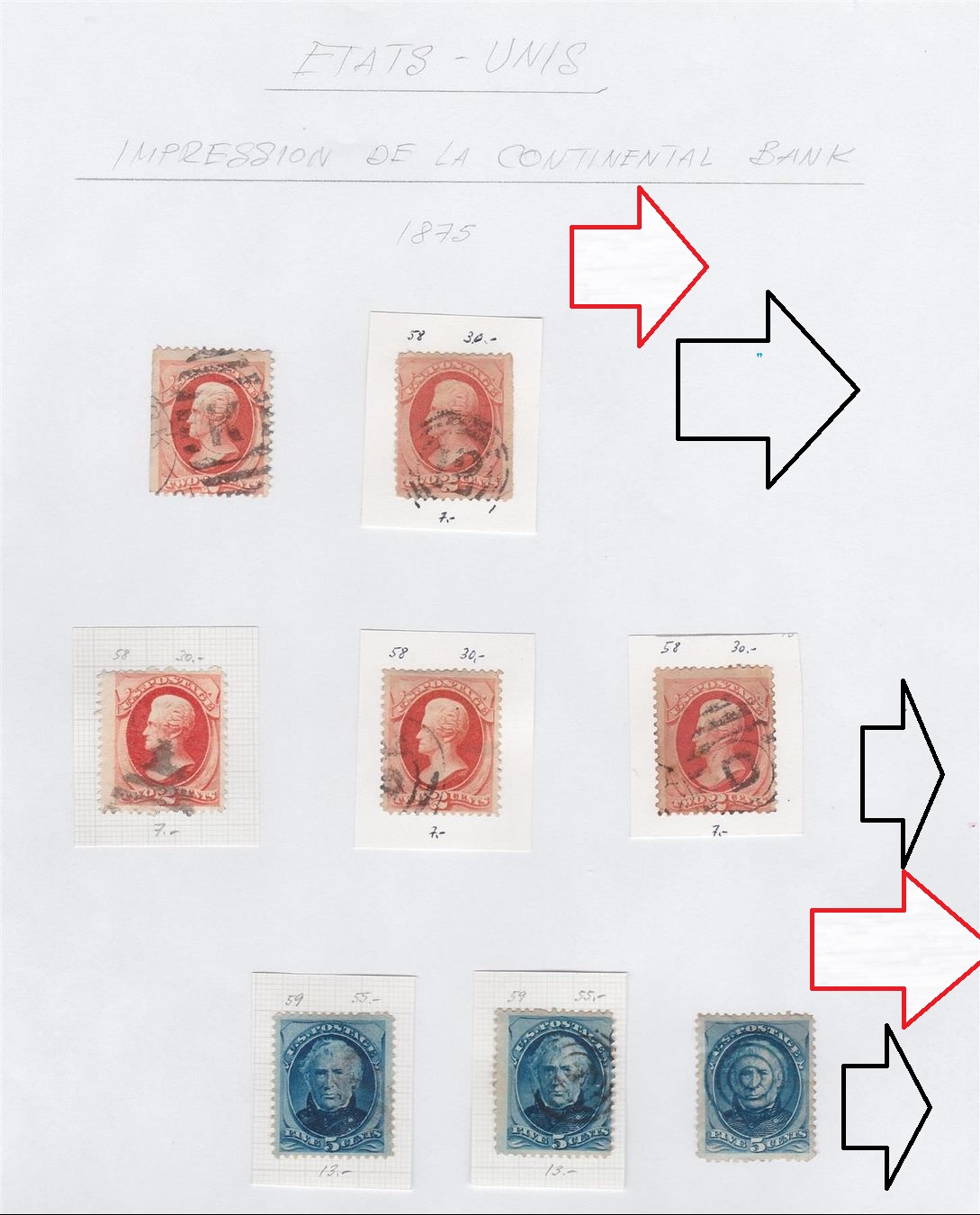 |
|
Send note to Staff
|
|
|
|
|
Pillar Of The Community
673 Posts |
|
|
This is very simple. One is on Soft Porous paper, the other is not. It's VERY easy to distinguish this with a good strong light, and a pair of tongs. Hold two stamps up to the light. Look at the PAPER (not at the color) from the BACK of the stamp. It will look like this: 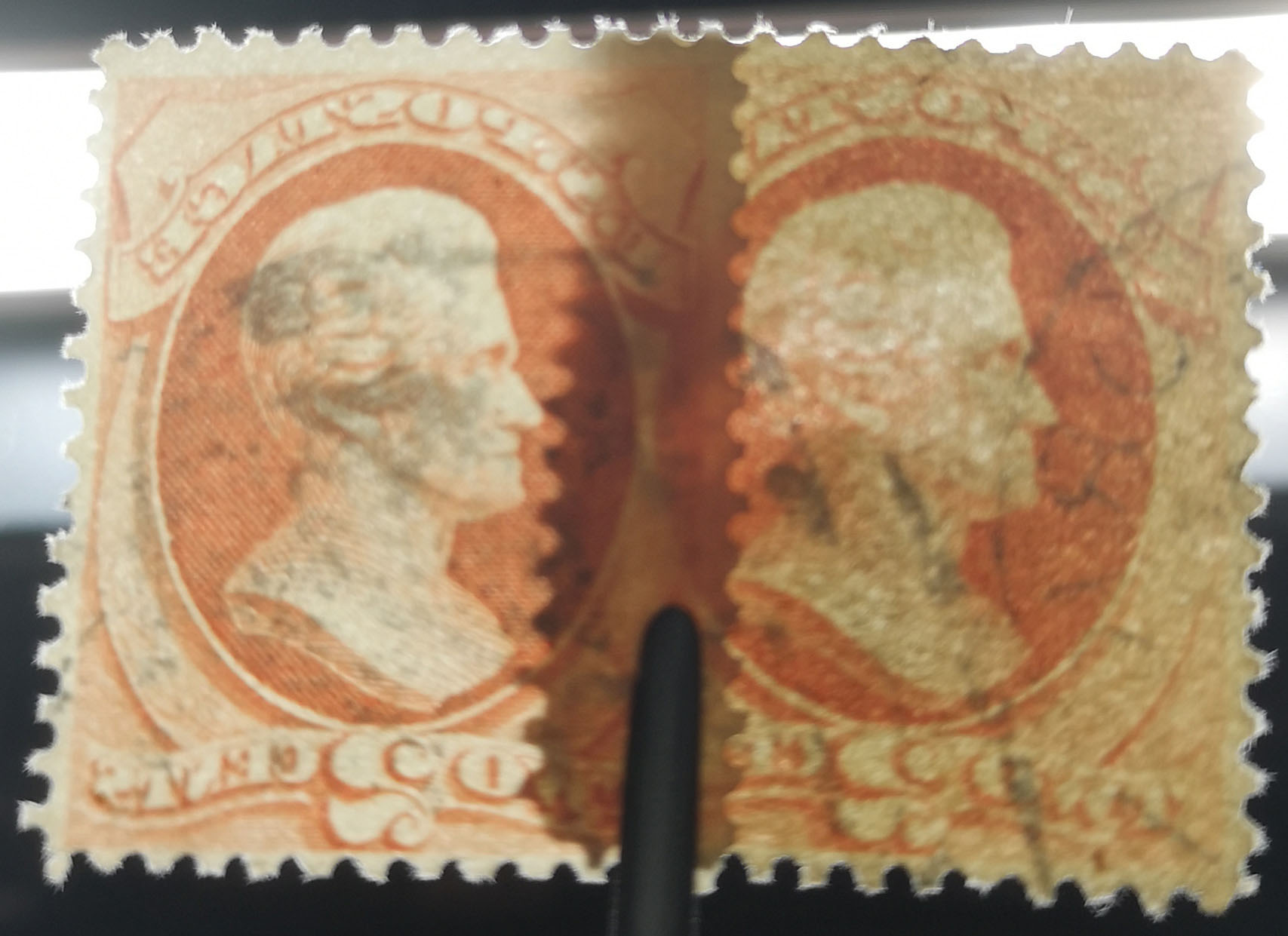 The image on the left is a 178, the one on the right is a 183. Note the "honey comb" effect on the right image, which is typical of the soft porous paper. This will be true of ALL soft porous issue. So same applies to your 179 and 186, and all your bank note issues. |
Send note to Staff 
|
|
|
Valued Member
213 Posts |
|
|
Unfortunately, there are some watermarks that fall in-between the two shown here.
For the basic collector identifying used stamps, paper color is the most distinguishing characteristic. The two papers are made of different materials, cotton (aka hard) and linen (aka soft). Cotton fibers are white while linen fibers are yellowish (flaxen colored).
Flip the stamps over, and if the color is a white or turning to grey when toned, then it's cotton paper. If the paper is somewhat yellowish, turning to tan when toned, then it's linen paper.
Of course, some papers age to the point of distress, but those types are fairly obvious to spot and may be ignored.
|
|
Send note to Staff
|
|
|
Valued Member
36 Posts |
|
|
Quote:
This is very simple.
One is on Soft Porous paper, the other is not.
It's VERY easy to distinguish this with a good strong light, and a pair of tongs.
Hold two stamps up to the light. Look at the PAPER (not at the color) from the BACK of the stamp.
It will look like this:
thanks. Quote:
Unfortunately, there are some watermarks that fall in-between the two shown here.
For the basic collector identifying used stamps, paper color is the most distinguishing characteristic. The two papers are made of different materials, cotton (aka hard) and linen (aka soft). Cotton fibers are white while linen fibers are yellowish (flaxen colored).
Flip the stamps over, and if the color is a white or turning to grey when toned, then it's cotton paper. If the paper is somewhat yellowish, turning to tan when toned, then it's linen paper.
Of course, some papers age to the point of distress, but those types are fairly obvious to spot and may be ignored.
Hey thank you very much from your insightful answer. I have another question but I need time to ask it correctly. |
|
Send note to Staff
|
| Edited by ok1 - 02/05/2019 10:19 am |
|
|
Pillar Of The Community
673 Posts |
|
|
AJ Valente,
There are NO watermarks in the banknote era stamps. Also your description of the two paper types is inaccurate at best.
Look at the image I showed above. The soft porous appears to have almost "two layers" of weave, is physically about twice as thick as wove papers. Simply holding them up to the light will instantly tell you whether its soft porous or wove paper. Look at the images.
|
|
Send note to Staff
|
|
|
Moderator

United States
12330 Posts |
|
|
Valued Member
213 Posts |
|
|
ClassicPhilatelist Pores don't form geometric patterns on their own. Something else is at work here--no? "Wire marks," are a form of watermark, albeit unintentional, and they are made by the primary wire of the machine. Such marks are found in all Banknote papers, and the average collector would have a hard time distinguishing which is which on the basis of your description (" the "honey comb" effect "). Good, better, best. The best and easiest method is to separate the papers by color as I described. See "wire mark" in: https://paperonweb.com/PaperDefects.htm |
|
Send note to Staff
|
| Edited by AJ Valente - 02/05/2019 6:38 pm |
|
|
Valued Member
213 Posts |
|
|
So, I thought I'd go through the new method as an example of how it's done. Just happen to have some 2-cent stamps on stock pages. To the left are the National/Continental (N/C) prior to 1878. To the right are the Continental/American (C/A) from 1878-on. These stamps have been sorted by the traditional method suggested previously. 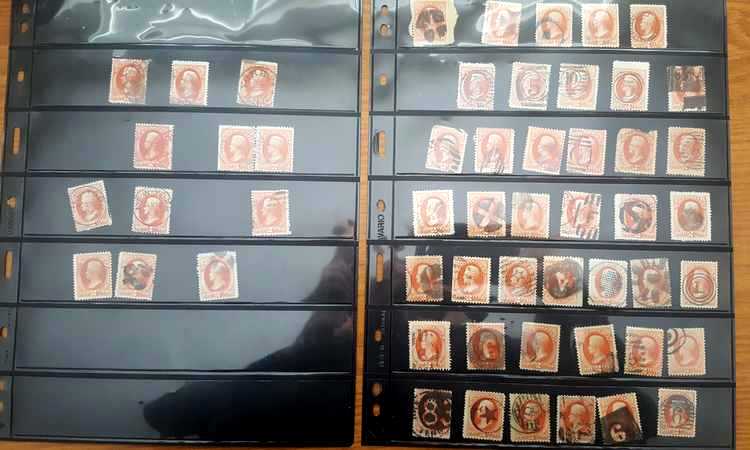 |
|
Send note to Staff
|
|
|
Valued Member
213 Posts |
|
|
The process is to pull them out and dump them on their backs into two piles, the N/C on left and C/A on the right. 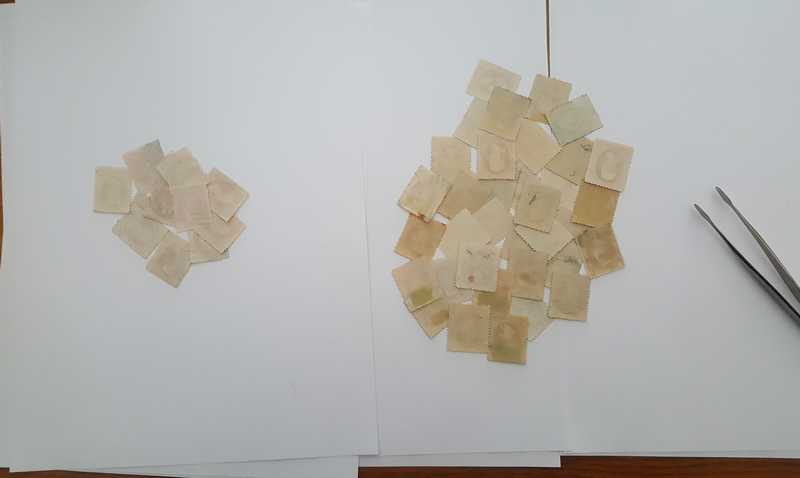 |
|
Send note to Staff
|
|
|
Valued Member
213 Posts |
|
|
Next, the obviously "toned" papers are separated into piles directly below the "normal" papers. Generally, at this point anything that looks out of the ordinary are compared with one or more of the other piles. At some point a satisfactory grouping is achieved. 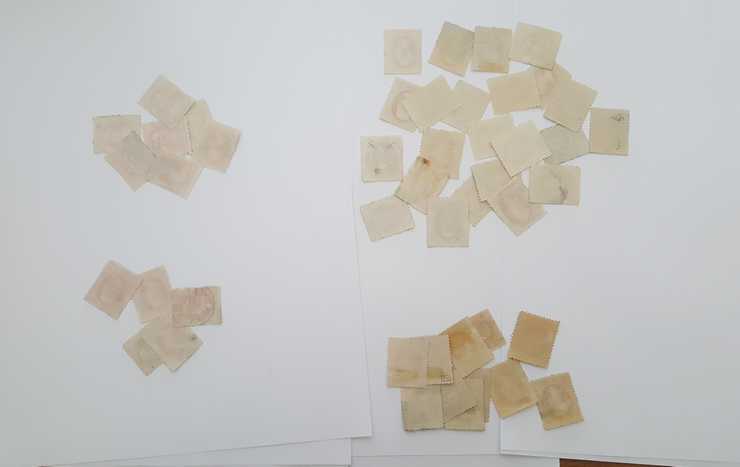 |
|
Send note to Staff
|
|
|
Valued Member
213 Posts |
|
|
A close-up view of the C/A papers (yellowish) after sorting. Some of the papers at left are somewhat odd colors (marked by red leaf) due to environment factors, but the rest conform to the normal shade. 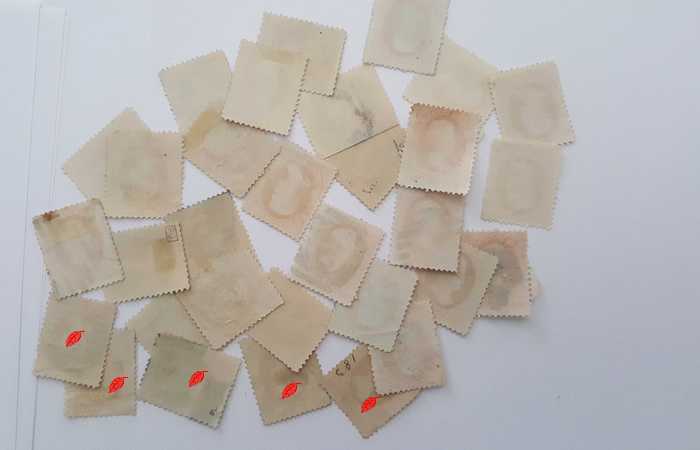 |
|
Send note to Staff
|
|
|
Valued Member
213 Posts |
|
|
Valued Member
213 Posts |
|
|
Close-up of N/C papers (off-white) with toned varieties (grayish) at bottom. Some of the stamps in the photograph may not seem as grayish as they do in person--but you get the idea. 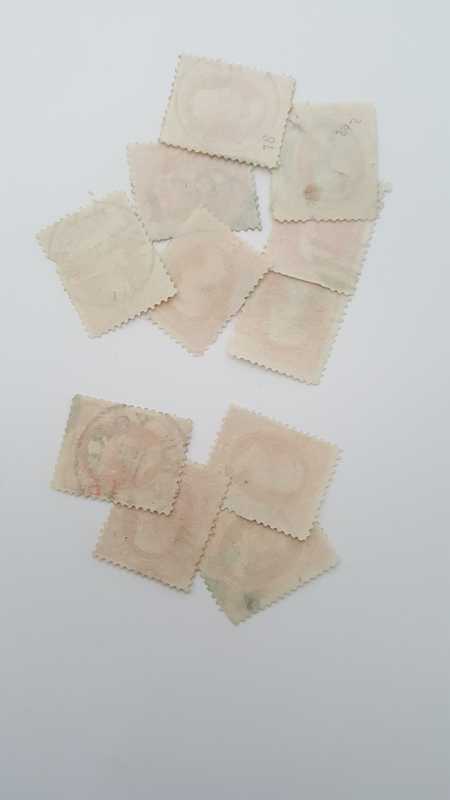 |
|
Send note to Staff
|
|
|
Valued Member
213 Posts |
|
|
All finished now. Here are the N/C stamps again, now confirmed by paper color. The bottom row are the "toned" varieties. Compare these with original group. Notice any differences? 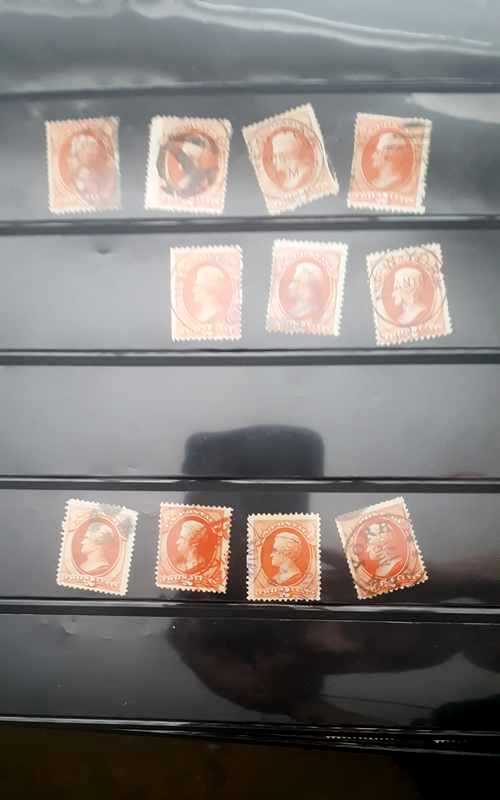 |
|
Send note to Staff
|
|
|
Valued Member
213 Posts |
|
|
Finally, all the C/A papers (yellowish), with toned group (tan) on bottom row. The second to bottom row with just three stamps are odd-colored papers (brownish-gray). I am rather particular about paper color, and if it doesn't exactly match one group or another, then I assume the papers have been altered by environmental factors. Fortunately, the cancellations date these stamps to the C/A period. 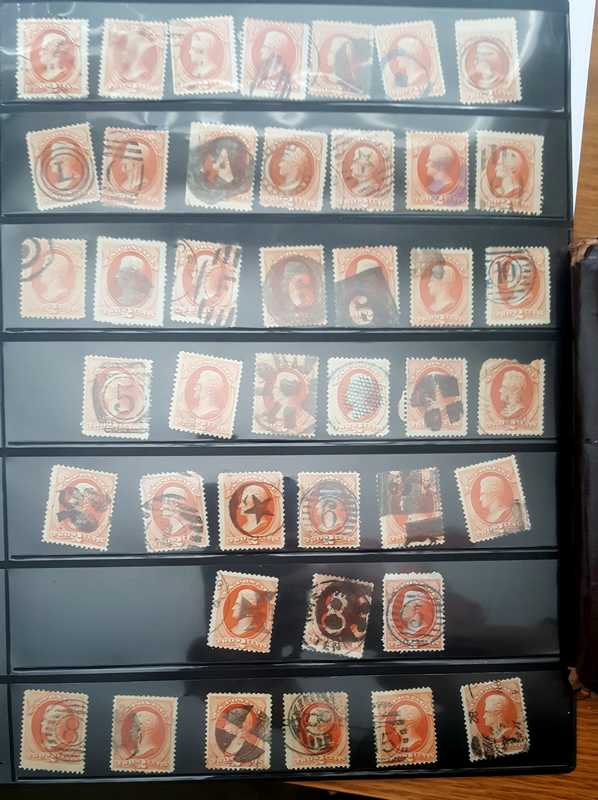 |
|
Send note to Staff
|
|
| |
Replies: 14 / Views: 2,061 |
|



 Posted 02/03/2019 6:14 pm