|
This page may contain links that result in small commissions to keep this free site up and running.

Welcome Guest! Registering and/or logging in will remove the anchor (bottom) ads. It's Free!
To participate in the forum you must log in or register.
| Author |
 Replies: 7 / Views: 3,310 Replies: 7 / Views: 3,310 |
|
|
Pillar Of The Community
6364 Posts |
|
|
A longer answer follows, although certainly abbreviated. Based on a fairly good run of Scott catalogs to draw upon, both US and worldwide with some gaps, here are a few examples from my romp through various editions: The airmail stamps we now call C1, C2, and C3 were originally 520, 521, and 522. Between the 1929 and 1930 worldwide catalogs, they were moved to become 1300, 1301, and 1302, leaving a gap which remains unfilled today. This was a time when "back of the book" issues were given blocks of higher numbers. For example, Parcel post Q1-Q12 were 1450-1461. Special handling QE1-QE4 were 1463-1467, the Official Stamps started with 1500, etc. Clearly this did not leave room for unlimited future expansion, and some of the number ranges were shifted. This is why it is common to find 4-digit numbers on the back of revenue and other BOB stamps in vintage collections. The 1940 worldwide catalog introduced the now-familiar alphabetic prefixes for the various BOB categories. Yes, the change was controversial. George Sloane wrote about the changes in his column at the time. Introductory pages from the 1940 WW catalog: 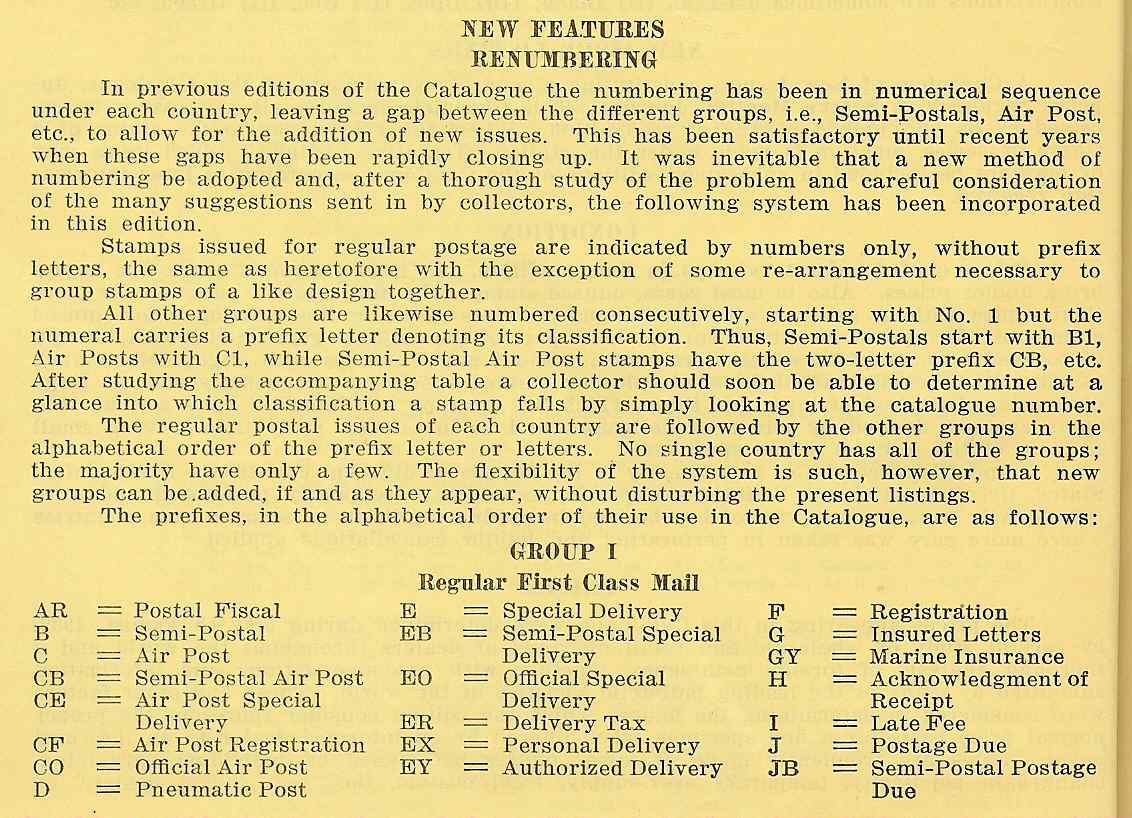 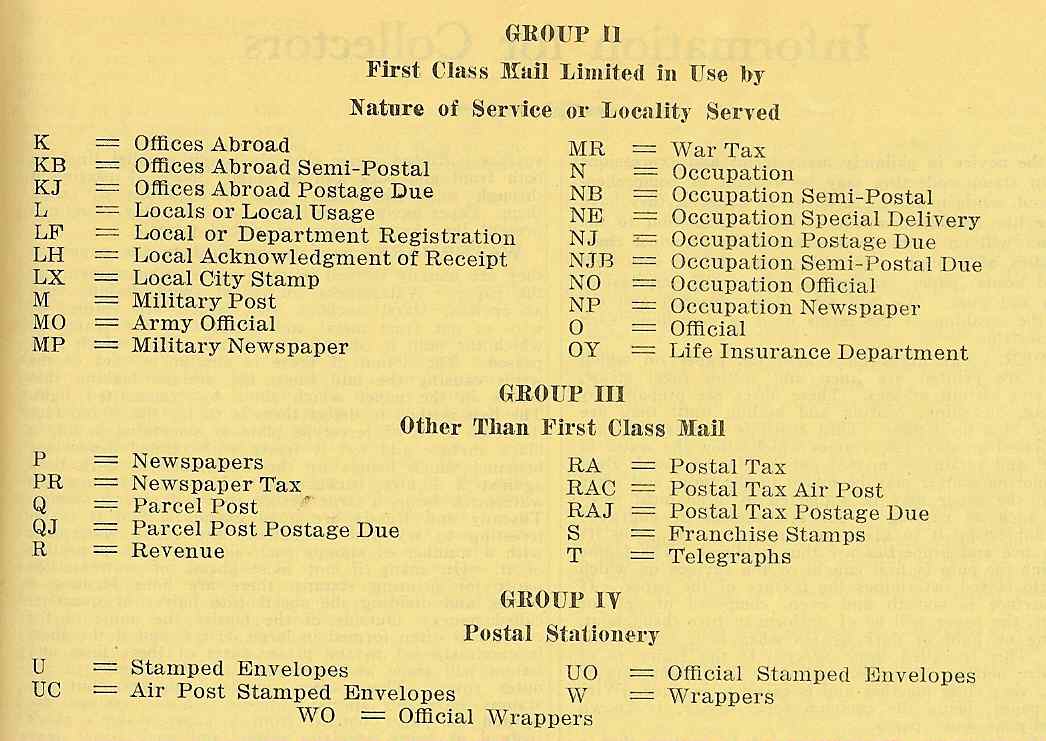 In the front of the catalog, for many years the numbering started with the postmaster provisionals. Scott 1 was Alexandria, #2 was Annapolis, etc. What we now call Scott #1 was still #28 in the 1943 WW catalog. It had become #1 by the 1949 Specialized. Most of the rest of the pre-civil war stamps shifted their numbers downward. To use an example alluded to in a recent thread, prior to the mis-1940s renumbering, Scott #50 was the 10 C green type V, (Plate II), now known as Scott 35. Painting with a very broad brush over this era, this left gaps which are unfilled and from additional scholarship revealing some stamps which would be more accurately placed in the essay, proof, or special printing sections. Most of the numbers from #63 upward have remained the same. Of course several varieties were not discovered (or get major catalog number recognition) until well after the numbers for their era were well established. Some of the perforation varieties of the Washington-Franklin series come to mind. The five varieties of the 2 cent offset issues of the WWI era, what we now call Scott 526-528B and 532-534B, were merely lower-case varieties of 526 and 532 until sometime between the 1956 and 1959 Specialized catalog editions. Thus older collections may have "526" penciled on the back of any 2 cent offset stamp. Similarly the 3 cent offset types III and IV were both varieties of major numbers 529 and 535. From the 1954 Scott Specialized: 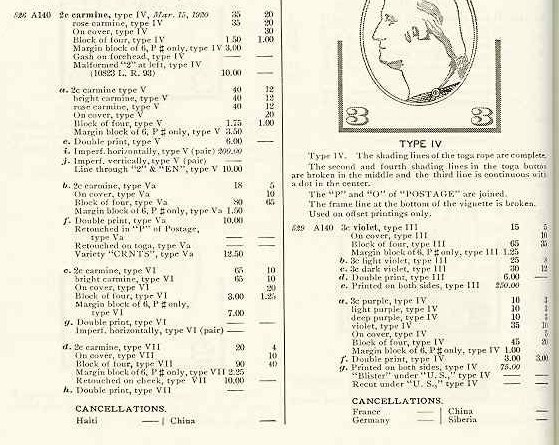 The common black Hardings were also renumbered from 611-613 to 610-612 to make a space for the rare now-#613. Think of the confusion in reviewing old-time collections – the number was correct when penciled-on in the 1940s, but is now incorrect. The collector was not bumbling or incompetent. The numbering just changed! Why was #610 even available to be used? My guess is the anticipation of the issuance of higher denomination perf-horizontal coils, which never materialized. Scott left 607-610 open and ready for them. Still waiting! More recently, Scott has renumbered the varieties of the Liberty series. And like 607-610, also have assigned blocks of numbers for lengthy definitive series anticipating the approximate number of stamps to come. Some guesses were long and some were too short for the actual number, which results in gaps or upper-case suffixes to shoehorn the extra issues into their proper sequence. Anyway, this was a quick piece based on my observations. Every gap has a story. No doubt many of you will know of other examples from your specialty areas to share here. |
|
Send note to Staff
|
|
|
|
|
Pillar Of The Community
1367 Posts |
|
|
Very interesting. The comment by George Sloane alluded to above (in 1940) was a somewhat jokey reference to the frustration felt by many collectors at the time about Scott renumbering so many stamps. It's inevitable, of course. No catalogue editors can possibly know what varieties exist of any stamp until years and much study have gone by, and sometimes even actual postal stamps which hadn't been recognized as such might have to be added into the numbering system later when they're discovered to have been real stamps. There will always be shifting around of catalogue listings, and there doesn't seem much you can do about that.
But sometimes catalogue editors just flat out shoot themselves in the foot with dumb decisions. The intro to the 1940 catalogue above says that Scott had once numbered all U.S. stamps consecutively (who would ever have guessed doing something so logical?) . . . but left a "gap between different groups" of stamps like semi's, air mails, and so on. I'd like to know which genius came up with that idea? It would seem on its face an idea that could not possibly have worked. And it didn't.
The "gaps rapidly closed up" over the years, making that system no longer tenable, one reason for the need to renumber. If stamps from no. 1 onward are supposed to be regular postal stamps, and stamps from no. 1000 onward are supposed to be air mails, and so on, we can all recognize there's going to be a problem. But the problem isn't just the assumption that the numbers would not run out. The problem was also Scott's compulsion with categorizing each type of stamp. Scott insisted on making separate groups of stamps of regular postal stamps, semi-postal stamps, air mail postal stamps, and so on. That was not necessary in any real postal sense. Stamps used to mail letters are "postage stamps". But it was also not a good idea from a chronological (historical) sense or from a design sense.
And we've had so few semi-postals, why not just put them in the regular listing wth all the other stamps? What is accomplished by listing a tiny number of stamps which are used by the general public for postage but with an extra fee for some cause separately? Just mark them as "semi-postals" in the regular listing.
When semi-postals and air mails of an era like the 1920s are relegated to the back of the album, it's bizarre. It separates them out of the group they belong with historically and by design. Looking at an album organized by the Scott catalogue is "deja vu all over again. You finish looking at the stamps of the 1990s and 2000s, and suddenly you're back in the early 20th century again with early air mails and semi-postals with old-fashioned designs and stamp topics all over again. If you've ever looked at the listing of Belgian stamps, it's truly strange. Over the years, Belgium has issued many semi-postals. Looking through the catalogue, you see thousands of Belgian stamps listed chronologically followed by another listing covering the same history consisting of more than a thousand additional stamps -- semi-postals.
Fortunately Scott did not also divide "regular" from "commemorative" stamps. What kept them from doing that, I wonder? If they had, we'd have an even more subdivided, and frankly weird,, organization of stamps. All our commems would go in a separate section of our albums away from "regular" stamps. It's done in countries' catalogues -- Japan, for one. In Japanese stamp catalogues, commemoratives are listed n a separate section with different numbers from "regular" stamps. Regular stamps are commonly or "regularly" available at post offices and were not issued to commemorate something special or available for a fairly limited amount of time. Had Scott chosen to do that, we'd have an even stranger sequencing of stamps -- at least from a chronological and design point of view.
Stamp collections are normally organized chronologically. From an historical point of view with all stamps of the same era together, and from the point of view of design with stamps of similar designs together, anything else would be pretty messy. By keeping stamps in their proper chronology, we clearly see what topics, issues, and interests were reflected in that era's stamps -- and we see similar designs grouped together so we can recognize 1920s or 1950s style stamps. History is told chronologically to make better sense. Art and design are also chronological for the same reason. A collection which separated stamps by color or size or perforation numbers might appeal to some (feel free if you're so inclined), but it's going to be confusing and quite strange for nearly everyone else. It won't make sense.
Users of stamps don't distinguish between types in any significant way. Users of the mails put semi-postal and air mail stamps on envelopes and mail them just as they put regular and commemoratives stamps on envelopes and mail them. Air mail was just a higher price for faster service. They were still postage stamps, still stamps to mail an envelope. To the stamp user, there really wasn't any great difference. Special delivery stamps were the same -- costlier for a purpose, but just higher priced stamps to mail a letter.
The stamps that are different are official stamps, postage dues, and others not used to mail a letter by the general public. List those separately. The categories of stamps Scott uses don't really make a lot of sense, and if they do it's mainly because we've become used to them over the years.
Consider how you'd feel if Scott created even more categories. What if they listed separately stamps you have to lick and stamps you don't lick? Those are significant differences. Or what if they grouped stamps by printing method, engraved, typographed, and other printing types? How about a completely separate category for stamps issued on their own separate sheets as stamps were traditionally for many generations, with a separate section for stamps issued on sheets with other stamps about the same topic-- as "sheetlets" often are. These wouldn't make much sense -- but neither does separating types of stamp which all mail letters. If you put stamps on an item to be mailed, and it's mailed, it's a "postage stamp". No other category is necessary. Just list them all consecutively without categories.
Other catalogue publishers figured this out long ago while Scott held onto its policy of separate categories. Most other catalogues -- British, French, German, and others -- do not use separate sections for semi's or air mails. They are listed together. And this creates albums where stamps from the 1960s are with the other stamps from the 1960s.
When Scott realized it had to renumber their catalogue all over again, It's a bit hard to understand why they didn't also abandon their unnecessary stamp categories. Instead, they stuck us with a silly system of segregated categories, apparently only seeing the one problem -- their silly numbering system with the "gaps" for new numbers -- but leaving the other silly numbering system of categories, now with letters, in its place. My favorite category would be be something like a semi-postal air mail stamp |
Send note to Staff 
|
| Edited by DrewM - 09/28/2018 01:17 am |
|
|
Pillar Of The Community
United Kingdom
8636 Posts |
|
|
The European approach isn't entirely uniform. Yvert separates air-mail stamps in its catalogues and albums, although Maury lists them in their chronological place. Davo separates air-mails in its albums. No-one else, as far as I know, separates charity stamps from other issues. |
|
Send note to Staff
|
|
|
Pillar Of The Community
6364 Posts |
|
|
Not to catalog-bash, but another catalog oddity ... why not list the first 3 US airmails in the order they were issued?
the 24 cent bi-color Jenny should have been C1
the 16 cent (remain) as C2, and
the 6 cent should have been C3.
|
|
Send note to Staff
|
|
|
Pillar Of The Community
1367 Posts |
|
|
There's nothing wrong with criticizing an institution, otherwise how will it ever be improved?
Hasn't Scott historically rearranged stamps which are in the same group of stamps in denomination order even if they were issued in a different chronological order? I think they've done that with all the major issues of regular stamps. I imagine that was their intention with the air mails. It may not make sense in one way, but for OCD types it makes sense in another way, I suppose! I imagine the intention is to create an attractive album page, one with stamps mounted in increasing denomination order. Imagine if the 10c stamp was mounted before the 3c stamp! It would drive some people nuts.
Yes, other catalogues are also not consistent. But the fact that European catalogues also have their strange inconsistencies may not be the best argument for the Scott catalogue doing the same thing. Decades ago, Scott's editors should have done a more thorough rethinking of what needed to be redone with the numbering mess they had started with. They made one change, but not others. It's probably too late now, though! Once the cement has hardened . . . . |
|
Send note to Staff
|
| Edited by DrewM - 09/28/2018 01:28 am |
|
|
Valued Member
United States
238 Posts |
|
|
Is the George Sloane article on the web somewhere? I didn't find anything doing a quick Google search. |
|
Send note to Staff
|
|
|
Bedrock Of The Community
United States
10866 Posts |
|
|
"The intro to the 1940 catalogue above says that Scott had once numbered all U.S. stamps consecutively (who would ever have guessed doing something so logical?)"
One can only imagine the hue and cry today if that had been followed. Anyone who does not know the year a specific stamp was issued regardless of type would be totally lost among about 10 or 12 thousand possibilities. Plus stamps of the same set were frequently not issued at the same time, so that means even more hunting. It would really be the world's biggest mess. And at this point we have all been using them this way are entire collecting period anyway. |
|
Send note to Staff
|
|
|
Pillar Of The Community
6364 Posts |
|
|
George Sloane's 1940 comments appear on page 69 of "Sloane's Column", which is a collection of George Sloane's columns from Stamps, published by the BIA in 1961. 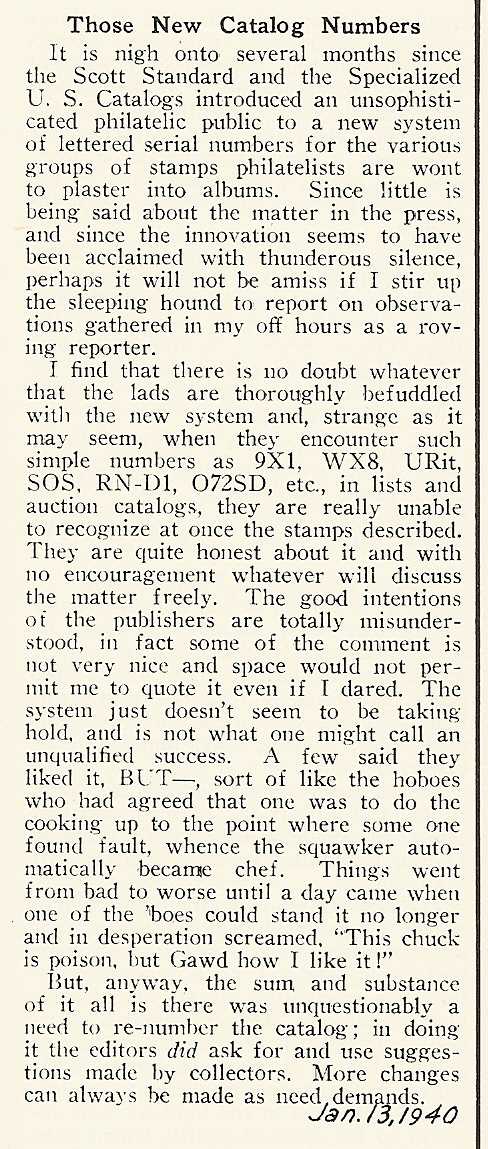 Another interesting change in the Scott worldwide catalog occurred in 1940 (or maybe in the 1939 edition, which I don't have) - the change of Scott being a retail price list backed up by their stock to being just a general listing. Here are the same sections from the introduction section from 1938 and 1940, respectively: 1938: 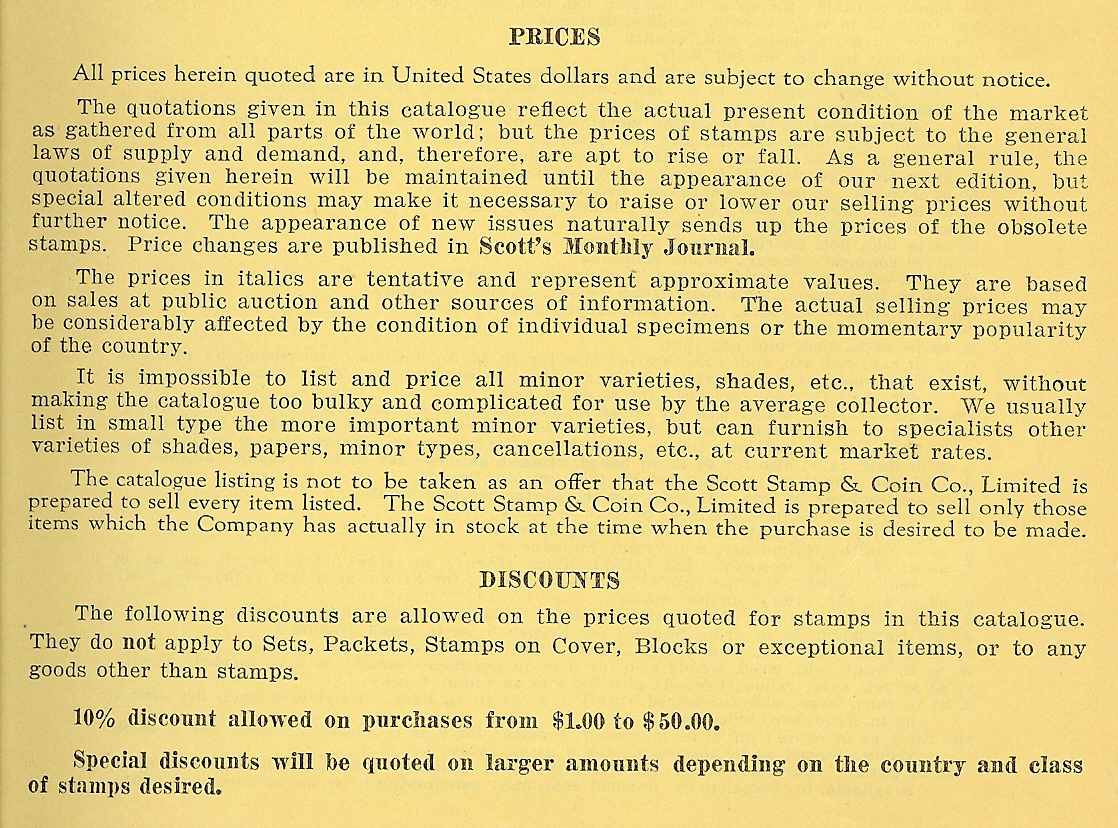 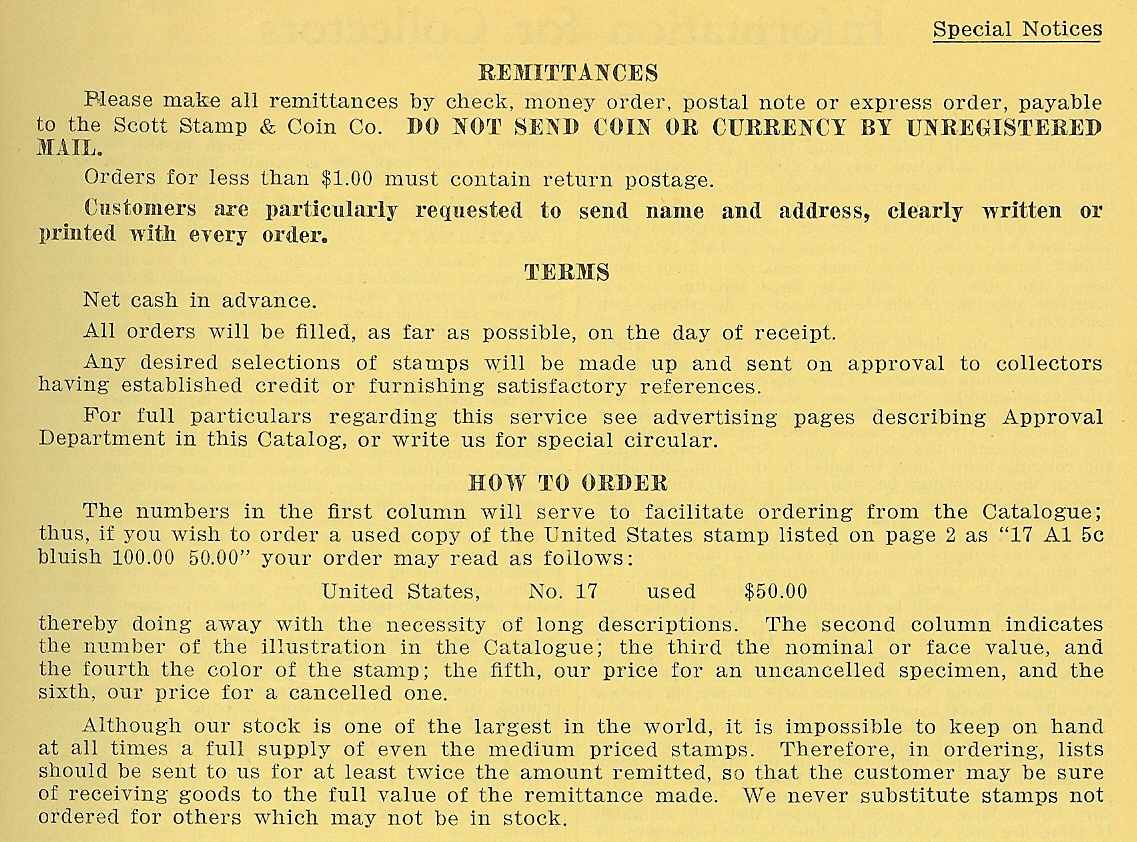 1940, quite reduced!: 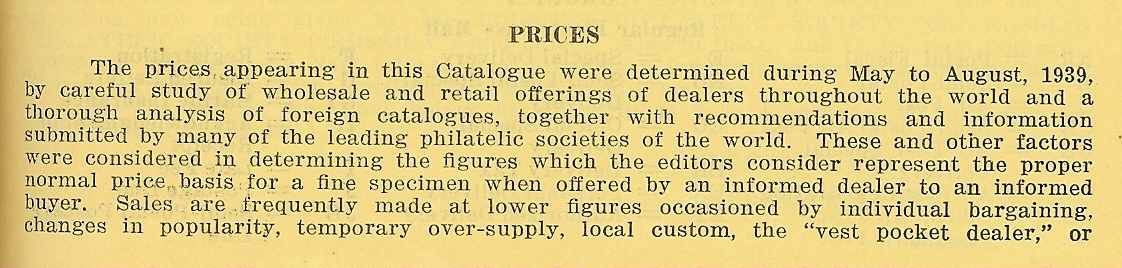 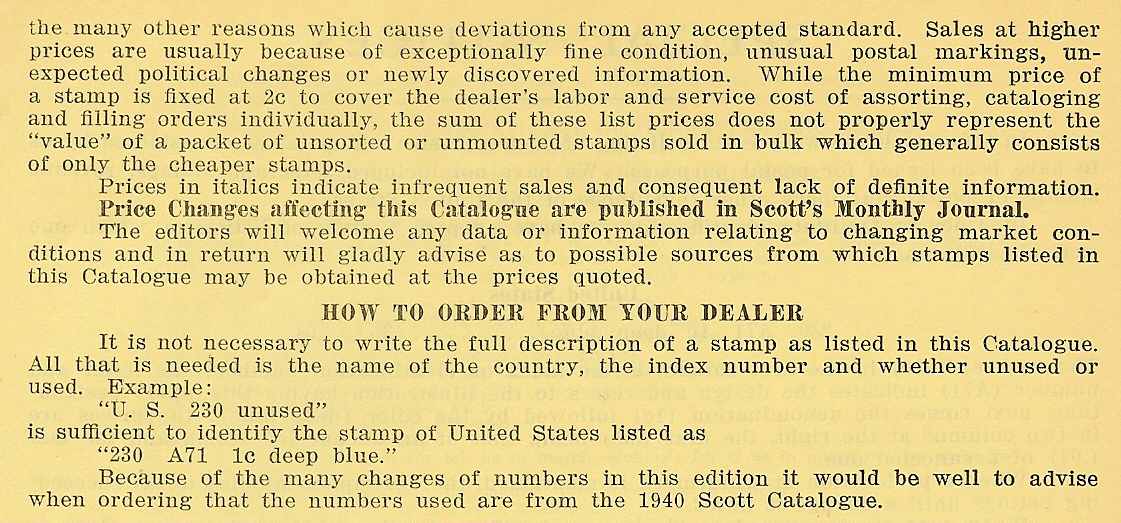 |
|
Send note to Staff
|
| Edited by John Becker - 09/28/2018 11:39 am |
|
| |
Replies: 7 / Views: 3,310 |
|
|
To participate in the forum you must log in or register. | |
 2023 Freedem Stamp. Is This Stamp Fake? Transvaal Postal History Help Earliest Stamp With In-Design Date? My First Stamps Help Newbie.help With Stamp Identification (J29) Inherited These Stamps, Are They Genuine? APS Membership Discount Metropex Stamp Show: Roseville, Minnesota October 23-24 Weird Covers, 1885,1886, And 1982 For Users Of Two-Post Blue International Albums What Is Your Experience With Binders. New Member Posting Image Of Avatar, Front And Back Of U2 Cut Square, Market Value Or References? Working On An Offline Collection George Washington 3 Cent 1861 With Print On The Back Hello From The Netherlands - New Member Then And Now, From Old Postcards New Member Wanting To Add An Avatar Sparks Auction Fees? 163 VF Nyfm Vertically Ribbed 163 XF Quartered Cork, Labeled Jumbo 136 VF Quadruple Split H Grill Nashville Philatelic Society-Your Invitation To Our Auction Night Meeting Monday, October 26, 2026 Nashville Philatelic Society-Your Invitation To Our Meeting Monday, October 19, 2026 Christmas Around The World 2026 C.e. In The Large Queen Cancel A More Condensed Album Page Experiment. 2023 Freedem Stamp. Is This Stamp Fake? Transvaal Postal History Help Earliest Stamp With In-Design Date? My First Stamps Help Newbie.help With Stamp Identification (J29) Inherited These Stamps, Are They Genuine? APS Membership Discount Metropex Stamp Show: Roseville, Minnesota October 23-24 Weird Covers, 1885,1886, And 1982 For Users Of Two-Post Blue International Albums What Is Your Experience With Binders. New Member Posting Image Of Avatar, Front And Back Of U2 Cut Square, Market Value Or References? Working On An Offline Collection George Washington 3 Cent 1861 With Print On The Back Hello From The Netherlands - New Member Then And Now, From Old Postcards New Member Wanting To Add An Avatar Sparks Auction Fees? 163 VF Nyfm Vertically Ribbed 163 XF Quartered Cork, Labeled Jumbo 136 VF Quadruple Split H Grill Nashville Philatelic Society-Your Invitation To Our Auction Night Meeting Monday, October 26, 2026 Nashville Philatelic Society-Your Invitation To Our Meeting Monday, October 19, 2026 Christmas Around The World 2026 C.e. In The Large Queen Cancel A More Condensed Album Page Experiment.
Disclaimer: While a tremendous amount of effort goes into ensuring the accuracy of the information contained in this site, Stamp Community assumes no liability for errors. Copyright 2005 - 2026 Stamp Community Family - All rights reserved worldwide. Use of any images or content on this website without prior written permission of Stamp Community or the original lender is strictly prohibited.
Privacy Policy / Terms of Use Advertise Here |
| Stamp Community Forum |
© 2007 - 2026 Stamp Community Forums |
| It took 0.17 seconds to lick this stamp. |
 |
|
|
|


 Posted 09/27/2018 3:19 pm


