|
This page may contain links that result in small commissions to keep this free site up and running.

Welcome Guest! Registering and/or logging in will remove the anchor (bottom) ads. It's Free!
To participate in the forum you must log in or register.
| Author |
 Replies: 34 / Views: 9,335 Replies: 34 / Views: 9,335 |
|
|
|
Pillar Of The Community
United States
8956 Posts |
|
|
Don't use detergent. Do it the "citrus" way, or do not soak them at all
Peter |
Send note to Staff 
|
|
|
Pillar Of The Community

United States
1951 Posts |
|
|
Pillar Of The Community
United States
1951 Posts |
|
|
I know most of you are sick of Machin talk, but I don't care. I like them.
Recently, I had dialogue with Robin Harris aka The Machin Nut. I have been observing that PPP, ACP, and PCP stamps don't have bands. I theorized that if there are no bands, and the paper looks white, then we must be looking at a PPP, ACP, or PCP stamp. Conversely, if there are bands, then it cannot be PPP, ACP, or PCP. So I asked Robin. His response:
John:
A quick glance through Deegam's handbook suggests your theory that PPP, ACP, PCP stamps do not have phosphor bands is correct.
Robin Harris
I'm passing this along to help other confused Machinites like me.
Jack Kelley |
|
Send note to Staff
|
|
|
Pillar Of The Community
United States
4520 Posts |
|
|
I finally got around to take some pictures under SW UV. The ones on left are PCP and ones on the right are ACP. These were only available in the types. I need to find all that are unused. The lower right is brighter and has a decent afterglow to match ACP. The only unused stamp is the lower left. The upper right does not look that much different than the unused PCP on LL. The UR has no clear after glow like LR. UL X965 UR X966 LL X945 LR X967 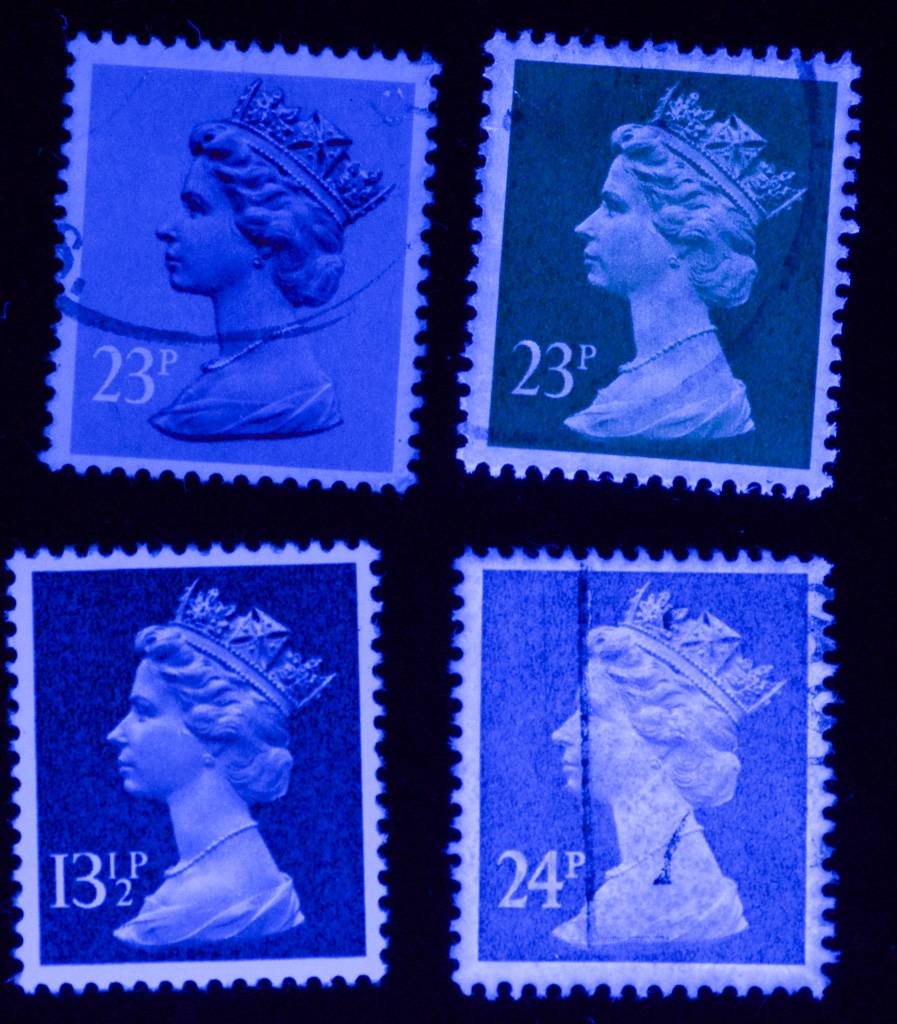 Note: UV light is from bottom of image. The results continue to confirm used stamps do not seem to exhibit the properties needed to identify phosphor types. At least with banding you can usually see the residual carrier for the phosphor visually. Under UV, it looks more like staining. |
|
Send note to Staff
|
Al |
| Edited by angore - 12/20/2019 07:24 am |
|
|
Pillar Of The Community
United States
4520 Posts |
|
|
Here are two Mint stamps Left is X952 PCP paper, right is X936 ACP. The difference is clearer and the ACP did have a slight afterglow. This image is side illuminated with lamp on each side. 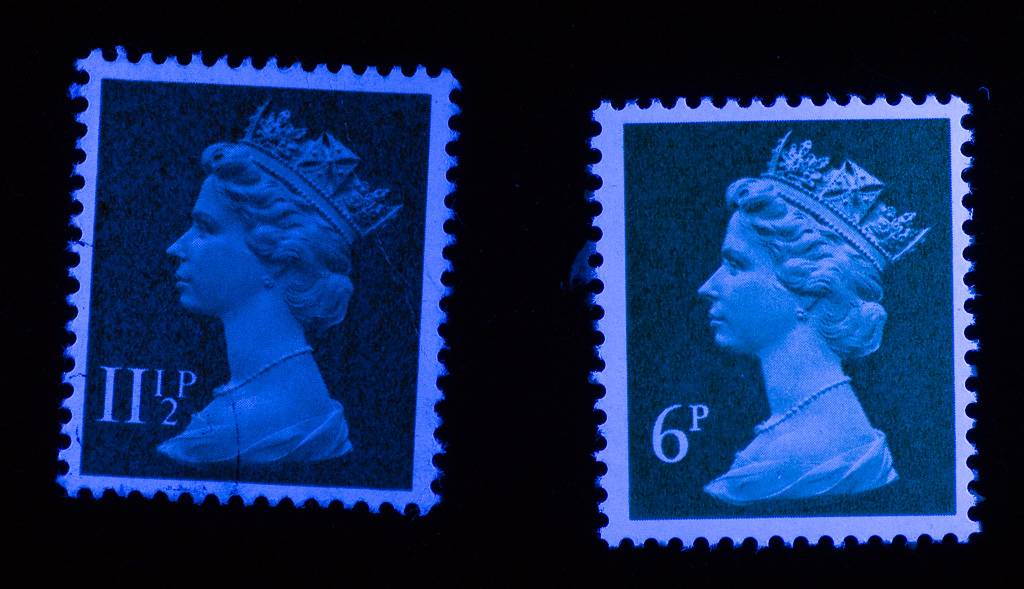 |
|
Send note to Staff
|
Al |
| Edited by angore - 12/20/2019 1:18 pm |
|
|
Pillar Of The Community
Netherlands
6647 Posts |
|
|
Actually, there are PPP stamps with phosphor bands. The 2p exists with All Over B3 phosphor. When PPP was introduced (10p stamp) some sorting machines were not modified to recognise phosphorised paper. So, they applied the usual two B3 phosphor bars.
PCP and ACP are paper coatings. It does not have an afterglow after exposing it to UV light. PPP is a phosphor tagging. This will have some kind of afterglow.
PCP comes in two varieties: PCP1 and PCP2. |
|
Send note to Staff
|
|
|
Pillar Of The Community
United States
4520 Posts |
|
|
Here is a primer on paper types from Adminware's web site.  |
|
Send note to Staff
|
Al |
| Edited by angore - 02/09/2020 06:16 am |
|
|
Pillar Of The Community
Netherlands
6647 Posts |
|
|
Correct. I said PCP and ACP have no afterglow. They do, but quite different from PPP. You will see when you compare them. |
|
Send note to Staff
|
|
|
Pillar Of The Community
United States
1179 Posts |
|
|
LATE Follow-Up Question to ANGORE's POST on the, "... primer on paper types from Adminware's web site..." Is there ANY site, book or publication that shows an actual "side-by-side photo comparison of papers fluorescing-on a value-by-value basis" or even one set of papers side-by-side, shown under UV light? As an example on the 1p Crimson Issue of 2/15/1971. Adminware indicates the issue was printed on: OCP 2-Band, FCP 2-Band, FCP JET, PPP, PCP, ACP, OFNP, FCP-"A" Phosphor. Do these ALL fluorces to the the same degree and appear as the same basic color under UV light? I doubt it. What does a 2-Band FCP look like next to a 2-Band Jet Phosphor? Do they appear the same? What is an FCP-"A" Phosphor color under UV light? ANGORE: The two 23p stamps shows, I believe, both shown are two different printed colors making the fluorescense appear differently, the left being a green and the right a dark blue. Am I correct? While the 13-1/2p is an Orange Brown of 1971 compared to a 24p of 1989 being a Rust color issue? ANGORE, I greatly appreciate the images you posted...they helped me a little. Can you answer the following for me??? What 1p Crimson on phosphor paper has a 4mm center band & fluoresces w/two bright yellow side bands? What 1p Crimson 2-band on phosphor fluoresces a deep red velvet color? What 1p Crimson 2-band on phosphor fluoresces a slate green? What 1p Crimson 2-band on chalk phosphor paper fluoresces a brown? What 1p Crimson center stripe phosphor paper fluoresces slate green? and finally: What 1p Crimson 2-band (barely view) on chalk phosphor paper has margins (only) fluores bright white? Thanks for all your help in advance, and a Happy, HEALTHY New Year to ALL on SCF! A very, VERY Confused NEW Machinite!  |
|
Send note to Staff
|
| Edited by Hal - 12/31/2020 10:09 pm |
|
|
Pillar Of The Community
Netherlands
6647 Posts |
|
|
There, basically, are three phosphor colours: violet, yellow and blue.
Enschedé changed the composition of its yellow-fluorescing phosphor. On the 1p crimson, all three exist. These range from yellow to greenish yellow. Enschedé paper absorbed the phosphor ink too much. To counteract absorption, Enschedé sealed the paper with varnish bars before applying the phosphor bars. The phosphor bars appear in a slightly different colour where the varnish was applied.
The blue phosphors exist in two types. One reacts to short-wave uv-light only. The other reacts to short-wave and long-wave uv-light. These come in a range from almost white to almost violet. The brightness varies from vary bright to very dull.
Before these, the fluorescence was violet. The old, B3-phosphor, shows up as dark bars under short-wave uv-light. Its afterglow, however, is violet. The newer A-phosphor does not show up as easy under UV-light, but also has a violet afterglow. The colour of the phosphor refers to the afterglow.
In 1973, the coating of the paper of some stamps was contaminated. This caused the normal violet afterglow of the B3-phosphor to become yellow-green.
The violet phosphor was the third type used. It was used on Machins from the start. The Wildings, however, first had green phosphor, then blue and then the violet phosphor. The last was used on Machins. The old green phosphor was used on the 2½p stamp in error, in 1972. There was another green phosphor. If I remember correctly, this was from a Questa booklet of the 1990s.
OCP, OFNP, and FCP are coated papers. The coating does not contain phosphor. The coating of PCP contains phosphor that has tends to make the paper look slightly darker under uv-light, giving a violet afterglow. The coating of ACP contains phosphor like the A-phosphor. OFFP is similar but lacks optical brightening agents that make the paper look bright white under long-wave uv-light. OFNP also lacks the optical brightening agents.
So, where colours can only be green (more yellow-green), violet, yellow (ranging from yellow to yellow-green) or blue (ranging from almost white to violet).
• Deep red-velvet: does not exist at all. Either you are perceiving this colour, or the phosphor reacted to a chemical. Or are you describing fluorescence of the crimson ink (also likely to be a chemical reaction).
• Slate-green: does not exist. Again, you might be perceiving this colour.
• Brown: does not exist. It might be you are describing B3-phosphor when held under short-wave uv-light.
• Phosphor paper with phosphor bars does not exist for the 1p. Either the paper has a coating containing phosphor, or it has a coating that does not contain phosphor and has phosphor bars.
• Paper fluorescence varies. The "F" in FCP stands for fluorescent. This has margins that are bright white under long-wave uv-light, especially next to OCP. But it is less so next to ACP.
I am not saying you write impossible things. You might be describing things in a way that is not helpful for identification.
It might help when you give more information on what type of uv-lamp you use and whether you are describing what you see when the light is on or just turned off. It also helps to be more specific about what part of the stamp you are describing. There are four margins. Usually, the top and bottom show fluorescence between bars on FCP and ACP. Pictures may help.
|
|
Send note to Staff
|
|
|
Pillar Of The Community
United States
4520 Posts |
|
|
As one of my last posts said, I find dealing with used stamps to be challenging since the condition is not always good.
What I would like to see is an image of a Jet phosphor compared to the regular phosphor. These early stamps did not have much of a detectable after glow. |
|
Send note to Staff
|
Al |
|
|
Pillar Of The Community
United States
1179 Posts |
|
|
First, NSK & ANGORE Thank you very much for your answers and to answer your questions, I'm viewing viewing the printed-side of appx 750 -1 pence, Crimson Machins under an old fashion RAYTECH LW-8L, .16 AMP, Longwave UV-Lamp. Based on descriptions on the Adminware Website, the Deegam Machin Handbook, and the few posts I have been able to find so far on the web and SCF...and now some additional information posted I have a better idea of what I am dealing with in terms of visuals.
Unfortunately, NSK has provided the answer I didn't want to hear...there is nothing in print or on the web showing a side-by-side comparison-by-value of each phosphor paper under UV-light. I was also hoping to see what a "phosphor chalked paper" looked like vs. a "non-phosphor chalked paper" under UV-light. Oh well, can't have everything.
I suspect the face colors of "Deep Red-Velvet" vs "Brown" vs "Slate Green" are a combination of any of the following: Ink + Phosphor + "Paper Coating Agent", coupled with the affects of Fluoride or other Water Treatment Agents, Water contaminants, Detergents, Cancellation Bleeding, etc., or the effect of water temperature at time of stamp soaking may play a role in the current colors I'm seeing.
The 4.5mm Single-Band Phosphor with two Bright Yellow-Green Bands had to be the Enschede' OFP issue of 10/17/79. I have at least 200 copies that match JKELLEYs description of MACHINS with no bands, though some maybe very light or have been washed-off in soaking. I understand what you are calling a "violet afterglow." Does the "NP" in "OFNP" indicate "Non-Phosphor"?
What is the difference between PCP and PCP2 paper?
I will attempt to photo & post images for review. The UV-light is handheld and the camera on my phone is not the best quality…holding the two-at-one may be a problem; which is why I was looking for a book or website with the same. NSK, I greatly appreciate your assistance and descriptions – I'll get back to you on the photos. Thank you, again!
Best regards,
Hal
|
|
Send note to Staff
|
|
|
Pillar Of The Community
Netherlands
6647 Posts |
|
|
PCP is the general term for Phosphor Coated Paper. This comes in PCP1 and PCP2 that are "boundaries." PCP stamps can appear dull or glossy. The ones with a dull finishing are PCP1 and those with a very glossy finishing are PCP2. This was not intentional and there is a range of finishes in between.
I get the impression you are mixing phosphorescence and fluorescence. Until ca. 1995, phosphorescence on Machins is the afterglow when irradiating the stamps with short-wave uv-light. Long-wave uv-light does not give an afterglow at all. This afterglow is caused by the phosphor bars or phosphor in the coating. Here also lies to answer to your question about the phosphor chalk-surfaced and non-phosphor chalk-surfaced papers. Have a dark spot, irradiate with a short-wave uv-lamp. After switching off the lamp, the one that glows in the dark - this can only last shortly as angore wrote - is the one with phosphor.
There are only few gravure stamps with a phosphor bar with added yellow fluor that were printed by Harrison. The 1p was not among them. So, I agree with your conclusion it, likely, is an Enschedé stamp. |
|
Send note to Staff
|
|
|
Pillar Of The Community
United States
4520 Posts |
|
|
From the original post, the PPP (all over phosphor) can be determinede in normal light. The image is grainier. Under long wave, the fluorescent paper (intentionally or unintentionally) will glow. This is one complication since early days it was not controlled. This can be confused with ACP/PCP. From my experiments, I can usually determine ones that are ACP because they have a stronger afterglow but there are always some in the "cannot determine" (PCP, ACP) due to experience, stamp condition, etc This is a table from Deegam showing phosphor response under LW and SW. 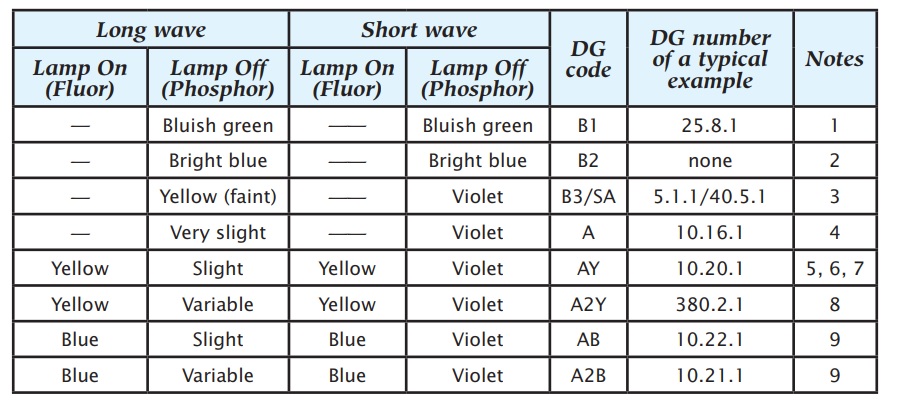 |
|
Send note to Staff
|
Al |
| Edited by angore - 01/02/2021 06:06 am |
|
|
Pillar Of The Community
Netherlands
6647 Posts |
|
|
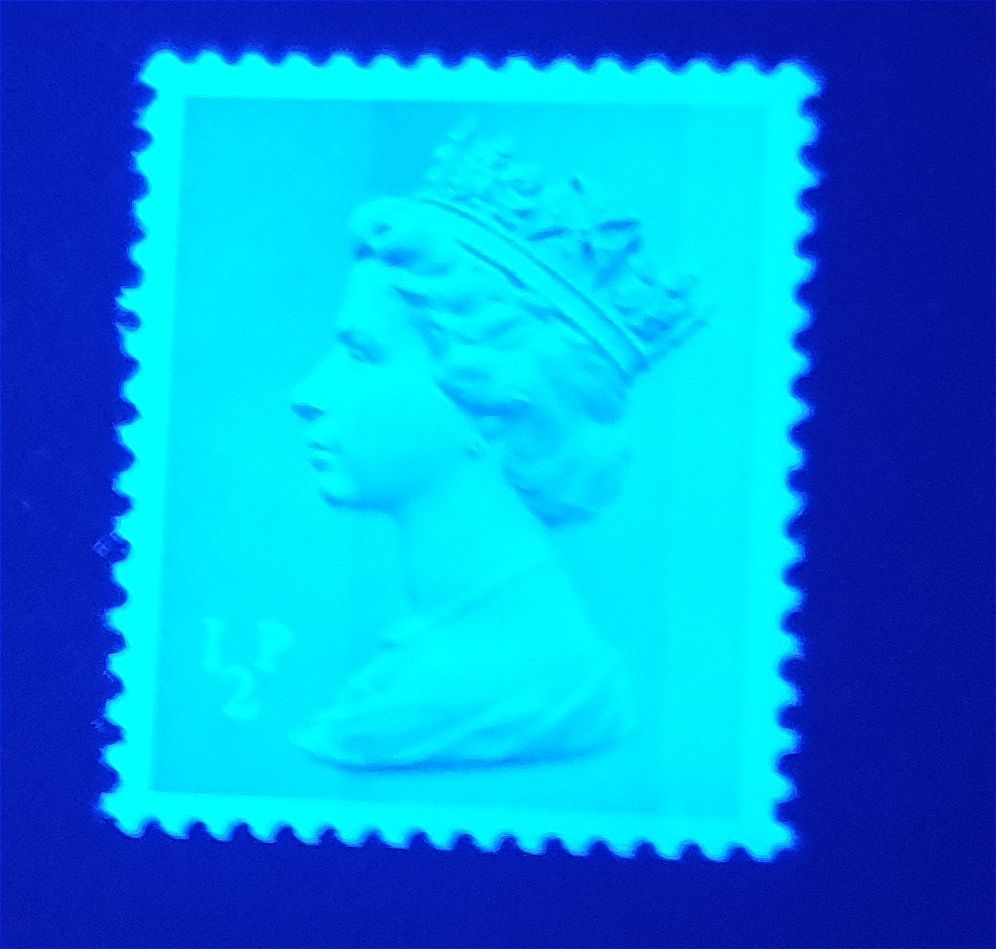  Both images were taken with the uv-lamp turned on. The top one is what you see under a long-wave lamp. The bottom one is what you see under a short-wave lamp. I think it requires some imagination to see a broad band in the centre in the long-wave light. It is very clear in the short-wave light. In neither case, there was a visible luminescence after turning off the light. There is a good chance I did not see it as my eyes were adjusting to the sudden darkness. Noticeable afterglow from B3, SA and A phosphors when a long-wave lamp is turned off is difficult to be sure about. When you turn off the lamp, your eyes adjust to the environment. The short-wave afterglow is stronger and lasts longer. That is the most reliable. I cannot say I have seen that afterglow from long-wave uv-light and I have seen a lot of fresh, mint Machins. Long wave uv-light will capture fluorescence. FCP is Fluorescent Coated Paper. The optical brightening agent will appear bright under long-wave uv-light. This is helpful when comparing OCP and FCP. Confusion between FCP and PCP should not be necessary. Both have OBA and show luminescence under long-wave uv-light. FCP only occurs with phosphor bars. There are about five stamps that have PCP and phosphor. FCP shows phosphorescence where the phosphor bars are and none where they are not. PCP shows phosphorescence over the whole surface. If you have FCP without bars, you have a missing phosphor stamp. Of course, used stamps may be affected by use and soaking. Just use short-wave uv for non-elliptical stamps. |
|
Send note to Staff
|
|
|
Replies: 34 / Views: 9,335 |
|
|
To participate in the forum you must log in or register. | |
 Finally Found This R88A Plate Variety. Been Looking For One For Years Can USPS Imperforate Stamps Be Used For Postage? Hello From Albany, Oregom US Scott #rb11 Fake Or Facsimile? Scott #498 (1917-1919) Avatar Change Request 2023 Freedem Stamp. Is This Stamp Fake? Transvaal Postal History Help Earliest Stamp With In-Design Date? My First Stamps Help Newbie.help With Stamp Identification (J29) Inherited These Stamps, Are They Genuine? APS Membership Discount Metropex Stamp Show: Roseville, Minnesota October 23-24 Weird Covers, 1885,1886, And 1982 For Users Of Two-Post Blue International Albums What Is Your Experience With Binders. New Member Posting Image Of Avatar, Front And Back Of U2 Cut Square, Market Value Or References? Working On An Offline Collection George Washington 3 Cent 1861 With Print On The Back Hello From The Netherlands - New Member Then And Now, From Old Postcards New Member Wanting To Add An Avatar Sparks Auction Fees? 163 VF Nyfm Vertically Ribbed 163 XF Quartered Cork, Labeled Jumbo Finally Found This R88A Plate Variety. Been Looking For One For Years Can USPS Imperforate Stamps Be Used For Postage? Hello From Albany, Oregom US Scott #rb11 Fake Or Facsimile? Scott #498 (1917-1919) Avatar Change Request 2023 Freedem Stamp. Is This Stamp Fake? Transvaal Postal History Help Earliest Stamp With In-Design Date? My First Stamps Help Newbie.help With Stamp Identification (J29) Inherited These Stamps, Are They Genuine? APS Membership Discount Metropex Stamp Show: Roseville, Minnesota October 23-24 Weird Covers, 1885,1886, And 1982 For Users Of Two-Post Blue International Albums What Is Your Experience With Binders. New Member Posting Image Of Avatar, Front And Back Of U2 Cut Square, Market Value Or References? Working On An Offline Collection George Washington 3 Cent 1861 With Print On The Back Hello From The Netherlands - New Member Then And Now, From Old Postcards New Member Wanting To Add An Avatar Sparks Auction Fees? 163 VF Nyfm Vertically Ribbed 163 XF Quartered Cork, Labeled Jumbo
Disclaimer: While a tremendous amount of effort goes into ensuring the accuracy of the information contained in this site, Stamp Community assumes no liability for errors. Copyright 2005 - 2026 Stamp Community Family - All rights reserved worldwide. Use of any images or content on this website without prior written permission of Stamp Community or the original lender is strictly prohibited.
Privacy Policy / Terms of Use Advertise Here |
| Stamp Community Forum |
© 2007 - 2026 Stamp Community Forums |
| It took 0.35 seconds to lick this stamp. |
 |
|
|
|


 Posted 08/06/2019 10:59 am


