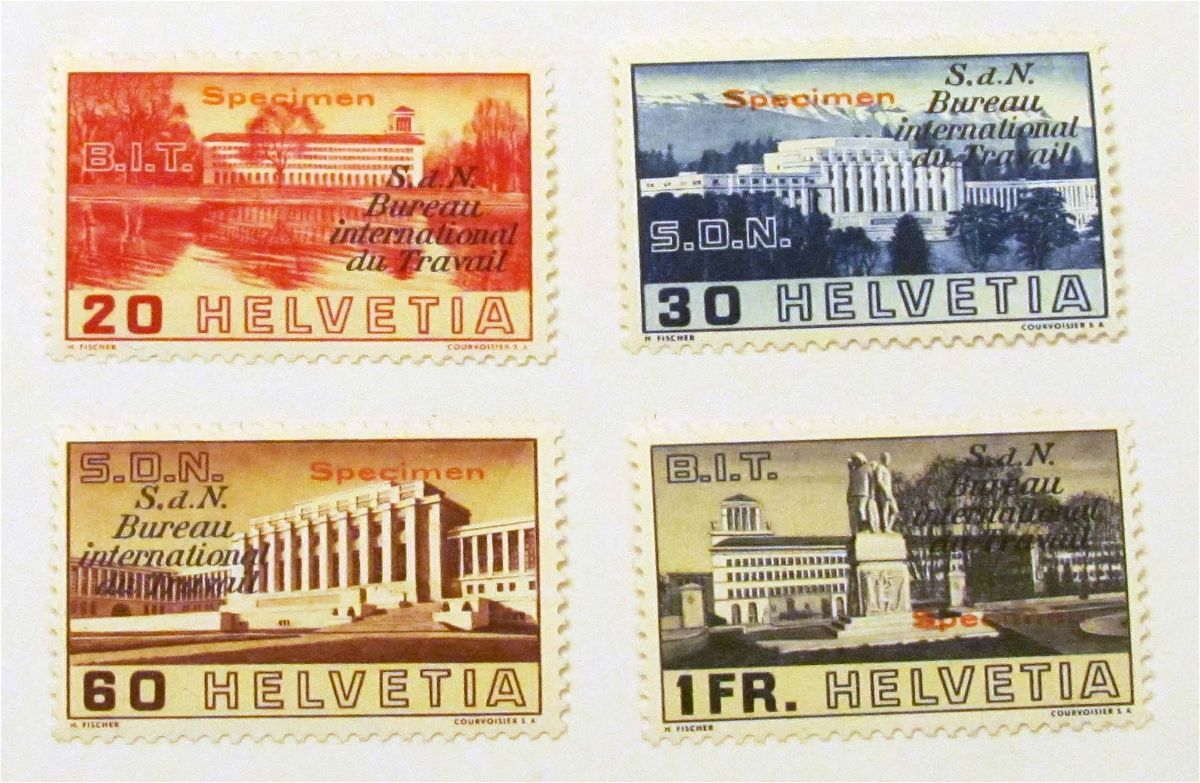
A general "chat" about Specimens...........
ABOUT SPECIMENS By DAVID PLUMMER
Local philatelic history has been made by the appearance of three
Australian high values overprinted "Specimen". These were issued (to
quote the inscription on the pack) to offer "collectors a rare opportunity to
add official 'Specimen* items to their collections," and to "enable Australia
Post to assist the Australian International Philatelic Exhibition, Ausipex
84".
The second of these objectives is the historic development mentioned. The
first is an echo of early Commonwealth philatelic history, and one wonders
that it was not a continuing practice. The overprinting of high values to
supply Australian collectors with samples of such stamps at a reduced cost
followed the introduction of the first Commonwealth adhesives, the
kangaroo-map design.
Specimen stamps had appeared elsewhere in the world long before 1913. In a way, their initial provision was a misunderstanding of an official
instruction issued by the Universal Postal Union in 1878. Part of the
agreement reached by member-nations provided for documents relating to
their postal arrangements to be sent to the central Bureau for general
distribution. This was, quite reasonably, taken to mean that copies of each
current stamp should be so forwarded, for archival purposes and also to
show what postmasters might expect to see on international mail.
From the beginning, some countries overprinted stamps before sending
them to the Bureau, others sent mint or lightly postmarked copies. The
early requirements were not large, but as the U.P.U. grew in strength, and
as stamps of higher value were issued, it became obvious that there was
some possibility of trafficking; light postmarks could be easily removed.
While, for example, up to 1867 the top value in British stamps reached
only 2/-that increased to 5/- in that year, and IO/-, £1 and £5 stamps were
on the way.
Till 1882, 92 copies of each stamp issued were sent to the Bureau. This
figure became 300 by 1886. By the end of the century there were 730, and
the U.P.U. was returning some of them to the senders because of storage
problems. (Why, if distribution was being undertaken as arranged?) In
1907 the quantity to be sent was reduced to 448, and later to 400.
A long set of stamps showing various works by
Goya was issued by Spain in 1930. To make sure
that they gained attention, specimen sets were
sent to major newspapers throughout the world.
"Muestra", reading upwards, may be noticed at
the lady's feet.
The customary overprint on British Colonial
stamps found a solution, and perforating the word "Specimen" in each
stamp was introduced.
Before returning to the history of Australian specimen stamps, certain
points about these stamps should be mentioned.
First, not all stamps so overprinted by other countries were prepared as
copies for U.P.U. files or for overseas postal authorities. The specimen
stamps just issued through our own philatelic sales counters may be quoted
as examples of this. Important visitors from other countries, stamp
designers and artists, politicians, and similar people may become recipients
of copies so overprinted. In certain cases, copies were sold to philatelists.
Additional suppplies were likely to be printed when some later important
occasion involved a "mass" presentation of postal material. The
distribution of "Specimen" stamps as publicity for new issues is increasing.
A U.P.U. Congress is held every four to five years, and for the national
delegates who attend these meetings an issue of stamps is usually made by the host country, a different venue being used for each Congress. These are often specimen copies, but latterly ordinary stamps have been used for such occasions, working on the theory that surely men of such eminence would not stoop to using their mementos for personal gain.
In 1929 a five-stamp issue was made by Great Britain for the Congress held
in London that year; the values were '/id., Id., l'/2d. and 2d., and £1. The
story used to run that the £1 stamp was issued because it was belatedly
realised that, at 5!/2d., the total face value of the set appeared rather
niggardly. The story can be believed if "belatedly" is dropped from it. The
very poorly designed low values were typographed, whereas the £1 stamp
was well designed and beautiful.
The Australian Stamp Monthly, April, 1983
Page 41
|





 Posted 01/02/2019 01:11 am