Stamp Community Family of Web Sites
Thousands of stamps, consistently graded, competitively priced and hundreds of in-depth blog posts to read


Stamp Community Forum
 
Username:
Password:
Save Password
Forgot your Password?

This page may contain links that result in small commissions to keep this free site up and running.

Welcome Guest! Registering and/or logging in will remove the anchor (bottom) ads. It's Free!

Market Value Vs Catalogue Value

Previous Page | Next Page    
 
To participate in the forum you must log in or register.
Author Previous TopicReplies: 115 / Views: 10,293Next Topic
Page: of 8
Pillar Of The Community
Learn More...
723 Posts
Posted 02/25/2019   7:20 pm  Show Profile Bookmark this reply Add rismoney to your friends list  Get a Link to this Reply
Eyeoneall: I don't actually think I would go broke but you may need some deep pockets, but at any given time there are only a handful of auctions with decent EFO major error material, (aside from a main event like Wingate, Important Errors, etc).

Your current competition prices at 80-90% cat with little negotiation room. I believe you can easily arb 30-50% cat acquisition values to 60-80% cat sell side if you build a reputation and listing count in the 100s/1000s. In many cases EFO cornering can be at or above cat, and still be below other sellers. I don't want to name who, but you can see for yourself.

Even crazier is there were balance collection lots of material that sold for like 10k that had 3-5x the value of material in them.

I also think that networking within the dealers circles is key to always being able to deliver to someone at your doorstep.


Send note to Staff  Go to Top of Page
Edited by rismoney - 02/25/2019 7:47 pm
Pillar Of The Community
United States
4077 Posts
Posted 02/25/2019   7:55 pm  Show Profile Check eyeonwall's eBay Listings Bookmark this reply Add eyeonwall to your friends list  Get a Link to this Reply
Brixton:

"But if E-bay only decides to display your item for 1 hour every day of the 7 days your auction is running, then the number
of potential bidders for your item will be VERY limited. This is why items that start at a penny seldom bring anywhere near
what they would if an established auction house sold them."

Absolutely ludicrous to suggest they do not show anyone's listings all the time. How does this help them?

As revenue collector wrote:

"If you use ebay's default "Best Match" [Worst Match as far as I am concerned] sort order, or their "recommendations", then
yes it is subject to ebay's algorithmic manipulation. However, I personally don't know anyone who uses this default sort order.
ebay newbies might, until they learn better.
Every one of my saved or bookmarked search uses either the newest listed or ending soonest sort order, which does not fall prey
to the algorithmic prioritization, hiding, or other shenanigans. I have yet to ever NOT be able to find a certain listing when
using those sort orders, nor have I ever had a buyer tell me they could not find my listings when using them."

As for this being why items that start at a penny seldom bring anywhere near what they would if an established auction house sold them,
again wrong.
Since you are talking about stuff that traditional auctions would sell, you are talking about higher priced items. One big reason
things sell lower on ebay is because buyers of better material do not want to spend the time slogging thru the garbage that clogs ebay
looking for decent stuff when they know a traditional auction will only list decent stuff. The other big reason is because they trust
a traditional auction more than many ebay sellers, either because it is some rando person they have never heard of or because they
have heard horror stories about certain big but horrible sellers on ebay. I don't sell high priced items, but I can tell you the 1c and
99c guys get more not less for the same items than I can because they have huge followings.


" E-bay does it, because from their perspective, they maximize profit when all items sell, not when a few items bring the highest prices.
So, if there are listings for 10 identical stamps, E-bay would rather that all 10 sell, even if they only sell for the minimum bid, then
to have 3 items sell for high bids."

How does having 3 items sell for high bids preclude the other 7 items from selling???

"If you go to sellers forums and you read the comments, many many sellers from all different product categories have experienced year over
year declines in sales of as much as 80%. This has been happening the entire time since Cassini was introduced and it's getting worse and worse."

The forums are populated with a higher percentage of complainers than the overall population. While I'm sure some have experienced large declines,
if things were as bad as you suggest ebay would have much lower profits. I have not experience any obvious decline in sales and I do not have
a clue how to manipulate any algorithms they use.

"Then there is the throttling that occurs on a regular basis where your sales are kept to within a narrow $ range every month, no matter how
much you list or how you lower your prices. If you have a really great day you can count on the next 2-3 days to be dead, followed by another
good day"

Of course you monthly sales totals will be more stable than your day to day sales. Do you have no understanding of math and statistics?
Send note to Staff  Go to Top of Page
Bedrock Of The Community
12552 Posts
Posted 02/25/2019   7:58 pm  Show Profile Bookmark this reply Add rogdcam to your friends list  Get a Link to this Reply
I smell smoke
Send note to Staff  Go to Top of Page
Pillar Of The Community
United States
4077 Posts
Posted 02/25/2019   8:18 pm  Show Profile Check eyeonwall's eBay Listings Bookmark this reply Add eyeonwall to your friends list  Get a Link to this Reply
must be ebay burning to the ground
Send note to Staff  Go to Top of Page
Bedrock Of The Community
12552 Posts
Posted 02/25/2019   9:19 pm  Show Profile Bookmark this reply Add rogdcam to your friends list  Get a Link to this Reply
Cherry?
Send note to Staff  Go to Top of Page
Valued Member
Canada
97 Posts
Posted 02/26/2019   12:05 am  Show Profile Bookmark this reply Add Brixtonchrome to your friends list  Get a Link to this Reply
Eyeonthewall

Let me explain my points, but first let me say that I thought as you did when I first started my E-bay business. I also want to ask you are you a full time E-bay seller?

But here goes.

I think you need first to distinguish between auction sales and fixed price retail BIN listings because they both work slightly differently. The first blush gut reaction is to think that because E-bay makes a 6.2% final value fee on the final selling price that they are sufficiently incentivized to not interfere in the display of items and to give items the maximum exposure on their platform. However, the final value fee on the overall amount of merchandise sold on the entire platform is does not change for fixed fee sales, as I will show. For fixed price sellers a more important revenue source is the monthly store fee. There is also the advertising fees charged to all the third party advertisers who clog up the site with ads, and now promoted listing fees on BIN listings. For now, I will focus on the store fees only.

The idea that E-bay will show all items and maximize profit doing so is based on the assumption that its buyer base grows at the same rate or better than gross merchandise value (GMV) and the number of sellers. However, if you look back over the last 10 years you will realize that E-bay has done very little if anything to advertise or attract new buyers, coasting on its established reputation. It's share price has been stagnant for several years now, despite constant fee increases and constant new schemes to introduce more types of fees.

This would not be happening if E-bay's buyer base were growing. What you would see instead is growth in their stock price, and sellers would be growing as well. I know that you think that all the hundreds of sellers who voice their complaints online are just a bunch of whiners. Indeed some are, but don't you think that is an overly simplistic way to look at them? Isn't it both possible and probable that if thousands of sellers make the same complaint and they are operating across multiple product categories that maybe there is at least a kernel of truth to what they are saying, or that maybe it is least worthy of some consideration?

If you accept the idea that the buyer base is at best stagnant and at worst shrinking, that is a game changer. Because now, in order to maximize revenue and profit, E-bay must look at which revenue source provides the most profit and ensure that source is optimized. Let's do a thought experiment here. Let's suppose that:

1. There are 1 million buyers with $10 each to spend, so $10 million every day at the start of the year. By the end of the year, there are 1.1 million buyers with $10 each to spend, so $11 million.

2. At the start of the year, there are 100,000 sellers each listing 500 items, for an average of $10 each. By the end of the year there are now 125,000 sellers, each listing 500 items for an average of $10 each.

3. E-bay's final value fee is 5% on each sale and each seller pays E-bay on average $50 a month to sell there, before the final value fee.

Ignoring the money E-bay earns from advertising, the amount of monthly revenue generated by E-bay from the store fees is:

$50 x 100,000 = $5,000,000 at the beginning of the year, and
$50 x 125,000 = $6,250,000 at the end of the year.

The growth in the number of sellers alone has increased E-bay's bottom line by $1,250,000 alone, before a single item has been sold.

At the beginning of the year there is gross merchandise listed of:

500 x 100,000 x $10 = $500,000,000 and $10 million of potential sales a day.

At the end of the year there is gross merchandise listed of:

500 x 125,000 x $10 = $625,000,000 and $11 million of potential sales a day.

The amount of merchandise has exploded relative to the amount of sales dollars available to absorb it. Total inventory has increased 25% while the total sales dollars available to absorb it has only increased by 10%.

Now, lets suppose at the beginning of the year, that the $10 million spent by buyers is spent as follows:

20,000 sellers sell 4 items each for $10 = $800,000
5,000 sellers sell 20 items a day for $10 = $1,000,000
40,000 sellers sell 6 items a day for $10 = $2,400,000
10,000 sellers sell 10 items a day for $10 = $1,000,000
5,000 sellers sell 40 items a day for $10 = $2,000,000
20,000 sellers sell 14 items a day for $10 = $2,800,000

E-bay generates 5% = $500,000 in final value fees per day, which in a month is 15,000,000 - higher than the store fees.

Now, if at the end of the year, the number of sellers has increased by 25%, but the amount of buyer dollars has not kept pace, then, in order to achieve the same sales results for the seller group as a whole, a lot more than $11 million is required:

If 20% of sellers sold 4 items at $10 each, then now 20% of 125,000 sellers is 25,000 sellers. 4 items each at $10 = $1,000,000

If 5% sold 20 items at $10, there are now 5% x 125,000 = 6,250 sellers. 20 items each at $10 = $1,250,000.

If 40% sold 6 items a day at $10, then there are now 40% x 125,000 = 50,000 sellers. 6 items a day at $10 = $3,000,000

If 10% sold 10 items a day at $10, then there are now 10% x 125,000 = 12,500 sellers. 10 items a day at $10 = $1,250,000.

If 5% sold 40 items a day at $10, then there are now 5% x 125,000 = 6,250 sellers. 40 items a day at $10 = $2,500,000.

If the remaining 20% sold 14 items a day, then there are now 20% x 125,000 = 25,000 sellers. 14 items a day at $10 = $3,500,000.

So, the total purchasing dollars required to support the same relative sales levels, on average, per seller, being the totals of the above amounts is $12.5 million = $1.5 million more than the existing customer base at the end of the year is willing to spend.

At this point, E-bay is in a position where it might start losing revenue from sellers if sellers who sell too little decide to close shop. For the purposes of this example, let's suppose that 4 items a day is the absolute minimum daily sales that will keep a seller loyal and paying the monthly fee. So, unless E-bay does something to re-distribute the sales among the seller base, they are going to start losing the sellers at the bottom. At the end of the year, there are 25,000 sellers in this group paying on average $1,250,000 per month. If E-bay allows all the other sellers to make the same sales then it stands to lose $1,250,000 that it could have made if it took actions to effectively re-distribute the $1,500,000 shortfall from the higher performing sellers to the lower performing ones.

If it does this, it will still earn the exact same final value fees that it made before. In fact, it will now earn 5% on the entire $11 million each day. But in addition, it will have maximized its revenue.

The sellers at the bottom who only sold 2 or 6 items may not notice any change, but the ones at the top will. If E-bay takes the entire $1.5 million from the top tier, those sellers will, on average experience a decline in sales from 40 items a day down to 16 items, an over 50% decline. They will be bitter, frustrated, angry but they will not be at the point where they close their store.

How does E-bay accomplish this re-distribution? By limiting the exposure of items being sold by the top performing sellers, while at the same time bumping those listings up that are owned by the bottom tier sellers that it does not want to lose.

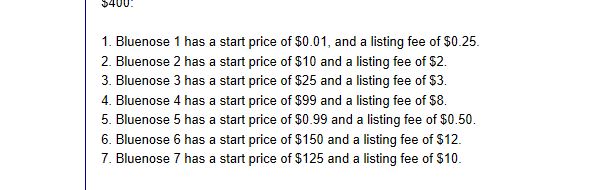
That is an example of a seller that has a store and pays a store fee. Now, let's look at an auction involving 7 identical stamps. Let's say in one week, there are 7 Bluenoses listed, all of which calalogue $400:

1. Bluenose 1 has a start price of $0.01, and a listing fee of $0.25.
2. Bluenose 2 has a start price of $10 and a listing fee of $2.
3. Bluenose 3 has a start price of $25 and a listing fee of $3.
4. Bluenose 4 has a start price of $99 and a listing fee of $8.
5. Bluenose 5 has a start price of $0.99 and a listing fee of $0.50.
6. Bluenose 6 has a start price of $150 and a listing fee of $12.
7. Bluenose 7 has a start price of $125 and a listing fee of $10.

Lets say that in that 2 week period there are 7 bidders interested in bidding on a bluenose. Bidder 1 is willing to pay $250, bidder 2 is willing to pay $150, bidder 3 is willing to pay $50, bidder 4 is willing to pay the full $400, while bidders 5, 6 and 7 are only willing to pay $125. Let's suppose further that the bidders go online at roughly the same time, one each day, and the bluenoses are listed each day one at a time. Lets suppose further that once a bidder starts bidding on a bluenose that he doesn't look for any more bluenose auctions unless he has had to drop out because he's reached his maximum bid. E-bay earns the usual 5% FVF on the sale.

If all 7 bluenoses receive at least the minimum bid, and sell, then E-bay will earn $35.75 in listing fees plus the final value fees. If all the bluenoses sell for the minimum bid, then E-bay earns $410.24 x 5% = $20.51.

Now, if the first bluenose is allowed to remain visible for the entire 7 days on the first day it received one bid, from the first bidder of say $100, but only shows as $0.01. on day 2, the second bluenose appears, but it has a higher start price than the first one, so the second bidder places his bid on the first bluenose and raises it to $150 and drops out because he is overbid. So he bids $150 on bluenose 2. On day 3, the third bluenose appears and now bidder 3 sees:

Bluenose 1 for $150, Bluenose 2 for $10 and Bluenose 3 for $25. So naturally, all things being equal, he sees that there are no bids on bluenose 3 and bids on that, bidding the full $50, but only showing $25.

So, now on day 4, bidder 4 sees:

Bluenose 1 for $150, Bluenose 2 for $10, Bluenose 3 for $25 and bluenose 4 for $99. He decides to bid on Bluenose 3, bidding $200 and raising it to $30.

On Day 5, bidder 5 sees:

Bluenose 1 for $150, Bluenose 2 for $15, Bluenose 3 for $30, Bluenose 4 for $99 and Bluenose 5 for $0.99. Naturally he bids on Bluenose 5 and bids his $125, but the bid shows as $0.99, as there are no other bids.

On Day 6, bidder 6 sees:

Bluenose 1 for $150, Bluenose 2 for $25, Bluenose 3 for $30, Bluenose 4 for $99, Bluenose 6 for $150 and Bluenose 5 for $0.99.

Bluenose 6 is too expensive for this bidder, so he passes on it and instead bids $125 on Bluenose 5. He is overbid though, as the bid is now $125 and he is not willing to go any higher. He Then bids on bluenose 2, but is outbid and bluenose 2 goes to $125. So he tries bluenose 3 and raises it to $50.

Finally on day 7, bidder 7 sees:

Bluenose 1 for $150, Bluenose 2 for $125, Bluenose 3 for $50, Bluenose 4 for $99, Bluenose 5 for $125, Bluenose 6 for $150 and Bluenose 7 for $125.

Naturally he bids on Bluenose 3 and raises it to $125, but cannot raise it enough to win. So then he bids on Bluenose 4 and bids $125 on $99.

So, at the end of the 7 days:

Bluenose 1 sells for $150,
Bluenose 2 sells for $125
Bluenose 3 sells for $125
Bluenose 4 sells for $99.
Bluenose 5 sells for $125
Bluenose 6 does not sell either.

E-bay's take is $35.75 plus 5% of $624, which is $31.20 for a total of $66.95.

Now, let's suppose that E-bay only shows each bluenose at certain times:

On day 1, bidder 1 bids $150 on Bluenose 1 and is the high bidder at $0.01. It is not visible for the rest of the day.

On day 2, bluenose 2 is listed but does not show right away because E-bay knows that any bidder will try and bid on bluenose 1 because they think it is $0.01. Bidder 2 bids $150 on bluenose 1, so that it pushes bluenose 1 to $150. As soon as bidder 2 goes back to search, Bluenose 2 appears. So he bids $150 on it and it shows at $10.

On day 3 bluenose 3 is listed for $25. E bay now knows that it has 2 bids of $400, so that there is a good chance that any new bidder will be bidding over $125. Therefore it does not show bluenose 3 right away either. Bidder 3 is shown bluenose 2, and bids $50, pushing it to $50. They are outbid, but then when they go back and exit the listing they see bluenose 3 and place a $50 bid, which shows as $25.

On Day 4 bluenose 4 is listed for $99. E-bay shows it and bidder 4 bids $400., which is recorded as $99.

On Day 5 Bluenose 5 is listed at $0.99. However E-bay does not show the listing on day 5 because it knows that there are currently 4 bidders who are willing to pay far more than the minimum bid. Because the start bid is so low E-bay knows that in the next 7 days there will be a bidder in all likelihood. So instead it shows bidder 5 bluenose 3. Bidder 5 bids $125 on it, pushing it to $55. Bidder 3 is outbid and looks for another bluenose and is shown bluenose 5, bidding $50 and showing at $0.99.

On Day 6 Bluenose 6 is listed for $150. E-bay knows that Bidder 3 will pay $50 for bluenose 5 but someone else will likely pay more for it. But it has a bid of $400 on bluenose 4 and no other bids. So now it makes bluenose 4 visible rather than bluenose 6. to bidder 6. Bidder 6 bids on it, bidding $125, which pushes it to $125, but Bidder 6 is unsuccessful. Then Cassini makes bluenose 3 visible to bidder 6 and bidder 6 bids it up to $55 forcing bidder 3 out.

On Day 7, bluenose 7 is listed at $125. Now, when bidder 7 logs on and searches, ebay wants to show bidder 7 bluenose 7 because it knows that on average chances are very good, based on the maximum bids entered by the other bidders that bidder 7 will be willing to bid the $125, since it was only bidder 3 that was only willing to bid less than $100. So bidder 7 bids and wins for $125.

So at the end of the period under this scenario:

Bluenose 1 sells for $150
Bluenose 2 sells for $50
Bluenose 3 sells for $55
Bluenose 4 sells for $125
Bluenose 5 sells for $55
Bluenose 6 does not sell
Bluenose 7 brings $125

So, the total realization is $560, a little less ($64) than the first scenario. However this is only because bidder 3's maximum bid was so low and the highest bidder, bidder 4 came in when he did, as well as the order in which the listings appeared. However, with good AI machine learning and with bidding history Cassini can very likely achieve better overall realization for e-bay, even if it does not maximize the realization for all sellers. So E-bay clears all the items and increases the chances that the sellers will list more items in the future, since all the items did sell for more than the minimum bid. But the sellers of bluenoses 2 and 3 only receive half as much as they would have if all the listings had been visible all the time.

These scenarios are simplified, but they do show that there is a reason for E-bay to use manipulation to make more money from sellers and bidders.
Send note to Staff  Go to Top of Page
Bedrock Of The Community
12552 Posts
Posted 02/26/2019   12:31 am  Show Profile Bookmark this reply Add rogdcam to your friends list  Get a Link to this Reply
Well done Brixton. Well done indeed!
Send note to Staff  Go to Top of Page
Pillar Of The Community
Learn More...
United States
1773 Posts
Posted 02/26/2019   01:33 am  Show Profile Check KRelyea's eBay Listings Bookmark this reply Add KRelyea to your friends list  Get a Link to this Reply
Where do these listing fees come from?


Send note to Staff  Go to Top of Page
Pillar Of The Community
United States
4077 Posts
Posted 02/26/2019   02:40 am  Show Profile Check eyeonwall's eBay Listings Bookmark this reply Add eyeonwall to your friends list  Get a Link to this Reply
An unbelievable amount of assumptions. Prove that inventory has gone up 25% and buyers funds have only gone up 10%, otherwise you have just rigged the numbers to try to prove your point. As for your Bluenose case, I am not going to waste my time on all the flaws in how you suggest things would proceed.
Send note to Staff  Go to Top of Page
Valued Member
Canada
97 Posts
Posted 02/26/2019   07:53 am  Show Profile Bookmark this reply Add Brixtonchrome to your friends list  Get a Link to this Reply
Eyeonthewall and Krelyea, you are both missing the point, and seizing on my assumptions, rather than understanding that this is a thought experiment designed to illustrate a point. These are all assumptions that are intended to show that anytime a company possesses more information than all the counterparties to a transaction, and:

1. It possesses advanced AI machine learning technology to produce algorithms using that information.
2. Is in a position to manipulate the market to benefit itself, and
3. There are no laws or regulations in place to stop them from doing it

Then they will use that information to benefit themselves at both the buyer's and sellers expense. I don't have to prove any of my assumptions, since I could have used entirely different ones and the point I am trying to make would be the same. For my first example I could have used any combination of assumptions and my analysis would have been the same where there was either an oversupply of merchandise or a shrinkage in the overall consumer spending. By the way, the fact that they may not interfere in some instances, does not mean that they do not do it some of the time. It depends on the circumstances.

However, one assumption that I did make here that was inherently conservative is this: I assumed that Cassini had no previous information about consumer spending trends or the number of bidders in an auction, and therefore could only REACT to a change in circumstances. In actual reality what is most likely now that E-bay has been around for over 25 years and has that much historical data stored in its servers (do you really think they delete it?) that E-bay can probably predict fairly accurately how much buyers will spend in any given month, for each category. They know how many fee paying store sellers they have. So, it is not rocket science for them to decide that each seller gets a notional "share" of that projected amount, and to throttle a seller when they get too much of that amount in 1 day. It is really not far fetched at all. I mean, look at what Don said about Facebook. Facebook and E-bay are two very similar organizations, in terms of how much personal information they have at their disposal.

On the auction side, Cassini will have a lot of historical data as to how often a bluenose is sold, what it usually sells for, how many bidders usually bid and what order they usually appear in (i.e. when the high bidder usually appears versus the cheap bidder). You'd be surprised what information it likely has. Now, my pretend scenario was one in which there was exactly enough supply to go around, but that will vary of course. Also, in my example, some sellers did just fine and got the result they wanted, most bidders were happy with their results. But the $400 bidder wound up paying more than he should have - not much more mind you, but more. And two of the sellers got much less than they should have. I formulated the example this way to show that some sellers on E-bay will always do just fine and they are the ones that will forever defend e-bay to the ends of the earth and say that people like me are crazy. But there are also sellers who get the short end of the stick all the time. How noticeable this is to you will depend on how much time and energy you spend on E-bay. For me, E-bay has been my livelihood for 3.5 years. I depend on it to pay my bills. So, I'm very watchful of what goes on and what the trends are in my sales. I am a top rated, 4.9 star seller, with a large following of happy customers. If you are just a casual seller, you will not be as attuned to this because you don't have enough volume to notice the patterns. Most buyers will never be any the wiser since they would have none of the information that I have presented here.

By the way, it took me a few hours last night to put these thought experiments together. Yes, I did rig my assumptions - because I knew that if I didn't, you would all seize upon that fact and miss my point. As it is, you're doing it anyway. My point again is that if E-bay can manipulate the market with the information it has then it will, if the circumstances make such manipulation beneficial to them. Sometimes the circumstances won't make it beneficial and then E-bay will let nature prevail, but in other instances they will manipulate things, and as a buyer and seller you have no way of knowing when they will and when they won't.

That is the reality of living in the 21st century in an internet world dominated by monopolies like Facebook, E-bay, Amazon, Netflix, Airbnb etc. Most of these companies, except for Amazon own no assets other than collective YOU. Their model is that they suck you in by offering you something for free and people take the bait and sign up. Eventually a network effect takes hold. This has been the subject of several PhD theses, by the way. As the network effect takes hold and people give away their information, either implicitly, though their use of the site, or explicitly, like when they actually post stuff to Facebook, the monopoly becomes stronger and stronger, and eventually reaches the point where their position in the market cannot be challenged. It is then, and only then that they begin to apply the thumbscrews to their "customers":

1. Facebook starts using algorithms to not show your posts unless you pay to boost them, or sells your information to advertisers who bombard you with ads no matter which device you are on.

2. Amazon starts "gating" product categories, squeezing out sellers of those products. As your ability to buy from other small businesses diminishes, the once good quality that Amazon offers will begin to erode as they start sourcing more and more product from China. Why bother selling you quality if in 20 years they have wiped out all the competition and you are already locked into a Prime membership?

3. E-bay eventually transforms itself from a managed marketplace of sellers to a retailer with a product catalogue, so that the available selection and breadth of products diminishes down to what E-bay considers most profitable, and sellers are now nothing more than suppliers to E-bay. E-bay boots off any sellers that do not sell products that it wants in its catalogue, forcing those sellers out of business. Buyers who were used to coming to E-bay to find those products are now screwed because there are few to no businesses in existence now that sell the products they want.

You can scoff at #3, but E-bay is already moving in this direction. They have a catalogue now and structured data. They have already reinvented themselves before. They want homogeneous products with standard identifying numbers like barcodes, ISBN's etc. They want listings that are stacked deep with quantity, are cheap and never run out of stock, listed on a GTC format. Because that, in the long run is what will make them the most money. Because then what they will have are mostly large sellers who will have other sales channels and won't complain when their sales on E-bay decline due to E-bay's manipulation. E-bay is getting tired of small sellers and categories of one-of-a-kind items that don't produce anywhere near the volume that homogeneous products do. They'll milk it for as much as they can for as long as it makes sense to them. But I highly doubt that stamps will ever make it into their product catalogue. Why? because despite being commodity items like many of you assert, for most stamps you cannot just phone up a supplier and buy 100 of most stamps. In the merchandising world of retail, 100 units is nothing. Most merchandisers think in terms of tens of thousands or millions of units. See what I'm saying?

It's the big picture I'm trying to illustrate here. But you guys are looking at the world though your magnifying glass.
Send note to Staff  Go to Top of Page
Pillar Of The Community
Learn More...
723 Posts
Posted 02/26/2019   08:27 am  Show Profile Bookmark this reply Add rismoney to your friends list  Get a Link to this Reply
What I dont get is how the spread between market value and catalog value is so darn wide, meanwhile everyone is talking about market rigging, supply and demand, and economies of scale.

Send note to Staff  Go to Top of Page
Edited by rismoney - 02/26/2019 08:29 am
Pillar Of The Community
United States
6430 Posts
Posted 02/26/2019   08:32 am  Show Profile Check revenuecollector's eBay Listings Bookmark this reply Add revenuecollector to your friends list  Get a Link to this Reply
Brixtonchrome,

I don't disagree with your general assertion #3. If you read the ebay forums, this move on ebay's part to get rid of collectibles, antiques, vintage, etc., has been predicted for quite some time. The handwriting is on the wall, and it's only a matter of when, not if.

The travesty is that rather than shuttering collectibles, ebay was in a position to eat its cake and have it too: by spinning off the collectibles side of the marketplace into its own platform/product, thus retaining it and allowing the commodity/consumables side of the equation to proceed on its own path instead of trying to shoehorn everything together.

However, that approach would cost ebay more in terms of resources and manpower, and the cumulative revenue vs. expense of collectibles is likely not as attractive as automatable widgets, which I'm guessing is why that approach hasn't been taken.

There isn't currently a viable replacement for collectibles; for stamps, none of the other competitors (Hipstamp, Delcampe, stamps2go) get even a tiny fraction of the traffic ebay does, and all 3 have major issues compared to ebay. What is likely to happen is that only when ebay kills off collectibles categories completely, will buyer and seller traffic start to migrate to one or more of these competitors, or a new competitor might emerge.

As much as the ebay naysayers want to hasten the demise of ebay, it's going to be a dark day for collecting when it finally happens. Frankly, I don't see a current viable alternative.
Send note to Staff  Go to Top of Page
Rest in Peace
United States
4052 Posts
Posted 02/26/2019   08:39 am  Show Profile Bookmark this reply Add ikeyPikey to your friends list  Get a Link to this Reply
.

Quote:
... However, if you look back over the last 10 years you will realize that E-bay has done very little if anything to advertise or attract new buyers, coasting on its established reputation ...


From the 2018 ebay Form 10-K (the annual report filed with the SEC under penalty of law):


Quote:
... We use product search engines and paid search advertising to help users find our sites ...


Quote:
... Sales and marketing expenses primarily consist of advertising and marketing program costs (both online and offline) ... Online marketing expenses represent traffic acquisition costs in various channels such as paid search, affiliates marketing and display advertising. Offline advertising primarily includes brand campaigns ...


Punch line? In 2018, ebay spent over three billion dollars on Sales & Marketing, amounting to over 1/3 of their net revenue.

Details: 2.7b in 2016, 2.8b in 2017, 3.4b in 2018.

If your premise is that their buyer base is stagnant because they make no effort to build that base, your premise is wrong.

As to their stagnant business, revenue rose every year from 2016 to 2017 to 2018, as did gross profit, Marketplace transaction fees, Stub Hub fees, Marketplace services, ande Classifieds (they sell one billion dollars worth of classified ads each year!) ... and the overall year-to-year revenue growth was in every geographic area, including the US, Germany, UK, South Korea, and ROTW.

They also enjoyed year-to-year increases in Gross Merchandise Volume and Transaction Take Rates (their percentage cut).

In a later post, you argue that ebay is disinterested in non-homogeneous goods (like the Bluenose) only hours after arguing that ebay is investing scarce IT resources in an elaborate scheme to manipulate the sales - matching buyers to sellers, no less - of non-homogeneous goods (like the Bluenose).

Cheers,

/s/ ikeyPikey (who reminds anyone who thinks that reports filed with the SEC do not matter that Elon Musk paid a twenty million dollar fine for an errant tweet)
Send note to Staff  Go to Top of Page
Valued Member
Canada
97 Posts
Posted 02/26/2019   09:18 am  Show Profile Bookmark this reply Add Brixtonchrome to your friends list  Get a Link to this Reply
Ikey,

I was speaking figuratively when I said that they make no effort to grow their buyer base. I know that they do paid search. But they have only just started doing online banner ads and proper paid search ads. Several years ago they got in trouble with google because they tried to do keyword spamming, so that if you typed in the word "vomit" you got an ad for "getting deals on vomit on e-bay". So, I'm sure they pay Google dearly for their exposure now. None of this means that they have been wise, effective or prudent in terms of how they advertise and how they grow their base.

Just because their revenue has gone up, does not mean that revenue for their sellers has. Remember that E-bay does not own the merchandise that gets sold, well not yet. They also get a significant portion of their revenue from third party advertising. So you cannot look at the 10K and be absolutely sure that the number of buyers overall are growing. A lot of the increases are coming from the canibalization of their seller base:

1. Increased store fees.
2. Increased final value fees and retroactive fees now being charged to people who have more than a stipulated percentage of returns REGARDLESS of the reason, even when they are pure remorse returns.
3. Promoted listing fees which can be as much as 15% over and above the final value fee, which now give visibility to listings that were previously buried in search.

When you add this to the revenue from all the third party ads that appear on sellers listings, and in many cases compete with them, I will bet that most of the growth is coming from these things and not from genuine marketplace growth.

Again, I go back to how the sellers are doing and how so many are losing their livelihoods because their sales are drying up and no matter what they try to do, they can't get it back. If E-bay's growth was truly coming from increases in buyer spending, then this wouldn't be happening to the degree that it is.

I note that you haven't even addressed my central argument. As usual you have fixated on 1 or 2 things and tried to disprove it and then declare that since you've successfully debunked that, then my whole argument is no good.

This is not how you argue fairly. You deal with the overall issue the person is arguing, which for me is whether a company will use information that it has to its advantage when it can and when doing so will benefit them. You have chosen not to do this.

I'd love to continue this, but I have an August year end that has to be filed by the end of the month that I have to complete.

It's been a slice.

Send note to Staff  Go to Top of Page
Pillar Of The Community
Learn More...
United States
1773 Posts
Posted 02/26/2019   09:19 am  Show Profile Check KRelyea's eBay Listings Bookmark this reply Add KRelyea to your friends list  Get a Link to this Reply
Brixtonchrome I don't think I'm missing the point at all. All through this topic you've presented yourself as an ebay expert with insight into it's inner working, AI etc. The 1st verifiable data you presented was the "Insertion Fees" in your long fiscal Bluenose analysis. Here's the problem - ebay stopped using sliding insertion fees several years ago. Insertion fees for stamps is 25c in US and 30c in Canada and I see this 25c fee every time I list a stamp, how can you be an ebay seller with 10 years experience and make this mistake? For me this makes me question the credibility of your other arguments. To me it's just another conspiracy theory.

In spite of your long circuitous fiscal analysis I am absolutely sure of one thing. My 7 day auctions are alive and available for bidding every second of the 7 day window. How do I know this? It's simple ebay wouldn't dare do anything else the class action lawsuit would be astronomical.


Anyway I live in an alternate universe. In my universe Mr Cassini had no impact and my 2018 sales exceeded my 2017 sales by 86%. ebay never limits my sales at all and January 2019 was my best month ever. I buy WW collections at auction or occasionally on ebay break them up into country collections and sell them on ebay. I auction 50-60 items/week 49 weeks a year starting everything at $2.59. I have only 1 consignor and he is very happy with the results and calls me weekly with compliments.

I pay no attention to Impressions or Click Thrus I focus on obtaining good material, presenting scans of every page of stamps, giving my customers good service with excellent packing, and my sales are strong..

Send note to Staff  Go to Top of Page
Page: of 8 Previous TopicReplies: 115 / Views: 10,293Next Topic  
Previous Page | Next Page
 
To participate in the forum you must log in or register.

Go to Top of Page

Disclaimer: While a tremendous amount of effort goes into ensuring the accuracy of the information contained in this site, Stamp Community assumes no liability for errors. Copyright 2005 - 2026 Stamp Community Family - All rights reserved worldwide. Use of any images or content on this website without prior written permission of Stamp Community or the original lender is strictly prohibited.
Privacy Policy / Terms of Use    Advertise Here
Stamp Community Forum © 2007 - 2026 Stamp Community Forums
It took 0.33 seconds to lick this stamp. Powered By: Snitz Forums 2000 Version 3.4.05