| Author |
 Replies: 17 / Views: 2,627 Replies: 17 / Views: 2,627 |
|
Pillar Of The Community
1375 Posts |
|
|
hello, the special booklet paper (SBP) is known for the time after the 10c Lindbergh airmail issue (see some other threads here), 1928. I always look for SBP stamps when I see some of the relevant stamps, but have a few questions though: 1. are there any links to auctions or collections or exhibitions of this collecting area? I only know my main source, a PDF called "Special Booklet Paper Printings of 1928" (don't find the original link anymore). Or is this area just something for specialists and never went to auction or something similar? 2. In the time even before, when there were still watermarks: are there really no horizontal/vertical watermark errors except the known ones (279a, 279Be, 283a)? In other countries we see many errors of watermark orientation, so except for those three (not very rare) stamps there never was any error at all? 3. Is the SBP really something that happened only in the mentioned period, so not before and after? If yes: what about the two stamps I show here. It seems that this perf 11 stamp exists both on vertical and horizontal grain paper? 4. Am I correct that the other stamps of this $1 issue can be defined as follows? - perf 12: horizontal grain - perf 10: vertical grain - perf 10 without watermark: horizontal grain - perf 11: see above 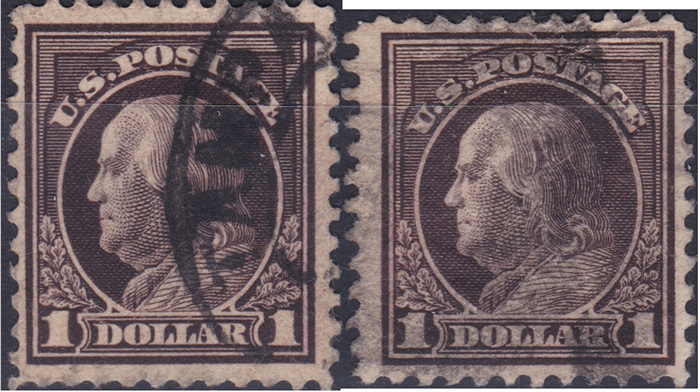 |
|
Send note to Staff
|
|
|
|
|
Pillar Of The Community
United States
901 Posts |
|
|
Rest in Peace
Netherlands
963 Posts |
|
|
This is NOT about a special paper but about turning the stamp paper 90 degrees before feeding it to the press.
In the mentioned article is in no way explained what makes the PAPER different. The usage may be different but NOT the paper itself....
Urban legends galore! |
Send note to Staff 
|
|
|
Pillar Of The Community
1375 Posts |
|
|
Yes, this is the link, thank you, and here another article: https://specialhandling.weebly.com/...th-cover.pdfAnd: yes, it's only turned 90 degrees and is called special booklet paper as the regular paper could not used in this orientation. My thread is not about if there could have been found a better term, but about the 4 questions and 2 stamps I showed above. |
|
Send note to Staff
|
|
|
Rest in Peace
Netherlands
963 Posts |
|
|
Stamperix,
so why not give us scans [of the back] that show the grain [horizontal] should you have one...
The term SBP is superfluous and doesn't help you much. Get the direction of paper clear!
Regular paper when in sheets can be turned! Be it that the sheets had the wrong shape. This would be OK for sheet-fed printing, but in the case of reel-fed printing you would need new cylinders!
Rein |
|
Send note to Staff
|
|
|
Pillar Of The Community
United States
1414 Posts |
|
|
Flat plate stamps in the 19th and 20th Century were printed wet. The paper would shrink across the mesh (or grain) while drying, altering the size of the stamp enough to make a big difference while perforating or cutting into booklet panes. After early experiments, the Bureau of Printing and Engraving determined that booklet panes printed on horizontal mesh paper could be cut more accurately. The term "special paper" referred to paper intended to produce booklet pane stamps. When booklet production was converted to rotary press (where shrinkage was less of a problem), the leftover special paper was used in sheet stamp production as documented in Robert Rufe's article.
When the size of regular issue stamps was reduced in 1890, American Bank Note Company, and then the Bureau in 1894 started using 400 subject plates on larger presses printed on vertical mesh paper. Higher denominations continued to be printed from 200 subject plates on horizontal mesh paper. The dollar Franklin issue perforation varieties, Scott 423, 460, 478 and 518 were produced from the same plate, from horizontal or vertical mesh paper. I haven't seen an article documenting paper on this subject. Similarly, postage due and special delivery paper orientation does not appear to be documented, except in vague mentions of plates sizes in the Scott Catalog. The Durland Plate Block catalog provides better documentation but is not definitive about paper orientation. Paper for 200 subject plates is not referred to as special paper.
Finally, some 279 and 279B stamps were printed on horizontal mesh paper. While this regarded to be an error, it may have been an experiment because the setup of the perforating machine would have to be changed to produce satisfactory results.
Recommendation to the OP and other posters, if not members: Please join the United States Stamp Society.
|
|
Send note to Staff
|
| Edited by cfrphoto - 03/08/2019 10:05 am |
|
|
Pillar Of The Community
1375 Posts |
|
|
Thank you very much. As this is not documented yet, it's even more an interesting area where it's good to spend some time with.
Is the Dollar Franklin stamp the only "difficult patient" of the definitive stamps or are you aware of other stamps from that period which may exist on different paper grain papers but no research has been done yet? (of course except the postage due and special delivery you mentioned already)
And as there are probably no other watermark orientation errors except those I mentioned above: those known errors must have been some more obvious errors rather than accidents of one person, so that other error stamps are not likely to exist? (which would explain the difference to other countries in this area)
|
|
Send note to Staff
|
|
|
Rest in Peace
Netherlands
963 Posts |
|
|
Whether there is documentation or not. Each stamp has a direction of paper. That is you can establish the orientation - vertical vs horizontal - with no problem!
Apparently - not only in the US - philatelists have been TOO LAZY in the 100 or more years so far to document this!
It should be in any specialized catalogue what the direction of paper is! |
|
Send note to Staff
|
|
|
Pillar Of The Community
United States
1414 Posts |
|
|
Scott 283a with vertical watermarks (sideways orientation) printed from 200 subject plates was recently recognized in the Scott catalog as different from 283 with horizontal watermarks printed on 400 subject plates. Although unlisted in Scott, AEF booklet pane singles on or off cover can be often be identified and are highly valued on cover.
Bank note era stamps were printed on vertical or horizontal mesh paper at various times. Except for the mention in Scott in the section describing early and late state H and I grills, no comprehensive published study exists to my knowledge. Suze differences seem less obvious when examining hard paper National and Continental bank note stamps printed on rag paper.
The 1875 reissues of the 1869 Pictorial issue were printed on paper of opposite orientation, making it possible to identify reissues through subtle size differences. The small design 1869 Pictorials were printed on vertical mesh paper oriented and the larger designs on horizontal mesh paper. In Volume IV of "Opinions" published by the Philatelic Foundation is found the following quote on page 107 "For example, the wing span of the eagle on the ten-cent Re-issue is wider than on the original stamp...". Volume IV is downloadable from the Philatelic Foundation web site. A later volume has a more complete article describing how to identify 1875 reissues by paper size, in addition to Robert P. Odenweiler's earlier article in the Collectors Club Philatelist.
|
|
Send note to Staff
|
| Edited by cfrphoto - 03/08/2019 1:35 pm |
|
|
Pillar Of The Community
1375 Posts |
|
|
Hello and thank you again. Yes, what you mention was in my mind, too, while I was not thinking of the time before BEP when I started this thread. Actually I think the size difference is also something you can notice between some grilled and ungrilled stamps of the 1861/67 series (for example 12c Z grill), but I still have to verify here a little bit. As you wrote about the AEF: how much size difference would you call important to make a perf 11 all around single an AEF single? (I know about the other criteria, just thought about a perf 11 all around here) I show an example where I think it's not an AEF single because of the 1920 cancel, so is this not difference enough, I guess? (at the top another perf 11 stamp, at the lower half the stamp in question, same scan) 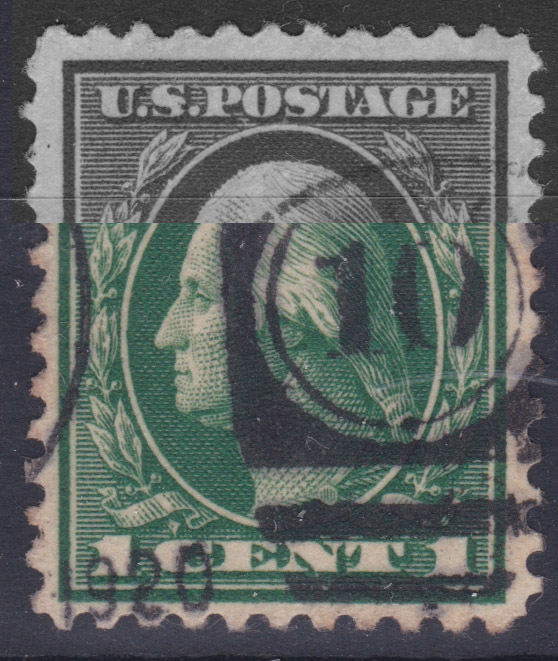 |
|
Send note to Staff
|
|
|
Rest in Peace
Netherlands
963 Posts |
|
|
Quote:
The 1875 reissues of the 1869 Pictorial issue were printed on paper of opposite orientation, making it possible to identify reissues through subtle size differences. The small design 1869 Pictorials were printed on vertical mesh paper oriented and the larger designs on horizontal mesh paper. In Volume IV of "Opinions" published by the Philatelic Foundation is found the following quote on page 107 "For example, the wing span of the eagle on the ten-cent Re-issue is wider than on the original stamp...". Volume IV is downloadable from the Philatelic Foundation web site. A later volume has a more complete article describing how to identify 1875 reissues by paper size, in addition to Robert P. Odenweiler's earlier article in the Collectors Club Philatelist.
You do NOT need to measure the size to establish the direction of paper! Even with just ONE size present you can establish the direction of paper with no problem ..... |
|
Send note to Staff
|
|
|
Pillar Of The Community
United States
4176 Posts |
|
|
?which would explain the difference to other countries in this area?
For some reason US collectors pay less attention to watermark orientations on US stamps than collectors of other countries. I can only guess it is in part due to large size of the watermark which often leaves only a part of a single letter showing makes it hard to determine the orientation. |
|
Send note to Staff
|
|
|
Pillar Of The Community
1375 Posts |
|
|
Galeoptix, when I find time I show some scans of the back to let you explain, thank you.
eyeonwall, I meant the factor that the paper could not used turned by 90 degrees normally which makes it unlikely for errors of one person to occur (which does not mean that no other watermark errors in any US stamp may exist)
cfrphoto: I think I understood better and think now that the size difference should be more or less the same as for sheet stamps vs. booklet stamps, so a bit more than I showed. |
|
Send note to Staff
|
|
|
Pillar Of The Community
1375 Posts |
|
|
Galeoptix, here the scan of the three stamps in question (from above). But this scan leads to the next question to: cfrphoto, could it be that the look at the paper of US classic stamps (Washington-Franklin), as in a scan, is not as useful to determine the paper grain, maybe in opposite to other countries or eras? 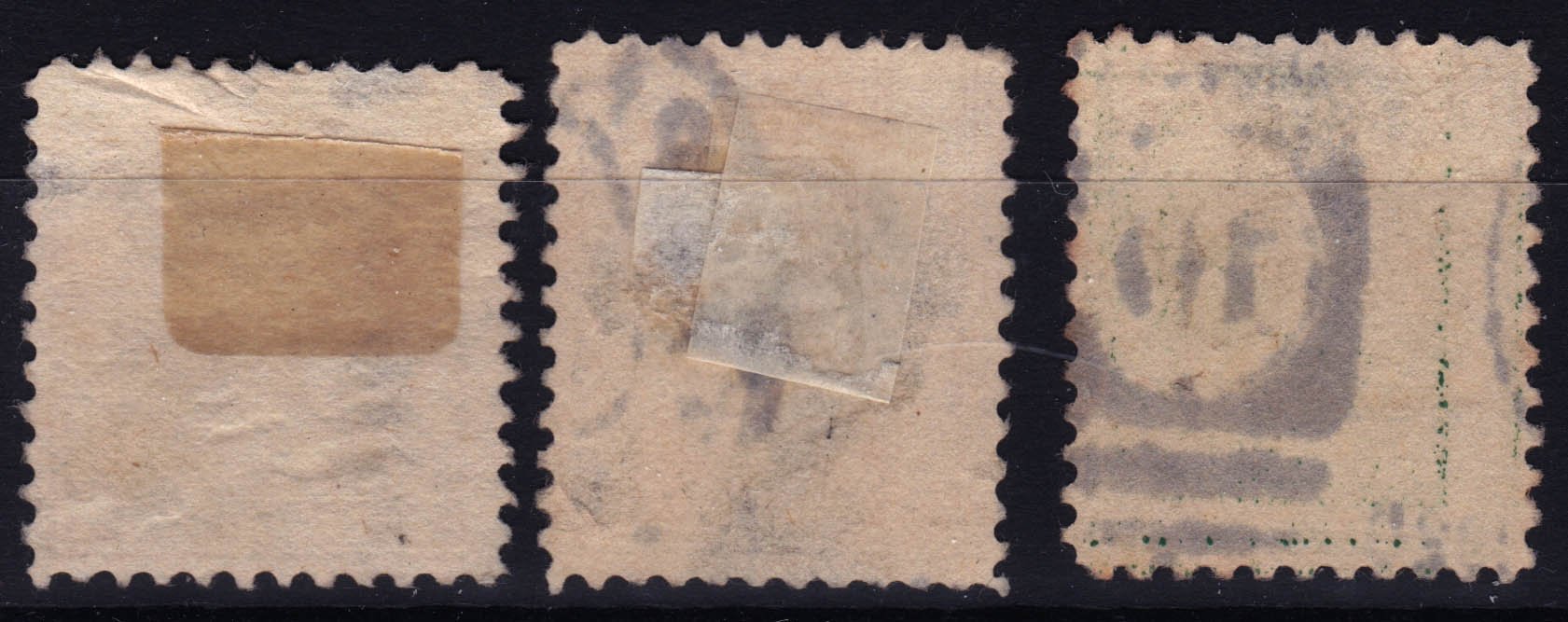 |
|
Send note to Staff
|
|
|
Pillar Of The Community
1375 Posts |
|
|
I would like to ask something about the original topic of this thread, as I did not understand the number of stamps issued in the first PDF (link above). On page 4 all known stamps on SBP are listed, with quantity printed on SBP (+total).
Are the quantities in millions (mentioned each time on that page) really the quantity of the SBP stamps?
If yes, do we have exact data and can say for example, that over 21.000.000 stamps of the Liberty 15c were printed on SBP? (I think so)
While this is something I can understand after all, I don't understand the information about the 15c Special Delivery on page 6. On page 6 it is said: "Fewest impressions (14.000) of all SBP stamps", and "only recorded example" next to the image of the block of six. On page 4 we learn about the 15c stamp: "quantity printed: 2.800.000". Isn't this the same stamp? What is the correct number then?
|
|
Send note to Staff
|
|
|
Pillar Of The Community
1375 Posts |
|
|
Ok I understood. "Impression" means impressions of 1 plate, so 14.000 impressions of the 15c plate means 2.800.000 stamp. So although this is the scarcest of all SBP stamps, it is not impossible to find some in a kiloware. (you would not expect this as you read the words "discovery copy" or "only recorded example" or "printed only from 7 to 13 August").
So my last post above is answered, while I still wonder if Galeoptix' approach for identifying the paper grain by looking at the paper also works for US classic stamps? |
|
Send note to Staff
|
|
|
Replies: 17 / Views: 2,627 |
|



 Posted 03/08/2019 06:49 am


