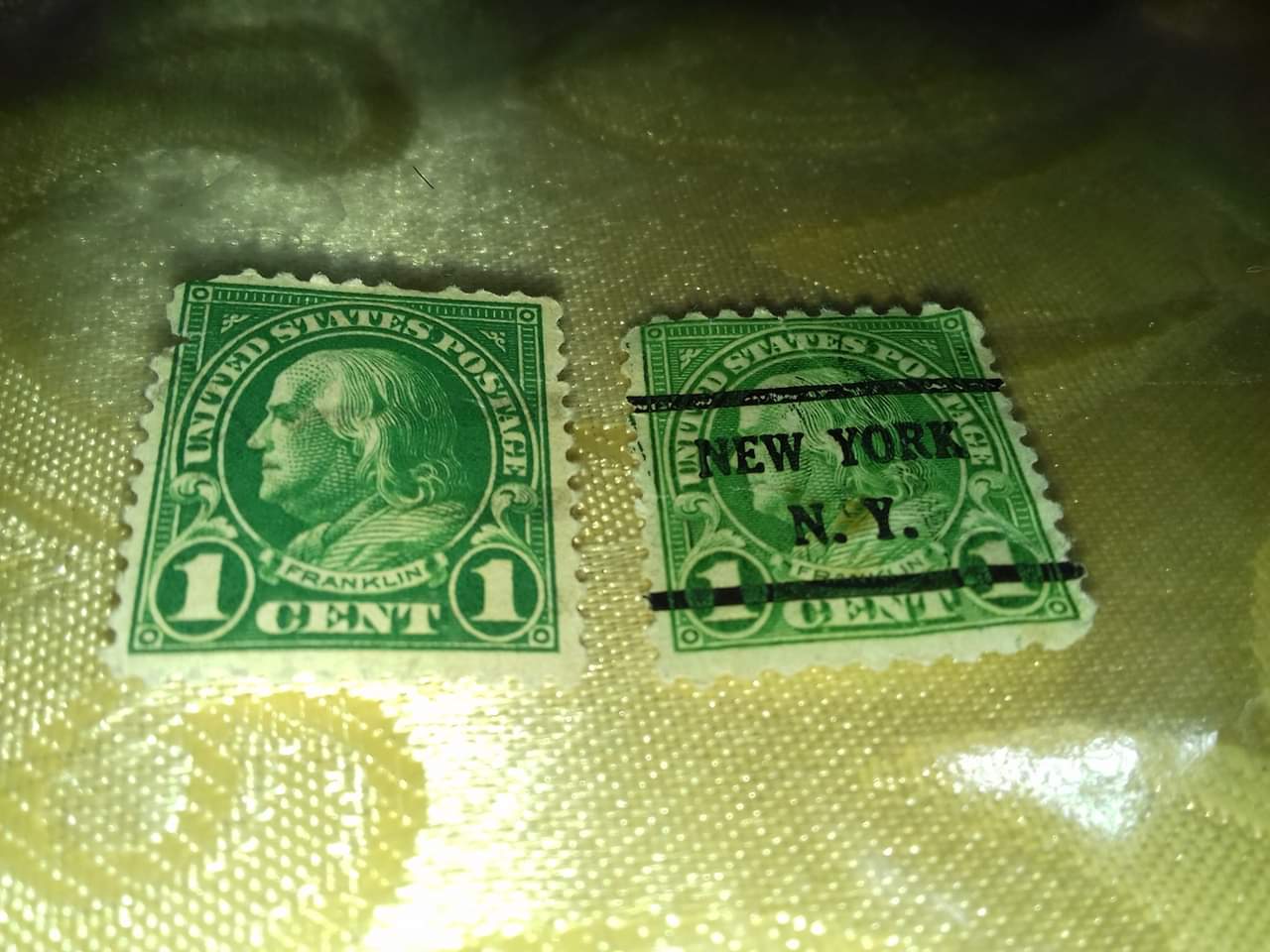
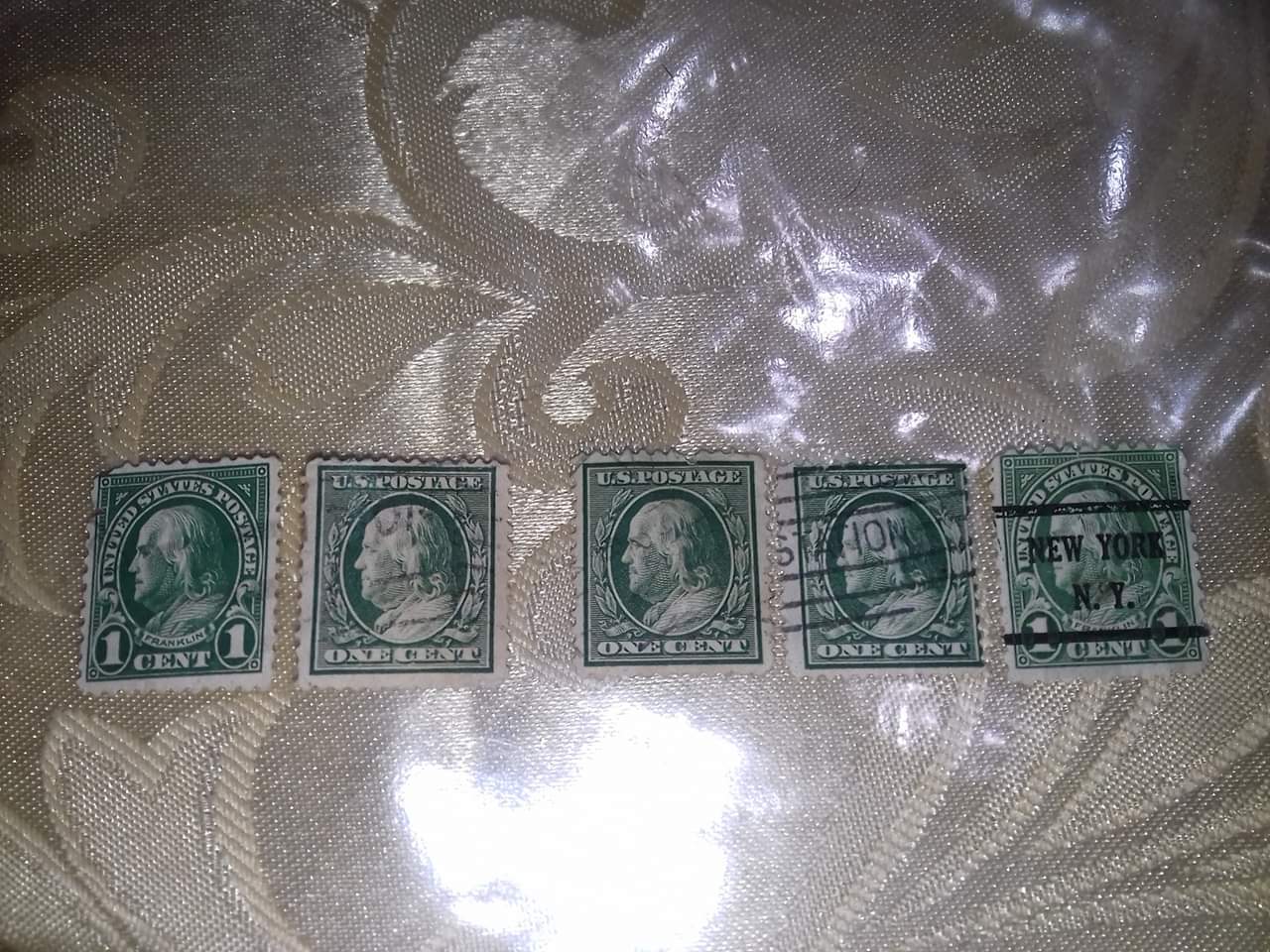
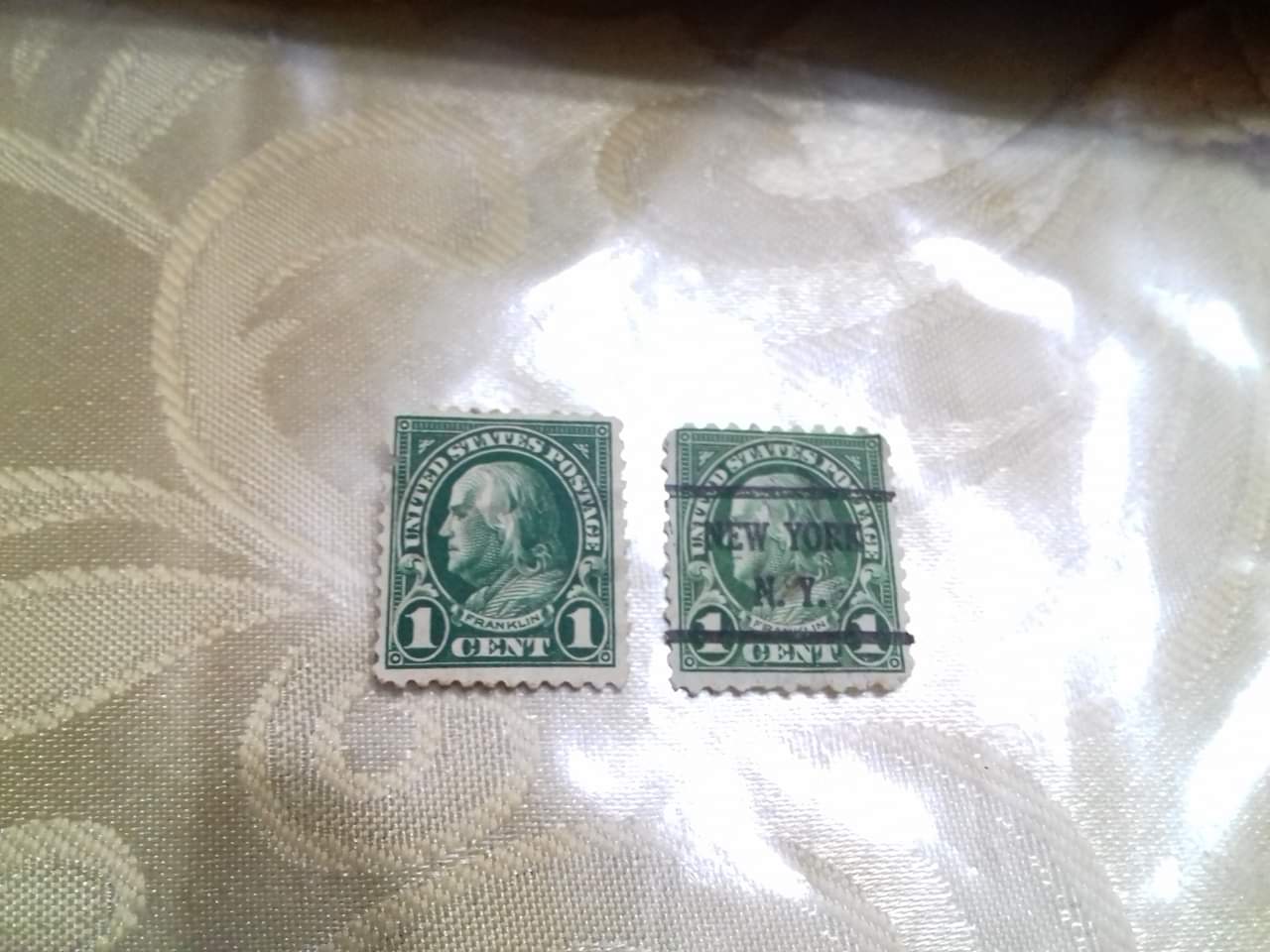
Hi Richard,
I see you've succumbed to the dark side of the 596 treasure hunters.
Let's help you help yourself here.
First, how do you identify a 596 from an "ordinary" 1c Franklin 1922-1925?
Step 1:
Check the perforation.
If you don't have a perf gauge, GET ONE. This is the single most crucial tool you can have to help you identify stamps.
"Perf checking" a stamp does not mean counting the number of perforations, rather it's a measure of the number of perforations in a specific space. So counting won't tell you the perf. Put the perforation against the gauge until the holes line up with the dots on the perf gauge. When they aline, look at the side to see what the perf is.
In the case of the 1c Franklins, if you perf check your's any that are not perf 11 can be immediately removed from consideration.
So now you have your pile of Perf 11's.
Look for pre-cancels (you have one in your lot above, the "New York N.Y" is a precancel.
In the 596's, MOST (but not all) are pre-cancelled with Kansas City. If you have any precancel that isn't a KC, then it's also out. So we just knocked your NY stamp out for certain.
Next, turn them all over, and look at the back.
Does the stamp have any green ink on it? If it does (from even a tiny speck, to perhaps a visibly identifiable image similar to the front), then it's out. These are "flat plate printed", and the 596 is a ROTARY PRESS stamp.
So eliminate all of those.
Still have some left?
Ok, next, take careful note of what it says in the Scott Specialized catalog about these issues. They are valued in the grade of FINE. There is a reason for that, and one need only take a look at the Siegel auction site to notice that all of these examples are poorly centered. Ranging from F to VG, none at F-VF or VF... so take all your great centered ones, and put them aside.
Still have one left?
You THEN have a candidate, but won't be 100% certain without expertizing. This will come down to fine examination of the stamp, including design size. The crazy thing is for some reason, everyone starts with this step FIRST, instead of LAST. That lends itself to something called "confirmation bias", where you seek to confirm just that aspect, instead of confirming that one of the other issues doesn't knock it out.
Also best to understand the "odds" your facing... Siegle census for this stamp lists 15 known copies. 10 of those are with Kansas City MO pre-cancel, 5 other copies are known. These are records going back to 1930 (just a few years after this stamp was issued). In 90 years, 15 examples have surfaced. It's not to say that others aren't out there, but you'll go nuts chasing them without gaining the self-knowledge needed to identify them quickly yourself.
I saw someone describe this interestingly in the following way:
Pick 1,000 miles of highway.
Walk that highway searching for a lost diamond.
For every piece of glass you find, it's going to be worthless.
You could walk the stretch 100 times, and still find nothing but glass, even if the diamond is there.
That's the kind of odds you're facing in finding a 596.
I'm not trying to discourage you from looking for them, but as you can see from other comments made on your post, many members here will have a limited (to negative) tolerance for "treasure hunters" who can't be bothered to learn how to identify their own stamps. I know that's not you. You've asked some intelligent questions in your other posts, and I want to keep you excited and encouraged to pursue what you find fun and interesting.
I'm not sure how many of the 551's were printed, but it's well over a billion, maybe more of this flat plate "look alike" issued (I'm not a specific specialist in this stamp, but don't feel I need to be to identify what is NOT a 596... if you can remove everything else, THEN you have a chance of having one). If there are 15 known compared to 1 billion similar stamps, even if you bought a bulk lot of "1c Franklins" in the other varieties having over 15,000,000 examples to look at, your odds of having a 596 in that group would still be .00225% that the lot would contain even 1 example, and that means its 99.99785% likely to NOT contain one. (And that's with a lot of 15 million to look through).
This is why members here are jaded with postings seeking "Do I have a 596", because the answer is an almost unquivicable no.
The key is, it's easy to identify what you DO have. Check the back.
Green specks, flat plate, can't be a 596.
Precancel other than a Kansas City pre-cancel? Not a 596.
The others aren't on cover, and the cancellations don't determine where they were issued (they are all used examples) but the general thinking is, they were all issued in Kansas City. So, identify the cancel as any other location, and it's not a 596.
Perf check it... Not 11 x 11, it's not a 596. (If it is 11x11, that doesn't identify it as a 596, or even as a candidate 596 yet...)
When you eliminate all that, and you think you still have one, send it in for cert.
|





 Posted 03/23/2019 1:08 pm