| Author |
 Replies: 25 / Views: 2,502 Replies: 25 / Views: 2,502 |
|
Valued Member
Australia
12 Posts |
|
|
Can anyone assist me in identifying these stamps. Not sure where to find this strange perforation. I have several of them but am unsure of their year and purpose.  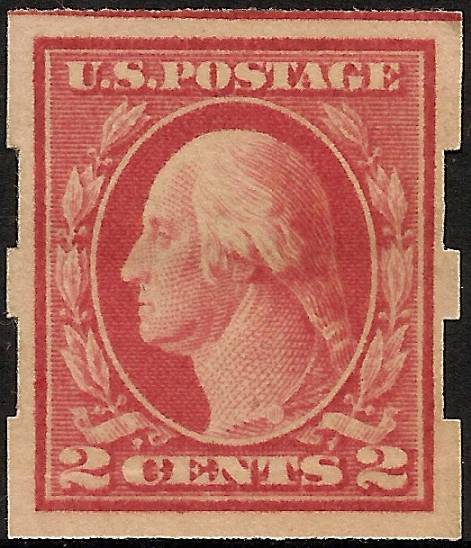 |
|
Send note to Staff
|
|
|
|
|
Pillar Of The Community
United States
6668 Posts |
|
|
Pillar Of The Community
United States
1170 Posts |
|
|
Hi I am interested in these stamps. If you send a higher resolution I will assist in identifying them. You can send directly to me. Doyou have any on cover? |
Send note to Staff 
|
Michael Darabaris |
|
|
Pillar Of The Community
673 Posts |
|
|
In the Scott Specialized catalog, they can be found under the heading "Vending & Affixing Machine Perforations". Examples of the various types of perfs are shown here. It's also easier to identify these WFs as there are a limited number of varieties within a particular perforation type.
First, we know that ONLY Imperf varieties are used as vending machine, Imperf Coils. So for this design type (A140) the only possibilities are:
2 Cent Examples
Flat Plates:
409
482
482A
Rotary:
459
Offset:
532
533
534
534A
534B
1 Cent
Flat Plate:
408
481
Offset
531
All were used in the Schermack Type III machines. This still drastically narrows down your ID process.
Now you just need to check water marks (If water mark, then you have either 409 or 459). Check for press type, and you can then go to individual designs to determine what you have.
For the 1 cent, very easy. If it's not flat plate, you know you have a 531. If it's single line watermark it's a 408, if not, it's a 481.
The Vending & Affixing section is around page 563 (2019 page) other years will vary slightly.
|
|
Send note to Staff
|
| Edited by ClassicPhilatelist - 03/28/2019 1:59 pm |
|
|
Valued Member
Australia
12 Posts |
|
|
Not really sure how to load or send h-ires pictures.
I do not have any on covers..
Thanks for the help so far. |
|
Send note to Staff
|
|
|
Pillar Of The Community
673 Posts |
|
|
JGreen,
At least post pictures of the back of the stamps.
They will help us tell what printing type was used.
(If there are ink spots on the back of the stamp that are the same color as the front, then the stamp is flat-plate printed.)
If it's a matter of watermarking, you'll have to do that. If you don't know how, get some Ronsonol fluid, put the stamp face down on a black surface (even a dealer card will do), douse it in the fluid (no danger at all), and look for any part of the letters USPS in the back. (This can be tricky on single line watermarks, because sometimes only a tiny part of the watermark is present in a perf or close to the edge. But hopefully you'll be able to see it clearly if present).
The 2c is too blurry to tell in detail what type it might be. So for that one we need a better picture, or scan using a PC and a scanner at 600DPI.
|
|
Send note to Staff
|
|
|
Valued Member
Australia
12 Posts |
|
|
Pillar Of The Community
6363 Posts |
|
|
The posts above can be greatly simplified.
Your 1 cent green stamp is either 408 or 481 differing by watermark, (with/without).
Your 2 cent stamp is either 409 or 482, again differing by watermark.
There is no reason to show us the back sides. Only the watermarking is necessary.
Your two examples are not printed by offset, which has a different appearance.
459 does not come with Schermack perfs, so may be ignored. |
|
Send note to Staff
|
|
|
Valued Member
Australia
12 Posts |
|
|
Thanks John Becker, I am appreciating any help I can get.
Total novice at his stuff. |
|
Send note to Staff
|
|
|
Pillar Of The Community
673 Posts |
|
|
Pillar Of The Community
6363 Posts |
|
|
Classic, I fully believe in the concept of teaching how to ID stamps rather than just giving answers, but to include 459 among the choices is irrelevant. The Washington/Franklins are challenging enough for beginners, so I chose to pick a middle of the road approach and point the OP down the path of the flat plate types versus the offsets. He still has work to do. I've been at this for quite a while - I got my first 534B Schermack certified in 1982. |
|
Send note to Staff
|
|
|
Pillar Of The Community
673 Posts |
|
|
Point taken about the 459's, but now we don't get to show him what to look for on the backs.
I know we all like to help, and your posts are certainly helpful, credible, and I enjoy reading them.
I see we are both after the same thing, I was just hoping to get to JGreen to SEE why he needs to look at the back.
Still friends?
|
|
Send note to Staff
|
|
|
Pillar Of The Community
6363 Posts |
|
|
I agree, one often can tell as much about a stamp from the back side as the front. The same is true for covers as well.
On a tangent, I have yet to see a really good flow chart for beginners to quickly differentiate the 2 cent W/F issues with a high degree of confidence. A major hurdle is that beginners often have only a few stamps, thus little comparison material to learn from. And conversely, reducing the pile of 10,000 mixed 2 cent W/F's to perf/watermark only those that need it. The illustrations in the literature are a poor substitute for examining real stamps. |
|
Send note to Staff
|
|
|
Moderator

United States
12330 Posts |
|
|
Pillar Of The Community
6363 Posts |
|
|
Don,
I am thinking of a simple yes/no flow-chart format. The Stampsmarter chart is just as intimidating to beginners as Scott's ID section.
I am thinking more along the lines of separating out the offset printings, the coils, the Schermacks, etc. The low hanging fruit. Then how to deal with the look-alike sheet stamps remaining, etc. |
|
Send note to Staff
|
|
|
Moderator
United States
12330 Posts |
|
|
Ah, I understand. If you have the time to draw it up (by hand on a napkin or however it is easiest) and send it to me I will look into how best to get it converted to an online format and get it posted.
Don |
|
Send note to Staff
|
|
|
Replies: 25 / Views: 2,502 |
|




 Posted 03/28/2019 07:11 am


