| Author |
 Replies: 17 / Views: 2,947 Replies: 17 / Views: 2,947 |
|
Valued Member
United States
102 Posts |
|
|
|
Hello all,
Coming across a rather beat up stamp in one of those H.E. Harris & Co. 300 stamp bags I got at a craft store not long ago that has (I'm guessing) Arabic all over it. (To be fair the bag was on sale, and honestly, was the initial pull for me to start collecting stamps.) Unfortunately I do not read/speak Arabic and as such I don't understand what it says.
It brings up a question that I'd love your take on regarding the best ways to go about identifying stamps that have foreign languages on them. Sure, I could easily flood the forum here with my stamp ID requests but that's not something I'd like to do (nor would it be appreciated I imagine).
How would you go about this without a resource such as the forum? Would the Scott catalogues be a good start?
Thanks!
PS- If this is the wrong place or if it's already been asked I apologize. I searched the forum and didn't see anything so I went ahead and wrote this up.
|
|
Send note to Staff
|
|
|
|
|
Pillar Of The Community
673 Posts |
|
|
Hi Wheatcent,
Sometimes the best thing to do is to post a really difficult ID. Even I'm not opposed to such things, we all get to learn from it.
Couple of things though, I don't think the catalogs will be much help until you can identify the issuing country. And if you're going international, you're going to need around 8 volumes.
I would recommend post up your stamp, once you identify it, you'll be able to identify more from that country.
I read/speak a bit of Arabic, and can help to ID it.
Another thing is, if you have a smartphone, download Google Translate app. You can get translations in some cases from that (they may be a bit inaccurate but it might be able to help) especially if the text is an overprint. For some "negative" text (where the text is white, or the background color) it is a little less effective. But it's not a bad place to start. You just hold the phone camera over the area and it magically translates and puts the text over the text you are scanning. It does not do well on text that is curved though. Needs to be flat, and horizontal in most cases, except for Chinese/Japanese where the script is often written vertically and left to right.
|
Send note to Staff 
|
|
|
Moderator

United States
12330 Posts |
|
|
If you are using a desktop PC, the challenge is often being able to search using non-Western characters like Cyrillic or the Asian languages. With stamp in hand, containing non-Western characters, you can still search for using the Stamp Smarter World Identifier. http://stampsmarter.com/features/Ho...eatures.htmlIn the 'Universal' search section, it has a pop-up virtual keyboard which allows you to switch to one of a number of non-English keyboards. Select the language, type one or more of the characters from the stamp, and it will lookup the country. Don |
|
Send note to Staff
|
|
|
|
Pillar Of The Community
United Kingdom
3218 Posts |
|
|
Hi wheatcent, There's a very useful Illustrated Identifier section at the back of the Scott catalogues which gives very clear examples of stamps where the country name wouldn't be obvious to English speakers. It's certainly an excellent starting place. I agree that Google Translate is very helpful, particularly in suggesting which language is being used (and so narrowing the choices as to which country or territory a stamp may come from). With some experience you quickly start recognising stamp styles and country names, for example the different way that Bulgaria has shown its name on stamps over the years. I've found it useful to learn the Greek and Cyrillic alphabets but I accept that may not be everyone's cup of tea! I must say I find the puzzle of stamp identification is fun in itself.  |
|
Send note to Staff
|
Nigel |
|
|
Moderator
United States
12330 Posts |
|
|
Using Google translator works if you can figure out how to enter a non-western characters; often not a task that many people can do. But something that everyone can do and a online capability that all stamp collectors should learn, a reverse image search. Simply generate an image of the unknown stamp and then use either RedEye or Google image search to match the image to other similar looking stamps. Here is a How To' article. http://stampsmarter.com/learning/Ho...eSearch.htmlDon |
|
Send note to Staff
|
|
|
|
Pillar Of The Community
France, Metropolitan
3755 Posts |
|
|
Pillar Of The Community
Canada
1462 Posts |
|
|
I have a handy little book called the Unitrade Postage Stamp Identifier. Been quite useful for non-Latin alphabets, abbreviations, non-English terms, etc found on stamps. |
|
Send note to Staff
|
|
|
Valued Member
United States
102 Posts |
|
|
Thank you all for the helpful responses. I'll get a picture uploaded here ASAP.
I'll look into those different links and the Google Translate app sounds like a good idea. I also like that there's a book dedicated to this issue (as well as a portion of the Scott catalogues).
Thanks again. |
|
Send note to Staff
|
|
|
Pillar Of The Community
673 Posts |
|
|
Google translate on the PC requires you to enter the text, but Google Translate app on a smart phone allows you to hover the camera over the item, and it will translate it in-screen. No need to enter anything.
Not everything can be translated that way, but it helps for a lot of stuff. I'm constantly in countries where I don't speak the language, and that feature as awesome. Works on stamp text if it's dark enough and distinctly identifiable.
|
|
Send note to Staff
|
|
|
Valued Member

United States
144 Posts |
|
|
Moderator
United States
12330 Posts |
|
|
Hi rascal
The ISWSC identifier was the basis for the Stamp Smarter identifier, accept that the Stamp Smarter identifier has images and many about 1500+ more stamps.
Don |
|
Send note to Staff
|
|
|
Moderator
United States
12330 Posts |
|
|
Quote:
...Google Translate app on a smart phone... Scott, Stamp collector demographics lags well behind the technology curve. On the philatelic websites that I have visibility into, only about 1/3 of the users are accessing the sites with mobile devices. Don |
|
Send note to Staff
|
|
|
Valued Member
United States
102 Posts |
|
|
Well it's been a few days and I finally got around to this one. ClassicPhilatelist, you said you knew a bit of Arabic, correct? Thanks again for the help and advice everyone. 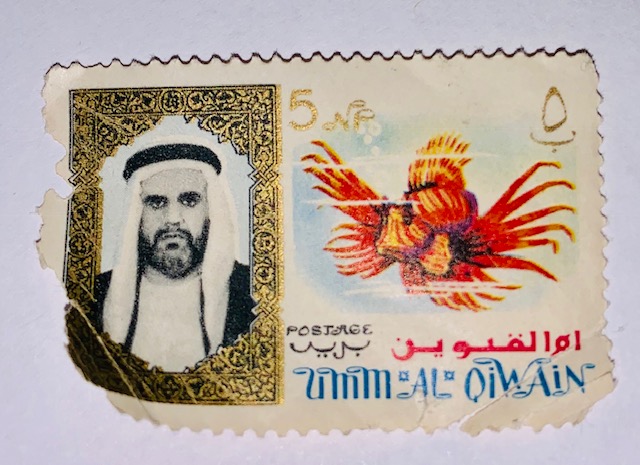 |
|
Send note to Staff
|
|
|
Valued Member
United States
100 Posts |
|
|
Valued Member
United States
124 Posts |
|
|
Umm Al Quwain (UAQ; Arabic: #1571;#1615;#1605;#1617; #1649;#1604;#1618;#1602;#1614;#1610;#1618;#1608;#1614;#1610;#1618;#1606;#8206;; pronounced [#660;um#720; al#712;qajwajn]) is the least populous of the seven constituent emirates in the United Arab Emirates, located in the north of the country. The emirate is ruled by Saud bin Rashid Al Mualla. It had 72,000 inhabitants in 2007 and has an area of 770 km2 (300 sq mi).[1]
The emirate consists in the main of the coastal city of Umm Al Quwain and the inland oasis town of Falaj Al Mualla, some 30 km (19 mi) from the coast.[1] |
|
Send note to Staff
|
|
|
Valued Member
United States
124 Posts |
|
|
Replies: 17 / Views: 2,947 |
|




 Posted 03/28/2019 08:52 am


