Stamp Community Family of Web Sites
Thousands of stamps, consistently graded, competitively priced and hundreds of in-depth blog posts to read


Stamp Community Forum
 
Username:
Password:
Save Password
Forgot your Password?

This page may contain links that result in small commissions to keep this free site up and running.

Welcome Guest! Registering and/or logging in will remove the anchor (bottom) ads. It's Free!

Looks So Japanese, Anyone Up On Their Konji?

 
To participate in the forum you must log in or register.
Author Previous TopicReplies: 10 / Views: 1,128Next Topic  
Valued Member

United States
147 Posts
Posted 03/28/2019   8:23 pm  Show Profile Bookmark this topic Add jb100056 to your friends list Get a Link to this Message
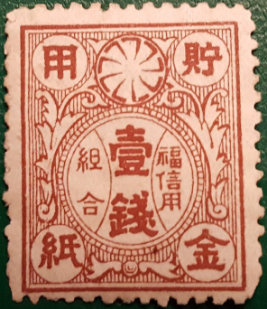
I can't find this one either although it looks easy:


Send note to Staff

Pillar Of The Community
United States
1430 Posts
Posted 03/28/2019   11:54 pm  Show Profile Bookmark this reply Add erilaz to your friends list  Get a Link to this Reply
It appears to be a savings stamp. The kanji in the corners literally translate to "money paper used for savings". The two large kanji in the middle give the denomination: one sen. The two smaller columns in the middle are the name of the financial institution: Fuku Shin'yô-kumiai, meaning something along the lines of "Good Fortune Credit Union".
Send note to Staff  Go to Top of Page
Edited by erilaz - 03/29/2019 12:05 am
Valued Member
United States
147 Posts
Posted 03/29/2019   06:29 am  Show Profile Bookmark this reply Add jb100056 to your friends list  Get a Link to this Reply
D#333;mo arigat#333;gozaimaa.

Very nice of you.
Send note to Staff  Go to Top of Page
Valued Member
United States
147 Posts
Posted 03/29/2019   06:31 am  Show Profile Bookmark this reply Add jb100056 to your friends list  Get a Link to this Reply
Not sure why I got scensored, just a simple "domo".
Send note to Staff  Go to Top of Page
Pillar Of The Community
United States
1430 Posts
Posted 03/29/2019   11:30 am  Show Profile Bookmark this reply Add erilaz to your friends list  Get a Link to this Reply
I know why you got censored. The Japanese past-tense ending in that expression contains a four-letter sequence that just happens to be the same as a certain four-letter word in English. I'd give you the proper Japanese response, but it would get censored for the same reason, so I'll just say, "You're welcome!"

This forum doesn't support vowels with macrons (long marks) either, hence the #333; for your long o. That's why I use the ASCII-friendly circumflex here rather than the macron: ô.
Send note to Staff  Go to Top of Page
Pillar Of The Community
673 Posts
Posted 03/29/2019   11:38 am  Show Profile Bookmark this reply Add ClassicPhilatelist to your friends list  Get a Link to this Reply
Arigato gozaimasu is the romaji spelling. It isn't censored.

There's no need to depict "long O" actually, and that isn't used in expressing Japanese in Japan. It's a perfectly phonetic language (zero exceptions), so O only has one sound, the long one... but no need to specifically point this out, because it's ALWAYS pronounced the same way.
SO that is good enough.

funny that any combination of shi and the letter t (space added to avoid censor) even contained within the word is censored... sounds like a flaw in the field validation.
Send note to Staff  Go to Top of Page
Edited by ClassicPhilatelist - 03/29/2019 11:45 am
Pillar Of The Community
United States
1430 Posts
Posted 03/29/2019   12:14 pm  Show Profile Bookmark this reply Add erilaz to your friends list  Get a Link to this Reply

Quote:
Arigato gozaimasu is the romaji spelling. It isn't censored.

But if you write the more "polite" past tense form, gozaimaa, it is.


Quote:
There's no need to depict "long O" actually, and that isn't used in expressing Japanese in Japan. It's a perfectly phonetic language (zero exceptions), so O only has one sound, the long one... but no need to specifically point this out, because it's ALWAYS pronounced the same way.
SO that is good enough.

That's not true. Every vowel in Japanese has a distinctly different long and short form, and the distinction is reflected when written in kana. Long o is written as "ou" or "oo" in hiragana, depending on the word ("ou" is more usual, but a small number of words MUST be written with "oo"). And pronunciation matters. When I went to see the Great Buddha at Kamakura with a Japanese friend (who is a close friend of the priest's family there), I asked, "This temple is called Kotoku-in, right?" She corrected me: "Kôtoku-in." I had been misled by the romanization on the entry ticket that I had on my previous visit, which simply said "Kotoku-in". Failure to indicate long vowels in romanized Japanese (and I'm well aware that this is a very common practice, even in Japan) is a grave disservice to anyone who is actually trying to LEARN the language.
Send note to Staff  Go to Top of Page
Edited by erilaz - 03/29/2019 9:54 pm
Pillar Of The Community
673 Posts
Posted 03/30/2019   07:59 am  Show Profile Bookmark this reply Add ClassicPhilatelist to your friends list  Get a Link to this Reply
How about you don't lecture the people who live in the country for the last 15 years on the language... you're comments are wrong, and offensive.
Send note to Staff  Go to Top of Page
Pillar Of The Community
United States
1430 Posts
Posted 03/30/2019   11:28 am  Show Profile Bookmark this reply Add erilaz to your friends list  Get a Link to this Reply
I apologize for being snippy and rude, because I certainly was (especially in the initial version of my post), but you triggered one of my pet peeves. And I'm not wrong.

There are some words where the long/short contrast is neutralized, and arigatô is in fact one of them. One often hears it pronounced with a short (or even "clipped") o; for those desiring more accurate phonetic descriptions (as I always do) the latter is a short vowel followed by a glottal stop. Another word of this type is sayônara (hiragana sa-yo-u-na-ra), which can be pronounced and written as sayonara (hiragana sa-yo-na-ra); Kenkyusha's New Japanese-English Dictionary (the "Green Goddess") lists both. If every o in Japanese is long, as you claim, why does this dictionary differentiate between short o and long o?

Here's an example of long o vs. short o that is NOT negligible. The surname Ono (hiragana o-no) has a short o and means "small field", whereas the surname Ôno (hiragana o-o-no) has a long o and means "LARGE field". The latter is often romanized as "Ohno" to make this distinction clear.

To quote the Wikipedia article on Japanese phonology: "Vowels have a phonemic length contrast (i.e. short vs. long). Compare contrasting pairs of words like ojisan /ozisaN/ 'uncle' vs. ojiisan /oziisaN/ 'grandfather', or tsuki /tuki/ 'moon' vs. tsûki /tuuki/ 'airflow'." (In the interest of full disclosure, I changed the macron on the long "u" to a circumflex in this quote, so that this forum could process it.)

I welcome you to PROVE me wrong. Duration of residency in Japan is not sufficient. I've heard of more than a few Anglophone expats in Japan who never bothered to learn the language. To give an example known to me personally, my uncle was stationed at Yokosuka for two years when he was in the Navy, and his wife and kids never left the base. I wouldn't trust anything they said about the Japanese language without outside corroboration.
Send note to Staff  Go to Top of Page
Edited by erilaz - 03/30/2019 11:48 am
Pillar Of The Community
United States
898 Posts
Posted 03/30/2019   12:42 pm  Show Profile Bookmark this reply Add Philatarium to your friends list  Get a Link to this Reply
I'm not at all trying to pile on, but, respectfully, Erilaz is correct. There is a distinction between short and long vowels, and it can affect pronunciation, and certainly does affect the hiragana 'spelling' (or katakana, for that matter), and is implicit in the kanji used.
Send note to Staff  Go to Top of Page
-- Japan, Korea, Trucial States & more on HipStamp: https://www.hipstamp.com/store/the-philatarium

long-term member: American Philatelic Society, Int'l Society for Japanese Philately, & others
Edited by Philatarium - 03/30/2019 12:46 pm
Pillar Of The Community
United States
1430 Posts
Posted 03/31/2019   03:30 am  Show Profile Bookmark this reply Add erilaz to your friends list  Get a Link to this Reply
Thank you, Philatarium.

It has been brought to my attention that the problem here may be that ClassicPhilatelist and I have a different understanding of what is meant by "short vowel" and "long vowel". As normally used in descriptions of the Japanese sound system (and in linguistics generally), the main difference between a short vowel and a long vowel is simply the duration of the sound.

That definition of "long vowel" certainly does not mean the same thing as the term "long vowel" that we native speakers of English learned in elementary school to describe certain diphthongal sounds in our own language. These sounds were indeed "long vowels" in the linguistic sense (i.e. lengthened versions of their short counterparts) in English once upon a time, but that was before the Great Vowel Shift came and screwed everything up about 600 years ago.

So if I'm talking about "short a" and "long a" in Japanese, I don't mean that they differ in the way that the vowels of bat and bay do in English, but rather that it's a difference between a shorter "ah" (as in obasan 'aunt') and a longer "aaah" (as in obâsan 'grandmother').

Send note to Staff  Go to Top of Page
  Previous TopicReplies: 10 / Views: 1,128Next Topic  
 
To participate in the forum you must log in or register.

Go to Top of Page

Disclaimer: While a tremendous amount of effort goes into ensuring the accuracy of the information contained in this site, Stamp Community assumes no liability for errors. Copyright 2005 - 2026 Stamp Community Family - All rights reserved worldwide. Use of any images or content on this website without prior written permission of Stamp Community or the original lender is strictly prohibited.
Privacy Policy / Terms of Use    Advertise Here
Stamp Community Forum © 2007 - 2026 Stamp Community Forums
It took 0.18 seconds to lick this stamp. Powered By: Snitz Forums 2000 Version 3.4.05