| Author |
 Replies: 47 / Views: 4,229 Replies: 47 / Views: 4,229 |
|
|
|
Rest in Peace
7742 Posts |
|
|
Quote:
Well, probably not a real mystery. No doubt, many do still exist in collections that have not seen the light of day in the past 30 years, and since it's a private census, those collectors have no way of knowing about my interest Mike, that was exactly that went through my head when I (foolishly) thought I could create a database with collector input...But I could NEVER collect all the information needed to complete a finalized percentage of what still exist. That is why I leaned towards 2 big time collectors to try and get a percentage plus or minus..But I guess I am beating a dead horse . Robert |
Send note to Staff 
|
|
|
Pillar Of The Community

United States
943 Posts |
|
|
Wert:
Since I collect postal history, but not stamps, I have pondered the concept of a stamp census only in the "academic" sense.
I see no practical way to conduct a realistic, meaningful census of any stamp that might have been originally printed in the millions or even thousands. In addition to the volume of potential census candidates, there is the issue of uniquely identifying each candidate so that duplication of entries is avoided.
For stamp issues that exist in the hundreds, a stamp issue census of this sort might be feasible, but then you still have the issue of separating new reports into new discoveries or a duplicate of an existing census entry. This can be an extremely daunting and time consuming task, and one which may be too difficult to encourage the general collector to try and participate in it, especially if it requires some level of expertise not commonly available or not well documented.
I have no other idea as to how to accurately measure or estimate survivability (say as a percentage) for stamps, or even of postal history covers or other paper ephemera. I suspect it is highly time-of-creation sensitive. Stamps or other items issued in the 1850s likely will have a lower survivability rate than those issued in the 1890s. Beyond that, it is, as John Becker noted, guesswork.
Perhaps other readers have thoughts. I'd like to hear them.
Mike |
|
Send note to Staff
|
|
|
Pillar Of The Community
United States
943 Posts |
|
|
Wert:Quote:
Now remember in the 1800's heating houses used wood burning stoves and the prime starter for fires was paper, even today it is done. This would include newspapers, mail and other forms of paper.
 I also have proposed the "outhouse" theory when it comes to pondering the survivability of larger paper items like letters, newspapers, magazines, and catalogs. |
|
Send note to Staff
|
|
|
Rest in Peace
7742 Posts |
|
|
Quote:
For stamp issues that exist in the hundreds, a stamp issue census of this sort might be feasible Mike, I realize that it is an impossible task...You may be correct that stamps only issued in the hundreds have a chance of database entries...Like the stamp below that only had 788 printed...But even that knowing every stamp collector in the world does not read this web page, even that is almost impossible. Scott 72p - Only 788 printed. 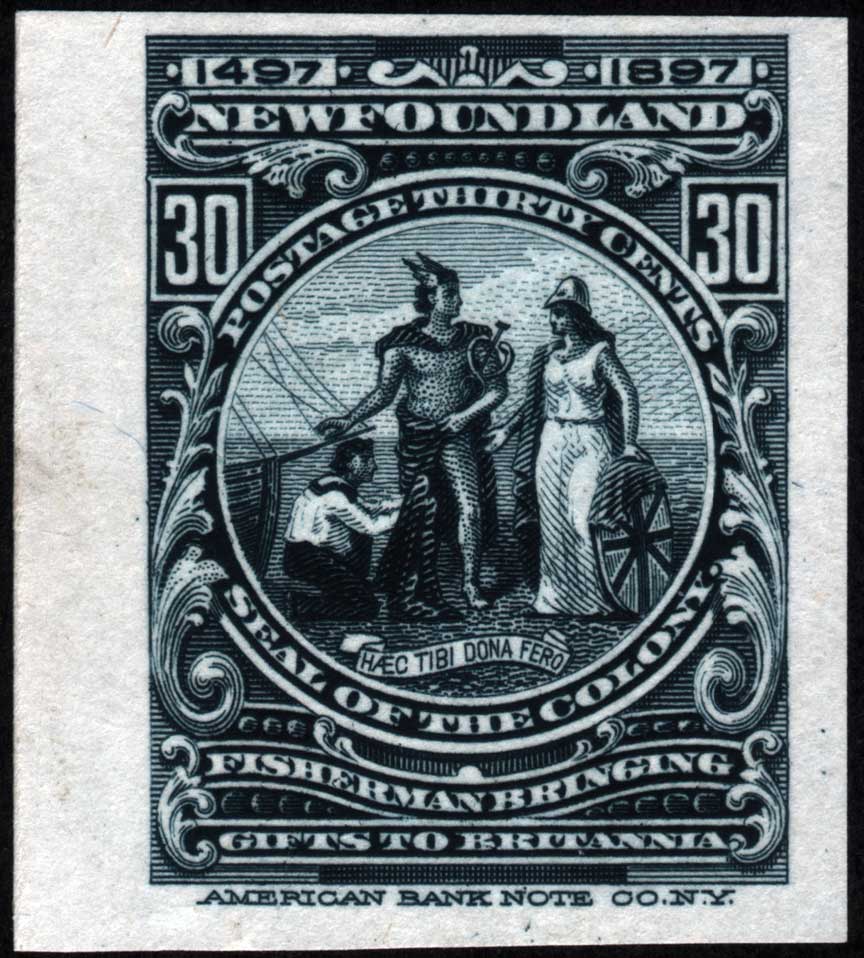 And yes Mike I would encourage others to way in with their ideas. |
|
Send note to Staff
|
|
|
Valued Member
135 Posts |
|
|
The only ones that can can up with some form of numbers is the Greene Foundation, which certifies to the greatest extent, the true rarities. They have issued the certificates, so they should have some form of population. If one could get access to the duplicate certificates, and mine that information, you could get some form of a population. At least for the rarities, and everything that is MNH for the 1st 200 Unitrade numbers and varieties. As for the used cheaper stamps, it would be pointless. |
|
Send note to Staff
|
|
|
Pillar Of The Community
United States
943 Posts |
|
|
Wert:This Forum is a mere microcosm of the philatelic community. Hypothetical Thoughts... And this is not personal to you, but in general... If I were to execute a census of your example stamp issue - either as a stamp or the stamp used on cover (which would certainly help with locating where other examples of the issue were located - assuming it served that purpose), I'd start with personal contact with collectors who might have an example, then work with BNAPS, and spread the word anyplace I could. You probably know best the Canadian based auctions who might have handled and sold copies in the past. Work through all their catalogs, both those on-line and earlier printed ones. Follow with catalogs from the US, Great Britain, and Europe. Talk with major dealers (e.g. Gary Posner). With only 788 copies known, it is would definitely be a high profile stamp. It will be difficult to distinguish examples from old black/white photographs in old auction catalogs, so don't be afraid to record possible duplications - who knows, you may one day encounter the original buyer, and confirm it with another entry. I would be surprised if in the initial effort using just the above resources you identified more than 25-50 copies during the first year. But you start the census, document every find, and if possible, have it posted on-line where others can find out about it, examine your work, and eventually other examples will come out of the woodwork. You may not live long enough to see even half the reported copies included, so find a really young collector to mentor and carry the census project forward. But the important thing is to START !! If YOU don't do it, who will? End of soapbox. Mike Edited Addition: Thanks to fantail for mentioned the Greene Foundation, which I overlooked. There may be other Certificate Issuing entities that would have records. For my US cover census I have mined the Philatelic Foundation archives as well as the APS Expertizing Office. |
|
Send note to Staff
|
| Edited by mml1942 - 08/04/2019 12:07 pm |
|
|
Moderator

United States
12330 Posts |
|
|
A large factor in survivability is when philately became aware of the stamp and if it got press as being less than common. If collectors in 1897 understood that the Newfoundland stamp was a low print run, than the survivability is probably quite high; folks understood to put them back and not use/destroy them.
US stamps like the Zeps have a remarkable survivability rate, they were understood to be collectable right from the start (and had higher denominations). The only attrition are those which became victims of accidents at the hands of collectors.
Many First Trip US HPO covers have a very high survivability rate, these strictly philatelic cover were saved in large quantities. Yet commercial HPO covers, which occurred in very large quantities given the time span of some of the routes existence, were almost never saved as anything special. Therefore even through the original numbers are far greater than First Trip covers, commercial HPO covers are now many times more rare due to low survivability.
Don |
|
Send note to Staff
|
|
|
Valued Member
Canada
12 Posts |
|
|
Are there no population counts from grading services, as there are with coins? It would never give you an absolute count, but it would give some idea of relative scarcity. |
|
Send note to Staff
|
|
|
Pillar Of The Community
United States
728 Posts |
|
|
I can only think of one population count that has a slight chance at being a total count and that is the three copies of the 2c LQ on laid paper that have been found. All are certified but the problem remains that quantity printed is conjecture as no one knows how many sheets were printed. There can also be more that have not been identified. So having one certain number of any stamp does not give us any accurate data on quantity issued so no way to say anything about percentage of surviving copies with no quantity printed known.
Other stamps have quantities printed but no actual number of surviving copies mint/used can be determined so no way to calculate surviving percentage on these either.
So in any case the percentage of survivable stamps can not accurately be determined. |
|
Send note to Staff
|
|
|
Valued Member
111 Posts |
|
|
Millions upon millions are still available, and you can probably still buy them by the pound. |
|
Send note to Staff
|
|
|
Pillar Of The Community
United States
2055 Posts |
|
|
Quote:
Are there no population counts from grading services, as there are with coins? It would never give you an absolute count, but it would give some idea of relative scarcity. Yes, most of them keep track of how many certs they issue for certain stamps. For certain rarities, their population numbers may be fairly accurate. It's unlikely anyone would shell out the (well into) 5 figures or more for a Scott 5, for example, without a certificate, so any of those that have changed hands in the last 5 decades or so would be logged somewhere. Of course that wouldn't account for those that have sat in family collections since before certification became common or those that are still unidentified. Expertizing services also do a lot of grading and certification of "condition rarities", e.g. stamps that are much more common but happen to be extremely high grade. Population figures for those wouldn't be very meaningful, since few people would bother with certs for them in lower grades. |
|
Send note to Staff
|
|
|
Valued Member
Canada
12 Posts |
|
|
Wouldn't it be the highest grades only of common stamps that matter? The rest can literally be bought by the pound mostly it seems, as said above.
The rare stamps as posted above are well documented.
I wonder how many collections exist that no one has ever heard of, like the Landon coin collection that came out of nowhere a few years ago. In coins, even that sort of thing only happens once or twice a decade. |
|
Send note to Staff
|
|
|
Rest in Peace
7742 Posts |
|
|
There are many stamps probably still out there, now another thing that could make rare stamps even rarer is the fact that these may have rare cancels which makes the survival rate even lower.
Robert
|
|
Send note to Staff
|
|
|
Moderator
United States
12330 Posts |
|
|
And of course 'demand' is the other important part of the formula; it does not matter if something is 'rare' if those who want it are even rarer.
For example, I pick up a rock in my backyard; it is the only rock in the world which is shaped exactly like this. While it is 'rare', no one really cares or wants it.
I touched on this in my post above. Demand begins impacting the survival rate immediately and continues to be a factor throughout the entire lifespan of the collectible.
Don |
|
Send note to Staff
|
|
|
Pillar Of The Community
United States
2830 Posts |
|
|
Somehow the endgame for this thread escapes me. It reminds me of pursuits where people invest virtually unlimited resources to answer an unsolvable question. |
|
Send note to Staff
|
|
|
Replies: 47 / Views: 4,229 |
|




 Posted 08/03/2019 11:27 pm


