| Author |
 Replies: 34 / Views: 6,384 Replies: 34 / Views: 6,384 |
|
Valued Member
United States
22 Posts |
|
|
|
The new Scott Specialized lists several new additions this year. A few of those are the "Special Paper" varieties of 563, 564, 566, 567, 568, 569, and C11.....+ 4 more. I a looking at my Plate Block collection and there may be one or two of these already in my possession. Is there a way to measure the stamp design or the distance between designs (vertically or horizontally) to determine the identity of the stamps? I have the plate numbers, but the plate numbers were used for both regular and special paper varieties. Any assistance is greatly appreciated.
|
|
Send note to Staff
|
|
|
|
|
Pillar Of The Community
United States
1414 Posts |
|
|
Please read the article on pages 67 to 70 by Robert G. Rufe in the 2020 Scott United States Specialized Catalog of Stamps and Covers. Images on page 68 and 69 show how to make the size comparison. Attempts to use a measuring device like a ruler will fail.
If the number of catalogs sold continues to decline.... |
Send note to Staff 
|
|
|
Valued Member
United States
22 Posts |
|
|
I have the digital version of the 2020 Scott's catalog you reference, and I have read the article three times. But when you only have one plate block, you don't have anything to compare it to. I have a very accurate micrometer that would allow me to measure the design dimensions, but I still do not have any other reference. I know (from the article) that 563, 564, and 566 are supposed to be wider and shorter than the regular issue sheet stamp. This is due to the orientation of the paper when the plate printed the image. The others are suppose dto be slightly taller but narrower than the regular image. But what are the dimensions I am looking for?? |
|
Send note to Staff
|
|
|
Pillar Of The Community
United States
1414 Posts |
|
|
The size difference is related to paper orientation. Normal sheet stamps are printed on vertical mesh paper. Shrinkage occurs across the mesh (or grain) and the amount varies depending on the amount of moisture in the paper when the stamps were printed and ambient conditions. It was possible to cut booklet panes more accurately when horizontal mesh paper, called special paper, was used.
Design dimensions vary depending on the amount of shrinkage. Comparison with any flat plate sheet stamp or block from the 1922 Third Bureau issue should work. Except for booklet panes, low values (½ to 10 cents) were printed on vertical mesh paper. Again, attempting to measure where the width or height varies will fail.
|
|
Send note to Staff
|
|
|
Valued Member
United States
22 Posts |
|
|
Thanks. I will try to use the 565 plate block that I have as a standard. Since it was never printed on the special paper, it should be a usable standard for the "normal" printing. Anything that varies significantly from that must be a special paper variety. Does that make sense?
Bob |
|
Send note to Staff
|
|
|
Valued Member
United States
209 Posts |
|
|
Valued Member
United States
22 Posts |
|
|
Yes, this is very helpful. Armed with this information, I think I can figure out what I have (or don't have) in the collection. I believe my collection has a mixture of both regular and SBP plate blocks. But I only have a single plate block of each. It now appears that I need two of each (regular + SBP) to be complete. Is this a great hobby or what???
Bob |
|
Send note to Staff
|
|
|
Pillar Of The Community

United States
1498 Posts |
|
|
I find myself wondering how long it will take Scott to renumber the QEs. After all, the original 1928 printing of QE1 thru QE3 was supposedly all done on special booklet paper. The later 1940 printing was not. The same could be true of C11, but the initial plate numbers for the 1928 C11 printing appear on both regular & special paper … there is no way to know for certain which was used first. All of the other 7 sheet stamps that eventually were printed on special paper initially appeared prior to 1928, so there is no question for these as to which came first. |
|
Send note to Staff
|
|
|
Valued Member
United States
209 Posts |
|
|
Here is a Scan that of plate numbers for the booklet papers that Bob hands out when he gives a talk about the special paper. 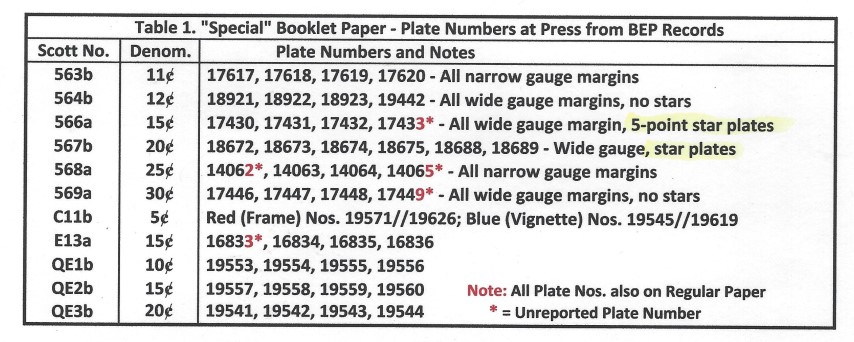 |
|
Send note to Staff
|
|
|
Pillar Of The Community
United States
1498 Posts |
|
|
Think I've figured out how to easily recognize the special handling varieties. When I examined all of my copies (including my duplicate pile), I started with a known group of mint dry printed stamps (QE1a thru QE3a). Theoretically, these should be taller & wider than all of the others. I then compared the height of the remainder to the known group. Apparently, these were my only dry prints. Then I sorted the remainder into narrow & wide. I discovered two duplicates (a used QE1 & a mint QE3) that were wider. When I compared them widthwise to the dry prints, I could again discern no difference. I basically deduced that the difference in height between the 1928 special papers & 1940 wet prints was too small for my aging eyes to easily see … as were the difference in width between the 1928 & 1955 printings. When I was done, I checked ink color & other details … everything seemed to check. Moral of the story … sort first by height. Tall ones will be the dry prints. Sort the remainder by width. Wide ones will be the wet prints on special paper, narrow ones the 1940 wet prints on regular paper. |
|
Send note to Staff
|
|
|
Valued Member
United States
6 Posts |
|
|
Thanks Vinman for letting me know about this thread. The catalog has most of the necessary detail, and some graphics may be helpful. The Special Handling for me is easiest as there are three very distinct printings and the measurements really don't overlap. The stamps are cheap enough to cut a simple template of the 1928 yellow-green (the "muddy green" - the 1940 regular wet printing is significantly narrower, and the 1955 dry print is just slightly wider; the height measurements are valid, and another follower of these stamps is preparing an article on the height analyses. Here is a graphic for QE1a dry print superimposed over a QE2b 1928 wet print (on "Special" Booklet Paper): 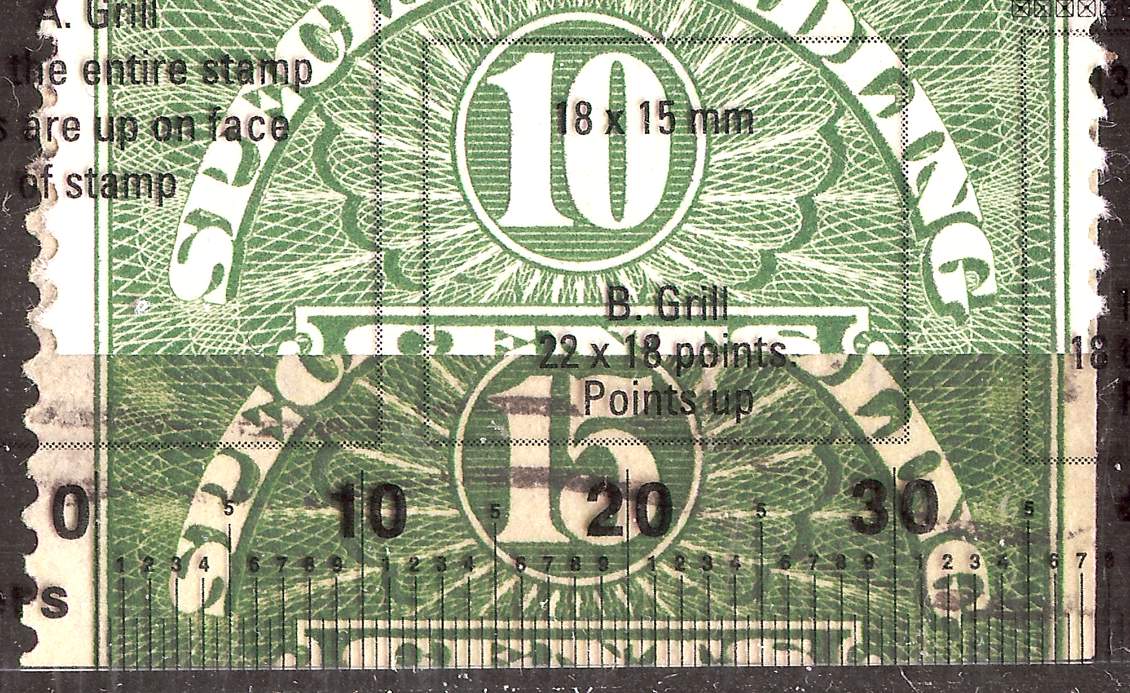 The dry print width measures 36.4 mm; the 1928 SBP width is 36.3 mm. Height may work well. See complete detail on all the Special Handling stamps at SpecialHandling.weebly.com |
|
Send note to Staff
|
|
|
Pillar Of The Community
1375 Posts |
|
|
interesting news about Scott.
are the SBP stamps listed as plate block only or also for each stamp as singles?
if also as singles: what about the value range, probably about 3x the normal stamp or are there exceptions? |
|
Send note to Staff
|
|
|
Pillar Of The Community
United States
1498 Posts |
|
|
I glanced at the 2020 Scott … I think most of the special papers CV run about 2 to 6 times the regular. Except, of course, for the QEs … the special papers should be the most common of the 3 special handling printings. Moreover, the QEs are the only ones more common than the regular paper wet prints (about 2 to 1). The dry prints should be even less common (about 30 to 1). As I recall, I don't think there was any difference between CVs for QE1-3 and QE1b-3b. Will doublecheck when I visit my library tomorrow. On strictly a percentage basis, 566a is the least common … the numbers reported by Rufe indicate about a 38 to 1 ratio. Except for the QEs, the most common would be 569a for which the ratio is about 6.75 to 1. No quantity info was available for C11b or 567b.
Since the special paper QEs were printed first, I would not be surprised to see Scott renumber these at some point. The QE1b-QE3b (wet print on special paper) came first (1928), QE1-QE3 (wet print on regular paper) came next (1940), and the dry print QE1a-QE3a arrived last (1955). |
|
Send note to Staff
|
|
|
Moderator

United States
12330 Posts |
|
|
RE: CV
I do not envy Amos, calculating the number of originally produced stamps can be challenging but determining the survivability and/or current demand seems closer to a 'guess'. Demand will be helped by the addition to the Scott catalog but understanding just how much this kind of freshly released information impacts the current marketplace is tricky.
RE: Future threads
One thing is for sure, this will drive a lot of forum threads from folks who have whipped out their digital calipers. I have bookmark this thread (with Robert's good image and promotion of the simple template approach) so I can link folks to it in the future.
Don |
|
Send note to Staff
|
|
|
Pillar Of The Community
1375 Posts |
|
|
Thank you. My guess is that there won't be many threads about SBP as there are no extreme high value rarities like for the coil and sheet waste stamps.
In the Durland catalogue you find values for the SBP plate blocks since longer, so I think that Scott will also look into those values.
About the 567b and the C11b it would be interesting if Scott gives a value althought the quantity is not known. Durland does value them as the other SBP stamps, so about 2-3x value. By the way the 15c special delivery is listed with a value of about 5x. |
|
Send note to Staff
|
|
|
Valued Member
United States
6 Posts |
|
|
Fourth Bureau stamps... Here's the graphic I promised earlier. For illustration only, as I have not re-scanned the original stamps. The Scott #566a Plate Block #17430 is Special Booklet Paper, and the superimposed regular paper #569 Bison and the #556 Liberty singles are both narrower. I use inexpensive templates cut from mint and used Scott #551 Hale stamps to measure aside Fourth Bureau SBP candidates for 563b, 564b, 566a, 567b, 568a and 569a. Over the past five years, I still have not found a top PB of 6 for 567b nor 569a (see respective exhibit pages on website noted above). I have been accumulating these stamps, and now have about 40 unused certified items - mostly singles, some pairs, blocks and plate blocks. These are mostly for educational purposes, and I envision selling them at some point for the full CV of the stamps, plus the cost of the cert. More later as indicated. Thanks for the observations. 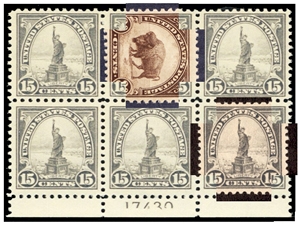 |
|
Send note to Staff
|
|
|
Replies: 34 / Views: 6,384 |
|



 Posted 12/29/2019 7:45 pm


