| Author |
 Replies: 17 / Views: 1,668 Replies: 17 / Views: 1,668 |
|
Valued Member
Canada
209 Posts |
|
|
|
Good evening, while reading archived BNAPS articles, I note the following comment:
When attempting to classify a stamp by the paper thickness, it may be necessary to remove a stamp from its cover to measure the thickness. If the stamp is carefully replaced, no harm will be done to it.
What do you think? Impact on provenance? Surely this would need to be noted in a stamp description? Chris (btw - this was posted after 2000)
|
|
Send note to Staff
|
|
|
|
|
Bedrock Of The Community
Australia
38679 Posts |
|
|
A periphery response,
I saw a frame of a noted Thai Philatelist, on a collection that had covers displayed, One such rare cover had noted that the stamp had been removed, to facilitate stabilisation of toned paper, and then re attached.
In that circumstance, it was obviously allowed by Exhibit officials.
|
Send note to Staff 
|
|
|
Pillar Of The Community
607 Posts |
|
|
IMHO it is quite acceptable to lift and replace the original stamp(s) but ideally you should a) have a good reason to do so, b) disclose it on cover or cert. |
|
Send note to Staff
|
| Edited by archerg - 02/04/2020 03:28 am |
|
|
Pillar Of The Community
Canada
1324 Posts |
|
|
I think removal and re-attachment destroys the cover. With a very sensitive micrometer - could you not measure the double thickness against the single thickness? |
|
Send note to Staff
|
|
|
Moderator

United States
12330 Posts |
|
|
I think there are a few situations where you have to lift a stamp from a cover.
I look at this the same way I look on rebuilding an antique car engine. If a car's originality is outstanding, I might just deal with the engine smoking a bit just to retain that outstanding originality. But if the engine is knocking and/or the car is not really drivable due to engine issues, then it makes sense to impact the originality and rebuild the engine.
So if I am going to throw a cover in the 'unknown box' and never take it out for a drive because I cannot make a positive ID on the stamp, then would rather lift the stamp.
I concur with the opinion that lifting a stamp on a cover demands it to be documented.
Don
|
|
Send note to Staff
|
|
|
Valued Member
United States
46 Posts |
|
|
So since my work deals with "Compliance Area" with state and federal government disclosing is everything. Disclosing is a mediating factor in judging the factors. So if stamp is removed or detaches naturally, adhering stamp back on cover should always be disclosed. |
|
Send note to Staff
|
|
|
Pillar Of The Community
United Kingdom
579 Posts |
|
|
This also begs the question - what do you re-attach the stamp with. I suspect the original almost certainly had gum Arabic or something very close as the adhesive. Is it acceptable to use modern adhesives to replace it ? Should you use a water soluble adhesive that could be removed again if required. As I get old(er) I find I am getting more cynical. So if the paper thickness had a great affect on the value of the stamp how would that be noted in a display and would the judges / next buyer be prepared to believe what was said. CanadaStamp said Quote:
I think removal and re-attachment destroys the cover. With a very sensitive micrometer - could you not measure the double thickness against the single thickness? After some consideration I think this is the right way to go. AQ |
|
Send note to Staff
|
|
|
Moderator
United States
12330 Posts |
|
|
Typically stamps are re-attached with hinges (facilitates future identification, if there was reason to lift the stamp in the first place then it is likely that someone else will want to examine the stamp in the future).
Don |
|
Send note to Staff
|
|
|
Pillar Of The Community
New Zealand
731 Posts |
|
|
This is a subjective question with no clear answer of right or wrong, I suppose.
That said : I am in the never remove it camp because I see only downside in impacting value. What USED stamp is not worth more on an original valid cover than as a single stamp with a hinge on the back? And not sure the upside from incremental knowledge about the thickness of a stamp. I'm not aware of a single Newfoundland stamp (my world) where knowing this determines some tectonic knowledge gate/value. But each to his own.
|
|
Send note to Staff
|
|
|
Rest in Peace
United States
4052 Posts |
|
|
'
Perhaps it is worth remembering that, with today's imaging technology, you've got a really, really good chance of satisfying any doubts that the once-lifted-stamp and the now-hinged-stamp are the same stamp, on the same cover, in the same place on that cover.
Remember, as well, that the earlier the issue, the more differences we find from stamp-to-stamp ... even to the extent that we can indulge in plating.
Cheers,
/s/ ikeyPikey |
|
Send note to Staff
|
|
|
Rest in Peace
7742 Posts |
|
|
Quote:
I suspect the original almost certainly had gum Arabic or something very close as the adhesive. Is it acceptable to use modern adhesives to replace it Hey..Are you using a regummed stamp...If it was off cover. are you saying it is ok to re gum and old stamp..?? Everyone says re gummed stamps are considered altered..I know I would not buy a re gummed single stamp. Lets not say it is ok on cover to add non authentic gum...Just like it is not ok to re gum a single stamp. Just my opinion. Robert |
|
Send note to Staff
|
|
|
Rest in Peace
United States
4052 Posts |
|
|
Quote:Quote:
... I suspect the original almost certainly had gum Arabic or something very close as the adhesive. Is it acceptable to use modern adhesives to replace it ... ... are you saying it is ok to re gum and old stamp..?? Everyone says re gummed stamps are considered altered..I know I would not buy a re gummed single stamp. Lets not say it is ok on cover to add non authentic gum...Just like it is not ok to re gum a single stamp ... C'mon, kids, let's pay attention: Don said they're hinged. Cheers, /s/ ikeyPikey |
|
Send note to Staff
|
|
|
Pillar Of The Community
United States
728 Posts |
|
|
I seldom remove a stamp from an envelope, but when I do to determine if it is watermarked or the paper is a certain paper, etc. I always use a hinge to reattach it. That way if another person wants to verify what I find they can. Also, introducing a new substance to the paper always risks damaging or altering the stamp, the envelope, or both. The less chemicals added to the papers the better. |
|
Send note to Staff
|
|
|
Pillar Of The Community
Canada
1416 Posts |
|
|
If you are only concerned by the paper thickness, would it be preferable to simply measure the cover thickness just outside the stamp, and then on the stamp, so the stamp paper thickness would be the difference between measurements. (Of course, yoou'll need numerous measurements, but with new very precise electronic thickness gauges, that should be possible..... |
|
Send note to Staff
|
|
|
Rest in Peace
United States
4052 Posts |
|
|
Quote:
... measure the cover thickness just outside the stamp ... A worthy thought; try it & see if the spot-to-spot variation in the old envelope paper is small enough, and the difference in width between the thinner & thicker paper stamp is large enough, to get a reliable result ... but don't count on it until you've tried it a few times.  Cheers, /s/ ikeyPikey (who is thinking of Civil War distress covers & giggling) |
|
Send note to Staff
|
| Edited by ikeyPikey - 02/07/2020 5:39 pm |
|
|
Rest in Peace
7742 Posts |
|
|
Quote:
yoou'll need numerous measurements, but with new very precise electronic thickness gauges, that should be possible..... Gilles le timbre...The only thing wrong with measuring stamps on cover. it will not give you an accurate measurements.... Remember when measuring stamps that most collectors have, they are usually used single stamps that has been soaked....The stamp on a cover ALSO has the glue still behind the stamp which will throw off the measurement. I put together a box with my sound buffering and my software program to do a measurement, collect the graph say on a normal thickness particular stamp...You could put what you think is a thicker stamp and compare it with the graph of the normal stamp...Or thin stamp and do the same comparison...Graph below. Just some thing I was working on and have not a final product...This procedure will NOT give you a caliper measurement, but will tell you if it is THICK-NORMAL-THIN...See result on a single stamp below. Robert 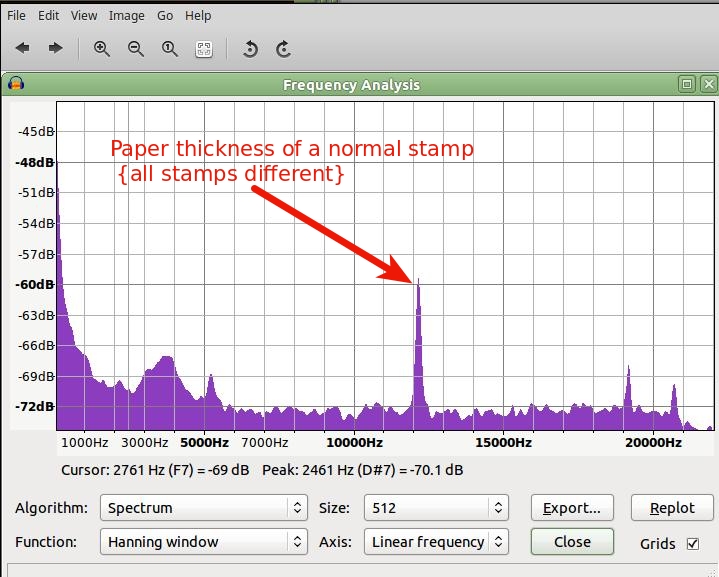 |
|
Send note to Staff
|
|
|
Replies: 17 / Views: 1,668 |
|



 Posted 02/03/2020 6:15 pm


