| Author |
 Replies: 18 / Views: 2,782 Replies: 18 / Views: 2,782 |
|
Moderator

United States
12330 Posts |
|
|
Folks may have previously heard me mention 'a saved jpg image color quality is only as good as the person who coded the algorithm'. This is because when we 'optimize' or save image files in a jpg or most other image file formats the application utilizes compression software code to greatly reduce the saved file size. For example, in an image file the compression algorithm looks for similar color pixels and combines them all into the same color. But not all algorithms are the same, some people are great coders and some people are not. For several decades I sat in 'code readings', these were engineering software review meetings. These often were quite arduous and difficult meetings since just like reviewing a book, everyone has their own opinion on how code should be written. But rather than try to describe what makes a good or bad code, the following example nicely illustrates the difference between a good and 'not so good' algorithm. Here is scanned image from a catalog with some text. 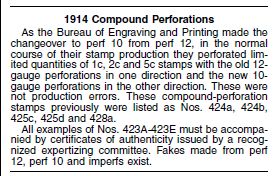 Here is the optical character recognition algorithm results from Adobe Acrobat Professional using the image above. 1914 Compound Porforations
As !he &.eau a ~ving and Pmting mado !he
"""'- 10 pen 10 hom po<1 12. in ""' nonnal
couroo a lhGir s1a1r0 procU~on lhoy perforatod im~
oo CJ,Janii1J<Is a 1c. 2c anc15c $lamps willllho old 12·
gaugo per1oratioos in ooo droetioo and lhG now 1 ().
gauge per1omtions in thG other drraction. Thesa wero
not production errors. Theso compound-perforation
starf11S proviously were listOd as Nos. 424a, 424b.
425<:, 425d and 429a.
Al1oxamp1os a Nos. 423A-423E rrust bo aooompa.
niod by cenificates a allhoniJCily issood by a rocog.
niz9d ~ ccrmittGG. Fal<os mado from pOr1
12, per1 1 0 and imperts oxistHere is the optical character recognition algorithm results from Abby FineReader using the exact same image 1914 Compound Perforations
As the Bureau of Engraving and Printing made the changeover to perf 10 from perf 12. in the normal course of their stamp production they perforated limited quantities of 1c. 2c and 5c stamps with the old 12-gauge perforations in one direction and the new 10-gauge perforations in the other direction. These were not production errors. These compound-perforation stamps previously were listed as Nos. 424a. 424b. 425c. 425d and 428a.
All examples of Nos. 423A-423E must be accompanied by certificates of authenticity issued by a recognized expertizing committee. Fakes made from perf 12. pert 10 and imports exist.Not only is the Abby algorithm far more accurate but it also contains logic which handled the white space and formatting. This clearly illustrates the contrast between a good and 'not so good' algorithm in two different applications. The take-aways; 1. You have no idea about the quality of the algorithm's when you save an image file but you can count on your image color and quality being changed. It is no longer the image that was sent from your scanner or camera, the colors and sharpness depend upon some software coder's skill and coding abilities. 2. You get what you pay for, if you use 'free' imaging applications chances are very good that they are using open source, generic algorithms. When you purchase quality imaging applications you are purchasing better quality algorithms. Don |
|
Send note to Staff
|
|
|
|
|
Moderator
United States
12330 Posts |
|
|
Now here are two scanned images 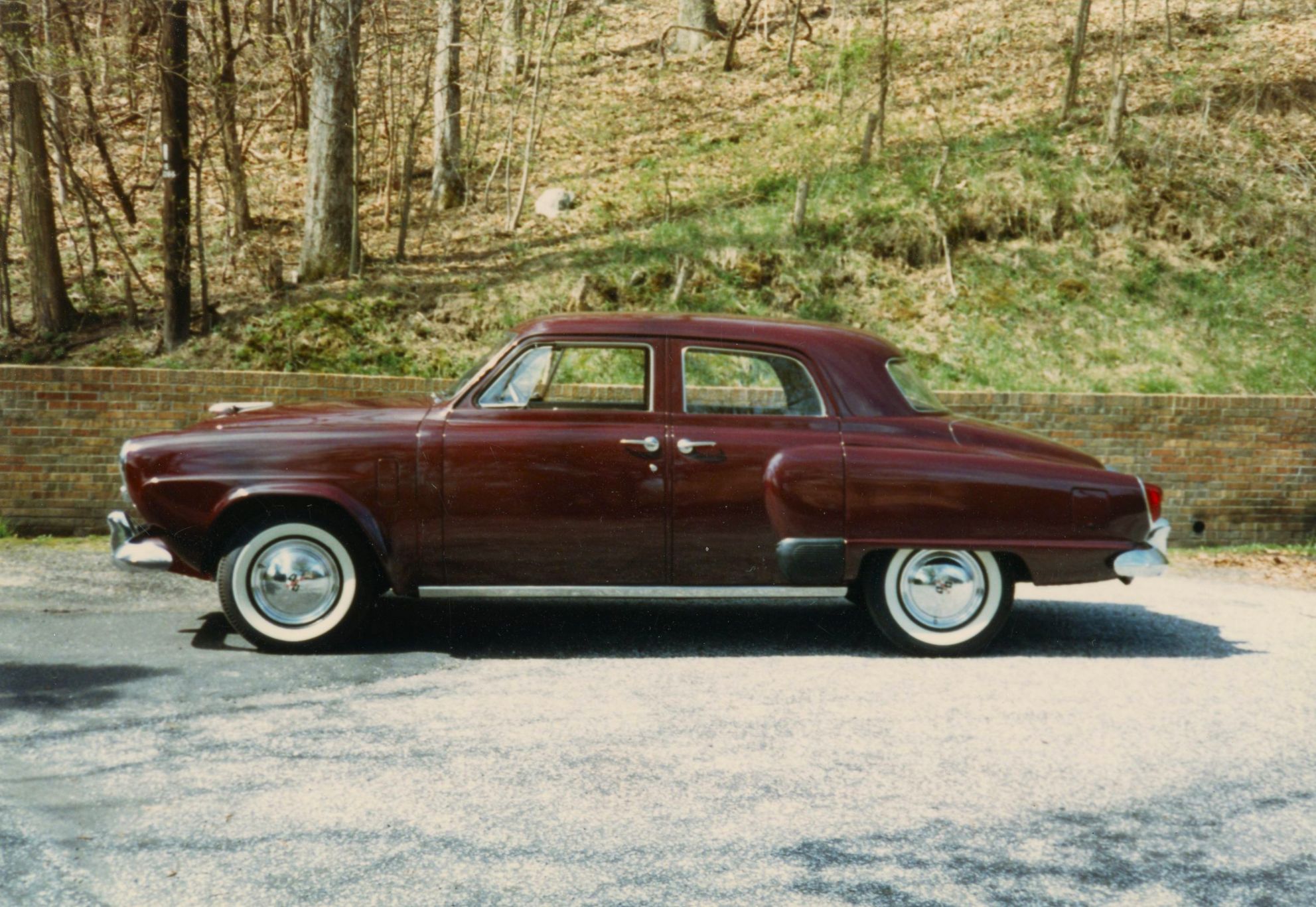 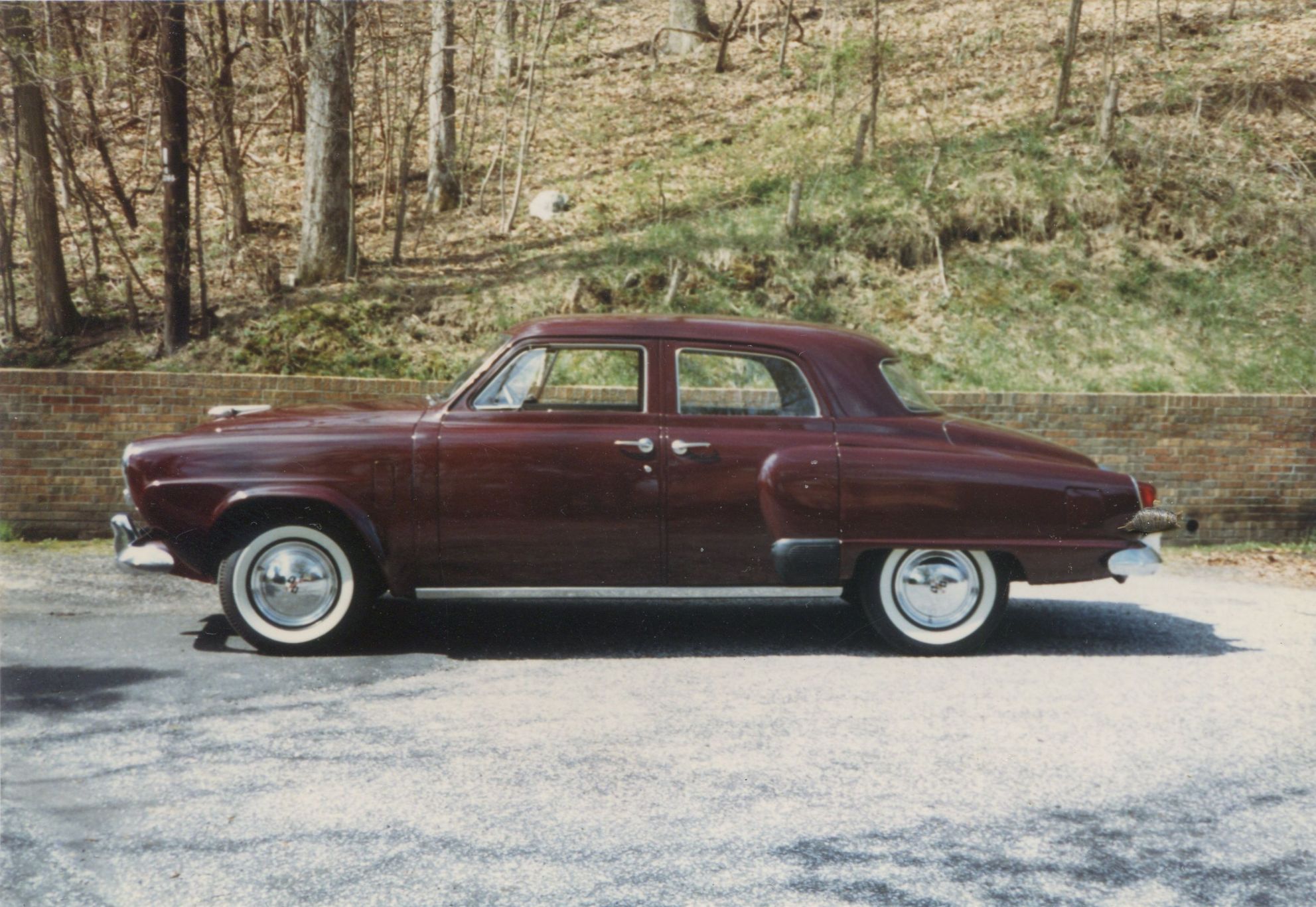 Both these scanned images used the exact same computer, cables, scanner driver software, application software, and same saved file settings. The top image was scanned on a brand new Epson V600 scanner with <50 scans on it while the bottom image was scanned using a 6 year old Epson V600 scanner with well over 500,000 scans on it. This illustrates the delta in image and color quality between a new and old scanner. Don |
Send note to Staff 
|
|
|
Bedrock Of The Community
12704 Posts |
|
|
Good stuff Don especially for a computer numpty such as myself. Thank you. |
|
Send note to Staff
|
|
|
Pillar Of The Community
United States
713 Posts |
|
|
Don,
Thanks. We all want these computer things to make life easy but sometimes it just doesn't work that way. I appreciate that stamp colors are not the same as we see on our computers and smart phones. I wish everyone could gain this understanding. |
|
Send note to Staff
|
|
|
Rest in Peace
United States
4052 Posts |
|
|
'
I think that we need to move away from Apparent Visible Color to the chemical composition of the ink.
After all, the only reason we see a difference in the color is because there was a difference in the ink, or a difference in the aging of the stamp.
There are relatively inexpensive non-destructive (or infinitesmally destructive) techniques - Secondary Ion Mass Spectroscopy comes to mind - that can tell you the composition of the batch of ink used to print that stamp.
Build a large enough database - starting with those magnificently provenanced reference collections - and Bob's Your Uncle.
Add the visual spectra from the least-aged stamps, and you've got a reliable way to decide which batches of ink were really all that different, and who's got what.
Cheers,
/s/ ikeyPikey |
|
Send note to Staff
|
|
|
Pillar Of The Community
606 Posts |
|
|
Very instructive thanks.
Can't keep my eyes off that handsome 1951 Studebaker Champion (iirc) with the suicide doors. |
|
Send note to Staff
|
|
|
Valued Member
United States
276 Posts |
|
|
Wow Don. Every time you post something about colors this old dog learns something new. Thank you! |
|
Send note to Staff
|
|
|
Pillar Of The Community
United States
1047 Posts |
|
|
Quote:
The top image was scanned on a brand new Epson V600 scanner with <50 scans on it while the bottom image was scanned using a 6 year old Epson V600 scanner with well over 500,000 scans on it.
This illustrates the delta in image and color quality between a new and old scanner. Hi Don: I'm not sure I understand the conclusion to your above post. Are you saying that image quality deteriorates as a scanner ages? Thanks. Don |
|
Send note to Staff
|
|
|
Moderator
United States
12330 Posts |
|
|
Hi Don,
It may be age on the LED light bar with degradation and intensity loss over time. Accuracy may also be impacted due to wear on the stepper motor and increased friction on the rails over time. Other electronic components, like the 12-line Matrix CCD itself, can also be impacted by thermal wear. Smaller components like electrolytic capacitors also degrade over time.
But we cannot eliminate possible component deltas between the two scanners. One of the hardest things about manufacturing electronic devices is component consistency. These devices are typically made up of hundreds of outsourced components on the PCBs (printed circuit boards). And there is no guarantee that a capacitor, resistor or ICs will not change coming from their manufacturer over time. Same part, same manufacturer, same part number but over a period of time running changes are made (similar to running production changes for long running to definitive stamps). The scanners also contain firmware and we cannot easily tell if Epson made running changes to their embedded software in the devices.
But consider all the variables listed above for identical scanners that obviously (given the deltas between the two scan above) can impact the colors we are seeing in the images. Now add in hundreds (thousands?) more variables when we consider different scanner models, computers, software, monitors, cables, etc. and it becomes quite apparent why image colors are unreliable.
Don
|
|
Send note to Staff
|
|
|
Valued Member
United States
15 Posts |
|
|
Hi Don,
Which image is truer to the original? To me, the older scanner image on the bottom looks more natural and the top one looks sort of color enhanced.
My main problem lately has been with my software trying to color balance and the scan or picture comes out too vibrant, especially when the paper color has a high contrast to the image color. Greens are too bright, reds are too dark, pinks are too red or "bright", and oranges Look a little bit too yellow.
Paper, on the other hand comes out too white, too blue, and exaggerates toning, My older camera and scanner actually take images that look "closer" to the original but a spot on color match can be very hard to capture.
I have been trying to use natural lighting more lately. I get the best results with my camera, not my scanner, during daylight hours when the room has natural light through open windows. Thoughts?
|
|
Send note to Staff
|
| Edited by Priceknight - 02/08/2020 11:41 pm |
|
|
Moderator
United States
12330 Posts |
|
|
Quote:
Which image is truer to the original? Hi Priceknight, Do you mean which image color is truer when viewed on my computer, with my video card processor, with my video software drivers, with my operating system, and with my monitor at 3PM**? We are all looking at the image above on different hardware, with different software, with different ambient lighting. The odds that any two people would see the exact same colors is virtually zero. While I am a technology lover through and through, stamp colors are one thing that technology currently hurts us more than helps us. Technology adds multiple additional complex layers of variables to the equation. So lets strip out all the extraneous color impacting variables. Say we had everyone in the same room, with the same ambient lighting looking at the same stamp. While the majority of us could easily detect a blue stamp from a yellow stamp we get into trouble with much more subtle hues, shades, and tints. If we could generate a representation of what each of us sees and placed them side-by-side, the differences would be obvious. But lets say we identify two of the representations that appear to be the same and deuce that these two people are seeing the same color. We pull these two people from the group and ask them to name the color they are seeing. One says 'bright red' and the other says 'carmine'. We are not born knowing color names, we all learn color names through our life experience. The chances that any two of us had the same color experiences and learned the same color names is very slim. Colors and color names are 100% subjective. Just like one person thinks that their spouse is beautiful and their kids are smart, another person might not agree. Who is right? Yet through our hobby's history, stamp collectors try to agree on stamp colors and stamp color names. Speaking of beauty, consider how this subjective attribute has changed over time. Look at how painters like Ruben depicted the human body in his 1635 'The Three Graces'. 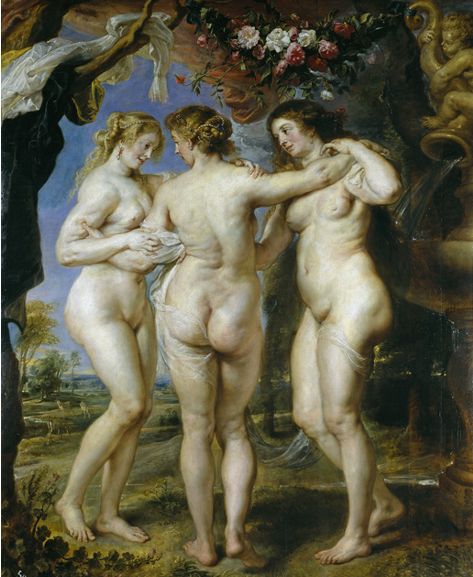 Not exactly the same as the body types seen on models of today. The same goes for color names, they have changed over time. Don ** I used Windows 10 which goes into 'night-time mode' at 8PM. This is when Windows 10 automatically changes the amount of blue light that monitors display to a more yellow color. So if I view a color on my monitor at 7:59 PM it looks different than if I view it at 8:01PM. |
|
Send note to Staff
|
|
|
Pillar Of The Community
United States
1162 Posts |
|
|
I am interested in shades and sub-shades on early US stamps. I have learned long ago that what somebody claims as being the shade/sub-shade of a stamp for sale, and photo'd on the internet, that what I see on my computer screen may very well not appear to be what is claimed. I have learned to take what I see with a grain of salt. Between all the variables of the equipment/software used at both ends of the viewing process, and the distinct possibility that the stamp is NOT, in fact, the shade being claimed, I generally depend on other factors to determine whether I am interested in a particular stamp. I trust some sellers more than others. Does the stamp have a cert? Who is the certifying organization? What is the return policy of the seller?
I agree with many others here - it will be a long time before we have a robust and dependable way to accurately view colors on our computers and over the internet. There are so many things that need to be fixed or standardized. I am not holding my breath!! |
|
Send note to Staff
|
|
|
Pillar Of The Community
United States
4166 Posts |
|
|
"Are you saying that image quality deteriorates as a scanner ages?"
It most definitely changes as it ages. The biggest factor is aging of the light source, and there are other factors as Don noted (although stepper wear will produce spatial distortion, not color distortion). Other factor would be cleanliness of the top surface of the glass you put the stamp on and whether there has been any outgassing onto the lower surface of the glass (which you can't clean off). And if you scan the stamp while it is in a holder (like a stock card or stock page) those are not entirely clear/colorless. |
|
Send note to Staff
|
| Edited by eyeonwall - 02/10/2020 02:03 am |
|
|
Pillar Of The Community
United States
1868 Posts |
|
|
Moderator
United States
12330 Posts |
|
|
The 'front line' of the color issue is occurring in places like this community and local stamp clubs, I hope the scholars will take the time to join and help educate us. (Note this thread is about saved image file not actual stamps in hand.)
Here would be my questions for the experts.
What is your opinion regarding the ephemeral nature of ink chemistry and how stamp colors change over time?
What is your opinion regarding the importance of an ambient lighting specifications?
What is your opinion regarding how each of us sees color differently?
Are you analyzing actual stamps or are you working with saved image files?
Do you know if they address these topics?
Don |
|
Send note to Staff
|
|
|
Pillar Of The Community
1375 Posts |
|
|
As there is no content without registration perhaps you can answer: do all papers only address the analysis of existing color on a paper, so the perception? If yes, the main problem (about here an at many place at SCF is talked very often) just stays the same. We don't know how the stamp looked like 100 years ago. So as said before it would be necessary to:
- find additional characteristics to each specific color other than color (ink material, ink thickness, used paper and so on)
- use new technology that really analyzes the color (and not the perception) |
|
Send note to Staff
|
|
|
Replies: 18 / Views: 2,782 |
|




 Posted 02/04/2020 08:37 am


