| Author |
 Replies: 19 / Views: 2,880 Replies: 19 / Views: 2,880 |
|
Valued Member
Norway
451 Posts |
|
|
I have noticed that stamps frequently reappear at auction after having been "sold" just a few months earlier. Sometimes it is resold at the same auction house, and sometimes at a different one. Scenarios that can explain why this might happen have been discussed in previous posts. Some of the explanations are innocent and some not so innocent, and my only takeaway has been that there is no reliable way that anyone can determine what transpired. My example is the #33 below. It "sold' at auction in December 2019 for $350, and it appears again at the same auction house next week. My gut feeling is that the auction house bid the price up in the December auction, and that it wasn't actually sold. The auction houses have the right to do this, and that is not my gripe. I just wish there was a way to know when this is happening. Can anyone offer some advice? 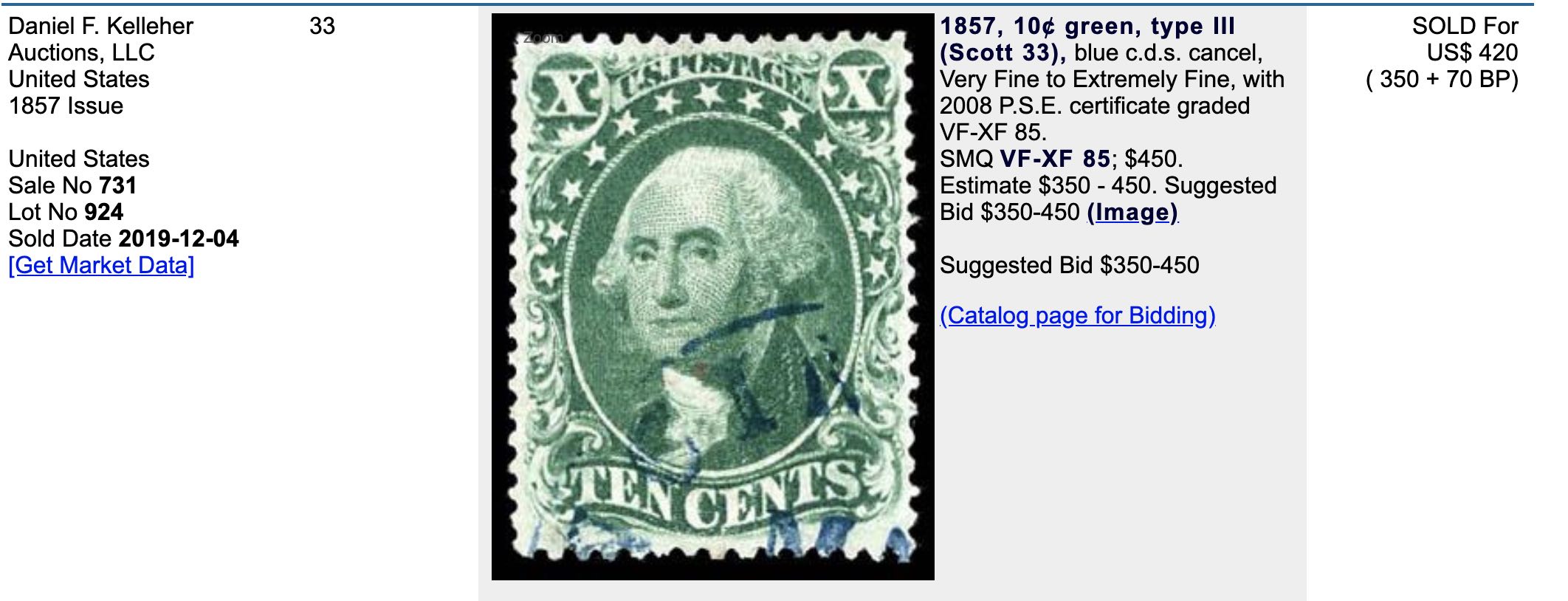 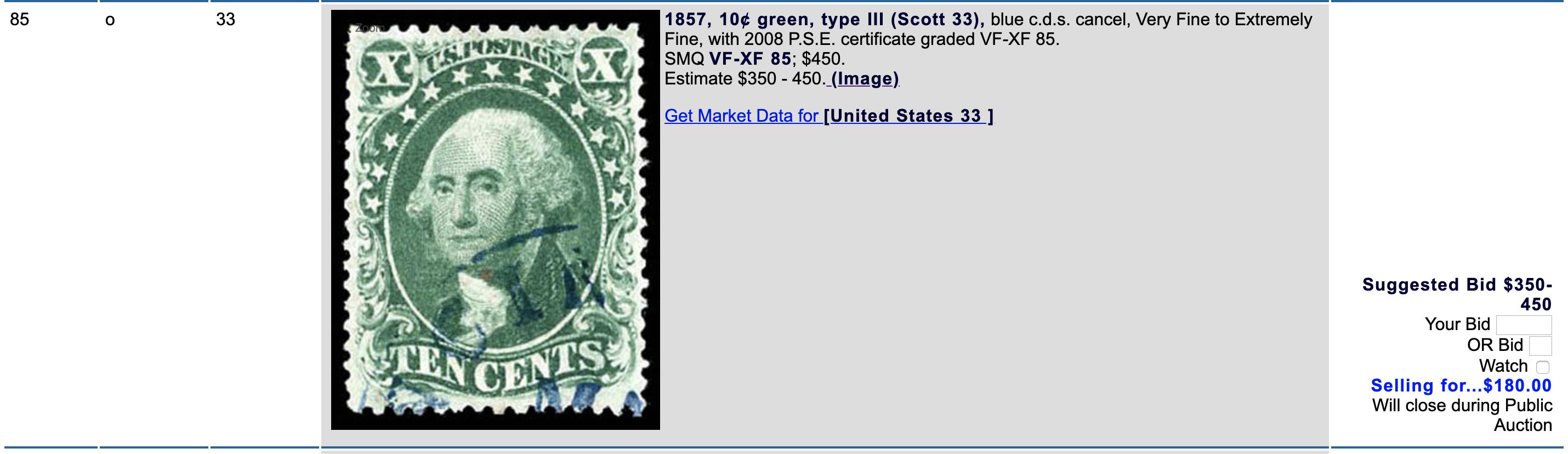 *** Moved by Staff to a more appropriate forum. *** *** Moved by Staff to a more appropriate forum. *** |
|
Send note to Staff
|
|
|
|
|
Bedrock Of The Community
12758 Posts |
|
|
One reason for this can be a non-paying bidder. Talk to any large auction house principal and they will tell you that it is one of the most unpleasant things that they have do deal with and it is not a rare occurrence. |
Send note to Staff 
|
|
|
Pillar Of The Community
United States
925 Posts |
|
|
It could also be a return - the buyer may have seen something in the stamp (maybe a perf crease or tiny thin) that was not called on the cert. The auction house might have taken the stamp back to keep the bidder happy but disagreed with the perceived fault so they ran the stamp again. |
|
Send note to Staff
|
|
|
Pillar Of The Community
United States
939 Posts |
|
|
Valued Member
224 Posts |
|
|
My inclination is to accept the more benign explanations offered by rogdcam and SPQR, at least with respect to Kelleher.
I've bought a number of items from them and have been satisfied, both with their service and the quality of the material offered. So far, stamps have been as described, and I've not returned anything. I have not dealt with many other auction houses, since I prefer to use a couple of trusted dealers for most purchases, so my experience may not be typical. But I have to say "so far, so good" with Kelleher. |
|
Send note to Staff
|
|
|
Valued Member
Norway
451 Posts |
|
|
Rest in Peace
United States
652 Posts |
|
|
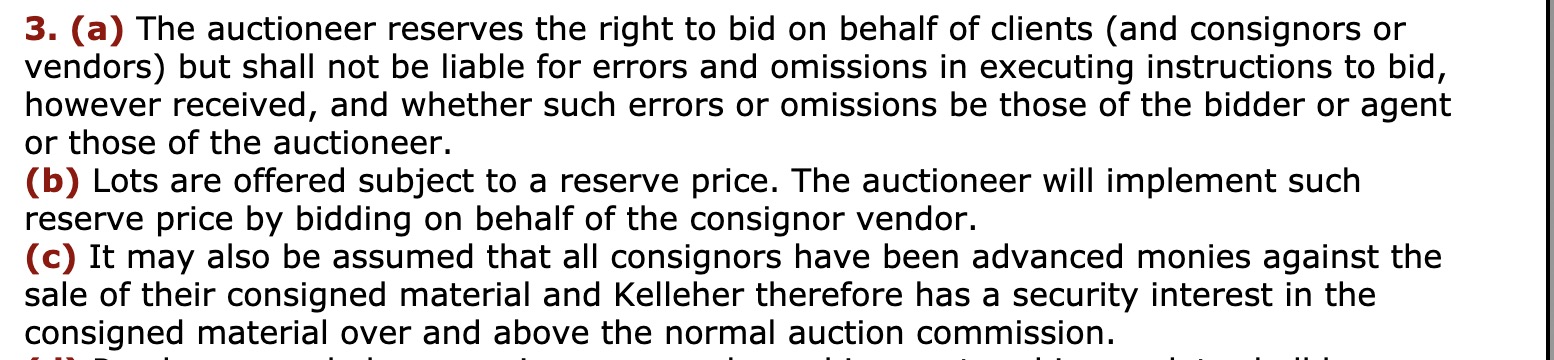
While it may be illegal to bid on its own items to raise the price, the auction house has an obligation to start an item at a figure that is both fair to the seller and to a buyer. Additionally, you need to take a very close look at the terms of sale as there can be buried in there a statement that items may have a reserve placed on the by the seller. |
|
Send note to Staff
|
|
|
Valued Member
Norway
451 Posts |
|
|
Bud - I don't mean to malign Kelleher with this example. I'm just trying to gain insight in to what goes on in auctions, and I was hoping that people in the know could offer some advice. |
|
Send note to Staff
|
|
|
Bedrock Of The Community
United States
10864 Posts |
|
|
The seller can also be the auction house itself. And if they don't think the item is going high enough........... |
|
Send note to Staff
|
|
|
Moderator

United States
12330 Posts |
|
|
Quote:
...I just wish there was a way to know when this is happening... I concur, I find the lack of transparency dreadful. Frankly I do not care what the intent may or may not be, it is the fact that the optics are so bad and yet the auction houses seem to take the position of 'the hobbyists can just deal with it'. Do they think that no one will notice? Or is this a case of a seller market where they can afford to not be concerned with the optics? This is 2020 and information is far more available than it has ever been in the past. SANS and other ways to compile vast amounts of historical sales data is going to continue to grow because today's consumers demand it. Consumers can quickly lookup historical sales data on things like cars, homes, and hotel rooms. ebay has not been throwing away decades of historical sale data (even if they hide it from view after 6 months). In fact, their historical sales data may be one of their most valuable assets. Forward thinking companies are already gathering, organizing and compiling their historical sales data internally and for their own marketing efforts. Don |
|
Send note to Staff
|
|
|
Bedrock Of The Community
12758 Posts |
|
|
The issue of transparency arises frequently here. Expertizing certificate opinions and data come to mind as do auction sales. I remember when car and truck pricing data first became available via online platforms such as Edmund's TMV. It caused much consternation amongst manufacturers and dealers. They not only survived but it served to build a level of trust and confidence between buyer and seller. Realizing that the stamp markets and automotive retailing are not apples and apples a higher level of transparency is still very doable. The stamp auction houses and retailers would likely benefit in the long run and it would weed out many of the less savory characters. There would need to be economical solutions however given that the philatelic market is not exactly a revenue giant. For the most part it is still rather "mom and pop". |
|
Send note to Staff
|
|
|
Pillar Of The Community
United States
752 Posts |
|
|
Unless you are an insider at a particular auction company, trying to figure out, as an outsider, what actually happened behind the curtain, is and will continue to be a pipe dream. Just one man's opinion. |
|
Send note to Staff
|
| Edited by funcitypapa - 02/10/2020 4:43 pm |
|
|
Pillar Of The Community
United States
939 Posts |
|
|
Bedrock Of The Community
12758 Posts |
|
|
Truth be told there are a few folks/companies still peddling philatelic wares that have had legal issues in the past, some of which the uninformed would find quite startling. |
|
Send note to Staff
|
|
|
Valued Member
Norway
451 Posts |
|
|
alub - Shill bidding is different than reserves. And in NY, the prosecute people for it:
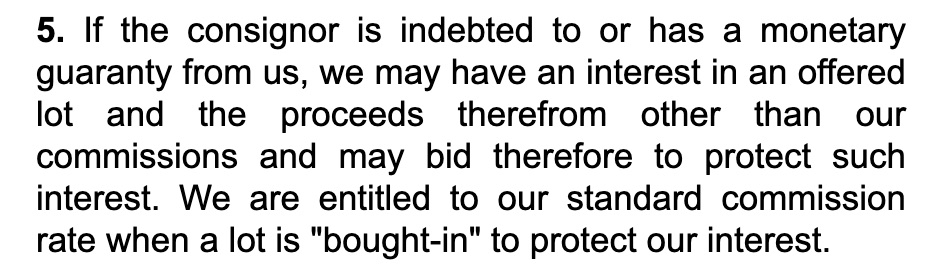
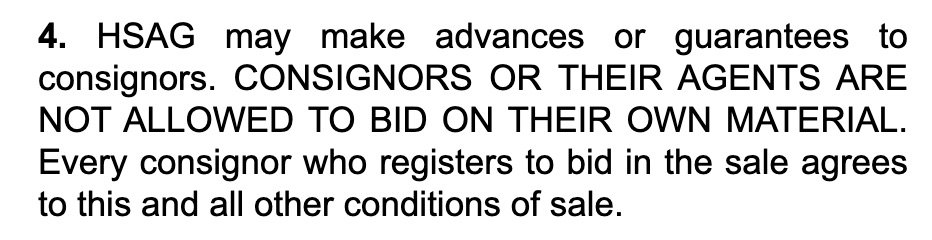
https://ag.ny.gov/press-release/200...ine-auctionsThanks for the reference, alub. I wonder if the auction houses I mentioned avoid violating the law because they warn bidders of the practice in their "Terms and Conditions". It took me a while to appreciate the fact that "sold for" auction prices may or may not reflect an actual sale, and therefore do not necessarily reflect true market prices. The auction houses may be just protecting a genuine economic interest in the item, but if they also own their own inventory, it could be used as a strategy to bump up SMQ values. |
|
Send note to Staff
|
|
|
Pillar Of The Community
United States
3528 Posts |
|
|
What happens is when a stamp is returned or just not paid for, the auction houses just don't update the prices realized in many cases. This has happened when I've consigned material. Both of the above scenarios.
I'm sure its a lot of bookkeeping for them to keep prices-realized accurate. This, especially when an item comes back several months later, from an expert organization with a negative opinion.
I agree that it would be nice, and good, if they did maintain accurate P/R. This would certainly be a valuable business practice improvement.
In most cases, I really don't think its anything particularly nefarious. |
|
Send note to Staff
|
|
|
Replies: 19 / Views: 2,880 |
|




 Posted 02/10/2020 06:53 am