| Author |
 Replies: 9 / Views: 1,414 Replies: 9 / Views: 1,414 |
|
|
Pillar Of The Community

United States
812 Posts |
|
|
Since the Volksstaat appears to have lasted only 7 Apr-17 May 1919, how does it happen that many of its official stamps appear to have been issued well after that? I.e., not merely sold, circulated or accepted as valid postage, but actually issued under the subsequent authority of the counter-revolutionary Freistaat. 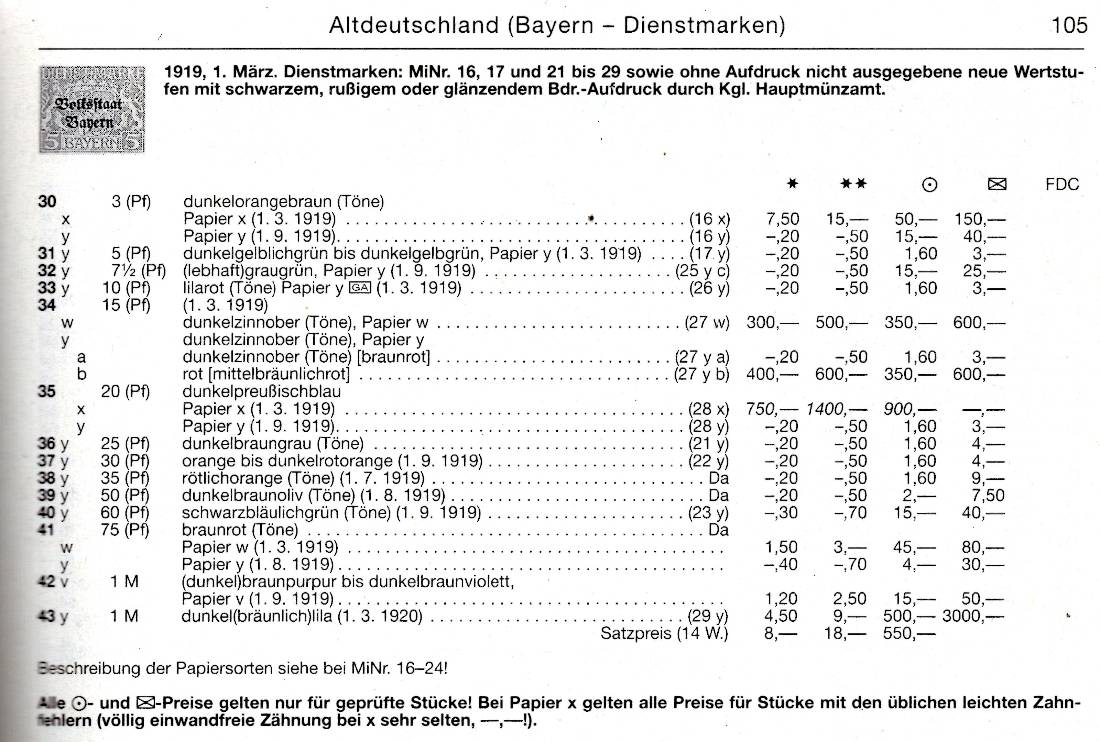 |
|
Send note to Staff
|
|
|
|
|
Pillar Of The Community
Netherlands
6641 Posts |
|
|
Volksstaat, basically, meant Republic. Freistaat was a word used in constitutions of German States, but civil servants and the media preferred the word Volksstaat. |
Send note to Staff 
|
|
|
Pillar Of The Community
United States
812 Posts |
|
|
Here's what I've learned so far:
The Volksstaat Bayern ( People's State of Bavaria) was established on 8 November 1918 as an attempt at a socialist state within the Weimar Republic. It was led by Kurt Eisner until his assassination in February 1919. On 7 March 1919, the new leader of the Socialists, Johannes Hoffmann, managed to patch together a parliamentary coalition government. But on the night of 6–7 April, Communists, energized by the news of a left-wing revolution in Hungary, declared a Bavarian Soviet Republic (BSR), with Ernst Toller as chief of state.
The Hoffmann government fled to Bamberg in Northern Bavaria. Troops loyal to the Hoffmann government mounted a counter-coup that was put down on 13 April by the new "Red Army" created from factory workers and members of the soldiers' and workers' councils.
The rival governments then clashed militarily on 18 April, when the BSR forces were victorious. Hoffman then called upon the services of a 20,000 man right-wing militia composed largely of demobilized soldiers (the Freikorps), which surrounded Munich, broke through the defenses on 1 May, ending the Bavarian Soviet Republic and establishing in its place the Free State of Bavaria (Freistaat). A new constitution was enacted on 14 August 1919, restoring Hoffmann as Minister-President and confirming Bavaria as a parliamentary state within the new Weimar Republic.
So, my question is: Why would the counter-revolution have continued issuing stamps with the overprint of the socialist/soviet Volksstaat which it had violently overthrown? Seems odd that the new, and frankly more conservative, government would simply have preferred that designation. Of course Hoffman was head of that government and perhaps was still something of a socialist. Perhaps that explains it.
|
|
Send note to Staff
|
| Edited by EMaxim - 06/12/2020 6:18 pm |
|
|
Pillar Of The Community
Netherlands
799 Posts |
|
|
Could be a simple need for stamps.
In those years inflation already started and postal ratea already went up. therefore stamps with higher values were needed.
It could also be that these stamps were already overprinted and were lying unused on the shelve untill 1919/1920.
There was a paper shortage in Germany in 1919/1920. Everything available was used even decommisionned 5 a 10 pfg coat of arms stamps.
In times of need you use what you have, not what you want. |
|
Send note to Staff
|
|
|
Pillar Of The Community
Netherlands
6641 Posts |
|
|
@EMaxim, You are assigning names to political movements. https://www.historisches-lexikon-ba...staat_BayernQuote:
In der Proklamation Kurt Eisners (USPD, 1867-1919) vom 8. November 1918 steht der Satz: "Bayern ist fortan ein Freistaat!", doch war darin auch von der "Republik" die Rede. In the proclamation of Kurt Eisner (USPD, 1867-1919) of 8 November 1918 appears the sentence: 'Bavaria is henceforth a Freistaat!", however was therein also mention of "Republic." Volksstaat was a Germanic word for Republic. Quote:
Unter direktem Bezug darauf nahm Bayern in seinem am 20. Februar 1919 im Kabinett verabschiedeten Staatsgrundgesetz das Wort "Freistaat" auf. Als Staatsname offiziell festgelegt wurde es allerdings erst auf Initiative des Ministerpräsidenten Johannes Hoffmann The name Freistaat Bayern already existed but was only made official at the initiative of Hoffmann. The word "Volksstaat" existed next to "Freistaat" and was popular with civil servants. Hoffmann will have had other priorities than to substitute "Freistaat" for "Volksstaat" on stamps. Both words were used contemporaneously. |
|
Send note to Staff
|
|
|
Pillar Of The Community
United States
2941 Posts |
|
|
Michel puts the date of the switch to Freistaat as 15 September 1919, which means only one of those stamps was issued after that date. That was likely for collectors, which accounts for the very high used value.
Michel also notes that this set was valid until 30 June 1920, so the Freistaat clearly had no problems using Volkstaat postage. |
|
Send note to Staff
|
|
|
|
Pillar Of The Community
Netherlands
799 Posts |
|
|
In addition to PostmasterGS mentioning that it was no problem. November 1919 Volksstaat and freistaat on cover. 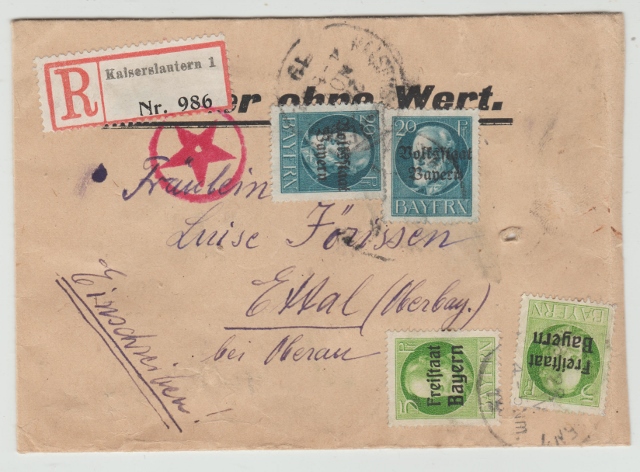 |
|
Send note to Staff
|
|
|
Pillar Of The Community
United States
812 Posts |
|
|
So, here's how I now understand the situation:
The terms Volksstaat and Freistaat are not synonymous and were never used interchangeably. The latter came into currency after the war merely as a way of acknowledging that Bavaria was no longer a monarchy. It does not really mean republic at all, though it has come to have that connotation. "'Bayern ist fortan ein Freistaat!', doch war darin auch von der 'Republik' die Rede." In this sentence, which NSK provides, the key word doch implies contradiction, i.e., Freistaat and republic were under consideration as alternative terms for the new state.
Exactly what sort of government Bavaria would have was at first uncertain. When Eisner and his party got control they established a socialist government and adopted the term Volksstaat. Under his successor, Hoffmann, the name continued. When more radical elements displaced him they employed the term Räterrepublik (soviet republic), though stamps continued to say Volksstaat.
After reactionary forces recaptured Munich on 1 May 1919 and put an end to the socialist regime, the Hoffman government, still in exile in Bamberg, issued the first Freistaat overprints on 17 May 1919. Michel also indicates that subsequent Freistaat issues appeared in August and early September, both before and simultaneously with the official Volksstaat stamps described in my OP. (I don't immediately find any Michel reference to a "switch to Freistaat" on 15 Sep 1919.)
Hoffmann then made the more neutral, more ambiguous term Freistaat the official name of the state only after he was made "Ministerpräsident" of the new conservative regime.
In sum: Volksstaat and Freistaat came to be associated with mutually (and violently) antagonistic ideological forces. I wondered, then, that the victors should have continued to issue a few stamps that bore the name of the government they had overthrown. I like Johan Buvelot's idea that, in the distressed circumstances in which Europe, and Germany especially, found itself after the war, the Bavarian postal authorities were obliged to use whatever stocks were to hand, especially if these had already been printed. Necessity trumped ideology in this case. Also like PostmasterGS's idea that the 20M Volksstaat stamp was issued largely with collectors in mind. And perhaps Hoffmann, the former head of the Volksstaat who had called in the paramilitary Freikorps and come back into the government with the conditional support of the conservatives, had some input here. But I don't think it plausible that the new conservative regime set out to print a few new Volksstaat stamps in an effort to please "the media" or any remaining adherents of the defeated socialists.
|
|
Send note to Staff
|
|
|
Pillar Of The Community
Netherlands
6641 Posts |
|
|
Please, read the article. Both used Freistaat. They were not the flags of two opposite parties. Both used "Freistaat" and "Volksstaat" was in general use, but preferred by one, whereas the other chose "Freistaat."
Volksstaat emphasised the republic, Freistaat emphasised the end of the monarchy.
The use of these words also is not limited to Bavaria.
You are making more of it then there ever was. |
|
Send note to Staff
|
| Edited by NSK - 06/13/2020 1:37 pm |
|
|
Pillar Of The Community
United States
812 Posts |
|
|
Thanks for the link. Reading it closely, I can't see anything there that contradicts what I've said. Freistaat does not by itself mean republic, but began as a "loose translation" of that word. At the start of the 20th century it was replaced by the term Volksstaat, again as a loose term that "could even mean a parliamentary monarchy." Already before 1914, however, Volksstaat had acquired the sense of a "Volksgemeinschaft" or people's commune. Under Eisner it became "a synonym for democracy" and "ein Kampfbegriff gegen den Obrigkeitsstaat" ( a fighting term in the struggle against the existing authorities). His Socialist Party clearly preferred the term Volksstaat. The reactionaries who overthrew the socialist regime clearly rejected it and returned to the more ambiguous Freistaat. So, at that time these were indeed "flags of two opposite parties." |
|
Send note to Staff
|
| Edited by EMaxim - 06/13/2020 2:32 pm |
|
| |
Replies: 9 / Views: 1,414 |
|




 Posted 06/12/2020 1:03 pm


