| Author |
 Replies: 19 / Views: 2,624 Replies: 19 / Views: 2,624 |
|
Valued Member
Canada
208 Posts |
|
|
|
Hi all
As I continue to learn about the SQs, I think I have read all BNAPS, RPSC, Maple Leaves, online articles and gained a pretty good understanding of this niche in Canadian philately.
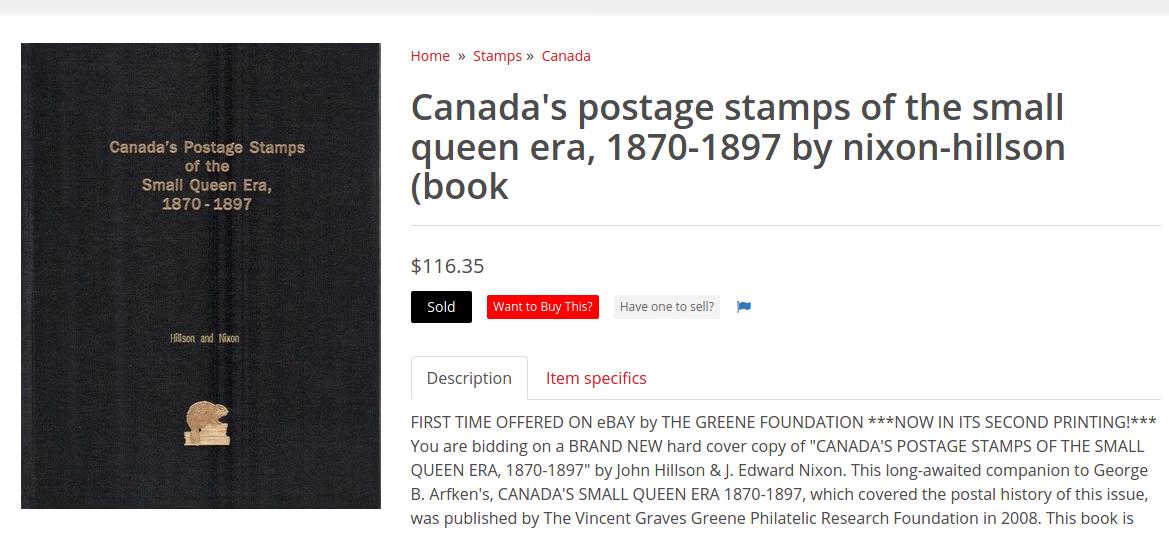
So, is it worth shelling out almost 200$ to purchase a copy of CANADA'S POSTAGE STAMPS OF THE SMALL QUEEN ERA 1870-1897 (Nixon and Hillson) from the Greene Foundation (considering the information is approaching 15 years old)? Has anyone purchased a copy and considers it essential for their collection? I would rather purchase 4-5 other books for the cost.
Chris
|
|
Send note to Staff
|
|
|
|
|
Rest in Peace
7742 Posts |
|
|
Moderator

United States
12330 Posts |
|
|
I would buy it, read it, scan it and make it into a PDF for myself, and then resell it. Edit: Don;t do this. I did this 'with all the books in my library. I love a nice library and a book in my lap as much as anyone else, but the logistics of storing a room full of book that my poor family will one day have to disposition AND the time and effort it took to perform a search and find the information I look for is simply overwhelming. Now I have an external drive with my entire library digitize on it. I have built a master PDF index which allows me to instantly search across every book in the library in seconds. (Note that this is a full text search.)
And lastly, buying the book and then reselling it is by far the most financially feasible approach for anyone who would like to have more references, stamps, and covers (unless you are independently wealthy). Edit: Don't do this.
If authors, publishers, and resellers had any sense they would already be offering digitized versions for sale along with the hard copies.
Don
|
Send note to Staff 
|
|
|
Pillar Of The Community
United Kingdom
576 Posts |
|
|
51studebaker
Digitized versions can always be copied and that copy re-sold without any money going to the publisher. Or just put onto one of the pirate book sites. Not such a problem with philatelic books perhaps given the limited "market" but it could be done and is with other reference books.
AQ |
|
Send note to Staff
|
|
|
Moderator
United States
12330 Posts |
|
|
Understood. But the ability to photocopy books also existed for several decades and no one seemed to care about that.
Additionally it takes a person little time to scan and OCR a book and offer it on a dark web if desired. There are multiple digitized versions of the Scott (and other) catalog available to anyone who wished to visit the seedy underbelly of the internet. These are scanned, illegal versions so I do not see how a publisher not offering them prevents theft.
When an author or organization publishes a specialty book, what it the objective? If the objective is only to make a buck, then doing a small run that ends up costing significant money is the approach to use. But if the objective is to promote the specialty and/or get the information in front of as many people as possible then offering both versions is the better approach.
I think that far too many good books have been relegated to obscurity with 'old school' thinking. By the time short run and costly books finally become public domain the effort can often lose much of its value. I think it is better to get a work into as many paying hands as possible while it is current.
Don |
|
Send note to Staff
|
|
|
Pillar Of The Community
United States
4490 Posts |
|
|
Quote:
Not such a problem with philatelic books perhaps given the limited "market" but it could be done and is with other reference books. Back in the early 70's you get printed copies of the Scott catalogs from in Taiwan during their heyday of copying books and vinyl records. It was printed on super thin paper. |
|
Send note to Staff
|
Al |
|
|
Valued Member
Canada
382 Posts |
|
|
Don,I am dreadfully disappointed (actually disgusted) by your promotion of the idea of copying books then reselling the original. In my opinion, that is no different than stealing! If collectors are going to steal the work, there is absolutely no sense for authors and publishers to go through the agony of producing reference books.
The Nixon / Hillson Small Queen book is expensive but, due to the low printing quantity, does not "make a buck" for the Greene Foundation. Neither do the authors realize any profit from the sale of the book. Ted Nixon and (the late) John Hillson spent several years assembling and checking data and took more than five years to produce the manuscript. When printing, we had to colour correct each page to ensure faithful colour reproduction.
This book is undoubtedly the best and most important book ever written about the Small Queens and should be an essential addition to a serious collector's library, but for the sake of the publishing wing of the hobby, BUY A COPY and stop being cheap about everything!
Garfield Portch FRPSC
President
Vincent Graves Greene Philatelic Research Fundation |
|
Send note to Staff
|
|
|
Moderator
United States
12330 Posts |
|
|
I do not agree that reselling something that you have purchased is stealing in any way shape or form and frankly think you owe me an apology. You are welcome to say you disagree, but please do not imply that it is stealing or make it sound that I am advocating anything close to stealing.
Moving beyond that, what I am advocating is the increasing the popularity of the collecting and study of Small Queens. As I stated, I think the intent should be getting the information in reference materials in front of as many people as possible and this includes offering it in alternate formats. I understand that if Greene makes makes a buck or not is not important, what is important is putting eyeballs on the content. So limiting access for whatever reason(s) does not help grow popularity for Small Queens or the hobby in general.
I would like access to this information and being cheap has nothing to do with it. Doctors have told me for years that I have little chance of living much longer, so I no longer make purchases which will turn into disposition headaches for my family and I outlined how I have digitized everything in my old library. I am dreadfully disappointed that I have to choose between buying a hardcopy and digitize it or simply not collect Small Queens. But to say that people are being cheap because it is only offered in a hard copy format is wrong, there are very legitimate reasons to seek out digitized books.
Don
|
|
Send note to Staff
|
|
|
Pillar Of The Community
United States
922 Posts |
|
|
Quote:
I do not agree that reselling something that you have purchased is stealing in any way shape or form Reselling the book is fine. Making and keeping a digital copy is the problem. |
|
Send note to Staff
|
|
|
Moderator
United States
12330 Posts |
|
|
Quote:
Making and keeping a digital copy is the problem. How so? If I buy any hard copy book or magazine that I want to keep I will always digitize and use it. I do not understand why it would be unethical or immoral to then sell a hard copy that I am no longer use or need. Edit: This is wrong and no one should do it. There are very legitimate reasons (including not discriminating against handicapped people with eye sight and other physical limitations) to want to own and use digit copies and it makes no sense not to want to a no-longer-needed hard copy book. I am really surprised at the push back here. There is nothing illegal, immoral, unethical or otherwise wrong with digitizing a copy of a book you purchased for your own use. Don Edit To Add To add, I am not copyright lawyer but digitizing a hard copy book for your own personal use falls under 'fair use', obviously you cannot redistribute the work. This is no different than putting a copy of an song on your MP3 or making a backup disk of a movie disk or tape you purchased (as per existing court precedence regarding Diamond's Rio MP3 player and the earlier court's rulings with Sony's Betamax VCR). I believe that the courts found that since you already purchased the content, making copies making copies of the book for personal use has no impact the market value of the work. |
|
Send note to Staff
|
|
|
Valued Member
109 Posts |
|
|
As an author of several stamp books, I would suggest that as long as you continue to retain your purchased printed book it is ok to have a digital version.
However, once you sell the printed copy I would be quite offended that a digital copy was being retained (unless that was part of the original purchase agreement).
Robin Harris
|
|
Send note to Staff
|
|
|
Moderator
United States
12330 Posts |
|
|
Are there legal precedence or rulings which state you have to retain the original copy? (I have not seen any although I am not a copyright/IP lawyer.) Again, you purchased the original work so the content has been paid for and market impact not significant.
Don |
|
Send note to Staff
|
|
|
Rest in Peace
7742 Posts |
|
|
Quote:
However, once you sell the printed copy I would be quite offended that a digital copy was being retained (unless that was part of the original purchase agreement). Agreed Robert |
|
Send note to Staff
|
|
|
Moderator
United States
12330 Posts |
|
|
What is relevant is the law (and hoping that Chris will offer his legal insight). If Chris says this is breaking the law then I will most certainly withdraw my suggestion.
Don |
|
Send note to Staff
|
|
|
Moderator

United States
5106 Posts |
|
|
I'd like to put a slight twist on the question. If I check out a book from the library, make a digital copy for my use, then return the book to the library, is that the same problem? |
|
Send note to Staff
|
|
|
Pillar Of The Community
606 Posts |
|
|
To answer the OP, the Hillson / Nixon book is excellent.
Owning a book does permit one to legally make a single personal-use copy. Upon selling the book, I don't know what one's ownership rights are. |
|
Send note to Staff
|
|
|
Replies: 19 / Views: 2,624 |
|



 Posted 06/26/2020 1:47 pm