| Author |
 Replies: 11 / Views: 1,439 Replies: 11 / Views: 1,439 |
|
|
Pillar Of The Community

United States
1838 Posts |
|
|
I took a flyer on a large, mixed condition set of 90c Perrys. Though they will be sellable, my ulterior motive is to try to improve the confidence I have in myself to separate 155s from 166s. The previous owner had identified all of them. That person was pretty accurate on soft paper. Most of the stamps ID'd as 191s were soft paper. I only found a couple in the rest that should have been ID'd as soft paper. However, I have no faith in that person's identification of 155 vs 166. That's fine. That's the purpose of this exercise. I have reference copies of both 155 and 166, but the variations are ever so slight sometimes that many copies seem right in the middle. Often I'm confident, but often, less so. So here is the exercise I'm doing for myself. I took out all the soft-paper stamps. I put the remaining stamps in something close to color order from the most carmine-y to the most rosy. There are plenty of faults - I'll worry about that later. For now, I really want to try to find the line between 155 and 166. Comparing to my certified copies, looking at lots of images and reading previous discussions, my initial take is that the top row are likely 155s, the bottom likely 166s. The dividing like in the middle might be between the second and third line, or I may have some misplaced. At this point, I'm open to any wisdom you'd like to share. I have a sense that, the upper corners may be the focal point for me to find the line between them. Maybe the 4th stamp on line 2 is misplaced? Working on it. 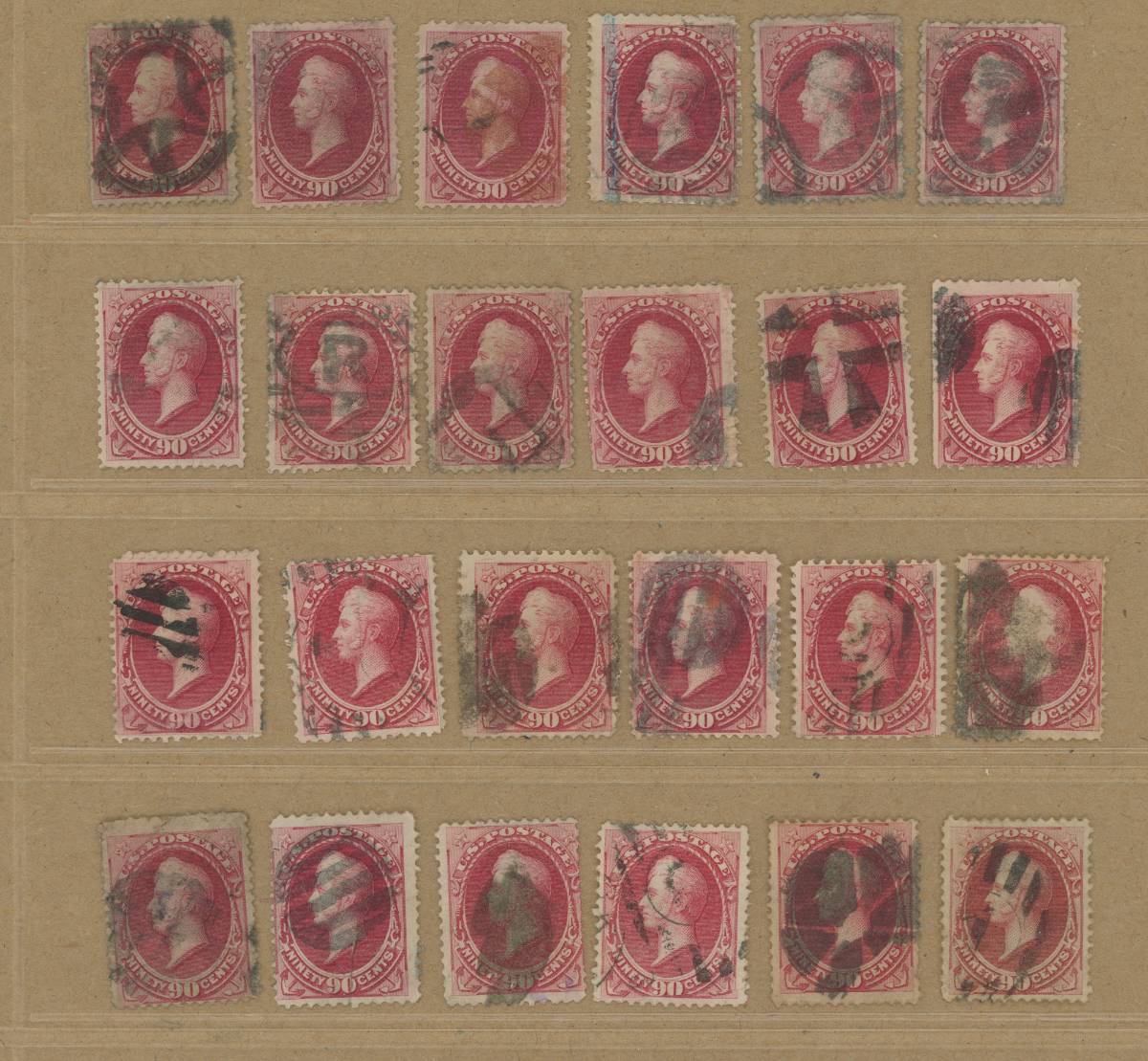 |
|
Send note to Staff
|
|
|
|
|
Pillar Of The Community
United States
1838 Posts |
|
|
Here's what I mean by focusing on the corners. The top row are candidate carmine 155s. The bottom 166. These corners show a distinct difference I'm describing as a "bluish tint" on the 155s that is not there on the 166s. This seems like a candidate for making the determination. Hmmmm. 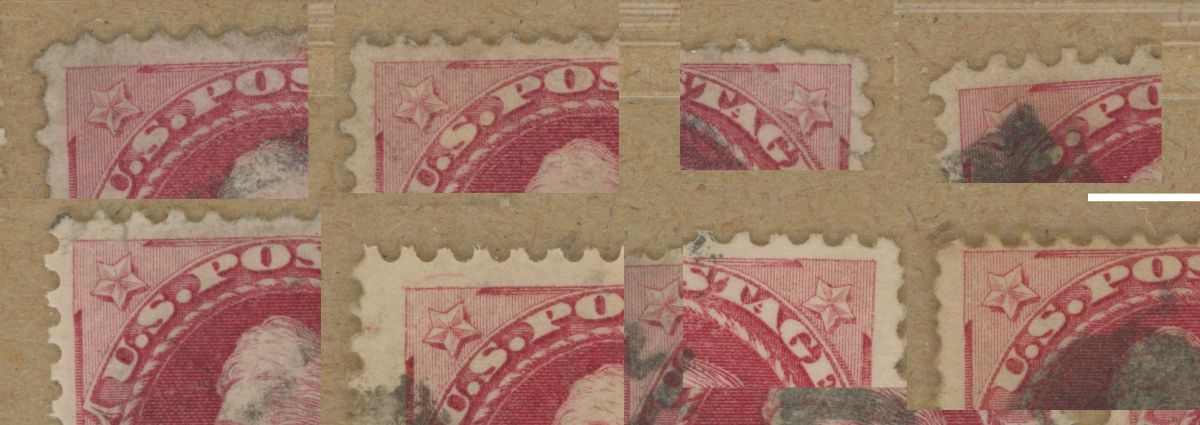 |
Send note to Staff 
|
|
|
Pillar Of The Community
United States
775 Posts |
|
|
I am surprised you have not gotten any responses. There are a number of experts here, though I am not one of them. But I wanted to say it is a lovely group of stamps; one hardly ever sees this many at one time. Your color problem rivals the ones I have with German stamps. |
|
Send note to Staff
|
|
|
Pillar Of The Community
United States
1838 Posts |
|
|
I appreciate the words. I think this is tough case for most of us. I doubt anyone has the magic words to make this easy. What I'm hoping, is that with this many I can start to identify a critical difference that I can rely on. So far, the slightly bluish tint idea seems to be holding up. If anyone thinks I have this completely wrong I'd certainly like to hear it. |
|
Send note to Staff
|
|
|
Pillar Of The Community
United States
1838 Posts |
|
|
Is there a slight shade difference between Scott #144 and 155? I bought a 144 for myself a while back that isn't certified (has some faults - so I've been living with that). I found one stamp amongst all the rest that I couldn't place as a 155 or 166 and I think a see a small number of grill points there. Those two stamps are pretty close in shade. At this stage I'd just like to know if an expert in this area would expect a slightly different shade on the 144 vs the 155. Thanks. |
|
Send note to Staff
|
|
|
Pillar Of The Community
United States
3305 Posts |
|
|
Certainly not the expert that you are looking for. Just some additional information.
While National held the contract to print stamps, there were 398,880 90C stamps issued, plus an unknown number of unissued stamps held by the stamp agent. There were 213,450 90c stamps issued in 1870, 60,540 in 1871, 72,150 in 1872, and 52,740 in 1873.
IF (big if) each years total were all printed at the same time, it would seem there are four possible hues or shades. |
|
Send note to Staff
|
| Edited by littleriverphil - 09/02/2020 9:22 pm |
|
|
Pillar Of The Community
United States
1838 Posts |
|
|
Here's the table from stamp smarter. I can't reconcile your numbers. That's ok, I get the point. That's sort of why I'm asking. The two stamps that I think are 144s both seem to fall into a slightly different color category than the rest of the hard paper stamps I'm looking at. I'm hoping that's additional support for them actually being 144s. The one I found appears to be fault free so it will be worth having the PF take a look at some point. 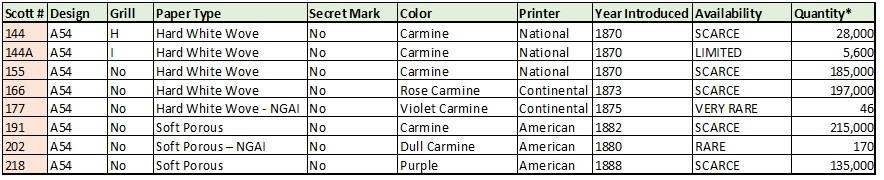 |
|
Send note to Staff
|
| Edited by rlsny - 09/02/2020 11:08 pm |
|
|
Pillar Of The Community
United States
3305 Posts |
|
|
I found the production information in John N. Luff's Postage Stamps of the United States. |
|
Send note to Staff
|
|
|
Pillar Of The Community
United States
578 Posts |
|
|
For 155 vs 166, I like looking at the oval medallion surrounding Perry. The ink is more heavily applied there (i.e. the color is less likely to be influenced by the paper color bleeding through, something that could more easily happen in the corners). Basically, if it's only carmine (pale to deep, actually a pretty wide range), it's a 155. If the color has any hint of "rose" to it (also a pretty wide range), then it's a 166. All (genuine) 144's fall into the same range as 155's, so if you have genuine grilled 90c, you can use that as a reference for 155 (the problem, of course, is that there are a lot of fake grills on 90c banknotes, so probably just as tough to figure out if your grill is genuine as it is to figure out whether your shade is carmine or rose carmine.)
FWIW, rather than thinking of the 155's as having a "bluish cast," I've always thought about the 166's looking a little "warmer" and 155's a little "cooler." It's the same difference ("cool" = blue, "warm" = yellow), but interesting that you also notice the bluish cast to 155's (which I agree with). This phenomenon is IMO similar to the 3c stamps of 1861, i.e. Scott 64a's (purplish cast) and 64's (bluish cast).
Anyway, just eyeing your scan up, I'd say that several stamps in row #2, plus stamp #4 in row 3, and possibly even stamp #2 in row 4, etc. all have a shot at being 155's. I'll preface this by saying that the shades of 90c banknotes are very subtle, and as the paper yellows, stamps that may be 155's start looking like 166's due to the yellow coming through. Send every stamp in this group to PSE & PF and I'd bet you'd get more than a couple conflicting ID's back...
P.S. Don't ignore other characteristics beyond shade. Certain papers & thicknesses are common to Continentals, others to Nationals. Other characteristics (i.e. cancellation type & period of usage) might also be more helpful in identifying 155 vs 166 than the shade itself... |
|
Send note to Staff
|
|
|
Pillar Of The Community
United States
578 Posts |
|
|
BTW, your first stamp (i.e. #1 in row #1) looks like it has some rose in it to me. That one might be a rose carmine (on the deeper end of that spectrum) Scott 166. |
|
Send note to Staff
|
|
|
Pillar Of The Community
United States
1838 Posts |
|
|
srailkb, Some good thoughts there. For all the main Scott numbers in the 19th century, this seems to be the most difficult for me. I've moved a number of these around since that scan. I will make another pass through. Thanks. |
|
Send note to Staff
|
|
|
Rest in Peace
United States
920 Posts |
|
|
rlsny - don't feel alone! I've moved mine around in my collection several times. |
|
Send note to Staff
|
|
| |
Replies: 11 / Views: 1,439 |
|




 Posted 08/25/2020 4:03 pm


