Stamp Community Family of Web Sites
Thousands of stamps, consistently graded, competitively priced and hundreds of in-depth blog posts to read


Stamp Community Forum
 
Username:
Password:
Save Password
Forgot your Password?

This page may contain links that result in small commissions to keep this free site up and running.

Welcome Guest! Registering and/or logging in will remove the anchor (bottom) ads. It's Free!

A Scott Catalogue Question ... Qe4 Vs. Qe4A

 
To participate in the forum you must log in or register.
Author Previous TopicReplies: 11 / Views: 2,164Next Topic  
Pillar Of The Community
Learn More...
United States
1493 Posts
Posted 10/24/2020   6:55 pm  Show Profile Bookmark this topic Add JLLebbert to your friends list Get a Link to this Message
Recently I stumbled across PSE certs for these two stamps that, at first, puzzled me. The QE4 was described as having been issued in 1929 (think this should be 1928) and yellow green in color ... QE4a was described as having been issued in 1925 and deep green in color. Which, of course, is just the opposite of what I find in my 2017 Scott specialized. The two certs were dated 2005 & 2006. My assumption, for now, is that these two numbers were swapped sometime between 2006 & 2017. Can anyone confirm this? I no longer have any catalogue earlier than the 2017.
Send note to Staff

Pillar Of The Community
Learn More...
United States
1812 Posts
Posted 10/24/2020   7:03 pm  Show Profile Bookmark this reply Add rlsny to your friends list  Get a Link to this Reply
I think there is a 1940 version too that Scott doesn't list. This based on some guy who claims to be an expert. But I'd like to get educated on these too.
Send note to Staff  Go to Top of Page
Pillar Of The Community
United States
8956 Posts
Posted 10/24/2020   7:09 pm  Show Profile Bookmark this reply Add Petert4522 to your friends list  Get a Link to this Reply
1987 Scott: QE3 June 25, 1925 yellow green
QE4 1929 yellow green
QE4a April 11,1925 deep green

Does this help a bit?

Peter
Send note to Staff  Go to Top of Page
Pillar Of The Community
Learn More...
United States
1493 Posts
Posted 10/24/2020   7:30 pm  Show Profile Bookmark this reply Add JLLebbert to your friends list  Get a Link to this Reply
Peter: Thanks, you've confirmed my hunch that Scott renumbered these to place the catalogue numbers in the same sequence as their issue dates.
rlsny: I don't know when Scott may have added the 1940 printing, but it was only 2 or 3 years ago that they added the 1928 printing of QE1 thru QE3 on special booklet paper. At that time, they assigned them a b suffix. For some time, the 1940 issues had been listed without a suffix while the 1955 issues had been given an a suffix. The 1928 issues were printed on special booklet paper whose grain runs perpendicular to that of normal stamp paper ... this resulted in slightly different horizontal & vertical design dimensions. When I first saw these listings a couple of years ago, I immediately assumed there would be a renumbering to place them in proper chronological order. Scott did so in the 2021 catalogue.
Note that QE4a was printed prior to the other QEs in 1928 and hence was not on special booklet paper. But the same color ink was used on all of the 1928 QEs. To summarize:
1925 wet printing: QE4 (deep green) on normal paper
1928 wet printing: QE4a (yellow green) on normal paper
1928 wet printing: QE1 thru QE3 (yellow green) on Special Booklet Paper
1940 wet printing: QE1a thru QE3a (green) on normal paper
1955 dry printing: QE1b thru QE3b (light green) on normal paper
Send note to Staff  Go to Top of Page
Pillar Of The Community
United States
737 Posts
Posted 10/24/2020   7:33 pm  Show Profile Bookmark this reply Add uboatnut to your friends list  Get a Link to this Reply
2014 Scott US Specialized, page 403

QE3: June 25, 1928, wet printing, yellow-green
QE3a: 1955, dry printing, yellow-green
QE4: April 11, 1925, deep green
QE4a: 1928, yellow-green
====================
2020 Scott US Specialized, page 450

QE3: 1940 wet printing, green
QE3a: 1955, dry printing, light green
QE3b: 1928, special booklet paper, yellow green

QE4: April 11, 192, deep green
QE4a: 1928, yellow-green
Send note to Staff  Go to Top of Page
Edited by uboatnut - 10/24/2020 7:40 pm
Pillar Of The Community
Learn More...
United States
1493 Posts
Posted 10/24/2020   8:30 pm  Show Profile Bookmark this reply Add JLLebbert to your friends list  Get a Link to this Reply
Think I may have accidentally clouded the issue.
In my 2017 Scott, QE1 thru QE3 are listed as being the 1928 printing and QE1a thru QE3a as the 1955 printing. The color for both printings is given as yellow green. No mention is made of the 1940 printing. So presumably, it was the 1940 printing that was effectively added in recent years. Part of the confusion comes from the recent addition to the catalogue of the 1928 sheet stamps that were printed on SBP (Special Booklet Paper).
Sometime within the past 2 or 3 years, 11 stamps printed in 1928 on SBP were added to the catalogue. An article in that year's catalogue stated the case for the addition of these stamps. Originally the author had only intended for the 3 special handling stamps (QE1 thru QE3) on SBP to be added, but the folks at Scott decided that all 11 SBP stamps should be addressed. The author's desire had been to clarify the confusion in the philatelic marketplace about the QEs which were frequently being misidentified by sellers & collectors alike.
The initial result of the catalogue change was the substitution of the 1940 printing for the 1928 (as QE1 thru QE3) and then the addition of the 1928 SBP stamps (as QE1b thru QE3b). The 1955 printing (QE1a thru QE3a) were left untouched except for an adjustment to the stated ink color.
Finally, in the 2021 edition, Scott gave the QEs what one hopes is their final renumbering, placing them in what seems to be the appropriate chronological sequence. Basically it was a reshuffling of the suffixes ...
1940 " "--->"a", 1955 "a"--->"b", 1928 "b"--->" ".
Note that unlike the other 8 stamps on SBP, the QEs have several differences other than the very slight difference in design size caused by the use of SBP ... e.g., ink color, gum color, sharpness of design, wet vs. dry print.
Send note to Staff  Go to Top of Page
Pillar Of The Community
Learn More...
United States
1812 Posts
Posted 10/24/2020   11:00 pm  Show Profile Bookmark this reply Add rlsny to your friends list  Get a Link to this Reply
Thank you JL and uboat for the education.
Send note to Staff  Go to Top of Page
Pillar Of The Community
3859 Posts
Posted 10/25/2020   09:51 am  Show Profile Bookmark this reply Add jogil to your friends list  Get a Link to this Reply
It can be confusing telling apart different printings and paper grain directions that affect stamp frame sizes.
Here are some illustrations that may be helpful even though they are from a different country stamp issue.


When a wet (17.5 mm x 21.5 mm) and a dry (18 mm x 21.5 mm) printed stamp with vertical grain paper is compared, the horizontal stamp frame widths will differ from each other and the vertical stamp frame lengths would be around the same.


When a wet printed stamp with horizontal grain paper (18 mm x 21 mm) is compared to a wet printed stamp with a vertical grain paper (17.5 mm x 21.5 mm), both the horizontal stamp frame widths and the vertical stamp frame lengths will differ from each other.

If a dry printed stamp with vertical grain paper (18 mm x 21.5 mm) is compared to a wet printed stamp with horizontal grain paper (18 mm x 21 mm), the vertical stamp frame lengths will differ from each other and the horizontal stamp frame widths would be around the same.
Send note to Staff  Go to Top of Page
Edited by jogil - 10/25/2020 09:57 am
Pillar Of The Community
United States
4284 Posts
Posted 12/07/2023   4:34 pm  Show Profile Bookmark this reply Add Parcelpostguy to your friends list  Get a Link to this Reply
[First Text then eye candy below.]


Quote:
Recently I stumbled across PSE certs for these two stamps that, at first, puzzled me. The QE4 was described as having been issued in 1929 (think this should be 1928) and yellow green in color ... QE4a was described as having been issued in 1925 and deep green in color. Which, of course, is just the opposite of what I find in my 2017 Scott specialized. The two certs were dated 2005 & 2006. My assumption, for now, is that these two numbers were swapped sometime between 2006 & 2017. Can anyone confirm this? I no longer have any catalogue earlier than the 2017.


Quote:
Peter: Thanks, you've confirmed my hunch that Scott renumbered these to place the catalogue numbers in the same sequence as their issue dates.


The QE 25 cent deep green came out in 1925 and was Scott numbered. The other three values came out in 1928 along with the yellow green 25 cent.

Scott changed their numbering system to the current model with QE for Special Handling. Per their convention of a "series" of stamps, they listed the values low to high, 1 being the 10 cent, 4 being the 25 cent and chose to list all of the 1928 issues in order and for what ever reason assigned the 1925 first printed 25 cent dark green as a variety (a) of the listed 1928 QE4 yellow green so the first printing in 1925 was labeled QE4a. I believe that was an editorial decision to group the same yellow green colors together, allowing one color title for the group.

Later as the wet/dry and special paper printing were understood, Scott with the help of Bob Rufe redid the QE listings to add missing details and did then switch the QE4/QE4a listing and only those listing to conform with the dates of issue, 1925 then 1928. Scott did not Change the low to high denomination ranking thus the first issued 1925 standalone 25 cent dark green is still listed after the first thee 1928 new values, 10, 15 and 20.

Furthermore, the yellow green and last 25 cent press run started January 14, 1928 and was completed January 19, 1928. This was more than 5 months before the other three values when to press as yellow green on June 22, 1928.

Here are the press dates and impressions for the 25 cent plates. 1925 is all dark green, 1928 is all yellow green. These are taken from BIA Research Paper 6***, the press dates and impression quantities of E, Q, JQ, F and QE. As the organization changed its name afterwards to USSS, it is now USSS research paper 6, no longer available as a hard copy but as an e-version from USSS.


25˘........................17095............17096.........17097............17098
4-4 to 4-16-25.....................................................x...................x............17850 impressions
4-9 to 4-16-25..........x....................x....................................................... 8400 impressions
1-14 to 1-19-28........x....................x...................x................... x ............3500 impressions
Impressions..........11900..........11900............21350.......... 21350

............................17099................17101..........17102.............17103
4-4 to 4-16-25..........x...................................................................x
4-9 to 4-16-25....................................x..................x
Impressions........17850..................8400...........8400................7850


Plates went to press in these sets, Dark Green
4-4 to 4-16-25 17097 17098 17099 17103 17850 imp
4-9 to 4-16-25 17095 17096 17101 17102 8400 imp

Yellow Green
1-14 to 1-19-28 17095 17096 17097 17098 3500 imp


Quote:
QE1 thru QE3 are listed as being the 1928 printing and QE1a thru QE3a as the 1955 printing.


Quote:
2014 Scott US Specialized, page 403

QE3: June 25, 1928, wet printing, yellow-green
QE3a: 1955, dry printing, yellow-green
QE4: April 11, 1925, deep green
QE4a: 1928, yellow-green
====================
2020 Scott US Specialized, page 450

QE3: 1940 wet printing, green
QE3a: 1955, dry printing, light green
QE3b: 1928, special booklet paper, yellow green

QE4: April 11, 192, deep green
QE4a: 1928, yellow-green


Scott is taking liberties. Here are the denominations and dates of standalone press runs for the other three denomination after 1928 (Note all press runs after October 1954 are Dry Printings):

10 cent:

11-26 to 11-28-41
8-6 to 8-12-42
8-26 to 8-28-43
8-21 to 8-24-44
7-31 to 8-5-46
3-8 to 3-10-48
7-26 to 7-28-49
9-22 to 9-25-50
2-7 to 2-8-52
3-6 to 3-10-52
5-18 to 5-19-53
2-26 to 3-2-54
V V V------------V V V-----Dry Printings...V V V.....
11-4 to 11-9-54
8-23 to 8-26-55
9-19 to 10-10-55
9-19 to 10-12-55

15 cent:

11-27 to 11-28-41
8-6 to 8-11-42
8-26 to 8-31-93
8-22 to 8-29-44
7-31 to 8-6-46
9-7 to 9-10-48
7-26 to 8-2-49
8-7 to 8-11-52
8-17 to 8-18-53
10-12 to 10-18-54
V V V------------V V V-----Dry Printings...V V V.....
11-4 to 11-9-54
10-6 to 10-10-55


20 cent:

7-29 to 8-2-40
11-28 to 12-3-41
8-5 to 8-10-42
8-30 to 9-2-43
8-22 to 8-29-44
7-31 to 8-8-46
7-26 to 8-3-49
8-17 to 8-?-53
10-12 to 10-19-54
V V V------------V V V-----Dry Printings...V V V.....
11-9 to 11-10-54
10-6 to 10-11-55

***True title as first published:
B. I. A. Research Paper
# 6
Printing History of Special Delivery, Parcel Post,
Parcel Post Due, Special Handling, Registration,
Official Mail and Postal Savings Flat Plates


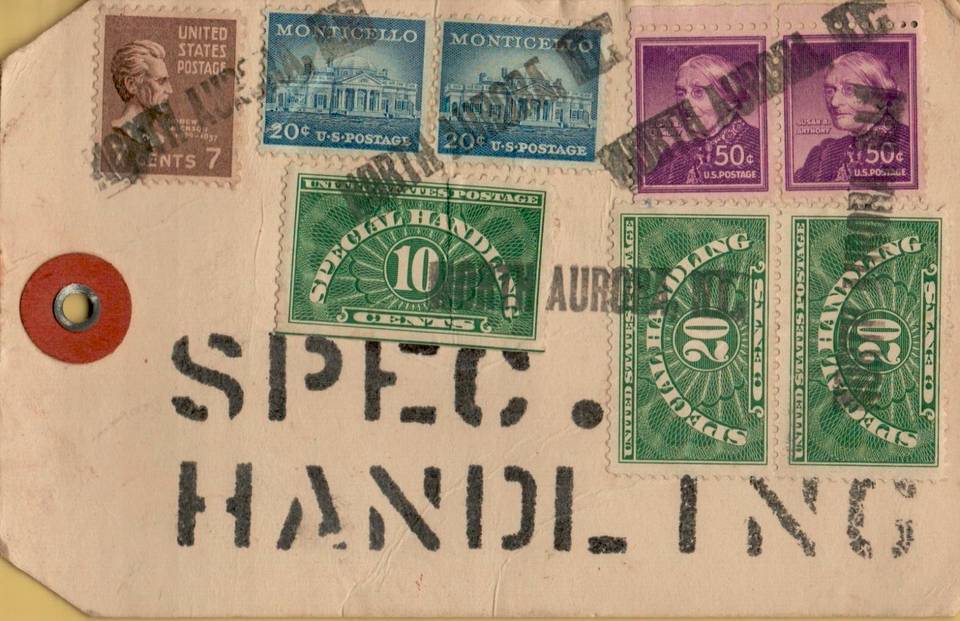
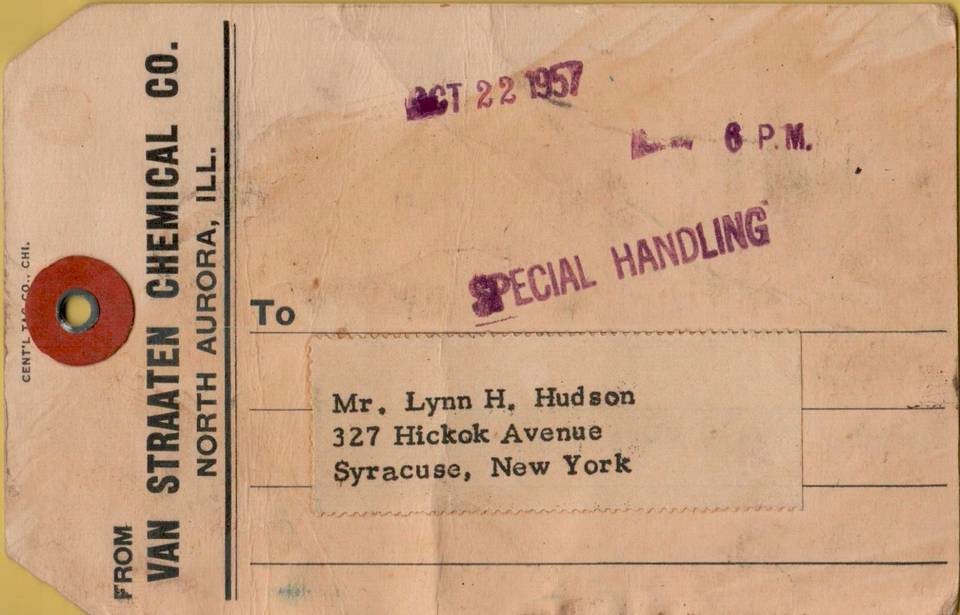
Here is the promised eye candy:
Send note to Staff  Go to Top of Page
Pillar Of The Community
United States
4284 Posts
Posted 12/10/2023   5:29 pm  Show Profile Bookmark this reply Add Parcelpostguy to your friends list  Get a Link to this Reply
The special handling goodie post just above is a bold tag to say the least. It rates as follows:

14 pound, Zone 5 with Special Handling for over 10 lbs. Total postage and fees, $1.97.

That said, I think it is more important to discuss how I rated the tag. Thus, I have chosen to do a step by step process referencing the 3rd Edition of the B&W Domestic Rate Book in order to "rate the cover." (Rating Special Handling; Rating Parcel Post; Determining Parcel Post Zone -- text for later searches on SCF)


Late 50's special handling items with QE stamps are tough to find. Here, It also soon after the July 1, 1957 rate change.

So this is how I figure the rating (I mention the page numbers in the 3rd Ed of B&W):

50 cents SH stamps must mean over 10 lbs (page 366, top chart, column 4. Regular stamps could also be used but SH stamps were service specific. As 50 was the top fee, no regular stamps paid any part of the fee.

There are 627 crow fly miles between the two cities (I use https://www.distance-cities.com/ ) . This allows me to assume it is zone 5, a distance between 600-1000 miles (page 225, lower grid).

Zone 5 is 26 cents for the 1st pound, 9.25 cents for each additional pound or fraction. 26 + (9.25 x 13) = 26 + 120.25 = 146.25 rounds up to $1.47 for 14lbs. Again page 225, upper grid, column 14. If you turn the page you will see the next rate change was in 1960 so column 14 is what you need. Additionally fractions of a cent are not rounded the same way consistently over the years, here it was up. The USPOD would list every zone and each weight within in a large chart giving the correct cost for each combination in the July (annual) USPOD Postal Guides and in the monthly guide when a rate change occurred. Now this parcel post rating confirms weight over 10 lbs, thus it is correct for the 50 cent SH fee.

Checking my work:
If zone 4, postage calculates to either 148.2 cents or 141.3 cents and with rounding neither hits $1.47.

The reason I check the lower (or upper at times) zone is to see if the package's stamps makes a correct zone based solution. At times (I am making up numbers here) the postage for a zone 3 10 lbs and a zone 4 8 lbs work out to 22 cents each so I must determine the actual zone, not deduce it by postage and fees affixed.

28 miles is the difference between the zones 4 and 5 here with this tag. Crow fly of 628 miles with a 600 mile zone dividing line is how I arrived at 28 miles.

Since zones are measured from the center of the quadrant in which the post office is located and any other quadrant with any portion within the average distance circle of 600 miles means all post offices in the entire quadrant count in zone 4 and outside of the circle zone 5. The quadrants are defined by fixed latitudes and longitudes, always the same. However those northern more are smaller in square miles than those further south.

Every post office has a + or - distance from the center of the sending (parcel acceptance post office) quadrant and also a + or - distance from where the zone circle hit the quadrant of the addressee post office of delivery.. So when the crow fly distance is near the extremes of a zone, and the two zones each provide a correct postage rating, I must go to the map and actually measure between the two quadrants. This is not well described in the book, nor much anywhere else. I have stumbled upon it in one archived exhibit copy. The process is as clear as day with an original USPOD map and instructions. The map shown in the B&W 2nd and 3rd editions is a privately printed version not a USPOD version. The private map was designed to be used throughout the entire USA. The USPOD issued a different map version for each quadrant and the post offices it contains. It has the distance circles of each zone preprinted on the map from the center of the quadrant for which the map was issued.

NOTE: If you have only the 2nd edition and want a step by step for those pages, ask and I will provide. For now I don't have ready access to my 1st edition thus must decline a page by page request for that edition. But in both books with some searching you can find the information in both editions by reviewing the two chapters involve, 4th Class (Parcel Post) and Special Handling. The 1st Edition does not have the parcel quadrant map.
Send note to Staff  Go to Top of Page
Bedrock Of The Community
United States
10594 Posts
Posted 12/10/2023   5:38 pm  Show Profile Bookmark this reply Add revcollector to your friends list  Get a Link to this Reply
Interesting that they still had 7 cent Prexies at the PO so late. The 7 cent Liberty was more than a year old at that point, and North Aurora is a suburb of Chicago. Of course 7 cents would have been a fairly odd value at the time with only occasional use.
Send note to Staff  Go to Top of Page
Pillar Of The Community
United States
4284 Posts
Posted 12/10/2023   7:03 pm  Show Profile Bookmark this reply Add Parcelpostguy to your friends list  Get a Link to this Reply

Quote:
Interesting that they still had 7 cent Prexies at the PO so late. The 7 cent Liberty was more than a year old at that point,


Yes it is. However, I am not aware of Prexies being recalled for return and destruction. Thus if in need of a seven cent order, the stamp issuing office may still send out what is on hand until the prior issue is used up, unless the Liberty was specifically ordered. Additionally, I don't know how much matter was mailed by the firm on a daily basis, a significant amount I would believe, and they could have purchased a pane or two of the Prexie sevens and were just slow to work through them.

That said, this firm seems to have a high outgoing mail volume due to having a special rubber stamp for "SPECIAL HANDLING" which they liberally used on this tag. Additionally, they clearly had 50 cent stamps in inventory and could have used one more Liberty in lieu of the 50 cents worth of SH stamps. In spite of that I think they went with the SH stamps as they standout on the tag from across the room and are more likely to not be overlooked for actual SH Service.
Send note to Staff  Go to Top of Page
  Previous TopicReplies: 11 / Views: 2,164Next Topic  
 
To participate in the forum you must log in or register.

Go to Top of Page

Disclaimer: While a tremendous amount of effort goes into ensuring the accuracy of the information contained in this site, Stamp Community assumes no liability for errors. Copyright 2005 - 2026 Stamp Community Family - All rights reserved worldwide. Use of any images or content on this website without prior written permission of Stamp Community or the original lender is strictly prohibited.
Privacy Policy / Terms of Use    Advertise Here
Stamp Community Forum © 2007 - 2026 Stamp Community Forums
It took 0.19 seconds to lick this stamp. Powered By: Snitz Forums 2000 Version 3.4.05