| Author |
 Replies: 29 / Views: 1,447 Replies: 29 / Views: 1,447 |
|
Valued Member
72 Posts |
|
|
Does this stamp have a performance of L14? or is the program wrong?  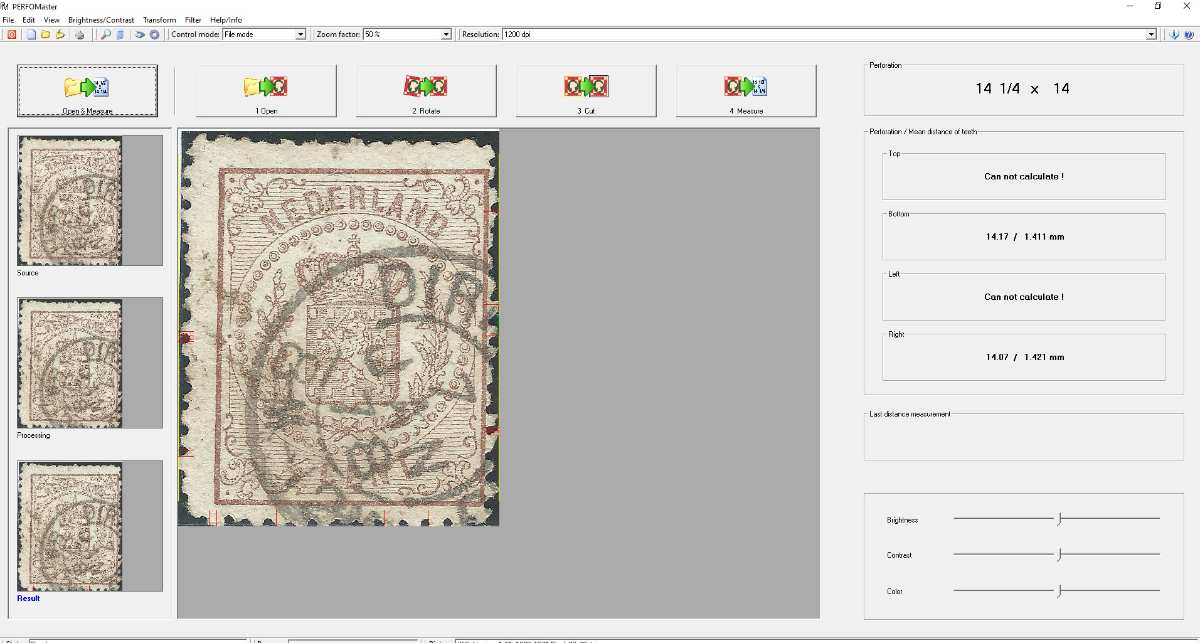 |
|
Send note to Staff
|
| Edited by SSlava - 02/01/2021 08:46 am |
|
|
|
|
Pillar Of The Community
Netherlands
6641 Posts |
|
|
Am I correct in understanding that "brand" = "marka," i.e., stamp and performance is perforation.
The 1/2 cent has the following perforation varieties:
1869-1873: line 14, small holes, thick paper
1870-1875: comb 13 1/4, small holes, thin paper
1875-1876: comb 13 1/4, large holes
It also exist without perforation.
The 1/2 cent does not exist with comb 13 1/4, small holes, thick paper (1869-1873), as do some other face values from this set.
|
Send note to Staff 
|
| Edited by NSK - 02/01/2021 08:45 am |
|
|
Valued Member
72 Posts |
|
|
Well, the program, perhaps, does not quite correctly show the result.
Stamp have a linear perforation or comb? |
|
Send note to Staff
|
| Edited by SSlava - 02/01/2021 08:50 am |
|
|
Valued Member
72 Posts |
|
|
The paper seems not to be thin (there are stamp that clearly have thinner paper). And so hard to say anything)). |
|
Send note to Staff
|
|
|
Pillar Of The Community
United States
8956 Posts |
|
|
Pillar Of The Community
Netherlands
799 Posts |
|
|
The last line of NSK's post should read: It does exist
Postmark is most probably Dirksland. |
|
Send note to Staff
|
|
|
Valued Member
72 Posts |
|
|
Quote:
The 1/2 cent does not exist with comb 13 1/4, small holes, thick paper (1869-1873), as do some other face values from this set.
Most likely the program meant perforation 14. |
|
Send note to Staff
|
|
|
Valued Member
72 Posts |
|
|
Quote:
The perf 14 has line perforation
Peter If I understand correctly, this stamp has a perforation L14? |
|
Send note to Staff
|
|
|
Valued Member
72 Posts |
|
|
Quote:
The last line of NSK's post should read: It does exist
Postmark is most probably Dirksland. All right, thank you. So what kind of perforations do you think are here? |
|
Send note to Staff
|
|
|
Pillar Of The Community
Netherlands
6641 Posts |
|
|
It looks like a line perforation with small holes. That exists in gauge 14. This seems to be in line with your measurement. Quote:
The last line of NSK's post should read: It does exist I gave up collecting "Netherlands" when they privatised PTT Post. My NVPH specialised is outdated (1988). That one says it does not exist. It might be the case it popped up after 100 years. Quote:
If I understand correctly, this stamp has a perforation L14? As I wrote "line 14, small holes." There is a good chance L14 stands for line-perforated gauge 14. |
|
Send note to Staff
|
| Edited by NSK - 02/01/2021 09:24 am |
|
|
Valued Member
72 Posts |
|
|
Quote:
As I wrote "line 14, small holes." There is a good chance L14 stands for line-perforated gauge 14. All right, thank you for your help! |
|
Send note to Staff
|
|
|
Pillar Of The Community
Netherlands
799 Posts |
|
|
It is not possible to verify a perforation without having the stamp in front of you. Part of the Dutch catalogue. Lijntanding means Line perforation. Kamtanding means Comb perforation. KL.G means small holes. Gr.G means larger holes. Dik papier means thick paper. Dun papier means thin paper 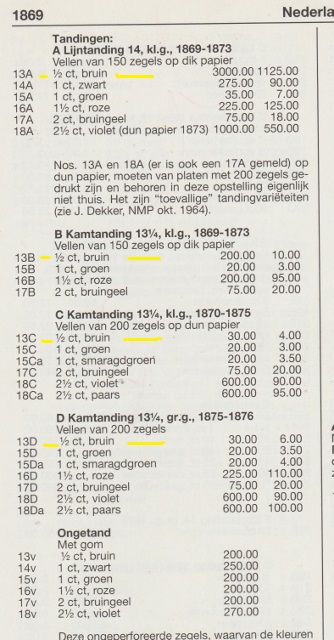 |
|
Send note to Staff
|
|
|
Pillar Of The Community
Netherlands
6641 Posts |
|
|
Valued Member
72 Posts |
|
|
And so this is what version? 13a, 13b or other? There are only 2 different varieties of this stamp in the Michel catalog. And then where do so many varieties come from))?
So what's the perforation? You need a toothsemer? |
|
Send note to Staff
|
|
|
Pillar Of The Community
United States
8956 Posts |
|
|
SSlava, you need to determine the perforation yourself. It is probably 13.25, but you need a good perforation gauge to check it.
There are four (4) known perforation varieties of this stamp and going into it this deep the Michel catalog is of no use here.
Start by getting a good perforation gauge,
Peter |
|
Send note to Staff
|
|
|
Pillar Of The Community
Netherlands
6641 Posts |
|
|
These numbers come from the NVPH catalogue. It is the catalogue published by the Dutch Association of Philatelic Dealers. Dutch collectors tend to use that catalogue. Michel, like Scott, Yvert & Tellier and Stanley Gibbons publish international catalogues that are less specialised.
The A-numbers are the only numbers that have a perforation gauge 14. This is a line perforation and the stamps are on thick paper. The note below the A-numbers mentions the 1/2 and 2 1/2 cent (there has been a report of 2 cent) exist on thin paper and must come from sheets of 200 listed as C-numbers and are accidental varieties. |
|
Send note to Staff
|
| Edited by NSK - 02/01/2021 11:39 am |
|
|
Replies: 29 / Views: 1,447 |
|



 Posted 02/01/2021 08:13 am


